Virupaksha Swamy

329 posts

Virupaksha Swamy banner
Virupaksha Swamy

Virupaksha Swamy

@swamy400

Bangalore Katılım Nisan 2026
110 Takip Edilen29 Takipçiler
Sabitlenmiş Tweet
Virupaksha Swamy
Virupaksha Swamy@swamy400·
If the US cedes control of the Strait of Hormuz, It will legitimize Iran’s claim over the strait. 1) They’ll start imposing tolls but these tolls don’t have to be fair. They could charge different rates to different countries, play favorites, and hike the fees whenever they want. 2) More importantly, forget the tolls. Iran would gain direct control over the oil flows. They’d be in a position to decide who gets to produce how much oil, making them the de facto leader of the Middle East - basically a new regional superpower. 3) Countries that don’t go along with Iran would be destabilized, overthrown, and replaced with friendly proxy regimes. 4) And eventually, all that accumulated power in the Middle East would be turned against Israel.
AllThingsVentured@AllVentured

Even if Iran is allowed to operate it's toll booth. What incentive does it have to allow all traffic through? Why not limit it to 90% of prewar flows, keep the price ~$130 and double its oil revenues?

English
1
0
2
121
Eric Nuttall
Eric Nuttall@ericnuttall·
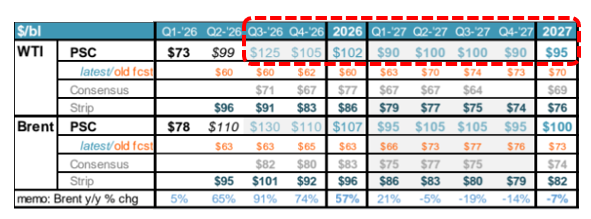
Most Wall Street analysts are afraid to make a bold call. Jan Stuart of Piper Sandler is not one of them.
Eric Nuttall tweet media
English
6
31
280
15.9K
Virupaksha Swamy
Virupaksha Swamy@swamy400·
@dampedspring Thinking Big Tech with likely backchannel ties to US intelligence agencies will be freely allowed into China is fantasy. China already has its own full-stack tech ecosystem, so there’s little incentive to let American firms come in and dominate local companies.
English
0
0
0
178
Virupaksha Swamy
Virupaksha Swamy@swamy400·
@PhilGordonDC "having missed the opportunity to declare victory after the first few weeks..." Iran shutdown the Strait of Hormuz on the first day of attacks. There is no declaring victory after that.
English
3
0
7
1.9K
Phil Gordon
Phil Gordon@PhilGordonDC·
Ten weeks in the strategic failure is undeniable. The risk now is that having missed the opportunity to declare victory after the first few weeks Trump can't accept defeat and humiliation so will keep looking for the next quick fix, thereby likely only making things worse.
Danny (Dennis) Citrinowicz ,داني سيترينوفيتش@citrinowicz

We need to be honest with ourselves: so far, this campaign has been a major strategic failure. There were certainly important operational achievements, and the level of coordination between U.S. Central Command and the Israel Defense Forces was highly impressive. But wars are not judged by tactical successes alone, they are judged against their original strategic objectives. The Iranian regime did not fall, and at this stage there is no indication that it is close to collapsing. There was no regime change in Iran; instead, there was a change within the regime, and arguably for the worse. The crisis appears to have strengthened Mojtaba Khamenei and the more hardline elements of the Islamic Revolutionary Guard Corps, giving them greater influence over Iran’s decision-making process. On the conventional front, Iran still retains most of its military capabilities. Even where damage was inflicted, it has not fundamentally altered Tehran’s ability or willingness to resume military confrontation. On the nuclear front, Iran continues to possess a massive stockpile of enriched uranium, including the same roughly 440 kilograms enriched to near-weapons-grade levels. More importantly, the regime still possesses the scientific and technical expertise necessary to enrich to 90% if it chooses to do so. And beyond that, Iran still maintains leverage over the Strait of Hormuz — which remained open and stable before the war began. I do not know how this conflict will ultimately end. But if these are the conditions under which it concludes, then this will be remembered as a profound strategic failure — one that leaves behind a far worse regional reality than the one that existed before the campaign began. Ignoring that reality will not improve the situation; it will only deepen the problem. Iran built its national security doctrine around asymmetric capabilities. Damage to its navy or air force, however significant tactically, does not fundamentally undermine its ability to wage this kind of confrontation. That is the reality, whether policymakers are comfortable acknowledging it or not. A serious strategy for weakening the Iranian regime in the future has to begin with an honest recognition of this reality. It is possible that the United States is planning additional, more significant steps. But if we are assessing the campaign as it stands today, the outcome is deeply negative. Without acknowledging that, Washington risks building its next phase on a false premise — and that is exactly how tactical achievements turn into strategic failure. No wonder Iran is not surrendering at the negotiating table if this is indeed the reality. It is time to go back to the drawing board rather than keep insisting on an approach that has already failed. And it starts with one basic understanding: Iran is not Venezuela. Conventional cost-benefit calculations do not necessarily work against a regime that is willing to sacrifice its own population to preserve its rule. There is no textbook solution here. Not the Kurds, not arming the opposition, and not targeted killings. None of these, on their own, provides a strategic answer to the Iranian problem set. It is time to think seriously about a different strategy, because the current approach is not containing the threat. It is producing a security reality that is, almost by definition, worse than the one that existed before. If the objective is to weaken the Iranian regime over time, then repeating tools that have already failed is not strategy. #IranWar

English
18
38
176
76.7K
Virupaksha Swamy
Virupaksha Swamy@swamy400·
@RunnerXBT No way it'll be 85$ in the month of Jul. There are physical shortages arleady in multiple parts of the world.
English
0
0
1
31
RunnerXBT
RunnerXBT@RunnerXBT·
How to profitably trade Oil since the war started you ask?
RunnerXBT tweet media
English
8
1
72
5.5K
RuhRoh
RuhRoh@weewoono·
It's over really, the next round of inflation is going to tear this country apart and that's a good thing
English
10
20
495
13.6K
Amad Din
Amad Din@AmadDin149328·
@PrepperCanadian Trump thinks going there with that many CEO gives him leverage for better trade deals. He'll be disappointed. Nobody trust the US anymore.
English
2
0
78
2.1K
Art Berman
Art Berman@aeberman12·
Oil spot prices have fallen while futures are now stealing the show Brent for Dec27 & Dec28 are now at crisis highs too. That means physical traders increasingly expect no real market normalization more than 2 years. How quickly things change as inventories grind lower. That's the real signal. #Oil #Brent #EnergyCrisis #OPEC #Commodities
Art Berman tweet media
Rory Johnston@Rory_Johnston

CRUDE CURVE RISING Brent Dec26 (white), Dec27 (blue), and Dec28 (orange) futures are currently sitting at crisis highs, which is what you’d expect as the initial panic-buying settled down and the curve began to grind higher as inventories steadily deplete.

English
3
23
87
11.1K
Virupaksha Swamy
Virupaksha Swamy@swamy400·
Trump’s visit to China with a big executive entourage feels more like an attempt to posture the US still trying to work with China. There will be headlines about friendship, cooperation, and big deals. But over the coming weeks and months, it could become obvious that China is ultimately siding with Iran. And once that reality sets in, the real US-China fallout / decoupling begins. And it could even turn into a new Cold War.
English
0
0
1
30
EscapeFromUtopia
EscapeFromUtopia@utopia_escape·
I'm off to bed, but I just had a thought. If the dollar melts, and we get 70's-style oil inflation, then resource companies with massive debts get a mini-jubilee. So here's the question: which miners/oil majors have huge debt loads that would benefit most from such a move?
English
4
1
20
1.6K
Virupaksha Swamy
Virupaksha Swamy@swamy400·
WTI near 100$ feels expensive but adjusted for M2 growth, prior oil peaks map to something far higher today. 1979 peak: 32.50$ M2-adjusted: 500$/barrel 2008 peak: 145$ M2-adjusted: 420$/barrel So today’s oil price is only 20-24% of those prior monetary-adjusted stress peaks. If the current setup becomes a real physical scarcity regime, not just a paper-market volatility event, 100$ oil may look cheap in hindsight.
English
0
0
1
50
HFI Research
HFI Research@HFI_Research·
This is sooooooooo good. Please please. I need more.
HFI Research tweet media
English
14
18
331
41.1K
Virupaksha Swamy
Virupaksha Swamy@swamy400·
@HFI_Research For too long, people have forgotten that more than anything else, it is oil that makes modern society possible.
English
1
0
8
568
HFI Research
HFI Research@HFI_Research·
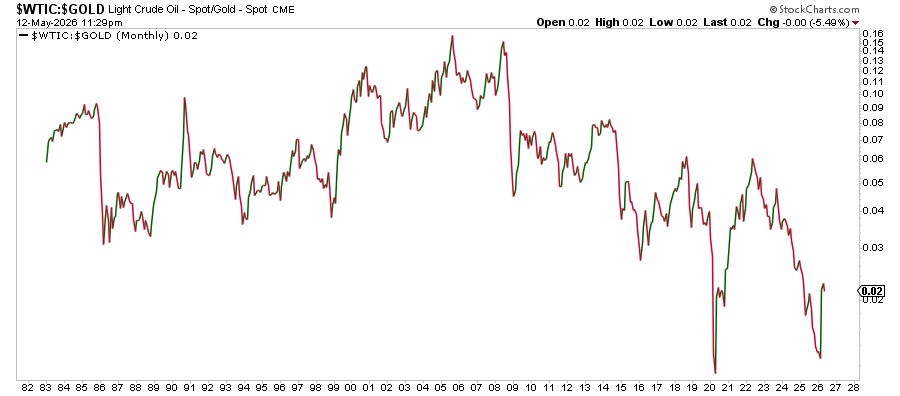
Oil to gold ratio. Food for thought.
HFI Research tweet media
English
6
14
137
13.1K
Virupaksha Swamy
Virupaksha Swamy@swamy400·
@ReganCoda The strait is indeed open (with tolls of course), except for countries that are at war with Iran.
English
1
0
0
121
Dal Riata Capital
Dal Riata Capital@ReganCoda·
I'm sympathetic to the view that Hormuz must open because the alternative is too awful for everyone but I can't get past the fact that Iran has a once in a generation chance to stick it to U.S. and establish deterrence by keeping it closed for much longer
English
16
2
61
5K
Virupaksha Swamy
Virupaksha Swamy@swamy400·
@GavMcCracken I think the actual barrels lost are much higher than the official 12–13 million bpd, because several OPEC producers were cheating/overproducing beyond their quotas, and now those barrels are also gone.
English
1
0
6
229
Gavin
Gavin@GavMcCracken·
Fauxios can tweet a peace deal is imminent & oil is $80 again but Reuters saying we're cooked through late May +65 days of tanker times does nuffin reuters.com/business/energ…
English
6
2
58
3.5K
Virupaksha Swamy
Virupaksha Swamy@swamy400·
@RKelanic The main reason is that Iran has sophisticated tracking and precision-targeting drone & missile technology. The other reasons don’t really carry much weight.
English
1
0
13
427
Rosemary Kelanic
Rosemary Kelanic@RKelanic·
A nagging question about the Hormuz crisis: Why aren’t more ships attempting to run the strait? 🤔 During the Iran-Iraq War, *thousands* of vessels ran the Strait of Hormuz, without military escort, despite attacks from Iran. Why not now? A few hypotheses: 1. Oil prices aren’t high enough yet to justify assuming the risk. To the extent Trump’s jawboning the markets keep the price artificially low, that’s a major policy failure. If prices skyrocket as global supplies grow critical circa July, perhaps we see more attempts? 2. Trump’s continued false promises to reopen the strait on U.S. taxpayer’s dime have crowded out private adaptation in the form of strait-running attempts. Why assume the risk today if the U.S. Navy will escort you tomorrow? 3. Iran’s capabilities to close the strait are perceived as stronger now, due to the accuracy revolution in missiles and drones. The capabilities likely are stronger now, but we don’t really know for sure, because shippers haven’t run the experiment. 4. We’re all less risk acceptant today across a variety of measures than we were in the 1980s (for example, see parenting today versus then). The risk aversion is perhaps heightened by the “CNN effect” of televised conflict, which didn’t exist back then, plus social media, with scary images of burning ships circulated everywhere. Other hypotheses???
English
93
18
145
20.1K
Virupaksha Swamy
Virupaksha Swamy@swamy400·
@RKelanic Demand destruction will kick in at some price point to offset the 12-13 million bpd supply loss and it won’t be below 200$.
English
2
0
5
496