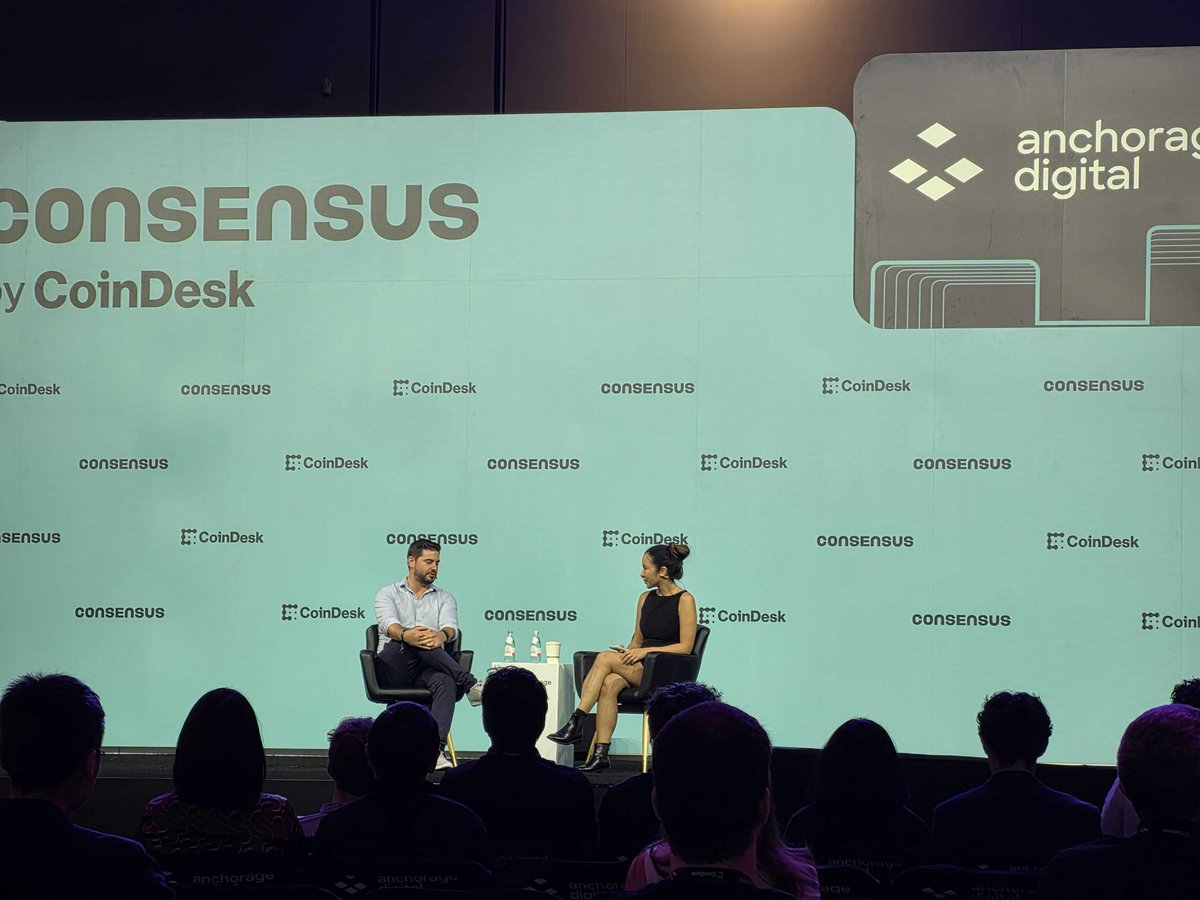
If users can leave overnight, what actually makes them stay?
- Incentives vs. real retention
- What actually creates stickiness
- And whether loyalty can exist in a permissionless market
@sylviatoeth (@Bullish) moderated a conversation with @keoneHD (@monad), Brian Truzo (@SuccinctLabs), @HoolieG (@cbventures), and @dotCuriousCat (@PortalVentures) on how protocols build durable value when switching costs approach zero.
At GTC 2026, NVIDIA engineers get "almost half their base compensation again in tokens."
Not crypto tokens. Compute tokens.
Token access is becoming a Silicon Valley recruiting tool. This is the new stock option.
#GTC2026#AI
If you're investing in AI infra — the thesis just got stronger.
If you're building on it — the window to capture value is narrowing.
Full report from @Bullish↓
linkedin.com/posts/sylvia-b…
It's an ecosystem where both coexist, with value created by orchestration layers, harness engineering, and domain-specific agents.
My biggest takeaway from GTC 2026:
This is the year AI ROI becomes undeniable. We've moved from demos to deployment.
I attended every session at GTC 2026. This is not a summary — it's an investor's field guide to what NVIDIA just told us about the next decade of computing.
The theme: generative AI → reasoning AI → agentic AI. Inference is now the revenue engine.
Jensen Huang just laid out NVIDIA's vision at GTC 2026:
→ $500B in Blackwell + Rubin purchase orders
→ $1T revenue potential by 2027
→ Tokens are the new unit of economic value
I was in the room at SAP Center. Here's what most people missed 🧵👇
NVIDIA's "CUDA flywheel" in one image:
More GPUs → more developers → more breakthroughs → more demand for GPUs
It's been spinning for 20 years. Agentic AI just hit the accelerator.
This is the most powerful platform lock-in in computing history.
#NVIDIA#CUDA
0/ Privacy in the Ethereum ecosystem is undergoing an evolution. A Renaissance, even, to sound a bit fancy.
What exactly is behind these changes and how might neo-Cypherpunk be involved?
A guest thread by @post_polar_ and @nicksvyaznoy.
Over the past year, many people I talk to have expressed worry about two topics:
* Various aspects of the way the world is going: government control and surveillance, wars, corporate power and surveillance, tech enshittification / corposlop, social media becoming a memetic warzone, AI and how it interplays with all of the above...
* The brute reality that Ethereum seems to be absent from meaningfully improving the lives of people subject to these things, even on the dimensions we deeply care about (eg. freedom, privacy, security of digital life, community self-organization)
It is easy to bond over the first, to commiserate over the fact that beauty and good in the world seems to be receding and darkness advancing, and uncaring powerful people in high places are making this happen. But ultimately, it is easy to acknowledge problems, the hard thing is actually shining a light forward, coming up with a concrete plan that makes the situation better.
The second has been weighing heavily on my mind, and on the minds of many of our brightest and most idealistic Ethereans. I personally never felt any upset or fear when political memecoins went on Solana, or various zero-sum gambling applications go on whatever 250 millisecond block chain strikes their fancy. But it *does* weigh on me that, through all of the various low-grade online memetic wars, international overreaches of corporate and government power, and other issues of the last few years, Ethereum has been playing a very limited role in making people's lives better. What *are* the liberating technologies? Starlink is the most obvious one. Locally-running open-weights LLMs are another. Signal is a third. Community Notes is a fourth, tackling the problem from a different angle.
One response is to say "stop dreaming big, we need to hunker down and accept that finance is our lane and laser-focus on that". But this is ultimately hollow. Financial freedom and security is critical. But it seems obvious that, while adding a perfectly free and open and sovereign and debasement-proof financial system would fix some things, but it would leave the bulk of our deep worries about the world unaddressed. It's okay for individuals to laser-focus on finance, but we need to be part of some greater whole that has things to say about the other problems too.
At the same time, Ethereum cannot fix the world. Ethereum is the "wrong-shaped tool" for that: beyond a certain point, "fixing the world" implies a form of power projection that is more like a centralized political entity than like a decentralized technology community.
So what can we do? I think that we in Ethereum should conceptualize ourselves as being part of an ecosystem building "sanctuary technologies": free open-source technologies that let people live, work, talk to each other, manage risk and build wealth, and collaborate on shared goals, in a way that optimizes for robustness to outside pressures.
The goal is not to remake the world in Ethereum's image, where all finance is disintermediated, all governance happens through DAOs, and everyone gets a blockchain-based UBI delivered straight to their social-recovery wallet. The goal is the opposite: it's de-totalization. It's to reduce the stakes of the war in heaven by preventing the winner from having total victory (ie. total control over other human beings), and preventing the loser from suffering total defeat. To create digital islands of stability in a chaotic era. To enable interdependence that cannot be weaponized.
Ethereum's role is to create "digital space" where different entities can cooperate and interact. Communications channels enable interaction, but communication channels are not "space": they do not let you create single unique objects that canonically represent some social arrangement that changes over time. Money is one important example. Multisigs that can change their members, showing persistence exceeding that of any one person or one public key, are another. Various market and governance structures are a third. There are more.
I think now is the time to double down, with greater clarity. Do not try to be Apple or Google, seeing crypto as a tech sector that enables efficiency or shininess. Instead, build our part of the sanctuary tech ecosystem - the "shared digital space with no owner" that enables both open finance and much more. More actively build toward a full-stack ecosystem: both upward to the wallet and application layer (incl AI as interface) and downward to the OS, hardware, even physical/bio security levels.
Ultimately, tech is worthless without users. But look for users, both individual and institutional, for whom sanctuary tech is exactly the thing they need. Optimize payments, defi, decentralized social, and other applications precisely for those users, and those goals, which centralized tech will not serve. We have many allies, including many outside of "crypto". It's time we work together with an open mind and move forward.
4/ Rather it may be quietly reborn at the most unsuspecting intersection of crypto and AI. Crypto didn’t invent distrust in the state. It simply mobilized it, turned it into code and networks.