akrem temimi

986 posts

akrem temimi

akrem temimi

@TemimiAkrem

Professor of Economics at Qatar University PhD. University of Illinois ay Urbana Champaign

Doha, Qatar Katılım Eylül 2021
321 Takip Edilen20 Takipçiler
akrem temimi retweetledi
Radha Tripathi
Radha Tripathi@Radha_AI·
INSTEAD OF WATCHING AN HOUR OF NETFLIX TONIGHT. This 60-minute Cambridge lecture by Demis Hassabis will teach you more about the future of AI than most people will learn in the next 5 years. Bookmark it and give it an hour, no matter what.
English
21
443
2.6K
459.7K
akrem temimi retweetledi
Johan Fourie
Johan Fourie@JohanFourieZA·
I've written a @claudeai skill that is useful when you’re starting a new project and want to absorb fifty papers before writing a word yourself. /tyler converts a folder of academic PDFs into a token-efficient markdown wiki for literature review. Point it at a directory of papers and it produces one lightweight .md file per paper, plus an index, so Claude Code can load an entire literature into context without burning tokens on raw PDF parsing. Named in honour of @tylercowen, the economist behind @MargRev and a famously voracious reader. Available from --> johanfourie.com/econtools.html
English
10
80
761
78.3K
akrem temimi retweetledi
Ethan Mollick
Ethan Mollick@emollick·
Its very limiting that a big set of very hard problems that we have just lying around are Erdos problems. Don’t get me wrong, they are quite cool, but we really need hard problems repositories for many fields, including areas that have less specified answers & require judges. Yes, math is the easiest field in which to do verified work, but it is also an area where direct implications of increasing AI ability on everyday life are less clear. We need more types of problems (complex engineering problems, large data sets in economics, physics, biology), for people to turn AI loose on, including speciations of how to evaluate them.
English
42
29
391
34.7K
akrem temimi retweetledi
Trita Parsi
Trita Parsi@tparsi·
The regional role in the US-Iran deal is astounding. 1) Many regional states actively helped reach a resolution. 2) Their support protects Trump from domestic criticisms and takes attention away from Israel's opposition. 3) The regional anchoring ensures greater durability.
English
28
174
861
51.1K
akrem temimi retweetledi
MOATH | معاذ
هذا أقدم مقطع في التاريخ تصور للحج، مدته 7 دقائق بس تستشعر الايام ذيك وانت تشوفه… المقطع تصور قبل قرابة 100 عام من اليوم وتحديدًا في عام 1928، ويظهر فيه مشاهد لسفر الحجاج من جدة لمكة ومشاهد لمكة المكرمة والكعبة المشرفة، ووصول الملك عبدالعزيز ربي يرحمه للإشراف على تنظيم الحج وغيرها من المشاهد "استخدمت الذكاء الاصطناعي عشان الونه واوضحه"
العربية
105
2.3K
7.7K
831.7K
akrem temimi retweetledi
Ali Hashem علي هاشم
According to my sources, the draft proposal that’s supposed to be finalised include: -End of war on all fronts including Lebanon -Freeing several billion dollars of Iran's blocked funds -Lifting the U.S. naval blockade and opening the strait of Hormuz -Withdrawal of American forces from the immediate vicinity of Iran After this, the parties will have 30 days to agree on the nuclear issue. These 30 days can be extended by mutual agreement. During these thirty days, passage will be facilitated through the strait. According to Iran, management of the Strait of Hormuz will be an Iranian-Omani issue, and is being negotiated with Muscat.
English
272
817
2.9K
1.6M
akrem temimi retweetledi
Nicholas Kristof
Nicholas Kristof@NickKristof·
Readers offered questions and pushback about my investigation into sexual assaults against Palestinians by Israelis. So here are our answers: nytimes.com/2026/05/21/opi…
English
610
743
2.4K
994.2K
akrem temimi retweetledi
🇹🇷🇹🇷 Hakan Boyav 🇵🇸🇵🇸
Unutma! Gazze'de İsrail askerleri tarafından kaçırılan 6 yaşındaki çocuk darp edildi ve bazı önemli organları israil tarafından çalındı Çocuk yaralı şekilde ailesine verildi Kendi çocuğun değil diye mi susuyorsun? Susma. Hemen paylaş
Türkçe
859
14.2K
18.4K
177.9K
akrem temimi retweetledi
Heidi Matthews
Heidi Matthews@Heidi__Matthews·
Flotilla participants are arriving at Istanbul airport. This is what Israel military and prison personnel did to them.
Heidi Matthews tweet mediaHeidi Matthews tweet media
English
5.6K
70.7K
171.5K
4.7M
akrem temimi retweetledi
Reem Alalwi🇴🇲
Reem Alalwi🇴🇲@ReemAlalwi16517·
فتاة فلسطينية تبكي بعد رؤيتها صورة لجدتها وخالتها محتجزتين كرهائن من قبل الجنود الإسرائيليين.
العربية
28
867
1.6K
30.7K
akrem temimi retweetledi
Edward Conard
Edward Conard@EdwardConard·
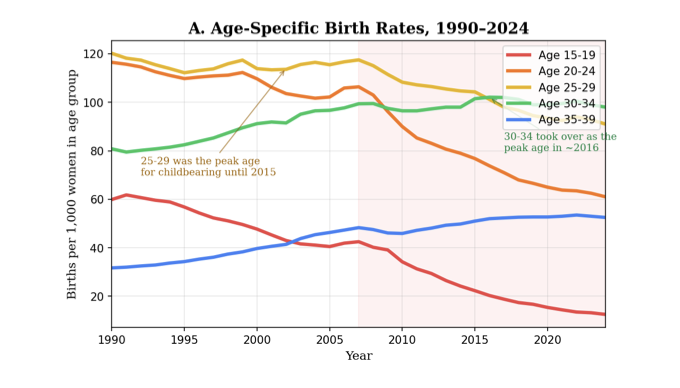
US birth rates over 2007–2024 were down 71% for women 15–19, 43% for those 20–24, and 23% for those 25–29, but up 9% for women 35–39. Hudson and Moscoso-Boedo argue that this monotone age gradient is the signature of a smartphone shock.
Edward Conard tweet media
English
5
9
45
12K
akrem temimi retweetledi
John Burn-Murdoch
John Burn-Murdoch@jburnmurdoch·
Excellent as ever from Jesus Some overlap w/ the thesis set out in my piece — that smartphones and social media are in large part accelerants, amplifiers and ‘internationalisers’ of social/cultural shifts that have been slowly unfolding for decades if not longer.
Jesús Fernández-Villaverde@JesusFerna7026

Smartphones are not the explanation for the recent decline in fertility. Instead, they are an accelerator of deeper forces already at work. Let’s start with the facts. Fertility is falling almost everywhere: in rich, middle-income, and poor countries; in secular and religious countries; and in countries with high and low levels of gender equality. The decline accelerated around 2014. So, no country-specific explanation will work unless you are willing to believe that 200 distinct country-specific explanations arrived at roughly the same time. Smartphones look like the obvious candidate: the first iPhone was released in 2007, and global adoption has been astonishingly fast. Economists understand the first major decline in fertility in advanced economies, from 6 or 7 children per woman throughout most of human history to about 1.8, that occurred between the early 1800s and roughly 1970, well before smartphones. The main drivers were a sharp fall in child mortality (effective fertility was rarely above 3 and often close to 2) and the shift from a low-skill, rural agrarian economy to a high-skill, urban industrial one. We have quantitative models that fit these facts well. Country-specific factors mattered too, of course. Proximity to low-fertility neighbors accelerated Hungary’s decline, while fragmented landowning structures accelerated France’s. But these were second-order mechanisms. This is also why most economists long considered Paul Ehrlich’s doom scenarios implausible. We forecast that fertility in middle- and low-income economies would follow the same path as in the rich, probably faster, because reductions in child mortality reached India or Africa at lower income levels (medical technology is nearly universal, and most gains come from handwashing and cheap antibiotics, not Mayo Clinic-level care). Much of what we see in Africa or parts of Latin America today is still that old story. But in the 1980s, a new pattern appeared. Japan and Italy fell below 1.8, the level we had thought was the new floor. By 1990, Japan was at 1.54 and Italy at 1.36. This second fertility decline began in Japan and Italy earlier than elsewhere, driven by country-specific factors, but the underlying dynamics were widespread: secularization, an education arms race, expensive housing, the dissolution of old social networks, and the shift to a service economy in which women’s bargaining power within the household is higher. The U.S. lagged because secularization came later, suburban housing remained relatively cheap, and African American fertility was still high. U.S. demographic patterns are exceptional and skew how academics (most of whom are in the U.S.) and the New York Times see the world. My best guess is that, without smartphones, Italy’s 2025 fertility rate would be about 1.24 rather than 1.14. I doubt anyone will document an effect larger than 0.1-0.2. Italy was at 1.19 in 1995, not far from today’s 1.14. The TFR is cyclical due to tempo effects, so I do not read too much into the rise between 1995 and 2007 or the decline from 1.27 in 2019 to 1.14 today. The direct effect of smartphones is not zero, but it is not, by itself, that large. Where social media, in general, and smartphones, in particular, matter is in the diffusion of social norms. What would have taken 25 years now happens in 10. Social media are not the cause of fertility decline; modernity is. But they are a very fast accelerator. That is why social media are a major part of the story behind Guatemala (yes, Guatemala) going from 3.8 children per woman in 2005 to 1.9 in 2025. Without them, Guatemala would also have reached 1.9, just 20 years later. Modernity, in its current form, is incompatible with replacement-level fertility. By modernity, I do not mean capitalism: fertility fell earlier and faster in socialist economies than in market economies. Socialist Hungary fell below replacement in 1960, and socialist Czechoslovakia in 1966 (both experienced small, short-lived baby booms in the mid-1970s). By modernity, I mean a society organized around rational, large-scale systems and formalized knowledge. Countries will not converge to the same fertility rate. East Asia is likely stuck near 1, possibly below, given its unbalanced gender norms and toxic education systems. Latin America faces the same gender problem plus weak growth prospects, so I expect something around 1.2. Northern Europe has more egalitarian family structures and might hold near 1.5. The very religious societies are probably the only ones that will sustain 1.8. All of this could change with AI or changes in population composition. We will see. But on the current evidence, deep sub-replacement fertility is the “new new normal.” Unless we reorganize our societies, better learn to handle it as best we can.

English
20
104
582
176.9K
akrem temimi retweetledi
Jesús Fernández-Villaverde
Jesús Fernández-Villaverde@JesusFerna7026·
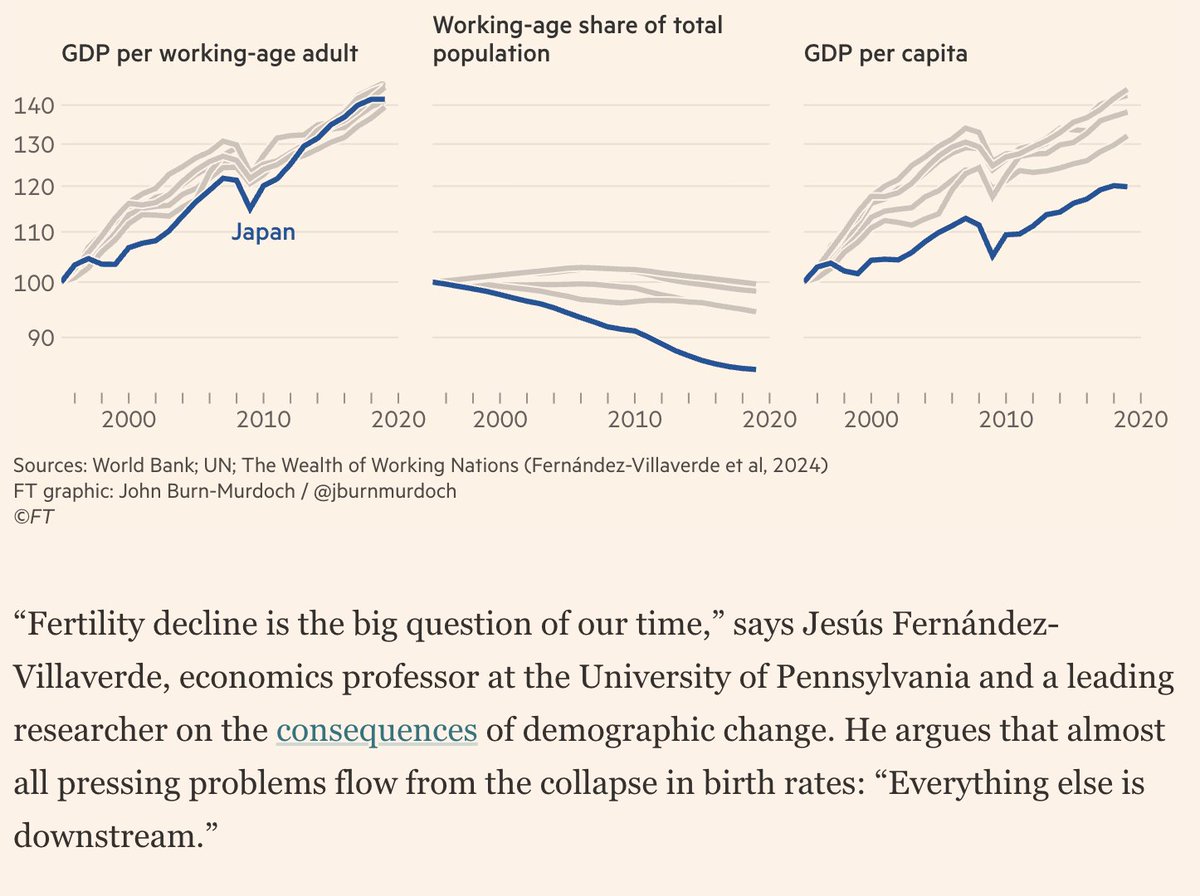
At the FT today, John Burn-Murdoch (@jburnmurdoch) has an excellent article describing how fertility is declining everywhere at the same time: ft.com/content/fba35e… He quotes me and, even better, draws the reader’s attention to my work with Gustavo Ventura, @King_ofSweden, and Wen Yao on “The Wealth of Working Nations.” If I may suggest, reading the article alongside the podcast I did with Derek Thompson, @DKThomp, will give you a good overview of the issue. BTW, I have decided to write something longer about all this over the summer with Nezih Guner, @NezihGuner. Hopefully, the gods of productivity smile on us, and we can have a draft by early fall.
Jesús Fernández-Villaverde tweet media
English
27
167
752
159.7K
akrem temimi retweetledi
hafid derradji حفيظ دراجي
لامين يامال سجل هدفاً عالمياً في مرمى الضمير الإنساني و الإنسانية جمعاء، وبيب غوارديولا أحرز ألقاباً وتتويجات أخرى خارج ميادين الكرة، أما رئيس الوزراء الإسباني فلم يتردد بدوره في التعبير عن توجهٍ سياسي. ... edgs.co/hnpwb
العربية
25
197
2K
19.9K
akrem temimi retweetledi
Mario Nawfal
Mario Nawfal@MarioNawfal·
🇮🇱 An armed Israeli settler blindfolded and bound a Palestinian farmer in the West Bank. Israeli soldiers showed up, watched, and left. Out of 1,500 settler killings between 2017 and 2025 1 conviction.
English
836
3.2K
21.8K
6.2M
akrem temimi retweetledi
Ali Abo Rezeg
Ali Abo Rezeg@ARezeg·
اليوم أيضًا انطلقت القافلة البرية المغاربية تجاه غزة، القافلة انطلقت من ليبيا، وتحمل على متنها عشرات الأطباء والمهندسين والنقابيين والنشطاء، هناك مشهد مؤثر جدا في الصور التي خرجت من القافلة، لأنها تحمل على متنها عشرات الكارافانات، وهذا بالفعل أكثر ما يحتاجه الناس في غزة، بشكل مُلحّ وعاجل، لا أحد يعلم هل سيتم السماح للقافلة بالعبور أم لا، لكن الذي نعلمه، أنها محاولة جادة وصادقة وشجاعة للفت أنظار العالم من جديد للكارثة الحاصلة، والتأكيد أنها ما زالت في أبشع فصولها، ومستمرة...!
العربية
8
144
534
7.8K
akrem temimi retweetledi
Pedro Sánchez
Pedro Sánchez@sanchezcastejon·
Quienes consideran que ondear la bandera de un Estado es “incitar al odio”, o han perdido el juicio o han sido cegados por su propia ignominia. Lamine solo ha expresado la solidaridad por Palestina que sentimos millones de españoles. Otro motivo más para estar orgullosos de él.
Español
11.7K
66.1K
314.8K
8.2M
akrem temimi retweetledi
Aseel Swaid
Aseel Swaid@aseelswaid9·
A young man reading the Qur'an to his father (Gadarif, Sudan)
Aseel Swaid tweet media
English
11
470
3.3K
51K