Ryan Lock (🤠/☀️)

1.6K posts

Ryan Lock (🤠/☀️) banner
Ryan Lock (🤠/☀️)

Ryan Lock (🤠/☀️)

@theSLRguy

Bootstrapped a Solar Company in Texas to $50m in revenue in under 3 years.

Dallas, TX Katılım Aralık 2021
1.1K Takip Edilen682 Takipçiler
Sabitlenmiş Tweet
Ryan Lock (🤠/☀️)
Ryan Lock (🤠/☀️)@theSLRguy·
Operations is a series of mini-game problems strung together. You’ll find reoccuring themes in the type of mini-games you are playing. I’m going to be writing about 1 Mini-Game per week so follow along by bookmarking this thread because I will be updating it each time I post a new one.
English
1
0
11
889
The Secret CFO
The Secret CFO@SecretCFO·
Working capital is the most underestimated force in business. Let’s imagine you have a business running at $ 500k per month of sales. All of a sudden you experience a breakout moment: - 15% sales growth month-over-month for a year - With a net income margin of 10% Extending that growth will lead to a total of $14.5M sales in the first year and $1.45M net income. Now make some working capital assumptions: - Days Sales Outstanding (DSO) of 30 Days - Days Inventory Outstanding (DIO) of 30 Days - Days Payable Outstanding (DPO) of 30 Days i.e. a Cash Conversion Cycle (CCC) of 30 Days: (DSO + DIO - DPO). Despite the $1.45M profitability, the business won’t generate any cashflow in year one. In fact it will outflow ~$375k of cash over those twelve months as it lays down the additional working capital needed to react to the growth. Now, lets run some scenarios (see the image) assuming that same business starts with $ 1M of cash on the balance sheet: If we assume the same dynamics, but instead imagine the business had poor inventory control, and ran on a CCC of 90 days. That same business would now have a negative cash balance of ~$3m by Christmas… or more accurately would be dead by June. And at that CCC, even if the business 2.5x that net margin to 25%, the business would still run out of cash in 9 months (that is despite now generating ~$3.6M of profit). Now imagine the opposite were true, the business, ran on a negative CCC of 60 days, funded by a willing supplier; with very tight inventory and receivables levels. In this scenario, even if the net margin were only 5%, the cash balance would explode to over $ 5M (positive) by the end of the year. In fact, at a negative 60 days CCC, even if the business operated at a 25% net loss margin, it would still survive the year (just about). This illustrates how much more sensitive working capital (and cashflow) is to changes in the business, than any profit metric you can choose. I call this effect: The Cashflow Megaphone. And as a long time turnaround CFO, understanding this inside out was the most valuable technical weapon in my armory in bending broken cashflows back into the black. And in times of volatile trading and macro conditions, these dynamics are more important than ever (especially when supply chains are gummed up like they are right now)
The Secret CFO tweet media
English
22
54
641
157.5K
Ryan Lock (🤠/☀️)
@mcuban if you read this, I’d like to propose the “Winners Fund” solution. Take 8-10% of the league revenue share program and put it into a Winners Fund. Each win = 1 share of the fund. Extend this down to the players as well to be bonused behind team wins. First Order effects: Teams are going to be willing to be more competitive now vs later where the difference between 20 wins and 30 wins is millions of dollars. Second Order effects: Teams aren’t going to sell their stars for draft picks. This breaks up talent consolidation and super teams increasing parity. Every game matters in this solution, it isn’t just a championship or bust league that is constantly forming fragile cap/draft stock super teams that blow up after a year or two to rebuild.
English
0
0
0
21
Ryan Lock (🤠/☀️)
The probabilities and incentives say otherwise. Flattening the pick odds now drastically skew EV towards keeping your own picks across all trades First, the “all in for a costar” trade where a contending team pushes 3+ picks and salary match to bring over a co star and chase a championship. (60-70% of trades involving a first round pick, grok) These trades now carry significantly more regression risk to the pick seller if their future picks have a chance of slipping from playoff/title contender into the 3 ball range. These trades will be repriced and require fewer picks to make deals happen. The good news from this is it will change up the current pick stacking and star swapping META. This will open up the free float of picks that can be traded because they don’t need to be hoarded for an all-in. Now we have to ask “What is the second order effect of more free float picks” Mark Cuban believes there will be a lot more trades. I believe that although there are more picks in free float, they won’t be able to move because the draft odds ev is too high for any real trade they could be a participant in. If I’m a mid tier team, I know I’m not 1 trade away from the finals. Outside of an unrealistic 2k Force Trade, I don’t have a large enough incentive to give up my 3 balls in the upcoming draft lottery. We can reasonably assume this removes all teams near the 3 ball range from being sellers of their picks. The only people with picks they want to trade are the current playoff teams. Which means we are back to our first order that those teams won’t give up endless future firsts anymore and their current picks are at their normal value discount. In summary, the 3-2-1 change will freeze the trade market because the value of rolling your luck on 3 balls for the #1 pick is too high and teams will be less likely to trade their current lottery picks or potential future lottery picks.
Mark Cuban@mcuban

When you flatten the odds, the number of trades will explode. It was impossible to know who would win the tankathon in the off season, and the leading tankers aren’t trading their picks at the deadline BUT you can have a good idea who isn’t a top 8 team in your conference. And teams will do everything they can to trade for their firsts. Get 2 non playoff firsts in a draft, and you have a good shot of having better odds than the bottom 3 this year. And even 2 picks at 5.4 pct each, makes you the equal of a tankathon 4 or 5 team. The question is what puts you in a position to trade for 1sts? Cap room at the deadline. Teams that were headed to the 2nd apron and needed saving. Give me that future first. Willingness to trade good players. Want my best player. We aren’t going anywhere this season. Give me that future first. I think the games to stay out of the bottom 3 will be fun. I think the protection limits are smart. Don’t want teams in the playin making decisions on draft vs win. But teams still have to figure out how to win and now, grabbing as many picks as possible, is the highest value approach Once you know you have the little c next to your team … can’t make the bottom 3, if it’s before the deadline, you can get aggressive If you don’t have a team you like, you make any trade that gets you a first. Just imagine if you have a good young team. But just not good enough to win a ring. And you believe the best player ever is coming this draft , you literally could trade your future firsts , plus your really good young , valued players and when combined with your own pick, or picks you already had, get 5 firsts that give you, with some luck , a 40.5 pct chance of winning the lottery. Still an almost 60 pct chance you won’t. But it sure would be interesting as it plays out. The good news for the nba, the bottom 3-2-1 is smart. The better news for Shams , the trade rumors are going to be off the charts as teams try to “aggregate up” to get the best odds they can


English
1
0
0
80
Tom Haberstroh
Tom Haberstroh@tomhaberstroh·
Interesting provision: "no team would be able to win three consecutive top-five picks" Would have prevented: Spurs (Wemby, Castle, Harper) Pistons (Cade, Ivey, Ausar, Holland) Cavs (Mobley, Garland, Okoro) Rockets (Green, Jabari, Amen, Reed)
Shams Charania@ShamsCharania

The NBA has disclosed to its 30 GMs a singular new anti-tanking reform that expands the draft lottery to 16 teams, flattens odds, and have a relegation zone where the bottom 3 teams are penalized with fewer lottery balls for the No. 1 pick. ESPN details: espn.com/nba/story/_/id…

English
117
404
4.4K
677K
Shams Charania
Shams Charania@ShamsCharania·
The "3-2-1 lottery" proposal, named to represent the number of lottery balls per team, would expand the lottery from 14 to 16 teams. Teams that do not qualify for the playoffs or play-in tournament but stay out of the relegation zone (spots four through 10) would receive three lottery balls each. Teams with a bottom-three record -- the relegation zone -- would have just two lottery balls but have a floor of the 12th pick while the rest of the 13 lottery teams could fall as far as the 16th pick. The 9th and 10th play-in seeds in each conference receive two lottery balls each while the losers of the 7-8 play-in games receive one lottery ball each. In addition, no team would be able to win the top pick in consecutive years or be able to win three consecutive top-five picks. Teams also would not be able to protect picks in the 12 to 15 slots going forward.
Shams Charania@ShamsCharania

The NBA has disclosed to its 30 GMs a singular new anti-tanking reform that expands the draft lottery to 16 teams, flattens odds, and have a relegation zone where the bottom 3 teams are penalized with fewer lottery balls for the No. 1 pick. ESPN details: espn.com/nba/story/_/id…

English
726
405
5.3K
8.1M
Ryan Lock (🤠/☀️)
The solve to the lottery system is to create a negative incentive for losing. I propose moving a portion of TV Network deals into a performance fund based on wins. Structure 10% of the rev share pool behind this win incentive Teams that win more get paid more from the league revenue share. It is now a financial decision to lose more games on purpose. As long as the Cap is balanced around the 90% you’ll prevent a Yankees/Dodgers situation. The teams that spend the most -> get the most -> get to spend more To keep the players from having reduced incomes due to this, you could pass through the 90/10 structure behind the same performance bonus. Players win games -> Team makes more -> Players make more
Shams Charania@ShamsCharania

The "3-2-1 lottery" proposal, named to represent the number of lottery balls per team, would expand the lottery from 14 to 16 teams. Teams that do not qualify for the playoffs or play-in tournament but stay out of the relegation zone (spots four through 10) would receive three lottery balls each. Teams with a bottom-three record -- the relegation zone -- would have just two lottery balls but have a floor of the 12th pick while the rest of the 13 lottery teams could fall as far as the 16th pick. The 9th and 10th play-in seeds in each conference receive two lottery balls each while the losers of the 7-8 play-in games receive one lottery ball each. In addition, no team would be able to win the top pick in consecutive years or be able to win three consecutive top-five picks. Teams also would not be able to protect picks in the 12 to 15 slots going forward.

English
0
0
3
194
Ryan Lock (🤠/☀️)
Ryan Lock (🤠/☀️)@theSLRguy·
If OpenAI is a charity shouldn’t my subscription be a donation?
English
2
0
4
100
NyanChuu🔮🇯🇵🍭
NyanChuu🔮🇯🇵🍭@tanpukunokami·
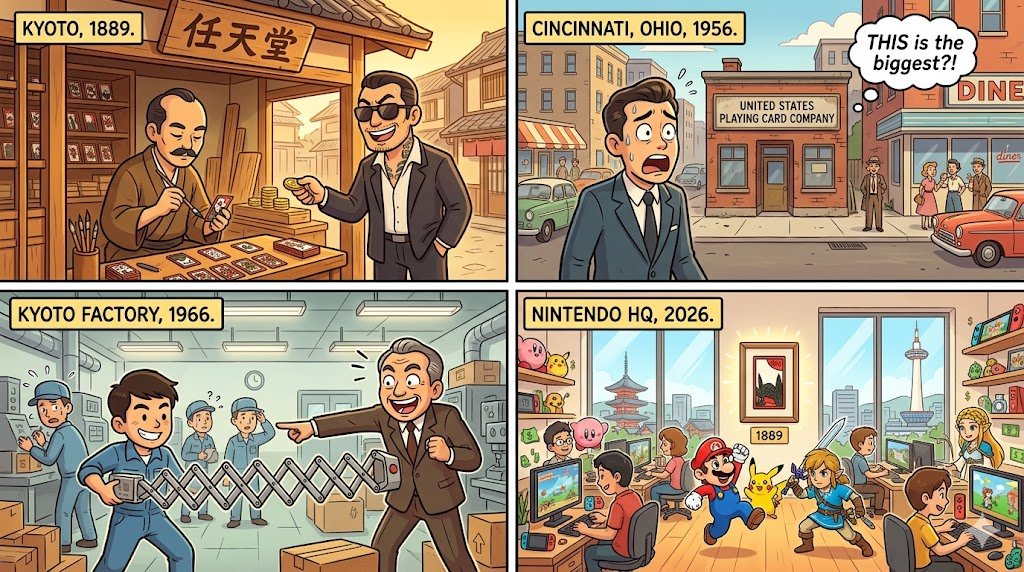
This might be hard to believe, but the company that made Mario started by selling cards to Japanese gangsters. In 1889, in Kyoto, Japan, a man named Fusajiro Yamauchi opened a small shop. He made Japanese playing cards by hand. Most shops didn't want to sell them. People used these cards to gamble. His main customers were the yakuza — Japan's mafia. Yamauchi didn't care. He made a deal with 70 gambling halls. Each one used 50 new decks a night, because dealers always changed cards to stop people from cheating. He named his company Nintendo. For the next 67 years, Nintendo only made cards. In 1956, Yamauchi's grandson Hiroshi flew to America. He went to meet the biggest card company in the world. It was in Cincinnati, Ohio. When he got there, he was shocked. It was a tiny office in a small building. That's when Hiroshi realized: cards had no future. Two years later, he made a deal with Disney. Mickey Mouse on playing cards. Cards for families, not gamblers. They sold 600,000 decks in one year. In 1966, Hiroshi was walking through a factory when he saw one of his workers playing with a toy. The worker had made it himself, just for fun. It was an arm that could stretch out and grab things. Hiroshi told him to turn it into a product. They called it the Ultra Hand. It sold over a million. The worker's name was Gunpei Yokoi. Twenty-three years later, Yokoi invented the Game Boy. Today, Nintendo is worth $65 billion. They made Mario, Zelda, and Pokémon. The original Nintendo Switch has sold more than 155 million — more than any Nintendo console ever. All of it started with a pack of cards made for a gambling hall in 1889.
NyanChuu🔮🇯🇵🍭 tweet media
English
32
57
371
14.4K
Ryan Lock (🤠/☀️)
Ryan Lock (🤠/☀️)@theSLRguy·
The shift away from traditional software companies has contributed to a broader perception that software engineers may face upcoming challenges. However, this trend is simultaneously driving increased demand for engineering talent, as more organizations choose to develop software in-house and smaller firms gain the ability to enter and compete in the market.
English
1
0
0
44
Anthony Pompliano 🌪
Anthony Pompliano 🌪@APompliano·
I have changed my mind on how AI will impact jobs in America. Previously, I believed AI would replace many entry level roles typically filled by young employees. The technology would then work its way up the organization and eventually reduce the total number of jobs in a company. The data is saying something different, so when I get new information I am willing to change my mind. The number of software engineers being hired has been increasing. The number of open software engineer roles is growing. The number of new college grads who get hired has increased 5.6% over the last 12 months. The unemployment level for people aged 20-24 years old who have a college degree has fallen from nearly 9% to almost 5% as well. The Wall Street Journal recently wrote “AI created 640,000 jobs between 2023 and 2025 in the U.S., according to an analysis by LinkedIn of job posting data, including new white-collar positions such as Head of AI and AI engineer.” And I am starting to see companies throughout our portfolio aggressively hiring to keep up with the demand for their products and services. If AI can make employees more productive, which is widely accepted as fact, then companies are going to want as many productive units of labor as possible. This is a key reason why I am changing my mind. AI appears to be a magical technology that will make companies more productive and more profitable. The net result will be more corporations, more startups, and more jobs. All three are big, positive wins for the American economy.
English
799
676
6.6K
2M
Darrel Frater ✝️
Darrel Frater ✝️@DarrelFrater·
Any founders interested in pitching my friends at Redbud VC tomorrow? They are a Pre-Seed venture capital firm investing in people strengthened by struggle, building massive tech companies. 💰 Check Size: $250K - $500K Comment "DM" below. Happy to get you connected.
English
257
14
227
22.3K
Shawn Gorham
Shawn Gorham@shawngorham·
Roofers - get this... I priced out a roofing material job at Home Depot - GAF, HDR reflective shingle. I have NEVER done this before at Depot... I always buy from the roofing supply houses Home Depot $6,811.18 QXO $7,387.87 $500 difference, same exact order Now Home Depot doesnt roof load so it will be interesting who use they to 3rd party deliver, fulfill the order. It might even be QXO I was shocked Home Depot was cheaper
English
72
2
290
67K
Clint Fiore 🦬 DM for Biz Deals
The 80% is creating a vast farm system for us we will continue to maintain relationships with and be ready to sell when the business is sellable, and the owner is ready and realistic. This is the long term compounding of our model and how we benefit from all these free valuations and value consulting we're doing every day. When the farm system is big enough we'll essentially never have to market to get Sellers- just tend the farm.
English
5
0
11
1.2K
Clint Fiore 🦬 DM for Biz Deals
We are valuing a ridiculous number of businesses right now. More than 1 per day. 80%+ aren't ready to sell or there's too big a gap between our valuation and their needs/expectations. We will bring you the <20% that: - are motivated and ready to sell that know their "why" they want or need to sell - have a business that's financeable with clean enough books to get through due diligence and underwriting - are realistic about the valuation range and ready to accept a Fair Market Value offer
English
11
0
67
8.7K
ちーとん。
ちーとん。@chieeton·
アメリカニキたちよ… こんなにでかい肉を焼くのは初めてなんだ。 ただ焼けば良いのか? でっかいTボーン肉なんだけど…
ちーとん。 tweet mediaちーとん。 tweet media
日本語
578
447
23K
5M
Jacques H. Bastien
Jacques H. Bastien@JacquesHBastien·
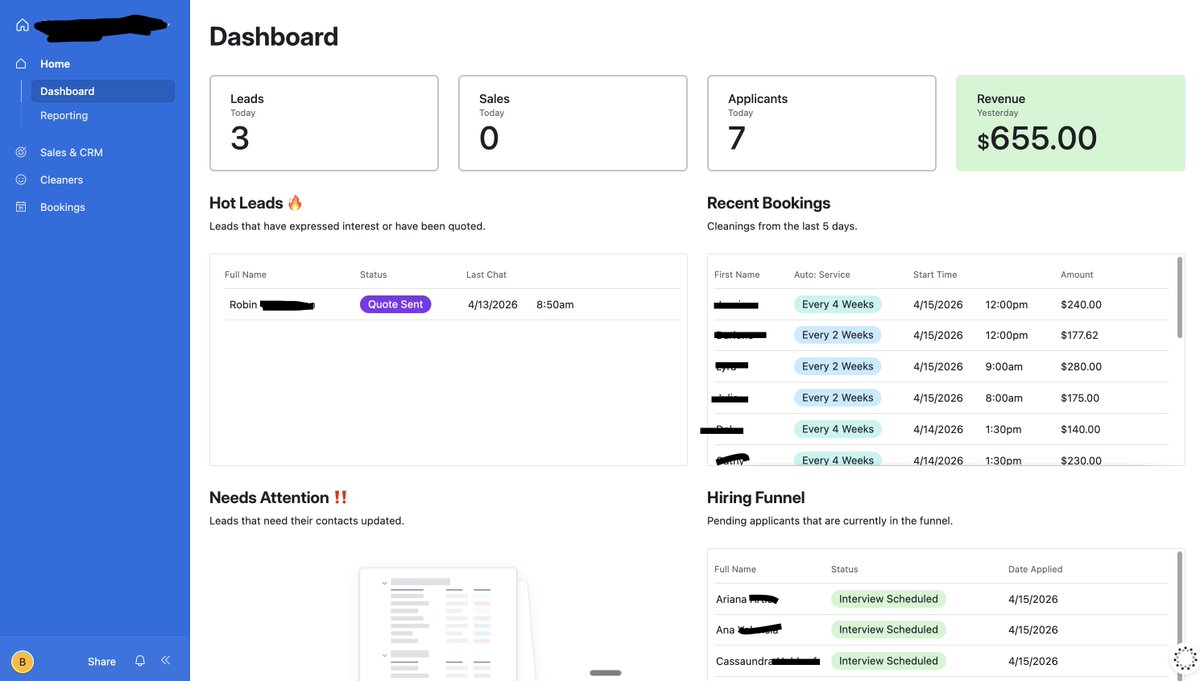
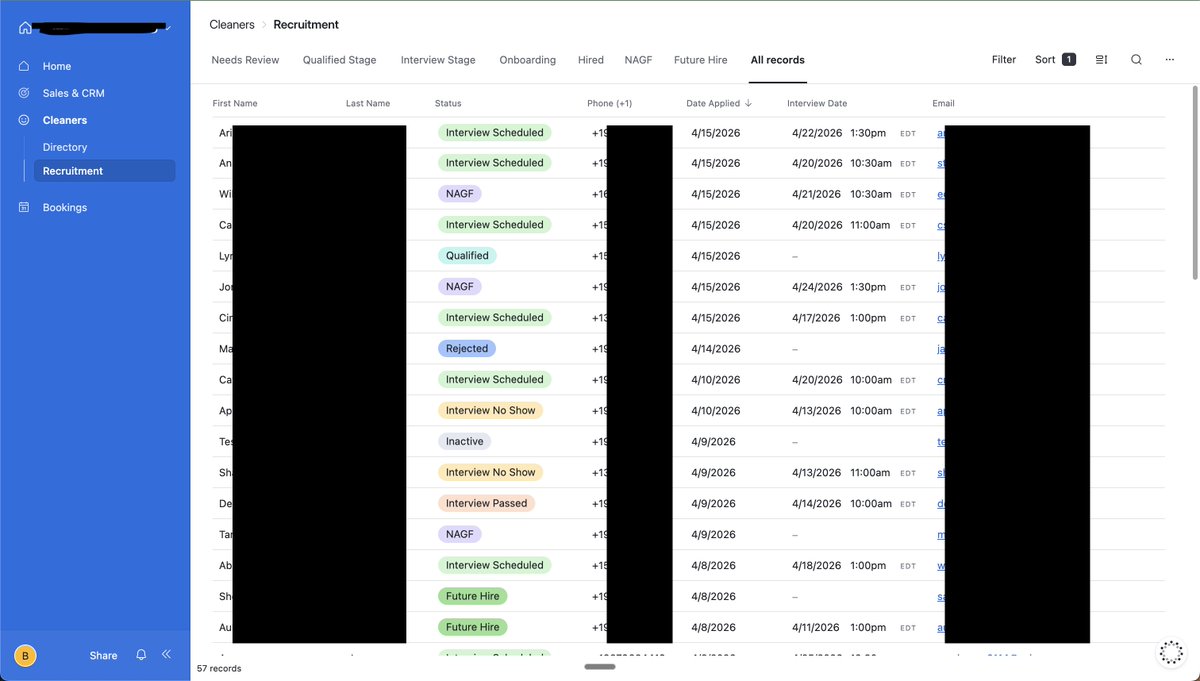
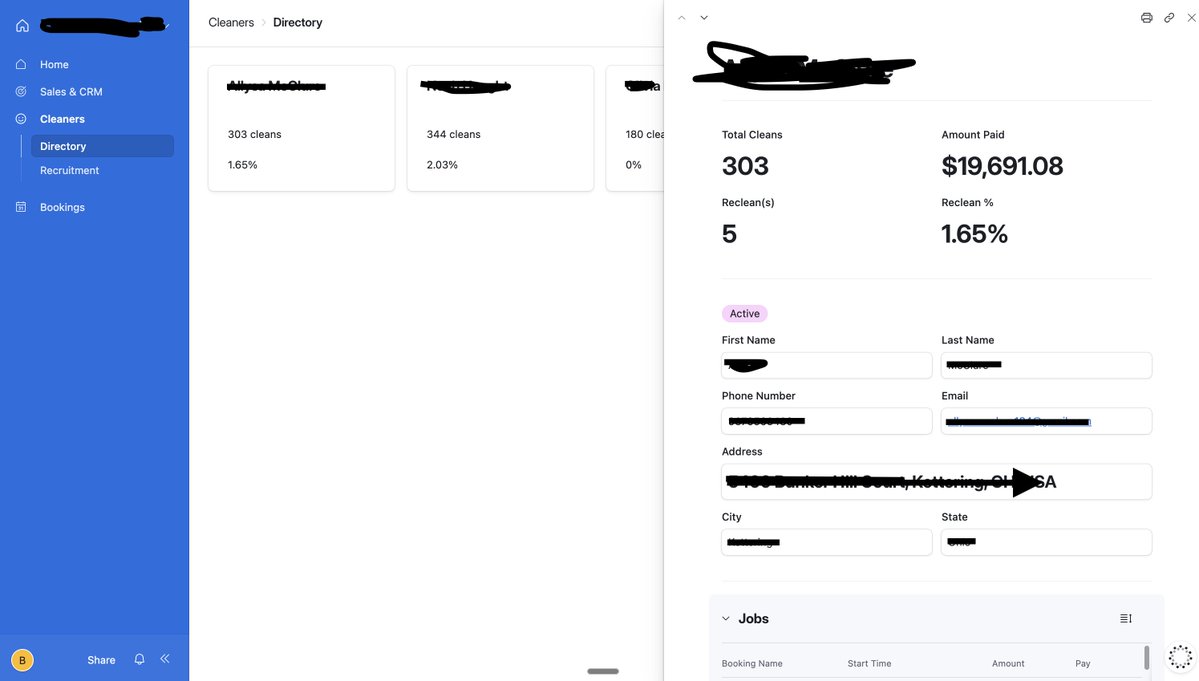
Wrapping up a CRM build for a cleaning business this week. We added: 1. All of their @gowithquo chats and call history 2. All of their leads (thumbtack, google, website, etc) 3. All of their bookings from @BookingKoala (including date on who cancelled, who only booked 1x, who to try to upsell) 4. All of their cleaners and applicants from @indeed And we put them together into a beautifully simple platform where everything speaks together and gives them true business intelligence. Customer summary, cleaner records, jobs search, and more. And the data stays updated automatically. My fav part, automating their entire hiring funnel from Indeed applicant to interview scheduled (without any human involvement). They're hiring 5x as fast and scaling even faster. I can't share too much here but hmu and I'll can share a BTS video.
Jacques H. Bastien tweet mediaJacques H. Bastien tweet mediaJacques H. Bastien tweet mediaJacques H. Bastien tweet media
English
9
2
32
4.5K
Sam Allsopp
Sam Allsopp@sam_allsopp_·
Something way overlooked when owning a business or managing people - How to balance empathy and running your business. Uncontrolled empathy destroys companies. Leaders making decisions based on emotion, guilt, desire to help etc. vs. incentives, consequences, long term outcomes end up harming the thing they're trying to protect. I'm not saying remove empathy- unique situations require you to understand someones situation and help within reason as long as your not destroying your company in the process. You should start conditioning yourself though to lookout for situations where you prioritize others at your company and cultures expense, you ignore risk and reality, or you become an enabler of bad behavior. For example- you keep a sales rep because you preach everyone being "family" at your company... you tell yourself they are trying, you're afraid of confrontation and what happens? They drag teams performance, causes resent from other sales reps, you lose money, you eventually have to fire them anyway. If you dont put boundaries on empathy you will destroy your company slowly but surely. You destroy performance you reward bad behavior and you unintentionally start to punish discipline and high performing employees. The goal is not to be less empathetic, it is to pair empathy with standards and consequences for the greater good.
English
5
0
35
2.3K