the_interested_reader

1.3K posts

the_interested_reader banner
the_interested_reader

the_interested_reader

@theinterestedr1

protocol researcher & architect, building a horizontally scalable L1 #stealth, former CTO @lavanetxyz

Israel Katılım Şubat 2019
202 Takip Edilen485 Takipçiler
Sabitlenmiş Tweet
the_interested_reader
the_interested_reader@theinterestedr1·
I have a strong conviction web2 small businesses will move on chain in the next 3 years My friend built a convenience application, he needs to integrate payments, he did a rough check, vendors today take 14% from deals and a base fee of 0.3$, killing low margin businesses 👇🏻
English
1
0
0
185
the_interested_reader retweetledi
Ofir Zohar
Ofir Zohar@zohar_ofir·
The agentic economy doesn’t just need platforms that scale. It needs platforms that respond fast. Agents don’t only make payments; they coordinate, negotiate, request quotes, place bids, verify conditions, and react to changing information. Each user request may trigger many dependent actions in a tight feedback loop. High throughput without high responsiveness still creates friction, delays, and missed opportunities. If every step takes too long, agents become less useful and markets become less efficient. To support real agentic finance, infrastructure must handle massive volume and deliver low-latency responses under load. Scalability matters. Responsiveness is also critical.
English
1
1
5
40
the_interested_reader retweetledi
Santiago R Santos
Santiago R Santos@santiagoroel·
This year I’m on pace to make the lowest number of angel checks into crypto. Dollar-wise I’m still deploying the same amount but more concentrated and in other sectors. Why is that? I haven’t seen that many good projects lately. Maybe a skill issue of mine, or founders are reaching out less because I’m heads down building Inversion now. But a lot of crypto VCs say the same thing, that they haven’t seen many novel ideas or great teams. Most of the venture dollars are going to later stage projects like Polymarket and Kalshi. Sentiment is quite bad out there. It’s so tempting to say we’ve innovated what we could. Perps are dominated by Hyperliquid. Gaming and social are “dead,” for now. I’ve seen this movie before. We haven’t finished innovating. Not even close. Most of what we’ve done is copy traditional finance and make a lot of the same mistakes in the process. But we have killer 0 to 1 foundations that have set the stage for the next crop of builders. The market has less patience for the 10th prediction market or perp protocol. It has zero for social, gaming and NFTs. For now. We need more creativity from builders. We need a few bold ones to try it again when so many have failed. Builders will come, but not right now. The best and brightest are in AI. We’ve seen this movie before too. Yes, it’s very hard to get scale. It always is. In some ways the days of making easy money with ICOs is dead. Such is the state of early movements. We’ve grown up. It’s more competitive but my god it’s not remotely late. It’s painfully early. I spend less time on angel investing now, making the occasional bet on founders I’ve followed or in spaces synergistic to Inversion. But I’m optimistic. Great founders get discovered and ideas get funded faster today because AI and open source have radically lowered the cost of launching something. That makes it very easy to start companies. Builders will come because we haven’t solved crypto. There are plenty of hard problems and smart people want to work on hard and meaningful things. Crypto has no shortage of either.
Suraj Sharma@suraj_sharma14

Here are the Web3 angel investors actively backing builders right now: 1.) Naval Ravikant (@naval) AngelList founder. Early Bitcoin believer. One of the most influential angels in all of tech not just Web3. Backs founders who are building for the long term. Not the next cycle. Focus: infrastructure, DeFi, open source, crypto primitives 2.) Balaji Srinivasan (@balajis) Ex-CTO of Coinbase. Former General Partner at a16z. One of the most crypto-native angel investors alive. Backs builders who understand why decentralization actually matters. Focus: network states, DeSci, Bitcoin, decentralized infrastructure 3.) Tyler Winklevoss (@tylerwinklevoss) Co-founder of Gemini. Co-founder of Winklevoss Capital. Seed and Series A stage. Brings direct operational experience from building a major crypto exchange. Focus: Web3, gaming, media, institutional crypto infrastructure 4.) Evan Luthra (@EvanLuthra) Builder-first philosophy. One of the most active angels backing early Web3 founders globally. Known for hands-on guidance from the ground up before projects reach scale. Regular presence at blockchain events. Active on X with his portfolio. Focus: early stage Web3, AI x blockchain, consumer apps 5.) Kunal Shah (@kunalb11) Founder of CRED. Co-founder of Freecharge. 200+ investments across fintech, consumer internet and Web3. Most active angel investor in Asia with massive reach across India's startup ecosystem. If you're building in India this is your most relevant name on this list. Focus: fintech x Web3, consumer crypto, payments infrastructure 6.) David Tisch (@davidtisch ) Managing Partner at BoxGroup. Co-founder of Techstars NYC. Pre-seed and seed stage. High volume. Hands-on. Strong New York network. Known for backing founders at their earliest. Focus: Web3, FinTech, consumer internet, digital health 7.) Santiago R Santos (@santiagoroel) Former Partner at ParaFi Capital. One of the most respected crypto-native angels in DeFi. Deep understanding of protocol economics and on-chain governance. Focus: DeFi protocols, token design, on-chain infrastructure 8.) Stani Kulechov (@StaniKulechov) Founder of @aave . Now actively angel investing in builders working on DeFi, social and lending primitives. One of the few founders who built a billion dollar protocol and is now backing the next generation. Focus: DeFi, social finance, lending infrastructure, open source 9.) Sandeep Nailwal (@sandeepnailwal ) Co-founder of @0xPolygon . Backs builders through Symbolic Capital. Known for the Nailwal Fellowship supporting individual developers. One of the most builder-friendly angels in the entire ecosystem. Focus: ZK infrastructure, DeFi, developer tooling, Indian builders. 10.) Julien Bouteloup (@bneiluj) Founder of Stake Capital. Builder of Curve ecosystem tools. Deep DeFi native. Backs founders who understand protocol mechanics deeply. Focus: DeFi, MEV, staking infrastructure, yield protocols What angels actually want in 2026 from their own words: - Working code over whitepapers - Real users over projections - Founders who understand the problem personally - Long term conviction over short term narrative - Crypto-native judgment plus execution ability The angels still writing cheques are more disciplined and more focused on fundamentals than ever before. Hype doesn't work anymore. Traction does. How to actually reach them: - Engage with their content genuinely on X - Build something they'd find interesting - Get a warm intro through their portfolio founders - Show up consistently before you need anything Cold DMs work occasionally. Warm relationships work always. Save this for a founder who is fundraising right now.

English
53
17
275
51.4K
the_interested_reader retweetledi
Ofir Zohar
Ofir Zohar@zohar_ofir·
Identity and reputation shouldn’t belong to the platform. Today, sellers, creators, and service providers build trust inside closed systems — and lose it the moment they leave. In an agentic world, this becomes critical. Agents need portable identity, history, and reputation to transact and coordinate reliably. Without portability, platform lock-in returns — just in a new form. Trust must live on shared rails, not inside a single company’s database.
English
18
1
22
120
the_interested_reader
the_interested_reader@theinterestedr1·
@sjdedic Defi rails today offer a primitive that won’t support that future, a lock on the world with an auction on who holds it and for how long. This is incompatible with that volume scalable asynchronous rails with a defi ecosystem built for it is the only long term winner
English
0
0
1
10
Simon Dedic
Simon Dedic@sjdedic·
Something I've been spending a lot of time thinking about as a crypto VC: DeFi today has maybe a few hundred thousands of active users. Maybe like 2-3M at best. But in an agentic world, every business, every app, every device could have its own agent interacting with financial protocols autonomously. We're not talking about 10x more users. We're talking about 1000x. And here's what most people aren't thinking about: the DeFi stack as we know it simply isn't built for this. Let me give you some examples. Money markets. Today's lending protocols require manual collateral management, have static liquidation thresholds, and make you go through multiple approval steps just to open a position. A human clicks through that in 30 seconds and doesn't think twice. An agent executing thousands of micro-loans per second across dozens of markets? Horrible friction. Agents need instant, permissionless and fully programmable credit. DEXs. AMMs like Uniswap were revolutionary because they solved liquidity for a world where most participants were unsophisticated retail users. But agents aren't unsophisticated. Every single agent is a highly efficient market participant that will always seek the best execution. They don't need passive liquidity pools,but more likely CLOBs with deep orderbooks, sub-second execution, and zero slippage. AMMs were built to make trading easy for humans. Agents don't need easy. They need optimal. Oracles. Right now, most DeFi protocols pull price feeds at fixed intervals. Good enough for human timescales. But when millions of agents are making real-time decisions, latency becomes a competitive edge. The oracle layer needs to go from "update every few seconds" to "stream continuously" or it becomes the bottleneck of the entire system. Wallets and identity. Agents don't have shitty wallets like Metamask. They don't sign transactions manually. They need programmable key management, session-based permissions, and granular spending limits. All on-chain, all automated. The entire wallet infrastructure needs to be rethought from the ground up. Probably could go on with this list forever, but you get the point: Most of the DeFi protocols and middleware solutions today assume a human is on the other end. Blockchains are the perfect rails for the agentic economy, but a whole new target group of users will also come with a behavioral change and hence whole new needs. Being visionary enough today to think three steps ahead and to understand what this future will look like / what it will require, will mint a whole new wave of millionaires and legendary investors.
English
59
10
187
21.1K
the_interested_reader
the_interested_reader@theinterestedr1·
@sjdedic Agreed, Equity share holders model is proven to work. You still have voting on board meetings, but you delegate most of the day to day to the talented chosen individuals, who can react fast enough
English
0
0
0
12
Simon Dedic
Simon Dedic@sjdedic·
One of the most misguided concepts crypto ever came up with might be governance tokens. Most companies don’t actually take governance seriously. They use it as regulatory arbitrage. The token exists because it’s essentially free money they can print on top of their equity. They would never hand over real decision-making power for their business to a random community (you). And even when it looks like they do, the vote is usually tilted through insider allocations so the outcome ends up exactly where it was planned from the start. That said, I do feel for the few teams that genuinely tried to make governance work. Ironically, those are often the same teams that truly cared about their token and tried to create real value accrual for it. But in practice, too many cooks spoil the broth. Running a business by democracy is one of the most inefficient structures imaginable. Endless proposal discussions, waiting for alignment, debating every step before anything can move forward. Meanwhile, you end up with a large number of “stakeholders” who aren’t actually interested in the long-term success of the business, but only in extracting short-term value from their position. It starts to resemble German politics: throw ten different groups with completely opposing views into the same room and the end result is that nothing happens at all. Crypto is still a startup industry driven by innovation. That means moving fast, trying things, breaking them, learning, iterating. Sometimes it works. Sometimes it doesn’t. But you learn and adapt. Nothing kills innovation faster than decision paralysis. The recent drama around @aave is a great example of this tension. In my opinion, @StaniKulechov and his team are among the best builders in DeFi and genuinely try to make things work for everyone involved. But when everyone thinks they should have a say (each with different incentives) progress inevitably slows down. I don’t even want to imagine where Aave as a business might already be today if the DAO hadn’t become such a bottleneck. An even clearer example might be @AcrossProtocol and @hal2001’s recent proposal to take the company private again, precisely to avoid these governance gridlocks, while instead making participants true equity stakeholders and aligning everyone around a shared long-term goal. Hearing rumors that apparently even more DAOs are considering this step for quite some time already, so wouldn't be surprised if we see a lot more of these. Governance was one of those ideas that was well-intentioned but poorly implemented. In theory, it sounds beautiful, a decentralized kumbaya world where everyone has a voice. In practice, it simply doesn’t work. The only real path forward for tokens is digital equity onchain, in whatever form that ultimately takes. Stop trying to design structures that artificially separate ownership, control and value. Investors and communities have become far too sophisticated to keep falling for that. Founders who understand this today will be part of the great comeback of this industry tomorrow. But those who still think they can extract value the old way and work around these issues will simply be left behind. Welcome to the new era.
English
56
46
286
15.9K
the_interested_reader retweetledi
Ofir Zohar
Ofir Zohar@zohar_ofir·
An overlooked consequence of the move toward agentic interaction is the transformation of the UI. Users won’t rely on interfaces designed by each application provider. Instead, they’ll interact with their own agents — and choose how results are presented. The UI between user and agent becomes decoupled from the APIs and services the agent uses. Most instructions will likely be given through natural language and voice.
English
15
1
16
154
AyoCFC 💫
AyoCFC 💫@AyomikunCFC·
@zohar_ofir What features are those ( if not decentralization and speed)
English
1
0
0
11
the_interested_reader retweetledi
Parul Gujral 🦇🔊
Parul Gujral 🦇🔊@whoisparul·
@k1rallik @Polymarket this is what happens when we prioritize speed over security and trust the chain too much, it's a wake up call for the industry to rethink its approach to risk management and security measures
English
3
0
2
1.7K
BuBBliK
BuBBliK@k1rallik·
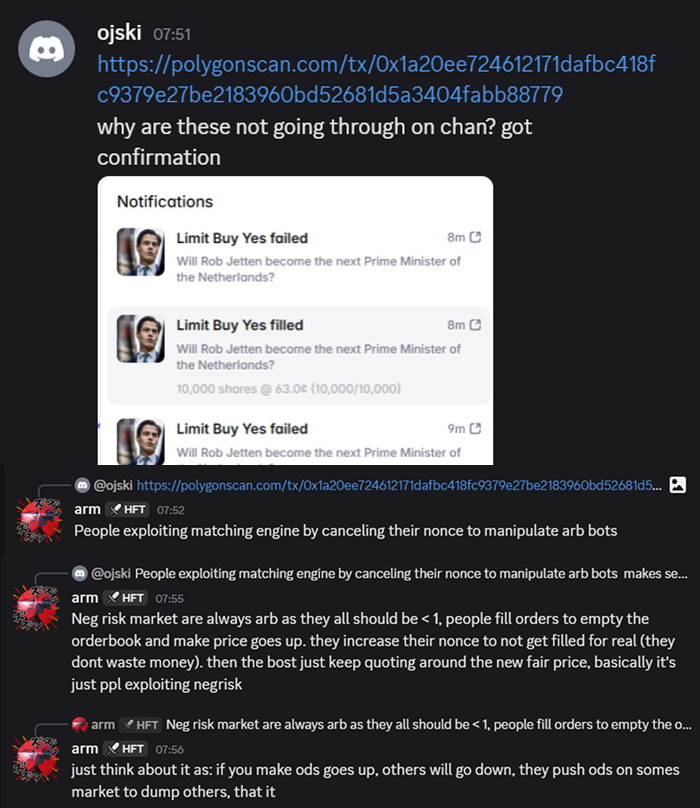
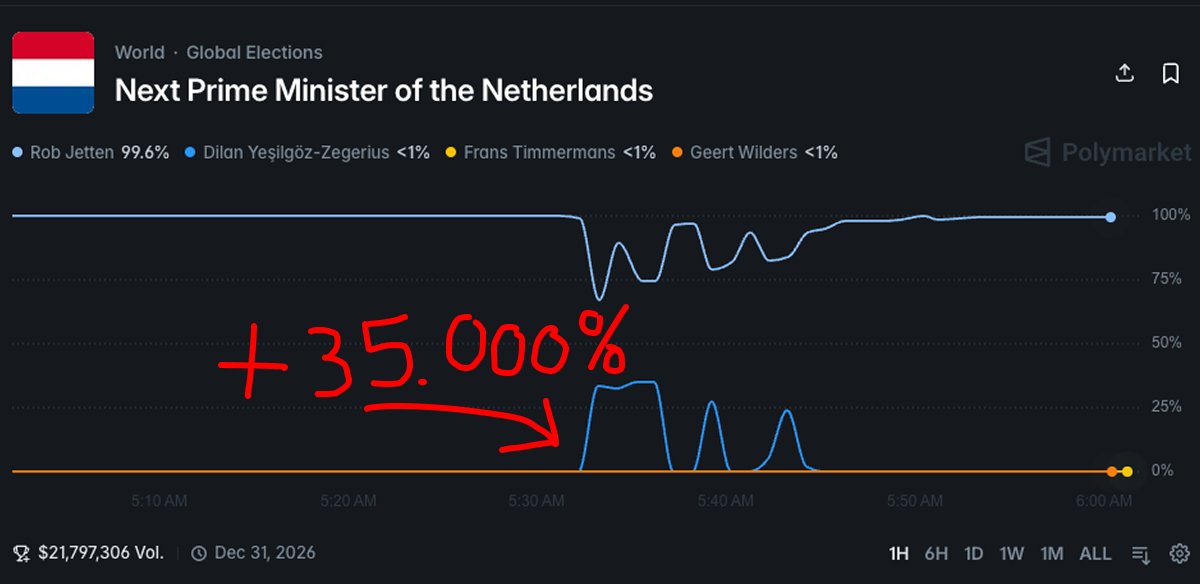
Polymarket exploit is draining arb bots NOW 🚨 people are LITERALLY trading ghost money there's an exploit - incrementNonce() - that lets you: - post a 10,000 share order - get matched with an arb bot - bot thinks it's hedged - you call ONE function for pennies - on-chain tx DIES - bot is left NAKED with an open position and you go in and rekt it. entire cycle costs a few dollars in gas profit - hundreds. saw the Dutch PM market today? odds pumped from 0.1% to 35% → +35,000% - with ZERO actual trades. the scary part? Polymarket CAN'T quickly fix this. no sequencer, no risk engine they just trust the chain, and the chain is slow. this isn't a bug - it's an ARCHITECTURAL FLAW.
BuBBliK tweet mediaBuBBliK tweet mediaBuBBliK tweet media
Lirratø@itslirrato

Polymarket exploit is officially out of control 🚨 Look at the Dutch Prime Minister market today: - Odds were artificially pumped from 0.1% to 35% - 350x artificial pump (+35,000%) - Only a few dollars spent on gas fees - 0 actual trades executed The exploit I warned about is now becoming a systematic issue It must be fixed immediately Thanks @Armv7lFx for the info

English
27
39
483
109K
the_interested_reader retweetledi
Itay Malinger
Itay Malinger@ItayMalinger·
Web3 products often treat users like engineers. Here is your gas estimate. Here are 10 pop-ups to make you connect your wallet. Here are 5 things you need to sign before you continue. Good luck. The best products treat users like guests. Everything they need is already prepared. We’re building for a future where using Web3 products is inviting, not discouraging.
English
24
2
33
1.2K
the_interested_reader retweetledi
Itay Malinger
Itay Malinger@ItayMalinger·
Complexity should live in the system, not in the interface. Every technical detail exposed to users is a confession: we could not figure out how to handle this ourselves.
English
16
1
26
386
the_interested_reader retweetledi
Ofir Zohar
Ofir Zohar@zohar_ofir·
The biggest gap between blockchains and real financial systems isn’t speed. It’s guaranteed quality of service under any conditions. To become true financial backbones, blockchains must give protocols reliable performance guarantees. That’s why real scale-out architecture isn’t optional. It’s a requirement.
English
16
1
21
114
the_interested_reader retweetledi
vitalik.eth
vitalik.eth@VitalikButerin·
Recently I have been starting to worry about the state of prediction markets, in their current form. They have achieved a certain level of success: market volume is high enough to make meaningful bets and have a full-time job as a trader, and they often prove useful as a supplement to other forms of news media. But also, they seem to be over-converging to an unhealthy product market fit: embracing short-term cryptocurrency price bets, sports betting, and other similar things that have dopamine value but not any kind of long-term fulfillment or societal information value. My guess is that teams feel motivated to capitulate to these things because they bring in large revenue during a bear market where people are desperate - an understandable motive, but one that leads to corposlop. I have been thinking about how we can help get prediction markets out of this rut. My current view is that we should try harder to push them into a totally different use case: hedging, in a very generalized sense (TLDR: we're gonna replace fiat currency) Prediction markets have two types of actors: (i) "smart traders" who provide information to the market, and earn money, and necessarily (ii) some kind of actor who loses money. But who would be willing to lose money and keep coming back? There are basically three answers to this question: 1. "Naive traders": people with dumb opinions who bet on totally wrong things 2. "Info buyers": people who set up money-losing automated market makers, to motivate people to trade on markets to help the info buyer learn information they do not know. 3. "Hedgers": people who are -EV in a linear sense, but who use the market as insurance, reducing their risk. (1) is where we are today. IMO there is nothing fundamentally morally wrong with taking money from people with dumb opinions. But there still is something fundamentally "cursed" about relying on this too much. It gives the platform the incentive to seek out traders with dumb opinions, and create a public brand and community that encourages dumb opinions to get more people to come in. This is the slide to corposlop. (2) has always been the idealistic hope of people like Robin Hanson. However, info buying has a public goods problem: you pay for the info, but everyone in the world gets it, including those who don't pay. There are limited cases where it makes sense for one org to pay (esp. decision markets), but even there, it seems likely that the market volumes achieved with that strategy will not be too high. This gets us to (3). Suppose that you have shares in a biotech company. It's public knowledge that the Purple Party is better for biotech than the Yellow Party. So if you buy a prediction market share betting that the Yellow Party will win the next election, on average, you are reducing your risk. Mathematical example: suppose that if Purple wins, the share price will be a dice roll between [80...120], and if Yellow wins, it's between [60...100]. If you make a size $10 bet that Yellow will win, your earnings become equivalent to a dice roll between [70...110] in both cases. Taking a logarithmic model of utility, this risk reduction is worth $0.58. Now, let's get to a more fascinating example. What do people who want stablecoins ultimately want? They want price stability. They have some future expenses in mind, and they want a guarantee that will be able to pay those expenses. But if crypto grows on top of USD-backed stablecoins, crypto is ultimately not truly decentralized. Furthermore, different people have different types of expenses. There has been lots of thinking about making an "ideal stablecoin" that is based on some decentralized global price index, but what if the real solution is to go a step further, and get rid of the concept of currency altogether? Here's the idea. You have price indices on all major categories of goods and services that people buy (treating physical goods/services in different regions as different categories), and prediction markets on each category. Each user (individual or business) has a local LLM that understands that user's expenses, and offers the user a personalized basket of prediction market shares, representing "N days of that user's expected future expenses". Now, we do not need fiat currency at all! People can hold stocks, ETH, or whatever else to grow wealth, and personalized prediction market shares when they want stability. Both of these examples require prediction markets denominated in an asset people want to hold, whether interest-bearing fiat, wrapped stocks, or ETH. Non-interest-bearing fiat has too-high opportunity cost, that overwhelms the hedging value. But if we can make it work, it's much more sustainable than the status quo, because both sides of the equation are likely to be long-term happy with the product that they are buying, and very large volumes of sophisticated capital will be willing to participate. Build the next generation of finance, not corposlop.
English
936
592
4.9K
942.7K
Grey Ledger
Grey Ledger@Airdrops_one·
Where $ATOM Gets Paid (Part3): Router > Religion Forget "ecosystem token." Forget " $ATOM is the ETH of Cosmos." * @Ripple shipped an EVM sidechain on the Cosmos stack. Doesn't touch $ATOM. * @OndoFinance is building tokenized-markets rails on Cosmos. Doesn't touch $ATOM. * Telegram/TAC, @mantra_chain, @Lombard_Finance, @Figure - all on the stack. None route through the Hub. The stack is winning. The token? Not so much. More chains means more potential Hub traffic - but potential isn't revenue. You can't tax an SDK. You can toll a route. -- What "router" actually means The only way $ATOM captures value is if the Cosmos Hub becomes a router - infrastructure that sits in the middle of real cross-chain flows and charges for the service. Not a landlord. Not a brand. Not a mascot. A router. The question isn't "does Cosmos win?" It's: does the Hub handle traffic someone will pay for? Everything below is graded against that standard. -- Fee surfaces - graded honestly -- 1. IBC Eureka routing fees Eureka brought Ethereum onto IBC in April 2025. Solana, Base, and Arbitrum are on the 2026 roadmap. First time there's real cross-ecosystem volume to route. If the Hub becomes the preferred crossing - fast batching, reliable settlement, lower cost - it can toll that traffic. Catch: Eureka enables direct chain-to-chain links. You can route around the Hub. Verdict: Plausible - but the Hub has to earn its position through speed and cost, not assume it. If chains bypass it, this surface is zero. -- 2. Neutral settlement + compliance middleware Stablecoin/FX primitives, RWA settlement, compliance toolkits that enterprises plug into because the Hub is neutral - no competing commercial product on the other side. Most defensible fee surface. Enterprises pay for interop, compliance, and reliability as a service. The Hub has no competing commercial interest - that's its edge. Reality check: none of this is live yet. Primitives need to ship. Toolkits need to be production-grade. Verdict: Best long-run surface - but it's a build, not a brand. Earliest realistic: late 2026. Enterprise timelines are slow, mired in legal and compliance. This isn't agile development. -- 3. Cosmos-as-Red-Hat (off-chain revenue) SLAs, audits, LTS branches, managed upgrades. @cosmoslabs_io is reportedly closing enterprise deals. Most immediately real revenue stream in the ecosystem right now. The paradox: revenue goes to @cosmoslabs_io the company, not $ATOM the token. Red Hat made billions. Linux kernel contributors didn't. Unless there's explicit on-chain routing - fee-share, buybacks, staker rewards - this is a Cosmos Labs equity story. Verdict: Stack-bullish. Token-neutral until the wiring exists. -- 4. Interchain Security (ICS) Was designed to be the " $ATOM gets paid" mechanism: Hub validators secure external chains, earn a cut of fees. In practice, the highest-profile chains self-validated, consumer chains left or shut down, and the 2026 stack roadmap doesn't mention ICS at all. Development is in maintenance mode. Hub operations teams are scoping deprecation work. Verdict: Dead end. The market tested "shared security as a product" and said no. Reinforces why the router model - charge for routing, not for security - is the path forward. -- 5. PoA enterprise chains + Hub interop Native PoA lets banks and fintechs run permissioned chains without a staking token. These chains still need to connect outward - the Hub could be that gateway. Fastest-growing use case. Slowest BD cycle. 6-18 months per deal. No CT signal. Verdict: High-fit, but 2027+ timeline. Don't expect hype. -- RWA is the near-term toll road If any fee surface generates revenue first, it's probably here. Tokenized US Treasuries crossed ~$10B AUM - up from ~$5-6B mid-2025. Stablecoins at ~$250B. Citi estimates tokenized assets could reach $4-5T by 2030. Institutions are already building on the Cosmos stack: ▫️ @OndoFinance - Ondo GM on Cosmos Stack. Bridges tokenized assets to public-market liquidity. Moved ~$95M into BlackRock's BUIDL fund. ▫️ @Lombard_Finance - BTC as institutional collateral. Cosmos-based Lombard Ledger. $1B TVL in first 3 months. ▫️ @Injective - digital-securities infrastructure for institutional issuance and trading. ▫️ @ZIGChain - brokerage rails + blockchain settlement, partnered with Apex Group ($3.4T fund admin). ▫️ @provenancefdn / @Figure - leading non-bank HELOC lender in the US, on Cosmos. ▫️ @progmat_en - Japan's largest regulated tokenization platform. Joint venture of MUFG, Mizuho, SMB. The pipeline is real. The revenue path to $ATOM is not - yet. If the Hub becomes the default router and settlement layer for this traffic, there's an obvious, chargeable service. If it doesn't, these remain proof that the stack wins while the token watches. -- What's wishful thinking ▫️ "SDK adoption tax." The SDK is permissive by design. You can't add rent to open source after the fact. ▫️ "Just add EVM." EVM compatibility is table stakes. @LayerZero_Labs just launched its own L1 with Citadel, DTCC, and ICE behind it. The moat is flows, not another VM. ▫️ "Narrative routing." If value-routing to $ATOM depends on governance politics, nobody trusts it. It has to be automatic, measurable, auditable - or it's just vibes. -- The tokenomics RFP - the silence is the signal The tokenomics-research RFP was the process meant to answer "how does $ATOM capture any of this?" Proposals were due in January 2026. As of mid-February - little public update. Fair: good modeling takes time. Doing it right matters more than doing it fast. Also fair: the stack team ships at pace - v25.3.0 went live in January, Cosmos EVM is being adopted by Ripple and Telegram, IBC Eureka is connecting ecosystems. The one process meant to solve token value capture is quiet while everything around it accelerates. Every month that gap stays open, the market prices $ATOM accordingly. What a credible outcome looks like: ▫️ Fee mechanisms tied to shipped Hub services - not hypothetical ones ▫️ Explicit revenue routing with numbers: fees -> stakers, buybacks, or burns ▫️ Inflation that actually drops (target: low single-digits, down from 7-20%) ▫️ A vote and implementation timeline What governance theater looks like: ▫️ PDFs and "further research" -- What has to be true by end of 2026 ▫️ At least one Hub fee surface live with measurable revenue ▫️ Tokenomics redesign shipped on-chain - not as a paper ▫️ Inflation below 5% ▫️ IBC Eureka beyond Ethereum - Solana, Base, or Arbitrum, at least one live ▫️ A named enterprise paying for Hub services with a visible route to $ATOM All five -> oh man! $ATOM starts looking like infrastructure equity with a token attached. Router > Religion becomes real. Three or more -> the router starts feeling real. Attainable, but a lot of work. Zero or one -> the stack keeps winning, $ATOM stays a spectator, and the bear case from Part 2 becomes the permanent state. That's the honest trade. ⚛️ Part 1: Cosmos Is Running the Linux Playbook. $ATOM Is the Open Question. x.com/Airdrops_one/s… Part 2: If Cosmos is “Linux,” where does $ATOM get paid? x.com/Airdrops_one/s… -- NFA. DYOR. Not a paid post. Sources: ▫️ Cosmos Stack 2026 Roadmap: cosmoslabs.io/blog/the-cosmo… ▫️ ATOM Tokenomics RFP: forum.cosmos.network/t/request-for-… ▫️ IBC Eureka walkthrough: blog.cosmos.network/ibc-eureka-tec… ▫️ Real-World Assets on Cosmos: cosmos.network/blog/real-worl… ▫️ LayerZero announces Zero L1: thedefiant.io/news/blockchai… ▫️ Cosmos EVM: github.com/cosmos/evm 🫡
Grey Ledger tweet media
English
13
25
120
14.6K
hoeem
hoeem@hooeem·
$15 trillion. that’s over 10x the market cap of bitcoin and it’s how much ai agents will spend by 2028 the 10x opportunity is knowing that there’s only one place that they spend it the 10x question becomes: where do billions of machines go when they need to move money? well, please let me tell you at the moment, nobody cares by 2028, everyone will care the money will be made in the window between “nobody cares” to “everyone cares” 𝐭𝐡𝐞 𝐜𝐨𝐫𝐞 𝐭𝐡𝐞𝐬𝐢𝐬 • ai agents can’t open bank accounts they’re not legal persons • no ssn. no kyc. no signature. banks will never serve them. • blockchain is the only financial system that doesn’t require permission or identity • all you need is a private key no gatekeeper, no approval, no human co-signatory • this isn’t a choice. it’s elimination. there is nowhere else for agents to go. 𝐭𝐡𝐞 𝐢𝐧𝐟𝐫𝐚𝐬𝐭𝐫𝐮𝐜𝐭𝐮𝐫𝐞 (𝐛𝐞𝐢𝐧𝐠 𝐛𝐮𝐢𝐥𝐭 𝐫𝐢𝐠𝐡𝐭 𝐧𝐨𝐰) • coinbase launched “agentic wallets” for autonomous ai agents • x402 protocol revived the http 402 “payment required” code for machine-to-machine micropayments • visa built a “trusted agent protocol” for cryptographic verification of ai agent transactions • lightning labs dropped agent-native tools for lightning network payments on the same day • smart contracts = the only “contracts” a machine can execute (no lawyers, no courts, just code) 𝐚𝐠𝐞𝐧𝐭𝐬 𝐰𝐢𝐥𝐥 𝐨𝐮𝐭𝐧𝐮𝐦𝐛𝐞𝐫 𝐡𝐮𝐦𝐚𝐧𝐬 • salesforce ceo predicted 1 billion ai agents by end of fiscal 2026 looks conservative now • ibm: “non-human identities will outnumber human users in organisations significantly” • gartner: 40% of enterprise apps will embed ai agents by end of 2026 (up from 5% in 2025) • 50% of enterprises using genai will deploy autonomous agents by 2027 (deloitte) • every company deploys hundreds sometimes thousands of agents. billions globally. fast. • agents spawn sub-agents. sub-agents spawn more. growth is exponential, not linear. 𝐭𝐡𝐞 𝐦𝐨𝐧𝐞𝐲 • gartner: ai agents will command $15 trillion in b2b purchases by 2028 • by 2030, 20% of all monetary transactions will be programmable (machine-initiated, machine-settled) • ai automation projected to inject $2.84 trillion into us gdp by 2030 • agentic ai market obliterates $47-52 billion by 2030 (46% annual growth) • banks report 77% roi on agent deployments • smart factories save ~$300m/year with agentic systems • agents don’t sleep. don’t take weekends. execute thousands of transactions per hour. 24/7/365. 𝐭𝐡𝐞 𝐬𝐜𝐚𝐫𝐲 𝐩𝐚𝐫𝐭 • ai agents already finding smart contract exploits autonomously $4.6m in vulnerabilities found (anthropic research) • exploit capability doubling every 1.3 months. cost to scan one contract: $1.22. • “death by ai” legal claims expected to exceed 2,000 by end of 2026 (gartner) • agent-to-agent commerce creates closed loops humans can’t see into • 75% of organisations have misconfigured agent policies rogue deployments are a bigger threat than outside hackers • 40% of large enterprises will need “guardian agents” to police other agents by 2028 • financial agent alignment is unsolved over-leverage, manipulation, portfolio destruction in seconds 𝐭𝐡𝐞 𝐪𝐮𝐞𝐬𝐭𝐢𝐨𝐧 𝐧𝐨𝐛𝐨𝐝𝐲 𝐢𝐬 𝐚𝐬𝐤𝐢𝐧𝐠 • when most on-chain transactions are machine-to-machine, what happens to chain value? • winning chains won’t have the best marketing they’ll have lowest latency, cheapest fees, most composable contracts • crypto user base isn’t going from 500m humans to 1b humans • it’s going from 500m humans to 500m humans + billions of machines • machines transact at volumes humans physically cannot match 𝐭𝐡𝐞 𝐛𝐨𝐭𝐭𝐨𝐦 𝐥𝐢𝐧𝐞 • blockchain wasn’t built for ai agents it was built by cypherpunks who didn’t trust banks • by accident of architecture, it became the only financial infrastructure for non-human economic actors • every agent that needs to transact will use blockchain. not most. all. no alternative exists. wow
English
108
114
856
88.5K
the_interested_reader
the_interested_reader@theinterestedr1·
@r0ck3t23 Nice concept, but you need an intermediate representation to see what you imagined and what’s happening are aligned. even if you remove code, it’s hard to think on all the cases and “compile” undefined behaviour to something that makes sense. break it to manageable components
English
0
0
0
7
Dustin
Dustin@r0ck3t23·
Elon Musk thinks coding dies this year. Not evolves. Dies. By December, AI won’t need programming languages. It generates machine code directly. Binary optimized beyond anything human logic could produce. No translation. No compilation. Just pure execution. Musk: “You don’t even bother doing coding.” Code was never the point. It was friction. A tax we paid because machines didn’t speak human. AI just learned fluent human. The tax is gone. Now plug that into Neuralink. No syntax. No keyboard. No screen. Musk: “Imagination-to-software.” Thought becomes executable. You imagine an outcome, the system architects and compiles it into reality instantly. We’re not automating programming. We’re erasing it from existence. The entire profession collapses into a thought. Decades of training reduced to irrelevance. The gap between idea and instantiation hits zero. You don’t build anymore. You imagine, and it materializes. Not incremental progress. Total phase shift. The way humans have created things for ten thousand years just became obsolete. Welcome to a world where the limiting factor isn’t skill, resources, or time. It’s whether you can picture what you want clearly enough for a machine to birth it into existence.
English
1.9K
2.9K
15.7K
4.1M
the_interested_reader
the_interested_reader@theinterestedr1·
@ItayMalinger Perform action in new tab, you don’t fear losing where you were, you can branch out to try things, you can always access information you had on the previous flow
English
0
0
0
17
Itay Malinger
Itay Malinger@ItayMalinger·
A random thought that just crossed my mind: the undo button is underrated. When users can reverse any action, they explore with confidence. When they cannot, they hesitate at every step. Fear is friction. Reversibility is freedom. What other designs do you think are underrated? Keen to hear thoughts.
English
17
0
22
203
the_interested_reader
the_interested_reader@theinterestedr1·
@santiagoroel @alive_eth When the token price is stable foundations can increase expense on research marketing and growth and it behaves like you would expect. The problem is revenue for most chains is not aligned with cost, and the problematic coupling of fees and earnings participation
English
0
0
0
5
Santiago R Santos
Santiago R Santos@santiagoroel·
A token is not a claim on future cash flows. It’s a floating-rate coupon on current network usage. Fees get distributed, not reinvested. There’s no mechanism turning Year 1 fees into Year 2 growth. The network grows. The token passes it through. Amazon has network effects. Google has network effects. They retain earnings and reinvest to accelerate the flywheel. Protocols distribute and hope the flywheel sustains itself. The fee burn doesn’t fix this. A burn is a rule. A buyback is a decision. ETH’s burn slows when usage drops and accelerates when usage spikes. It does the opposite of what intelligent capital allocation does. Apple buys back more when the stock is cheap. ETH burns less when the token is cheap. And yes, token holders can change code via governance. EIP-1559 took three years. The merge took six. A CEO reallocates $500M on a Thursday. Compounding lives in the frequency of good decisions, not just the ability to make them
English
11
3
69
7.9K
Ali Yahya
Ali Yahya@alive_eth·
This ignores one of the most powerful drivers of exponential growth — network effects. Here's what makes tokens valuable: 1. A well designed protocol grows exponentially because of a flywheel between investors, infra providers, developers, and users. 2. The protocol captures fees. 3. The protocol's network token is a claim on future cash-flows from those fees. 4. Therefore, if the protocol succeeds, the value of the token will also grow exponentially.
Ali Yahya tweet media
Santiago R Santos@santiagoroel

Writing this as crypto melts down. Sorry, this isn't a bear post. It's about something more structural: tokens can't compound. They weren't designed to. The wealth in crypto will go to the equity of businesses that use the infrastructure. Not the infrastructure itself. Long the technology. Bearish tokens in their current form. Very long the equity of businesses that compound the advantages this infrastructure enables. obviously.substack.com/p/why-tokens-c…

English
26
22
218
59.1K
magmar 🇺🇸
magmar 🇺🇸@0xMagmar·
A clear, step-by-step guide to transition an Ethereum L2 to a EVM L1, with native & free interop with ETH mainnet: 1. Spin up a single node L1 with EVM and 200ms block times (github.com/cosmos/evm) 2. Pause L2 sequencer 3. Extract all smart contract bytes from L2 4. Set up a genesis for L1 with smart contract bytes 5. Replay any individual transactions as needed if can't be captured in genesis (rare) 6. Move wallet RPC endpoints to L1 RPC 7. Shut down L2. 8. Set IBC connection (comes pre-loaded) to point at Ethereum 8. OPTIONAL: set your token to be native gas token for your L1 9. OPTIONAL: enable staking of native token for security. Otherwise, just keep running nodes yourself if you had a centralized sequencer. Whole process takes few days. No visible changes for your users. Now you have a fully EVM-compatible L1 with native interop with Ethereum, and your token is a gas token. DM with questions, we'll do it for you.
English
68
84
465
78K
the_interested_reader retweetledi
magmar 🇺🇸
magmar 🇺🇸@0xMagmar·
I used to be an Ethereum dev in 2016. I was the original cofounder and CTO for Cent - platform that later sold the Jack Dorsey tweet NFT for $2m. One of the first NFT projects on mainnet. Let me be clear - I never believed everything would live on “one chain.” Makes 0 sense. As soon as I discovered Cosmos is 2022 (Terra was bigger than Solana), it was clear that there will be many chains, not one, and that they’ll interoperate. I left Ethereum and went to Cosmos, and built a successful company (Skip.build) Fast forward to today - Vitalik and the EF is abandoning years of cumulative effort of thousands of developers who wanted to “build on Ethereum.” This is the risk of basing your business model on someone else’s token. You will always be second class. The world needs an open blockchain stack that is open source, and able to be run without “alignment” games and token dependency. This is what Cosmos is. We have the best technology, that lets chains be interoperable with all other blockchains via an open bridging protocol. Everything Ethereum promised, we’ve built. Switching to Cosmos is a powerful move. You can run your app at subsecond block times, with no security dependencies, and 100% ownership of your future and your brand. It makes sense for the best L2s (e.g. Polygon, built on Cosmos) that have outgrown Ethereum. IBC lets you interoperate with all kinds of offchain systems to connect into the real world. Start building for you and your users, stop building for $ETH. docs.cosmos.network
English
54
102
397
40.5K