
Sabitlenmiş Tweet
Zakir
1.2K posts


Zakir
@therealzakir
Low-frequency trader & apparently 'deep tech' guy. Making incremental progress is a superpower
NorCal Katılım Ağustos 2016
232 Takip Edilen127 Takipçiler
@LeaT_Design @MilkRoadAI Exactly. In this very interview he says he's not an investor. No way he's magically suddenly become one
English

@MilkRoadAI guy sees a productivity miracle and buys more ai stocks? sure. i'm watching the actual flow not his bullshit narrative.
English

Two weeks ago, Paul Tudor Jones was sounding the alarm.
He went on record saying the U.S. stock market is at 252% of GDP, a level that makes 1929's peak of 65% and the dot com era's 170% look mild by comparison.
His message was if we mean revert to historical P/E multiples, you're looking at a 30 to 35% decline and at 250% of GDP, that wipes out 89% of GDP in wealth, tax revenues collapse, the bond market gets smoked, and the budget deficit explodes.
He said if you buy the S&P at today's valuations, history says your 10 year forward return is negative.
Then he went to a private AI conference with about 35 to 40 people and he came back and bought more AI stocks.
What changed? He walked out of that conference believing we are at the 1981 moment, the equivalent of Microsoft launching the PC for mass commercial adoption. Claude Code, launched in January, is the inflection point.
Before that conference, his framework was pure macro, valuations, leverage, liquidity but after it, he layered in a new variable, a productivity miracle that has historically rewritten the rules on valuation for a multi-year window.
He still believes a correction is coming.
He said if stock market cap reaches 300 to 350% of GDP, what follows will be breathtaking but he also said the AI bull market has another year or two to run and 40% more upside from here and that's enough of a runway to stay long.
He's not ignoring the risk but rather decided the opportunity is bigger than the risk right now.
This is exactly why Milk Road analysts hold these assets in their portfolios and is up massively.
Go PRO to see exactly what we hold, the allocations, and the full thesis behind every position, link below!
Milk Road AI@MilkRoadAI
Paul Tudor Jones just went on CNBC and said three words that matter: "I bought more." This is the man who called Black Monday in 1987, who has run his fund for 46 years and who currently manages over $83 billion. When he buys, it's worth understanding why. His thesis was simple and precise. He drew a straight line between what's happening in AI right now and the PC productivity boom of the late 1970s and early 1980s. Apple dropping the first personal computer in 1977 was like ChatGPT in 2022, a moment of possibility that most people didn't act on. Microsoft bringing the PC to mass commercial adoption in 1981 was the real inflection, the moment it became a business necessity and Paul Tudor Jones said Claude Code, launched in January of this year, is that same moment for AI. The PC productivity boom that followed 1981 drove one of the greatest sustained equity bull markets in history. If PTJ's analogy holds and he has one of the best track records of anyone alive at reading these moments then we are in the first inning of a multi year AI equity supercycle, not the final one. He didn't pick individual stocks but rather bought baskets, hyperscalers, semiconductors, the whole stack. Because when you believe in a transformational technology cycle, you don't try to pick the winner, you buy the infrastructure. This is exactly why Milk Road analysts hold these assets in their portfolios. Go PRO to see exactly what they hold, the allocations, and the full thesis behind every position, link below.
English
@Ramblin_Rebel13 @TheOneLanceB I find the lifestyle of shorter timeframes for a short duration (say 2hrs a day) far less stressful than holding for weeks
English

@TheOneLanceB I'd add "lifestyle" to one of the downsides as well. If you hold something for weeks to months, you don't have to be glued to a monitor all day
English

THE SHORTEST TIMEFRAMES HAVE THE MOST EDGE!
This is a view I’ve mentioned before in interviews, but I’ve never taken the time to fully expand on.
In general, you want to be an expected value maximalist (within risk constraints). And the shortest human timeframes offer that. Yes, I mostly do bigger picture trades now but that’s due to scalability and quality of life, not bc they offer the most edge.
The paradox of markets is this:
-The shortest timeframes often have the biggest dislocations (most “edge per minute”)
-The longest timeframes often have the biggest tailwind (asset prices tend to rise over time)
-The middle is where many traders get chopped up
This principle is the reason why there were traders at Trillium that could be positive hundreds of days in a row. You’ll never see that with a swing trader or value investor.
1. Why short timeframes can have so much edge
At very short horizons, markets can be temporarily inefficient because of:
-forced behavior (stops, liquidations, margin pressure)
-delayed human interpretation of information
-mechanical flows around opens/closes
-short-lived supply/demand vacuums
Those create moments where price can be “wrong” for seconds/minutes relative to where it’s about to reprice.
In fact, at the extreme short end of human discretionary trading like the two following examples, you can find opportunities that approach 100% win rate with a profit factor of 10+. Of course there is a trade-off which I’ll get into.
2. Order flow imbalances
One of the biggest short-term edges is understanding order flow imbalance. Yes, these happen far less of the now than they used to as discussed in my interview yesterday with Serge. But they still exist particularly during times of market extremes.
-aggressive buyers/sellers temporarily overwhelm passive liquidity
-one-sided flow causes price to overshoot or stall
-liquidity can disappear at key moments, then refill at new levels
You’ll see this around:
-opening auctions
-panic flushes / squeezes
-large fund rebalancing windows
-crowded positioning unwinds
This is where the tape can get dislocated from “fair” value in the short run and where active traders can extract edge. It is also why some of those hyperscalpers like @EdBarry4 are positive so many days in a row.
3. Breaking news is where discretionary human traders still have the edge over algos in interpreting novel headlines.
There’s usually a sequence:
-headline reaction
-second-order interpretation
-positioning unwind/chase
-stabilization
If you’re prepared and fast, these windows can be highly asymmetric. In fact, breaking news can offer some of the best opportunities in existence, especially when applied to liquid instruments (think April 2025 tariff headlines!).
In fact, I’d argue tariff headlines due to their massive impact on global markets are some of the best expected value opportunities I’ve ever seen.
4. But there’s a tradeoff: liquidity + scalability
The shorter the timeframe, the more your edge depends on:
-execution speed
-order optimization
-fee minimization
-slippage minimization
So yes, edge can be highest in short windows but liquidity becomes the constraint. Many short-duration edges don’t scale without degrading returns.
That is why many traders post eye-watering returns in small caps but then you constantly see them doing their dumb small account challenges. It’s because their strategies don’t scale!
5. Beware the middle ground.
Take this thought experiment. Let’s say $AAPL flash crashes 90%. With near-certainty, Apple will bounce within minutes close back to the unaffected price. What happens overnight is more of a toss-up. What does the market do? Does news come out? Yet over the course of 5-10 years, it’s likely the $AAPL goes up.
In that middle ground, you take on variance from overnight risk, headline risk, and market risk. But don’t benefit much from the fact that over years, markets go up. It’s much more of a coin flip whether we go up or down any given day.
If I had to guess, the most edge is in tenths of seconds and seconds for humans. The least edge is in the window of weeks. Why not compete at even faster timeframes? Bc then you fight with HFT, commission structures, co-location, and more.
6. So how to apply this?
First, this is useful for the sniff test. Understanding that there is a trade-off between edge and liquidity is critical!
There is a reason why you see small cap traders that can scale a small account over 1,000% in a year (think early days of @theshortbear). There is also a reason why Warren Buffett has approached market returns.
It’s that trade-off between edge and scale. Similar to the general trade-off between win-rate and profit factor, it’s a safe assumption that these often tend to move inverse to each other. It’s the reason why that if I managed $1B my returns would probably get quartered and if I managed $10B my returns would approach market returns or worse.
This framework is also useful for finding the most edge and understanding your strategies. If you’re moving to a higher timeframe, you generally SHOULD expect more variance. That comes with the benefit of scalability.
Similarly, if you want to study micro-inefficiencies, particularly in less efficient markets like crypto, you can find some insane edges there.
Horse@TheFlowHorse
🧵 Maybe this post can help some of you. There are a few reasons why I prefer shorter duration trades, and my style gears toward that rather than longer holding periods. This is not to say that I do not hold trades for long periods of time, there are many instances where I do, but they simply do not represent the majority. As a caveat, I should start by saying I was trained this way early on and the people trading around me had a very similar approach. 1st - Personality, and this is important, because a lot of you will end up choosing a style based on what you think is cool. The first thing you should do is find what "fits." I like to be close to both the action and the feedback loop, and I get bored easily. Believe it or not, misalignment here is one of the reasons traders struggle initially, and this actually comes in handy for my last point (5) at the end. 2nd - My belief is that mid-frequency trading is probably the most difficult. Over very long periods the market is honest, and over very short periods it can be wildly distorted and create a significant amount of opportunity. The middle ground is where the danger exists. It is also probably the most competitive timeframe, and the hardest one to build a durable edge in.
English
@danieltb_dev @ShaanVP "Got distracted by shiny object" very underrated
English

must must must must must must must must must must must must must must must must must must must must must must must must must must must must must read
Shaan Puri@ShaanVP
Eesti
@TechLayoffLover This is no different than former computer engineering students bypassing hardware knowledge and going striaght to coding. This became known as CS
English

A CS professor at a mid-tier state university just sent me their internal placement data
Fall 2023: 89% of their graduates had offers by graduation. Average starting salary $94k
Spring 2024: 71% placement rate. Average dropped to $78k
Fall 2024: 43% placement rate. Those who got offers averaged $61k
Spring 2025: 31% of graduates employed in software roles six months out
This semester? 19% placement rate and falling
Faculty meeting last Tuesday got heated when the department chair suggested "pivoting curriculum toward AI collaboration skills"
One professor stood up and said "we're teaching students to build the systems that eliminate their own jobs"
The career fair last month had 12 companies show up. Half were MLMs and insurance sales
Students keep asking why they're learning data structures when the job postings all say "3+ years experience with LLM integration"
Professor told me the hardest part is the parent meetings
"My daughter took out $140k in loans for this degree and she's working at Starbucks"
Meanwhile the university is still running ads promising "94% job placement rates in high-growth tech careers"
The disconnect is crushing everyone involved
Faculty knows the industry has fundamentally shifted but the marketing department is still selling the 2019 dream
These kids mortgaged their futures for careers that evaporated while they were in class
English

Honey, it’s “please refrain” not “please restrain.”
This is what happens when your staff is from the Third World and can’t speak proper English.
Ilhan Omar@IlhanMN
I hope you aren’t drunk and took your staff’s advice, Rashida and I don’t know this man and feel confident he didn’t care about us. Please restrain from drinking too much as you have been warned from your staff and stay off social media when you are drunk. I pray in his holy month you find peace and respect for your self,
English
@TheOneLanceB @TheFlowHorse @gfc4 Retail traders are like hackers. You think hackers look for validation from Cybersecurity firms?
English
WILL DAY TRADERS EVER GET THE RESPECT THE DESERVE?
It has been an interesting week following this mega-viral post from @TheFlowHorse and the Market Wizards chapter list post from @gfc4.
I’ve come to one conclusion: most mainstream traders on Wall Street or investors at home are unable to fathom the skills of elite traders.
Truly, that’s the only thing that can explain the consistent attitude of the quants like @macrocephalopod and money managers like @orrdavid in the face of overwhelming evidence.
I’ve verified on Kinfo, Trillium verified me, SMB verified me, and Jack/George reviewed every single one of my brokerage statements. For some, nothing will ever be enough.
Historically Market Wizards has been THE gold stamp of trading approval. Yet now, because there is an edition heavily focused on day traders - the quants and money managers lose their shit and assume everything is a fraud now (Jack and George are now “paid shills” 🙄) rather than come to the more sensical conclusion that there are a subset of insanely talented day traders with eye-watering returns!?
Here is why - it’s because it invalidates everything their lives stand for. The fact that a security guard, a teenager, a musician, and a young kid from Indiana University can dwarf every achievement they’ve ever dreamed of all by the age of 40 and in many cases by the age of 30.
I think it speaks just to how fast the world is changing and how much the boomers will be left behind. This isn’t the world of quants and money managers anymore.
This is a world where young kids with drive have the tech and resources to change the world. More than ever, the trailblazers of every industry are becoming younger and younger. The old guard that refuses to believe will only be left behind.
And I get it, I sell a course. Traditionally that is associated with grifters and scammers. Yea, well Bitcoin in 2015 was associated with the same. The end result is that the boomers were missing the forest for the trees.
Most people would rather bury their head in the sand. Ignore all the evidence. Because it protects their fragile worldview.
That doesn’t change reality though. Every single trader in this book provided the receipts. If people don’t want to believe it, that speaks to the quality of what I and others have achieved.
My message to you all is the same message that @TheFlowHorse wrote:
IGNORE THE HATERS! YOU CAN ACHIEVE UNBELIEVABLE THINGS!
My course that I sell is the biggest joke of a business. I will openly admit that. I’ve invested thousands of hours into something that barely pays me minimum wage.
But I do it because I truly want to pass on my knowledge and share with you the concepts and insights I’ve learned.
Much of that knowledge is 100% FREE. Judge me by the quality of my content rather than the words of the trolls.
I don’t mind being mocked. I somewhat mind the credibility and brand of @jackschwager @gfc4 and Market Wizards getting caught in the crossfire.
So, how do we win? If you are young and hungry, use the knowledge we all share with you. This IS a new generation. Market Wizards ARE on X and freely sharing that knowledge. The haters laugh, but that is something BEAUTIFUL! It speaks to the accessibility of info today.
Use it to become great! Become your own epic story of what we all can achieve when we believe. And if you get hate along the way, keep pushing because it means you’re doing something right! ✊
Horse@TheFlowHorse
English
@TradersConf Another example of how capital preservation trumps growth. And not setting aside $ for taxes is just plain stupid.
English

I’ve been trading on and off since COVID, mostly doing options but didn’t have a profitable year until 2025. I took $50k to $300k by mostly just trading TSLA with monthly options. Near the end of the year, the market was really volatile so I didn’t want to hold positions for too long, so I started doing weeklies and 0dte. Big mistake. I dropped from $300k to $90k was able to make it back to $240k then back to $100k then hit big on 3 plays that took me back to $230k. I was able to end the year banking on over $150k in profits but the first week of 2026 I blew almost all of it. Lost $180k across 2 days trading while tilted. Tried to make some money back with the remaining amount and ended up losing another $25k. I decided I needed to pull out as my mental state is not well after losing my entire net worth. Tax season is coming up and because I only traded 1 stock, my losses from 2025 won’t be recognized due to the wash sale loss rule and I’m projected to owe ~$80k in taxes which I only have $40k in the bank to pay. I’m almost 40 and basically broke.
English
@Logically_Left @CCPISASSH0E Even the 80s was crazy. Culture and economic ambition kept people GOING (think the movie Wall Street, the influx of drugs, Hollywood and music paving new ground and keeping people on the edge of their seats, TV, consumerism and commercials keeping people tracking trends/deals).
English

@CCPISASSH0E He's talking about the 80's. By the 90's walkmen were actually cheap. People started to have pagers. We also had the Internet in the 90's, and games for consoles actually were cheap enough to have more than one or two games. So no one was bored. Quite the opposite.
English
@TheOneLanceB I find that when I fail to prepare properly, I immediately pay the price. Talent or muscle memory alone isn't nearly enough.
The line about devoting 100% of your focus toward 10% of the unknowns is on point and will try to remember this the next time I try to get fancy
English
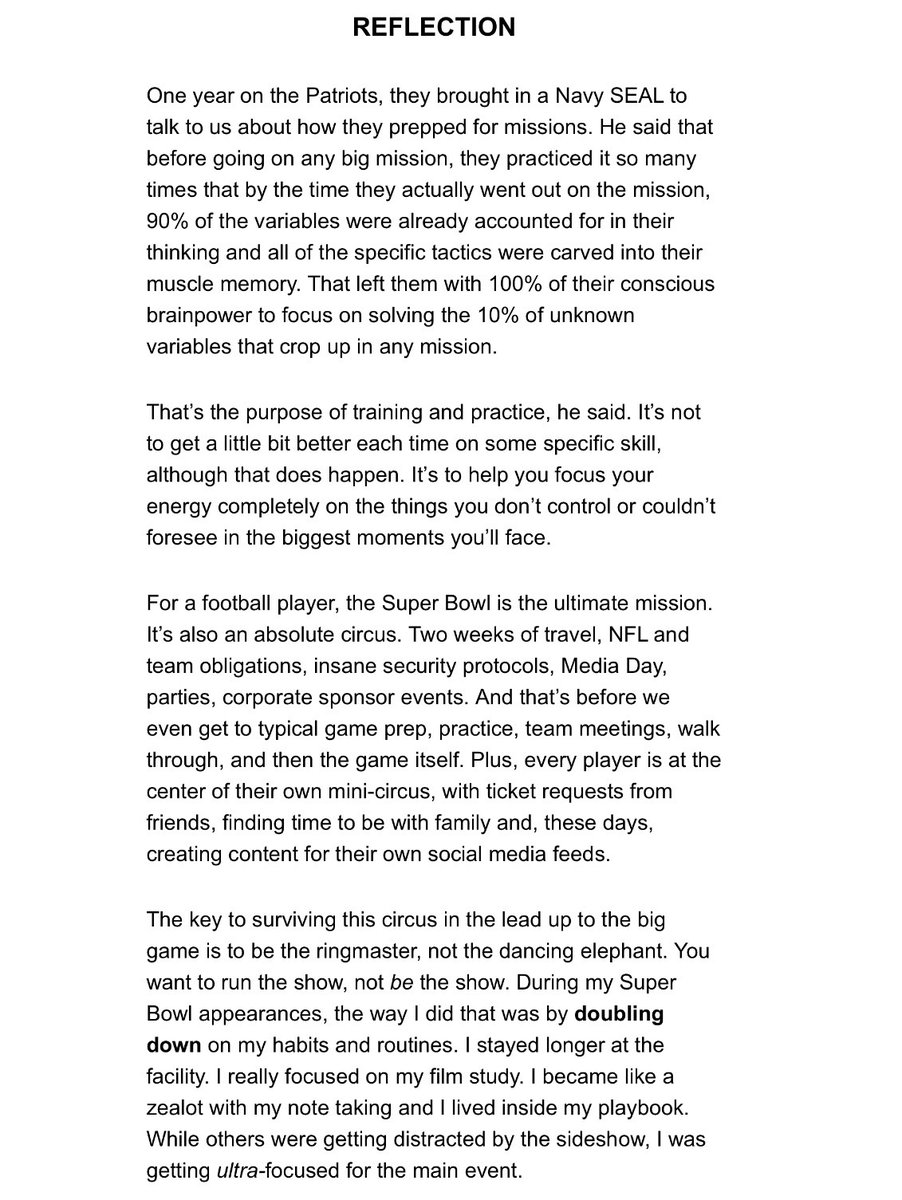
Fantastic parallel between Brady’s Super Bowl prep and trading.
Obsession over playbook, studying tape, making reps feel automatic so that you can focus on the unknown.
Full read: ckarchive.com/b/4zuvhehpv569…
English
@L2WTrades Scalping gets a lot of hate. Positives include being able to get your trading done in bite-sized sessions and high predictability (and one could argue there is more dopamine in the constant anticipation of swing trades playing out)
English
"I can't trade higher timeframes, they're too slow"
translation: your dopamine system is fried
you're not a "scalper by nature"
you're addicted to screen action
the 1-minute chart isn't your edge
it's your drug of choice
I used to be the same
would open a 4H chart
5 minutes later: back to the 1m
"just checking"
that's not analysis
that's compulsion
the fix:
delete 1m from your platform (not joking)
trade on 5m/3m minimum for 30 days
limit yourself to 2 trades per day maximum
first 2 weeks will feel like withdrawal
because it IS withdrawal
you're detoxing from cheap dopamine
the other side?
better entries bigger winners less stress actual profit
your "scalping personality" is a symptom
not an identity
English
@TheOneLanceB There's also minimizing 'career risk' for those of us holding down full-time jobs while also trading, i.e. explicitly pursuing a stable/less risky job while shifting your risk toward your side hustle, i.e. trading.
People ask me all the time why I'm not 'leveling up'...I chuckle
English
Hormozi's advice to traders on minimizing lifestyle risk:

English
@TheShortSniper Another way to remedy the high win % dilemma is to practively seek quiet periods of low trading activity when winning non-stop, I.e. take a breather when on a hot streak. I find that the biggest losses are often caused by simply becoming comically careless after X # of wins.
English
Most reactions to a big loss are: “Just set a max loss.”
That sounds clean. It isn’t that clean for very high win-rate systems.
To be clear upfront: I’m not saying Madaz martingales or constantly fights trades. Most of the time he wins cleanly. What follows applies only to a small % of trades where more active management is needed.
A ~95%+ win rate is extremely rare. But mathematically, maintaining a win rate that high almost guarantees rare but outsized losses. You’re compressing red days into tail events instead of spreading them out.
Everyone hates losing. But frequent, controlled losses actually train you — you get comfortable with red days and accept them as part of the business. Ironically, a very high win rate removes that training.
When you’re used to winning almost every day, a loss doesn’t just hurt P&L — it feels wrong. That sting makes it harder to walk away and easier to fight back when a trade goes offside.
Most of the time, that fight still works. But in the small % of cases where it doesn’t, losses can grow fast. That’s where the big drawdowns come from — and also why the win rate stays so high in the first place.
A hard max loss would reduce blow-up risk, but it would also create many more red days, because you’re forced out mid-process on trades that historically resolve green. That directly conflicts with a high win-rate model.
Same with sizing down. Smaller size limits damage, but it also weakens recovery. One of the reasons high win rates persist is the ability to recover efficiently when a trade doesn’t work immediately. Another tradeoff.
The real question isn’t “how do you eliminate losses?”
It’s “how much prior profit can one loss give back and still be sustainable?”
Wiping out weeks or months is part of the math.
Wiping out nearly a year is not sustainable.
This isn’t a criticism of Madaz. It’s an honest look at the math and psychology behind high win-rate trading — and the costs that come with it.
What do you guys think ?
madaz@madaznfootballr
P/L: -$298.9K😰 Absolutely REKT for the worst BLOW UP since $AIFF last year. A circus full of errors today lead to this. Broke my rule of trading during lull for the first time in months and pushed way more size than usual after seeing $SXTC looked like it was going to liquidate and went heavy on pops and instantly was forced to regret it. Could have stopped out too to take a smaller blow up but got caught in the halt and of course as insult to injury covered at the top just to see it drop all the way back down afterwards. Couldn't have played it any worse. Real fuckin' shitty but totally my fault. $ACON $FLYX $MNTS participation trophies.
English

@therealzakir Billionaire*
If you’re gonna make a joke -
check your spelling , you noob.
English
@systematicls Some realized this early on, really lived (and found like-minded souls who matched their energy), and sit back not having to really eat those last few pieces of candy with a desperate intensity described here.
Funny how 'investments' of all sorts work that way...
English

Life is really, really short, my friends.
You have a FINITE number of weeks. Some of us are already past the halfway mark. The lucky ones are one third through.
Do not waste time meandering about doing stupid things, arguing with narrow minded people, or debating yourself on whether to dare greatly.
DO IT.
LIVE.
yo gappy gappy!@yogappygappy
Second life
English
Just as 20% of your winners can account for 80% of your gains, the same or worse asymmetry can be said of your losers.
Don't let outsized losers re-define your PnL...eliminate these and prosper in 2026.
Not a new year's resolution, but a concrete plan to just take losses!!
English
@Trader_Dante Working 9-5 to add abstract value to shareholders is my preferred gig. However, to be part of this priveleged vocation, you have to give up a lucrative career in adding zero to negative value to the system and translating that to corporate ladder ascention.
English

Why work a 9-5 just to make someone else rich? Instead, you could be sitting on your own staring at the market all day, risking your own money with no guarantee of making any, with no health care and no pension plan. It’s cool. I love it so much. Cheers.
English

@systematicls Excellent piece. I would also argue that the Great Financial Crisis amplified the cracks in the social contract.
Web2.0 helped some young people buck the trend, but GenZ is now facing the realities of us being a primarily Service economy that serves those with existing assets
English