
Philippe Rola

22.8K posts

Philippe Rola banner
Philippe Rola

Philippe Rola

@ThinkingCC

#zentensivist, EMCrit Teammate, Proud daddy and husband. BJJ🟪. ICU Santa Cabrini Hospital.

Montreal, Canada Katılım Ağustos 2013
1.1K Takip Edilen11.6K Takipçiler
Philippe Rola
Philippe Rola@ThinkingCC·
Ergo, always check your interfaces in shock.
Dr. Chacón-Lozsán F .'.@franciscojlk

#ACVC 2026: Mixed shock: the reality behind cardiogenic shock An outstanding session by Dr. David Morrow. Morrow highlighting a critical and often under-recognized concept: 👉 Pure cardiogenic shock is rare. Mixed shock is common. 🔍 Key messages: SVR is not always elevated in cardiogenic shock → Wide variability, often with vasoplegia (SIRS component) Mixed shock = low CO + inappropriately low SVR → A combination of cardiac failure + vasodilatory physiology 📊 Epidemiology (SHARC data): .Cardiogenic shock (isolated): ~65% .Mixed shock: ~17% .Mortality highest in mixed shock (~48%) 🧠 Common phenotypes: -Cardiogenic shock → secondary vasoplegia -Cardiac arrest → stunned myocardium + vasodilation -Sepsis + cardiac dysfunction -Toxic cardiomyopathy (e.g., Ca-blockers, BBs) -Post-cardiotomy vasoplegia ⚙️ Pathophysiology: Inflammation (SIRS) plays a central role Microcirculatory dysfunction + iNOS activation Loss of vascular tone despite vasopressors ⚠️ Clinical implication: 👉 Hemodynamics must be interpreted dynamically, not assumed 👉 SVR ≠ always high → avoid “one-size-fits-all” approach 🛠️ Management principles: Phenotype-guided therapy Combine: Vasopressors (norepinephrine first-line) Inotropes when needed Careful fluid strategy Consider: .Methylene blue / hydroxocobalamin in refractory vasoplegia .CIRCI (steroids) in selected patients 📌 Take-home message: Cardiogenic shock is not purely cardiac. Recognizing the vasoplegic component is key to survival. #ACVC26 #CardiogenicShock #MixedShock #CriticalCare #Hemodynamics #ShockManagement


English
0
2
12
1.6K
Haney Mallemat
Haney Mallemat@CriticalCareNow·
Driving pressure is simple! • It’s not just for research. • It’s your daily bedside "fit check." • Anatomical size ≠ Functional lung volume. Stop being an ARDSNet robot. Use physiology to guide your volume. Comment to discuss.
English
3
6
17
1.7K
Guilherme Teló
Guilherme Teló@guilhermehtelo·
🚨 Just published! We validated an ultrasound-based score combining VExUS + LUS to guide decongestion in acute heart failure. A step forward toward more precise, ultrasound-driven management. Proud of our team! Congrats Henrique! onlinelibrary.wiley.com/doi/epdf/10.10…
Guilherme Teló tweet media
English
6
58
175
8.2K
Philippe Rola
Philippe Rola@ThinkingCC·
@Patrickdery Au monde oui, certainement. En Amerique du Nord, pas vraiment. Dans la moyenne. Bien moins qu’aux USA comme on est les plus taxes. Prefere-t-on que le QC ne soit aucunement competitif? Oubliez pas , pas de retraite payee.
Français
1
0
2
156
Patrick Déry
Patrick Déry@Patrickdery·
Les médecins spécialistes du Québec sont parmi les mieux payés au monde. Un médecin spécialiste gagne 445 611 $ par an, en moyenne. Leur syndicat trouve que ça n’est pas encore assez et demande une hausse de 14,5 % sur cinq ans. On devrait mettre l’argent ailleurs. Et les spécialistes devraient le dire à leur fédération. Mon texte ⬇️ avezvousvotepourca.substack.com/p/les-medecins…
Patrick Déry tweet media
Français
12
9
29
3.4K
Philippe Rola retweetledi
Dr. Chacón-Lozsán F .'.
Dr. Chacón-Lozsán F .'.@franciscojlk·
🫀 Rethinking shock: why MAP is not enough. One of the most persistent paradoxes in critical care is the patient with “adequate” mean arterial pressure (MAP) but ongoing tissue hypoperfusion. This review provides a compelling physiological explanation: arteriolar collapse and haemodynamic incoherence. Key concept: Critical Closing Pressure (CCP) is not a continuous downstream pressure, but a threshold phenomenon. When vascular tone exceeds intraluminal pressure, vessels collapse—interrupting flow regardless of upstream pressure. Implications: • Perfusion becomes heterogeneous across vascular beds • Macro-hemodynamic targets (MAP, SVR) may appear normal • Microcirculatory flow remains impaired Why this matters clinically: • MAP-centered resuscitation may fail • “Normal numbers” can be misleading • Shock should be understood as a failure of flow distribution and vascular recruitment Therapeutic perspective: The goal is not simply to increase pressure, but to: • Reduce excessive vasoconstriction • Relieve external vascular compression • Improve effective arterial inflow 🤓My perspective: This work reinforces a critical transition in ICU medicine: → From pressure-based resuscitation → To physiology-guided perfusion management When combined with concepts like microcirculatory coherence and precision medicine, this provides a more complete framework for understanding shock. 📄 Miller et al. Journal of Personalized Medicine (2026) DOI: 10.3390/jpm16020078 #CriticalCare #Hemodynamics #Shock #Microcirculation #IntensiveCare #PrecisionMedicine #ClinicalResearch #MedicalEducation
Dr. Chacón-Lozsán F .'. tweet media
English
0
39
145
5.7K
Philippe Rola
Philippe Rola@ThinkingCC·
Dr. Chacón-Lozsán F .'.@franciscojlk

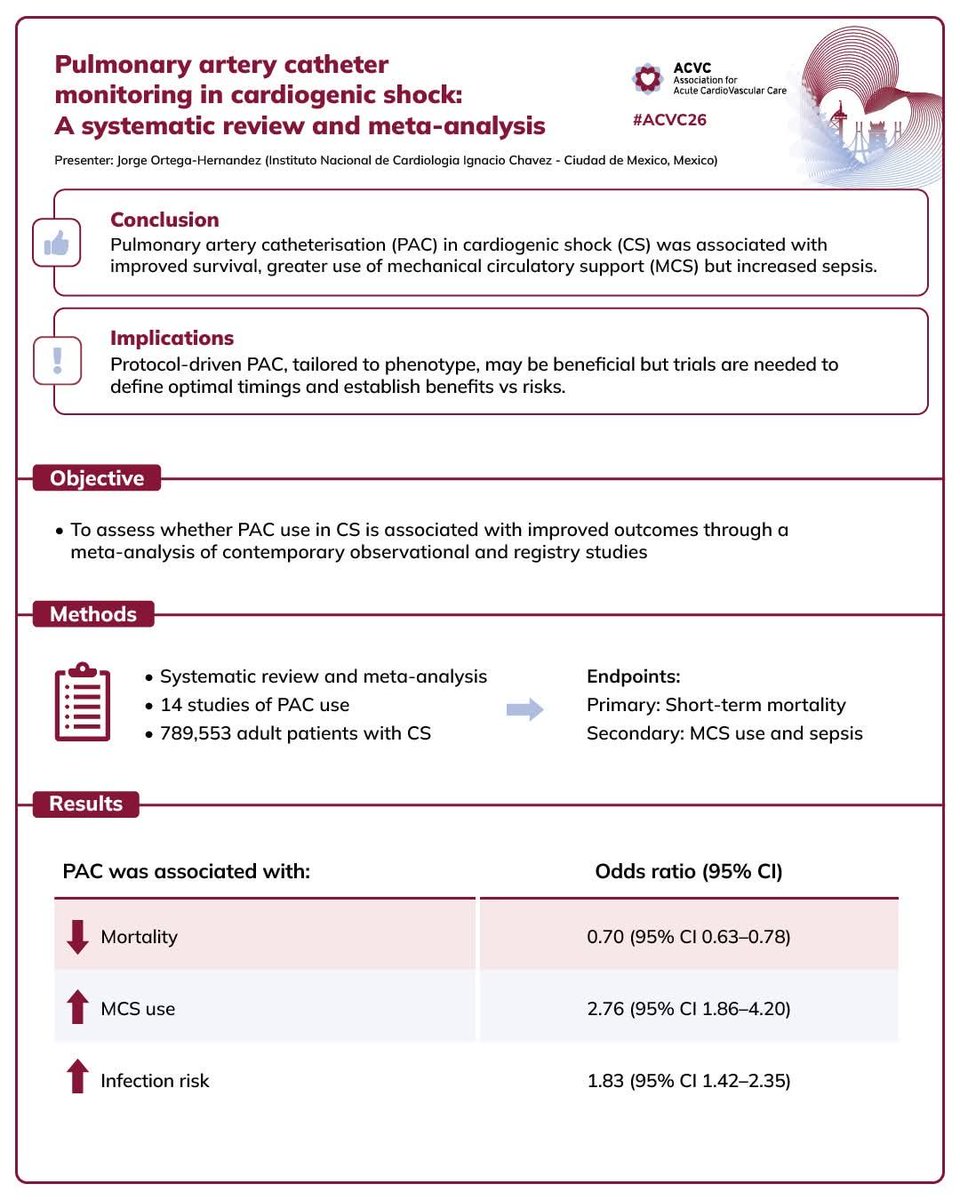
Pulmonary artery catheter in cardiogenic shock: back in the game? #ACVC26. A large meta-analysis (14 studies, ~790k patients) suggests that PAC-guided management in cardiogenic shock is associated with: ✔️ ↓ Mortality (OR 0.70) ✔️ ↑ Use of mechanical circulatory support (OR 2.76) ⚠️ ↑ Infection/sepsis risk (OR 1.83). 🧠 Clinical perspective This is not just about monitoring, it’s about decision-making. PAC may: • Improve hemodynamic phenotyping • Enable earlier and more appropriate MCS escalation • Shift care from reactive → protocol-driven precision management BUT: ⚠️ Observational data → strong risk of selection bias ⚠️ Benefit likely depends on center expertise & structured protocols ⚠️ Signal of increased infections cannot be ignored. 📌 Take-home PAC is not obsolete—it is underutilized and misunderstood. The future is not “PAC vs no PAC”, but: 👉 Who, when, and how to use PAC in cardiogenic shock Randomized trials are urgently needed. #CardiogenicShock #Hemodynamics #CriticalCare #Cardiology #MCS #ACVC

QME
1
9
25
2.4K
Dr. Chacón-Lozsán F .'.
Dr. Chacón-Lozsán F .'.@franciscojlk·
Pulmonary artery catheter in cardiogenic shock: back in the game? #ACVC26. A large meta-analysis (14 studies, ~790k patients) suggests that PAC-guided management in cardiogenic shock is associated with: ✔️ ↓ Mortality (OR 0.70) ✔️ ↑ Use of mechanical circulatory support (OR 2.76) ⚠️ ↑ Infection/sepsis risk (OR 1.83). 🧠 Clinical perspective This is not just about monitoring, it’s about decision-making. PAC may: • Improve hemodynamic phenotyping • Enable earlier and more appropriate MCS escalation • Shift care from reactive → protocol-driven precision management BUT: ⚠️ Observational data → strong risk of selection bias ⚠️ Benefit likely depends on center expertise & structured protocols ⚠️ Signal of increased infections cannot be ignored. 📌 Take-home PAC is not obsolete—it is underutilized and misunderstood. The future is not “PAC vs no PAC”, but: 👉 Who, when, and how to use PAC in cardiogenic shock Randomized trials are urgently needed. #CardiogenicShock #Hemodynamics #CriticalCare #Cardiology #MCS #ACVC
Dr. Chacón-Lozsán F .'. tweet media
English
2
9
36
5.4K
Riley Donovan
Riley Donovan@valdombre·
Quebec Immigration Minister defends the province's latest immigration cut: "We don't aim to become India, we aim to become Switzerland...It's better to be 9 million rich Quebecers than 15 million poor Quebecers"
Riley Donovan tweet media
English
220
850
8.6K
493.3K
Philippe Rola
Philippe Rola@ThinkingCC·
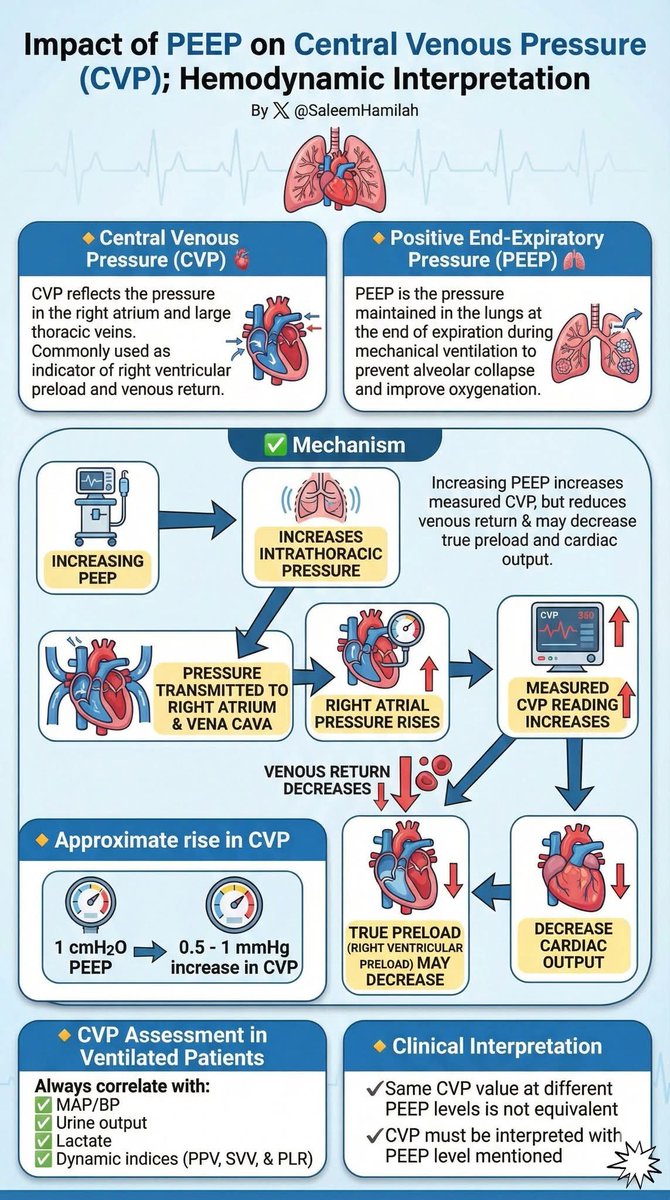
@SaleemHamilah Secondly, your peep needs to be greater than your central Venous pressure in order to affect Venous return. And thirdly, if peep recruits atelectatic lung, pvr/rap may drop.
English
0
0
1
72
Philippe Rola
Philippe Rola@ThinkingCC·
@SaleemHamilah There’s an important concept missing here, you have an arrow between the intrapleural pressure directly to the right atrium that is mitigated by pulmonary compliance. If you have a stiff lungs, not a whole lot of that is transmitted. (1/x)
English
1
0
2
212
Giacomo De Luca
Giacomo De Luca@jackdeliuc·
Vasopressors in cardiogenic shock by Daniel De Backer: norepi is still the first choice, vasopressin can be considered in selected cases (es. arrhythmias) but be aware of the potential negative impact on cardiac output. #ISICEM #ISICEM26 #criticalcare
Giacomo De Luca tweet media
English
1
16
59
3.3K
Philippe Rola
Philippe Rola@ThinkingCC·
@nickmmark @Pipes_n_pumps Agree, it’s a completely nonsensical debate, a diagnostic tool doesn’t inherently treat anything. It’s the wizard not the wand. The only question one should have about a diagnostic tool is its accuracy.
English
0
2
14
3.3K
Philippe Rola
Philippe Rola@ThinkingCC·
@G2Disrupt @NephroP @TaweevatA But if you have a big LA, one would be using E/A to determine if LAP would still allow fluids? Am just not sure what clinical decision it would help with…but always happy to learn!
English
1
0
2
52
NephroPOCUS
NephroPOCUS@NephroP·
#Nephmadness #POCUS #Nephpearls The formula 👇provides a simplified linear estimate of left atrial pressure (LAP) in mmHg, but has moderate correlation at best with invasively measured pressures and significant limitations in specific patient populations. Specific clinical scenarios where E/e' is unreliable include: - Mitral annular calcification - distorts tissue Doppler measurements - Severe mitral regurgitation - alters E-wave velocity independent of LAP - Tachycardia and atrial fibrillation - beat-to-beat variability and absent A-waves - must average multiple beats - Constrictive pericarditis - dissociation between intracardiac and intramyocardial pressures - Hypertrophic cardiomyopathy - poor correlation with direct LA pressure - Advanced heart failure with reduced EF - no correlation with PCWP changes - Cardiac resynchronization therapy/ventricular dyssynchrony - regional wall motion abnormalities affect e' - Normal hearts - E/e' shows flat response to variable filling pressures
NephroPOCUS tweet media
English
2
19
61
4.7K
Philippe Rola
Philippe Rola@ThinkingCC·
@Pipes_n_pumps @NHSBartsHealth @CommsC4TS Absolutely agree. Especially since you can have RV/LV stunning with trauma itself or as a consequence of shock/arrest. If you have a physiological approach the PAC is tremendous. If you’re just looking at CO, don’t bother.
English
1
0
3
461
Chris Bishop
Chris Bishop@Pipes_n_pumps·
As part of the ‘Transform Trauma’ project our institution started placing PA catheters in severely shocked patients who presented to our major trauma service @NHSBartsHealth @CommsC4TS Although too few to glean hard mortality outcomes, probably a useful tool for advanced multimodal haemodynamic evaluation - particularly in the setting of mixed shock or shock of unknown phenotype, and to guide MCS candidacy decisions More work needed, but a promising start! #Trauma #PACatheter #Hemodynamics #ICU #ECLS #ECMO
Paul Rees@DrPaulRees

@escardio @ACVCPresident @Jorgeheartshock Interesting - probably relatively under-used in UK cardiology practice, especially when compared to the US...

English
5
3
10
2.9K