Christian Beaumont

124 posts

Christian Beaumont banner
Christian Beaumont

Christian Beaumont

@thisgodisbored

Valkyr Inference and Training with Realtime Guarantees + Matryoshka Hybrid Rendering Engine https://t.co/yDE2noBUPy

Katılım Aralık 2025
32 Takip Edilen7 Takipçiler
Alex Volkov
Alex Volkov@altryne·
Sama gets grilled on @Helion_Energy - Q: Do you own approximately 22.8 million shares of Helion Energy? A: "Yes." Q: Did you first invest in Helion Energy in 2015? A: "I've invested several times, but that was the first." Q: Are the founders of Helion Energy friends of yours? A: "Yes." Q: Are you aware that Helion has an agreement with Microsoft to provide them with energy in 2028? @sama A: Yes Q: You own somewhere between a quarter and a half of @Helion_Energy A: I own closer to a third of Helion Q: Your Helion shares were worth about $1.65 billion as of December 2025? A: "Yes." Q: You also hold warrants in Helion? A: "Yes." Q: In 2024, OpenAI signed a scaled deployment agreement with Helion as a roadmap for potential future power purchases? A: "Yeah, I want to be clear. OpenAI has never bought or received any power from Helion, but this was a way for us to have the opportunity to do that in the future." Q: You say you were recused from the deal on both sides and did not sign it? A: "I was recused from it on both sides. So I didn't sign it. I think OpenAI signed it."
Alex Volkov@altryne

Breaking: Sama on the stand Musk v. Altman "I was thinking of running for Governor at the time" Replying to the lawyer's question about Sama wanting to be president

English
4
1
20
16.7K
Christian Beaumont
Christian Beaumont@thisgodisbored·
@truebound @dioxuslabs Well it isn't as secure as safe is it? I'm not sure what is idiotic to realize that. Unsafe literally means turn off safety checks and within the block safety is the responsibility of the author. The semantics are pretty clear.
English
1
0
0
129
Christian Beaumont
Christian Beaumont@thisgodisbored·
@voird33r @ai_studioxyz @zack_overflow @cihanyayla Rust is only useful because of human fallibility. It offers nothing to machines with full horizon visibility. Think about it, the Borrow Checker itself is a primitive attempt at full program reasoning. But completely unnecessary when an author has the same view. Author => LLM
English
0
0
1
46
zack
zack@zack_overflow·
Unfortunately, I don't use Zig now. Every 1.5-5x human DX productivity boost from Zig features is eclipsed by the 100x boost from coding agents writing Rust: Allocator interface: This is my favorite Zig feature, you feel so galaxy brain using a specialized allocator to optimize a code path (e.g. arena, stack fallback etc). The problem in Rust used to be that there was no Allocator interface equivalent and if you wanted a Vec that used a custom allocator you literally had to copy+paste the std version and modify it to use it (this is what Bumpalo did, look at the source). For a long while now there has been an Allocator trait in nightly, and it seems to be good now. Because it is a trait it is static dispatch, vs Zig's which is based on a vtable. Unlike Zig there isn't a community-wide convention of designing data structures to be parametric based on the allocator, but AI changes the game and makes it trivially to copy paste code and change that. I find it works well enough for my use-case. Arbitrary bit width integers + packed structs: Another beloved Zig feature of mine. It makes it so easy to do DOD-style CPU cache optimizations and stuff like tagged pointers, NaN boxing, etc. and even made bitflags really easy to make. You could always do this in Rust or any systems programming language but it was really ugly/unergonomic. The least worst option was using some crate like bitfield/bitflags which both rely on proc macro magic to work. Now, with coding agents I literally do not care how annoying it is to write the code by hand. Comptime: This is Zig's flashiest feature, no other programming language except maybe for obscure dependent-types langs have compile time evaluation as nice as Zig's. I thought I would miss it a lot, but I actually don't. For me, 95% of comptime usage is to create Zig's version of generic data structures with parametric types. Rust has a better designed type system IMO (see next section). In the remaining 5% of cases, not having comptime sucks. The only reliable way to reach an equivalent is through codegen. I'm making a game right now, and I have hardcoded hitbox geometry data generated from a tool that I want to bake into a data structure. Without comptime, I have to get Claude to write a script that generates the Rust file. However, I don't find myself needing compile time evaluation that much anyway. Rust's type system: I think I'd rather trade having comptime for Rust's better-designed type system, especially for bounded polymorphism (traits/typeclasses). Trying to do the equivalent in Zig is a nightmare. Also, I think that Rust's type system allows you to enforce more variants and prevent coding agents from making common mistakes. In my game I use the euclid crate which essentially allows you to not mix up coordinate spaces (very common problem in graphics programming) by creating specialized types for each coordinate space (e.g. Point or Point) Not having to deal with memory issues: With coding agents allowing 100x more code to be written, this also means you need to scrutinize 100x more Zig code for memory issues. Without formal verification, the surface area of the search space to enumerate to find bugs is just so much larger now. With the magnitude of code being generated now, Rust is even more attractive. Rust's tradeoff was always that it hinders developer productivity especially if you are unfamiliar with borrow checker, but this simply does not matter with coding agents anymore. And if you do use unsafe in Rust there's tools like miri which you can have the coding agent run the code against to make sure it doesn't cause UB or isn't violating Rust's aliasing rules when it comes to unsafe. I still miss writing Zig and find it to be a great language but I like Rust more and coding agents work with better with it.
zack@zack_overflow

It's not a question anymore, most of Zig's best features were designed for human ergonomics, which matters less now All of Rust's best features came at the cost of added verbosity, which applies less to agents because they have superhuman working memory and never get tired

English
31
72
1.1K
176.5K
Christian Beaumont
Christian Beaumont@thisgodisbored·
@schteppe Rust is only useful because of human fallibility. It offers nothing to machines with full horizon visibility. Think about it, the Borrow Checker itself is a primitive attempt at full program reasoning. But completely unnecessary when an author has the same view. Author => LLM
English
0
1
1
319
Christian Beaumont
Christian Beaumont@thisgodisbored·
@voird33r @ai_studioxyz @zack_overflow @cihanyayla What do you mean don't play dumb. Marking something unsafe doesn't magically make them safer. Sure those markers give you points where attention can be focused, but network effects compound. You only have to miss one to take down the whole system. And that's the same in Zig.
English
2
0
0
43
Liam Castaigne 🔜 AC
@thisgodisbored @ai_studioxyz @zack_overflow @cihanyayla You know what unsafe means, don't play dumb. "Unsafe" doesn't mean "incorrect." There's nothing to sweep under the rug because the whole point of explicitly marking unsafe is to call attention to potential invariant violations that would otherwise be implicit in other languages.
English
1
0
0
22
Christian Beaumont
Christian Beaumont@thisgodisbored·
@kethcode @FUCORY @ProgenticEngine Right, the zealots spoiled it for me too years ago. The entire rewrite it in Rust crowd made me want to do anything else. Completely insufferable. It's interesting because ultimately they are obsessing over a problem that is about to disappear. Poof! At this point buffering.
English
0
0
0
15
fucory
fucory@FUCORY·
It’s more nuanced than this. One example where zig is just better is an evm - zigs pointers are typesafe against nullability unlike rust - the correct memory strategy is arena allocation. Something that is way easier in zig and rusts borrow checker is overkill - a good evm requires a lot of unsafe rust. Zig is better than unsafe rust
zack@zack_overflow

Unfortunately, I don't use Zig now. Every 1.5-5x human DX productivity boost from Zig features is eclipsed by the 100x boost from coding agents writing Rust: Allocator interface: This is my favorite Zig feature, you feel so galaxy brain using a specialized allocator to optimize a code path (e.g. arena, stack fallback etc). The problem in Rust used to be that there was no Allocator interface equivalent and if you wanted a Vec that used a custom allocator you literally had to copy+paste the std version and modify it to use it (this is what Bumpalo did, look at the source). For a long while now there has been an Allocator trait in nightly, and it seems to be good now. Because it is a trait it is static dispatch, vs Zig's which is based on a vtable. Unlike Zig there isn't a community-wide convention of designing data structures to be parametric based on the allocator, but AI changes the game and makes it trivially to copy paste code and change that. I find it works well enough for my use-case. Arbitrary bit width integers + packed structs: Another beloved Zig feature of mine. It makes it so easy to do DOD-style CPU cache optimizations and stuff like tagged pointers, NaN boxing, etc. and even made bitflags really easy to make. You could always do this in Rust or any systems programming language but it was really ugly/unergonomic. The least worst option was using some crate like bitfield/bitflags which both rely on proc macro magic to work. Now, with coding agents I literally do not care how annoying it is to write the code by hand. Comptime: This is Zig's flashiest feature, no other programming language except maybe for obscure dependent-types langs have compile time evaluation as nice as Zig's. I thought I would miss it a lot, but I actually don't. For me, 95% of comptime usage is to create Zig's version of generic data structures with parametric types. Rust has a better designed type system IMO (see next section). In the remaining 5% of cases, not having comptime sucks. The only reliable way to reach an equivalent is through codegen. I'm making a game right now, and I have hardcoded hitbox geometry data generated from a tool that I want to bake into a data structure. Without comptime, I have to get Claude to write a script that generates the Rust file. However, I don't find myself needing compile time evaluation that much anyway. Rust's type system: I think I'd rather trade having comptime for Rust's better-designed type system, especially for bounded polymorphism (traits/typeclasses). Trying to do the equivalent in Zig is a nightmare. Also, I think that Rust's type system allows you to enforce more variants and prevent coding agents from making common mistakes. In my game I use the euclid crate which essentially allows you to not mix up coordinate spaces (very common problem in graphics programming) by creating specialized types for each coordinate space (e.g. Point or Point) Not having to deal with memory issues: With coding agents allowing 100x more code to be written, this also means you need to scrutinize 100x more Zig code for memory issues. Without formal verification, the surface area of the search space to enumerate to find bugs is just so much larger now. With the magnitude of code being generated now, Rust is even more attractive. Rust's tradeoff was always that it hinders developer productivity especially if you are unfamiliar with borrow checker, but this simply does not matter with coding agents anymore. And if you do use unsafe in Rust there's tools like miri which you can have the coding agent run the code against to make sure it doesn't cause UB or isn't violating Rust's aliasing rules when it comes to unsafe. I still miss writing Zig and find it to be a great language but I like Rust more and coding agents work with better with it.

English
8
2
65
11.4K
Christian Beaumont
Christian Beaumont@thisgodisbored·
@ID_AA_Carmack Right, and it's interesting because as the technology costs and ease of implementation approach zero, all that will be left is taste. The human element. A million AAA games created in days, hours or minutes. The differentiator will be what you yourself bring to the table.
English
0
0
2
1.5K
John Carmack
John Carmack@ID_AA_Carmack·
My reply to someone considering starting a video game company: The distribution of possible rewards for starting a video game company are generally not very good today. The market is well served, and gaining a foothold requires strong execution on both business and product issues, along with a substantial amount of luck. Plan to burn through seven figures with a not-great chance of making it back. If you do go for it, some bits of advice: Identify your customers clearly before you start. Not just a broad community, but specific people, and imagine them as you make decisions. Initially, build the smallest, most concise game you can imagine anyone paying for. It will still take much longer than you expect. Once something exists, hill-climb the value. Hopefully you will have some elements that clearly bring joy to people, which you can magnify. There will inevitably be tons of things that people find confusing, frustrating, or just boring that you will need to fix.
English
228
464
5.6K
275.9K
Felipe O. Carvalho
Felipe O. Carvalho@_Felipe·
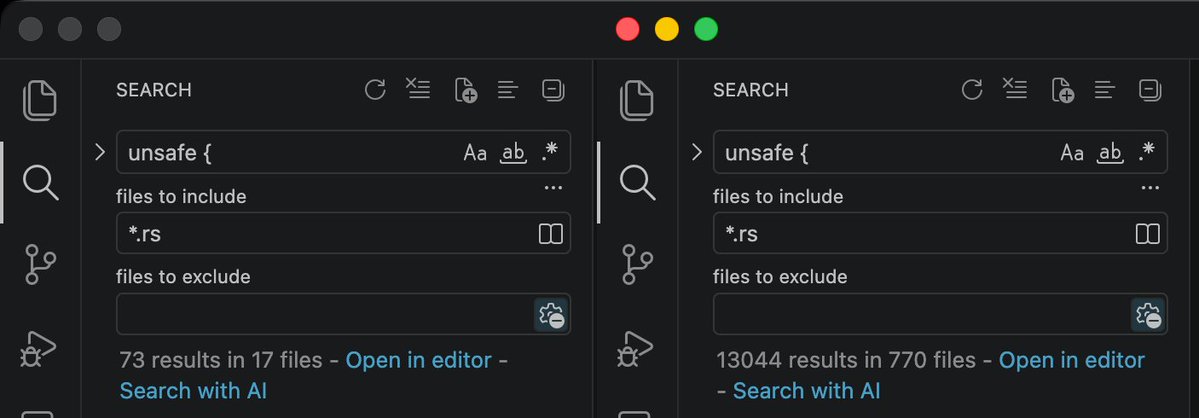
Counting `unsafe {` is a STUPID! It’s TRIVIAL to hide a bunch of unsafe blocks by wrapping lower-level unsafe code in “safe” fns. But that defeats the purpose of the annotation which is to propagate the idea that the caller and not the callee are responsible for enforcing safety
Felipe O. Carvalho tweet media
English
34
3
178
34K
Christian Beaumont
Christian Beaumont@thisgodisbored·
@FUCORY @ProgenticEngine @kethcode Thanks buddy. These people have no idea. What will really shock them is as these models continue to improve, the language of implementation itself becomes meaningless. They are starting to think holistically across the entire space as it is. Pushing Rust is so.. well you know
English
1
0
1
30
Christian Beaumont
Christian Beaumont@thisgodisbored·
@777Nikitf @zack_overflow @cihanyayla You are wrong. I have 120,000+ lines of Zig across multiple interconnected projects, and more being written by Opus 4.7 every day. In the last 200+ commits I have never seen a single segfault, compile error or memory leak. How is this "cope". Projection much?
English
1
0
0
48
Nikitf_777
Nikitf_777@777Nikitf·
@thisgodisbored @zack_overflow @cihanyayla "Claude writes beautiful Zig, as safe as real world Rust" – this is insane cope. Now go and compare the amount of issues mentioning segfaults in the bun repo and in the deno repo.
English
1
0
1
86
Christian Beaumont
Christian Beaumont@thisgodisbored·
@FUCORY @ProgenticEngine @kethcode You are wrong. I have 120,000+ lines of Zig across multiple interconnected projects, and more being written by Opus 4.7 every day. In the last 200+ commits I have never seen a single segfault, compile error or memory leak.
English
1
0
1
51
Theo - t3.gg
Theo - t3.gg@theo·
uv has 350k lines of Rust, and 73 "unsafe" calls. The Bun Rust port is already 681k lines of Rust, and has over 13,000 "unsafe" calls.

Theo - t3.gg tweet media
English
135
87
3.7K
617.4K
Proton
Proton@ProgenticEngine·
@kethcode @FUCORY Zig is optimizing for a 2010 open source world in a 2026 AI‑accelerated one.
English
1
0
0
77
Christian Beaumont
Christian Beaumont@thisgodisbored·
@zack_overflow @cihanyayla Claude writes beautiful Zig, as safe as real world Rust, especially with 13,000 unsafe code blocks. If people don't believe that then they haven't tried recently. Zig is faster to build It doesn't hide stuff Comptime is a massive productivity boost, even for AI Zig can interop
English
2
0
1
625
zack
zack@zack_overflow·
@cihanyayla I'd rather trade not having to deal with memory issues over the code being slightly easier to read
English
2
0
33
18K