Tim Peterson

9.6K posts

Tim Peterson banner
Tim Peterson

Tim Peterson

@timrpeterson

Programming, molecular biology @bioio_tech timrpeterson.eth @vita_dao

St Louis, MO Katılım Temmuz 2009
5.7K Takip Edilen4.1K Takipçiler
Sabitlenmiş Tweet
Tim Peterson
Tim Peterson@timrpeterson·
Evolution is the language model of biology. It’s tractable using cell fitness and genetics.
English
3
0
7
452
Tim Peterson
Tim Peterson@timrpeterson·
@LocasaleLab In fairness to them, you probably could have picked a better time to crap on the study like after everyone was done celebrating the win.
English
0
0
0
116
Tim Peterson
Tim Peterson@timrpeterson·
Most people dunking are doing ad hominems. They are right to celebrate the KRASi win, just as you are right to say progress could be better. You’re not attacking the person. You’re attacking the system. Can’t understand why it’s so hard for them not to troll as they likely agree with you that the system has serious flaws.
English
1
0
2
1.2K
Jason Locasale
Jason Locasale@LocasaleLab·
I care deeply about cancer research. I got into this field because cancer affected people around me, including my uncle who passed away from pancreatic cancer. For me, this has always been about combining a drive to understand biology with a desire to reduce human suffering. I want nothing more than for this drug to be successful. I hope the advances that stem from it meaningfully help patients. I hope pancreatic cancer follows a trajectory more like hematologic malignancies such as MM, CLL, CML where outcomes have improved substantially over time, and not what we’ve seen in many solid tumors like lung, colon, or melanoma. I would be very happy to be wrong. This drug also represents very interesting basic science. The originators of this work could very well be deserving of a Nobel Prize in Chemistry. My point is not to dismiss progress or the people working on it. It is to question whether the current trajectory is sufficient to achieve what should be the goal: large scale reductions in mortality. I genuinely hope this is the beginning of something much bigger.
Jason Locasale@LocasaleLab

Over 50,000 people in the U.S. die from pancreatic cancer every year. After this drug is approved and widely used, that number will remain essentially the same. In absolute terms, they are reporting a median survival shift of around six months. Yet we know resistance inevitably develops, as it does in all cancers subjected to drugs targeting mutations in the RAS/MAPK/PI3K pathway. If the goal is to meaningfully reduce cancer mortality, this does not move the needle. This is where decades of focus and billions in NIH/NCI funding have concentrated. National Cancer Institute is funded at roughly $9 billion per year, and a substantial portion of that budget is devoted to oncogenes and what is marketed as targeted therapies. This is then layered on top of a drug development and healthcare model where drugs like this can cost over $100,000 per patient. These are incremental gains at the late metastatic stage, where the biology is already stacked against you. Meanwhile, the two areas that actually determine population-level outcomes—early detection and prevention—remain neglected. If we are serious about reducing the number of people who die from pancreatic cancer, the priority cannot be continuing to optimize late-stage interventions that predictably yield temporary gains. The goal should be zero deaths. Right now, we are not on a path that gets us there. It is not surprising that this view is being met with backlash. Much of the criticism is coming from people whose incentives—academic , financial, or institutional—are tied to maintaining the current system in biomedical research and the biotech and pharma sectors that profit from it.

English
7
0
49
13.2K
Arc Institute
Arc Institute@arcinstitute·
mTOR inhibitors stop cancer cells from dividing, but they rarely kill them. New work in @MolecularCell from @LukeGilbertSF & lab reveals a mechanism connecting mTOR signaling, cholesterol biology, and ferroptosis that could turn growth arrest into cancer cell death.
Arc Institute tweet media
English
2
23
105
9.2K
Jason Kelly
Jason Kelly@jrkelly·
I don't I'm ever going to get tired of looking at @ginkgo's autonomous lab running a lot of different experiments at midnight. Let us help you kill the bench!
Jason Kelly tweet media
English
9
15
183
34.5K
Tim Peterson
Tim Peterson@timrpeterson·
@AlexanderKalian 🎯 Evolution is 10^40. Modern AI is 10^14. Its like a grain of sand vs all the sand on all the beaches on trillions of earths.
English
1
0
0
8
Dr Alexander D. Kalian
Dr Alexander D. Kalian@AlexanderKalian·
Here's one for the "AI will solve biology" crowd... I calculated an estimate for the minimum size of training data required, for AI to have any reasonable shot at "solving" drug discovery. (Not even wider biology - just AI drug discovery alone.) The results are terrifying... ~100 PB of data required. This alone needs a few data centres to store. ~1 trillion molecules in the dataset. Current open-source databases only have 123 million molecules, i.e. 0.012% of what is required. ~3.8 quadrillion bioactivity datapoints. Currently, the largest public database has 295 million bioactivities, i.e. 0.0000076% of what is required. And collecting this data would require... ~21,000 years of continuous research by 1,000 NCATS-style bio labs armed with high-throughput robotics. There are currently only ~100 labs of this calibre in the world. ~$3.8 quadrillion in research costs (not counting the building, set-up, or maintenance costs of the labs). For reference, McKinsey has estimated global pharma R&D expenditure to reach $350 billion by 2029. The research cost for gathering the data for AI to "solve drug discovery" is hence 11,000x higher than this. And even if in the future we build a huge global network of 1,000 giant fully automated bio labs, working 24/7 on this and with much higher efficiency, we can estimate ~10.6 years of non-stop work and ~$38.8 trillion in operational research costs (not counting lab set-up or maintenance). Whichever way you look at it, it currently requires vastly more money than the entire global economy is worth, as well as 21,000+ years of constant research work. I haven't outlined my math here (it is very long and technical, for another post) - but this is all subject to very generous assumptions. The true scale, time, and cost would likely be much much higher. In future, innovation may be able to lower this cost down into the ~$38.8 trillion range (i.e. "only" 1/3rd of the entire projected global economic output of 2026), plus 10+ years of continuous automated lab work. It's not feasible. And this is just for reasonably coming close to "solving" AI drug discovery for small druggable molecules. This is before we discuss other areas of pharmacology - such as nanoparticles, antibody therapies, and gene therapies. This is also before we discuss other topics in wider biology - such as synthetic biology, genomics, epigenetics, neuroscience, a rigorous solution to protein folding, nanorobotics, diagnostics, medical imaging, surgery, virology, parasitology, ecology, evolutionary biology, astrobiology etc.
English
18
4
35
14.4K
Tim Peterson
Tim Peterson@timrpeterson·
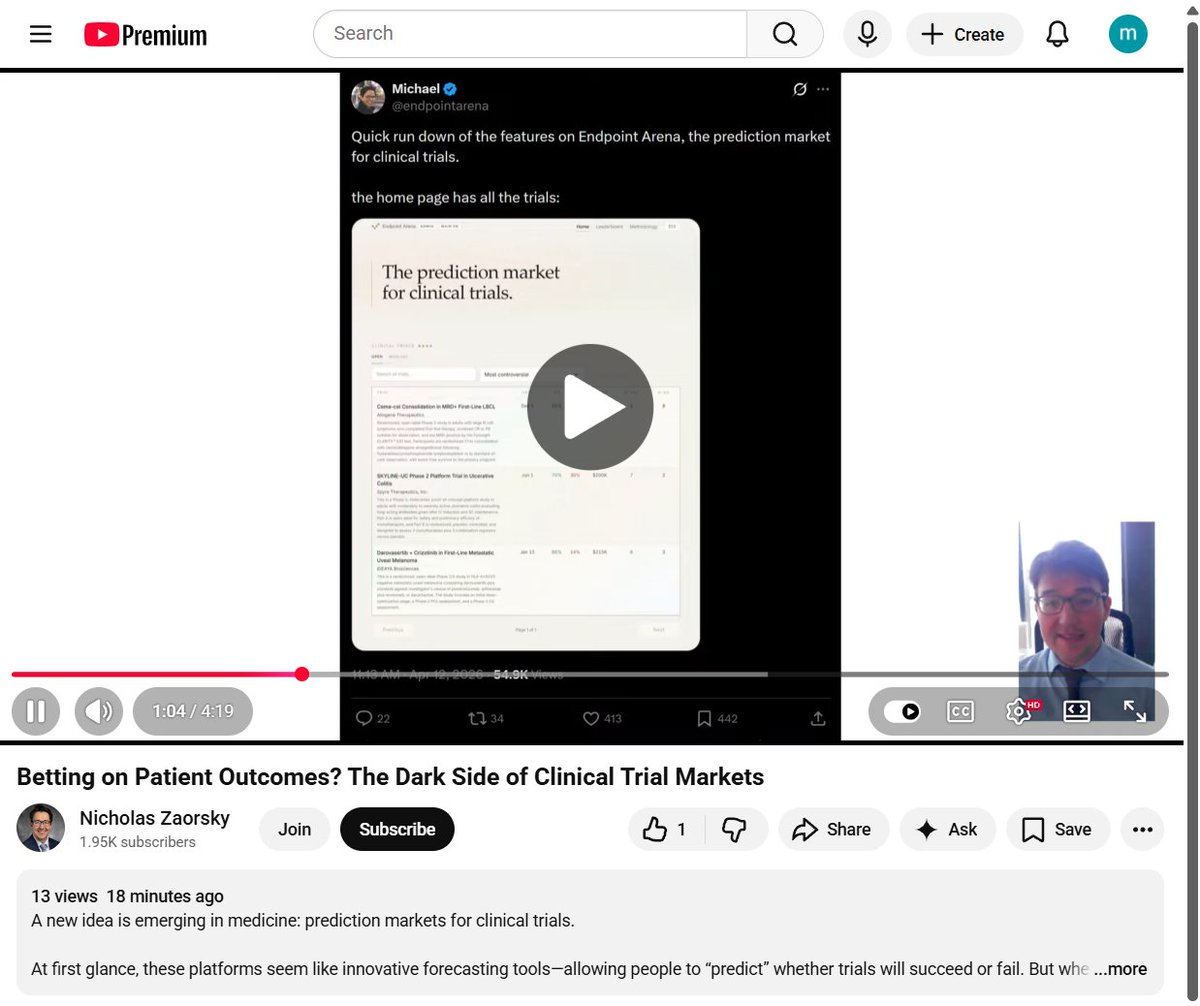
I’m moved by evidence that if a patient thinks a treatment will work, it is more likely it actually will. Lots of data on that. It’s my understanding currently a clinical trial patient has no idea what’s happening with other participants in the trial. However if there’s a prediction market with money behind it that the patients can see, I worry it will change their belief on whether the drug is working and thus actually affect the underlying biology. So I’m actually most concerned about screwing up whether we learn if the drug works or not.
English
1
0
4
468
Tim Peterson
Tim Peterson@timrpeterson·
@ShaneTuttleNCAA I can see college salaries flipping pro salaries because people care more about their college team
English
0
0
0
425
Shane Tuttle
Shane Tuttle@ShaneTuttleNCAA·
UConn G Braylon Mullins will hold the first ever “NIL Auction” to determine what his next team will be with the minimum bid starting at $6M. Mullins intends to return to college and wants to be with the team that is willing to pay him the most.
Shane Tuttle tweet media
English
852
242
3K
2M
Michael
Michael@endpointarena·
Quick run down of the features on Endpoint Arena, the prediction market for clinical trials. the home page has all the trials:
Michael tweet media
English
81
114
1.4K
550.4K
Tim Peterson retweetledi
Cooper Mitchell
Cooper Mitchell@homegymcoop·
Japanese gym equipment is extremely unconventional. Instead of training just hypertrophy, their machines often strengthen through mobility. They also have 5x the amount of centenarians than the US. I think they’re onto something.
English
292
642
8.1K
1M
Jeffrey Koury
Jeffrey Koury@jeffyfish9·
If you deposit $RSC onto @ResearchHub - you'll start earning yield to deploy towards funding research projects. Re-imagining how endowments operate!
ResearchHub Foundation@ResearchHubF

Something huge just landed at @ResearchHub. Introducing: Endowments. Starting today, everyone holding ResearchCoin (RSC) in their ResearchHub account will automatically earn high-yield Funding Credits, distributed daily. Funding Credits must be used to support projects on ResearchHub, turning your one-time investment into a continuous source of research funding.
English
4
4
16
1.4K
Melodies & Masterpieces
Melodies & Masterpieces@SVG__Collection·
Herbie Hancock turning ‘Cantaloupe Island’ into a groove you can’t escape.
English
24
565
2.8K
111.1K
tanay
tanay@tanaydesaii·
Scientific breakthroughs often come from “outsiders”, people too naive to respect the consensus. AI will empower a new generation of builders and citizen scientists to be this much needed outsider voice. It’ll completely disrupt the current paradigm of risk-averse, hyper-specialized consensus research designed for citations. Example: Opus 4.6 wrote me a 50-page biology textbook so I could build in a domain I had no formal training in ↓
Veera Rajagopal @doctorveera

Someone created an interesting LLM pipeline to map drugs to genetic evidence from public resource, inspired by my Works In Progress article on human genetics and drug discovery. I am yet to try this one myself, but the fact that someone outside the field got interested in genetics and went on to create this resource is the highest impact I can hope for my writing!

English
3
1
20
1.7K
Tim Peterson
Tim Peterson@timrpeterson·
Neurodegeneration and cancer are highly inversely correlated. We all have either prone to die or prone to survive genomes. I think the stat is cancer is 21x less likely in Alzheimer’s patients and vice versa. The general idea is to restore survival mechanisms in Alzheimer’s prone people. Easier said than done but mainly giving pro-cancer treatments would seem to help. Not joking.
English
0
0
0
77
Jacob Trefethen
Jacob Trefethen@JacobTref·
Why focus on Alzheimer's? It's a terrible disease, it is getting worse as populations age, and the complexity of the disease is a good fit for AI. Alzheimer’s affects not only the millions of people diagnosed, but their spouses, children, and other caregivers who support them. The disease places immense emotional and financial strain on families. Modern medicine has made more of a dent elsewhere... 🧵
The OpenAI Foundation@FoundationOAI

Alzheimer’s is one of the most devastating diseases, killing ~2 million people globally each year and costing over $1 trillion annually. It also remains one of the hardest unsolved problems in medicine. We believe advanced AI can help change that: openaifoundation.org/news/ai-for-al…

English
26
19
216
23K
Atlas Press
Atlas Press@realAtlasPress·
Potentially my favorite C.S. Lewis line of all time
Atlas Press tweet media
English
8
114
866
24.2K
Tim Peterson
Tim Peterson@timrpeterson·
YouTube is such rat poison for my kids. the correlation between time spent and subsequent abysmal behavior could not be more clear. Total ban is difficult but we’re getting close.
English
3
0
7
279
Tim Peterson
Tim Peterson@timrpeterson·
I fixed my sleep by stopping tracking it. Turns out this millennial old advice was right.
Tim Peterson tweet media
English
1
0
1
155