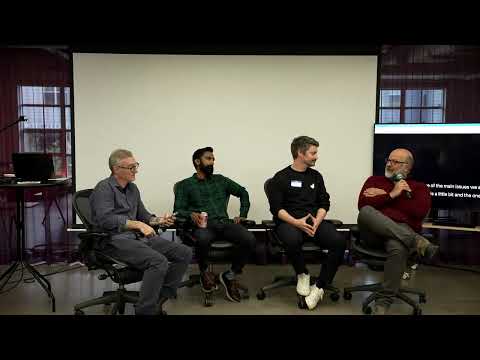
Come by and see @EvanGrenda at the AWS booth at GTC. @tavus video avatars, voice agents built with NVIDIA Nemotron models, and new realtime AI architecture patterns in @pipecat_ai!
Daily
2.3K posts

@trydaily
Build human and AI ultra low latency conversations. We maintain Pipecat with contributions from the developer community. https://t.co/tFy0gFjmb1 https://t.co/sLtBYxhhch

Come by and see @EvanGrenda at the AWS booth at GTC. @tavus video avatars, voice agents built with NVIDIA Nemotron models, and new realtime AI architecture patterns in @pipecat_ai!



Real-time transcription just got a significant upgrade. Universal-3-Pro is now available for streaming — bringing AssemblyAI's most accurate speech model to live audio for the first time. Developers building voice agents, live captioning tools, and real-time analytics pipelines now get three things they've been asking for: 🔹 Best-in-class word error and entity detection across streaming ASR benchmarks 🔹 Real-time speaker labels — know who said what, as it happens 🔹 Superior entity detection for names, places, orgs, and specialized terminology in real-time 🔹 Code-switching and global language coverage built-in

Voice workflows just got stronger with gpt-realtime-1.5 in the Realtime API. The model offers more reliable instruction following, tool calling, and multilingual accuracy. Demo with @charlierguo
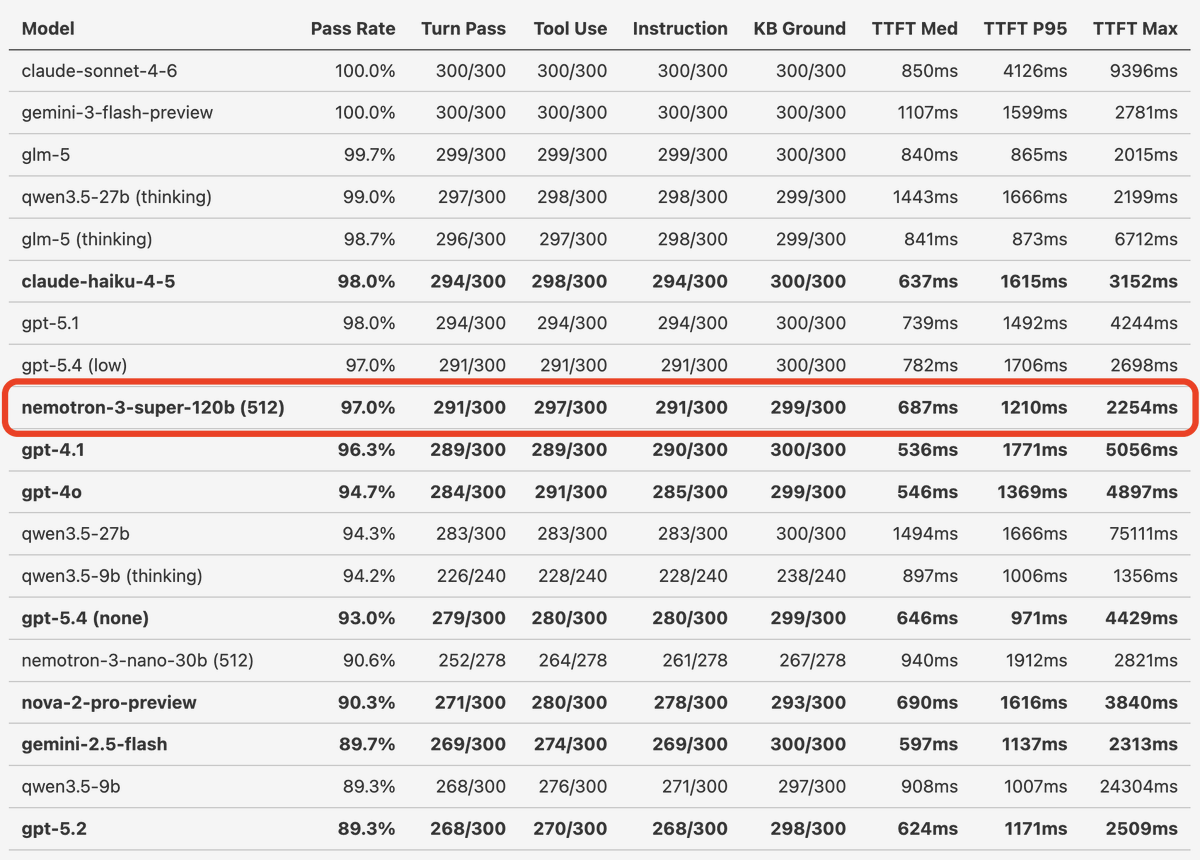
Claude Sonnet 4.6 scores 100%, with a median TTFT of 850ms, on our standard LLM Voice Agent performance benchmark. It's currently the fastest model that saturates this benchmark. I also re-ran the numbers for the whole leaderboard, and Claude Haiku 4.5 scored 98% with a TTFT of 637ms. This puts Haiku in front of GPT 5.1 in the rankings, and a bit better in "intelligence" than GPT 4.1, but 100ms slower. This is the first time we've had an Anthropic model that's a really good fit for most of our voice agent use cases. And now we have two! Claude models have always had great instruction following, tool calling, and conversational dynamics. But they've been slower than the other SOTA models. That's changed. One reason to re-run a benchmark like this is that latency changes. We continuously monitor latency for all the models we regularly use. But a specific run of a long-format benchmark like this is a bit different than our standard monitoring. Another reason, though, is that models like Claude, Gemini, and the GPT family are hosted systems and they evolve. A good rule of thumb is that changes in model behavior are probably your own code rather than real changes on the provider side. But that's not always true. And this performance jump for Claude Haiku 4.5 over the past two months is dramatic. I recently fixed some corner cases in tool call handling and improved the judging prompts in this benchmark. So I'll re-run Claude Haiku 4.5 against the benchmark code from 2 months ago, at some point, because I'd like to understand whether I previously had bugs that unfairly penalized Haiku. But either way, whether the model has gotten better or we've ironed out some issues with the benchmark, Haiku is impressive and is worth experimenting with if you are a voice AI developer.

Voice AI turn taking is a solved problem. The single most common complaint about voice AI, today, is that agents interrupt too often. But the voice agents I build for myself now respond quickly and interrupt me less often than the people I talk to every day. (I actually measured this.) @mark_backman made a @pipecat_ai PR two weeks ago that was the last piece of the puzzle for turn taking so good that I no longer ever think about it. The approach combines three layers of processing: 1. Voice activity detection, with a short (200ms) trigger. 2. A native audio turn detection model that's small, fast, and runs on CPU. This model captures audio nuances like inflection and filler sounds that don't get transcribed. 3. A prompt mixin for the conversation LLM that decides turn completion based on conversation context. None of these are new. We've been using VAD for a long time. We trained the first version of the Pipecat Smart Turn native audio model in December 2024. And we've been experimenting with prompt-based large model turn detection (sometimes called "selective refusal") for more than a year. Now, the Smart Turn model and the SOTA LLMs we're using in voice agents have both gotten so good that using them together feels like we've finally "solved" turn detection. Mark also figured out how to elegantly apply a "single-token tagging" technique to this problem. We sometimes use single-token tagging in place of tool calling, when we need a near-zero latency programmatic trigger. Mark's Pipecat mixin defines three single-token characters and prompts the LLM to output exactly one of them at the beginning of every response. - ✓ means the agent should respond normally (immediately) - ○ is a "short incomplete" - the agent should wait 5 seconds - ◐ is a "long incomplete" - the agent should wait 10 seconds The wait times, and the details of the prompt, are configurable, of course. Watch the video to see me talk to an agent that handles all my various pauses and inflections, plus phrases like "let me think," pretty much the way a person would handle them, in terms of response latency. Also, in the second half of the video, I ask the agent to adjust its response pattern because I'm going to tell it a phone number. This kind of "in-context" adjustment of response wait times is really useful. The LLM in the video is GTP-4.1. We've tested the prompt and single-token adherance with GPT-4.1, Gemini 2.5 Flash, Anthropic Claude Sonnet 4.5, and AWS Nova 2 Pro. Note that older models in all these families (and, in general, smaller open weights models) aren't able to reliably output these single-token tags. But the new models we're using these days are pretty amazing.


Drop 5/14: Introducing Bulbul V3, our latest text-to-speech model. It raises the bar for how human it sounds, while being super robust. In an independent third-party human listening study, Bulbul V3 delivers the highest listener preference, and low error rates across use-cases and languages. See details in our blog, but first watch the video. sarvam.ai/blogs/bulbul-v3


WeaveHacks is back! Jan 31-Feb 1 at W&B HQ in SF. This time we're building self-improving agents. We've seen @GeoffreyHuntley's Ralph and @Steve_Yegge's Gas Town push the boundaries of what agents can do. Now it's your turn to build what comes next. Details below. 👇