The Saint
17.2K posts


The admissions made in open court yesterday by Mr. Justice Brian Cregan have brought into sharp focus serious constitutional questions concerning the conduct of the Attorney General and the Chief State Solicitor’s Office. During proceedings, it was openly acknowledged that there existed a situation in which even individuals connected to proceedings were unaware of cases in which they had effectively become involved. That revelation raises profound concerns regarding how litigation involving the State bodies is being managed, supervised, and authorised. It points toward the operation of what appears to be an informal protocol within the Chief State Solicitor’s Office — a protocol that appears to exist outside the clear framework of constitutional and statutory law. Such conduct is incompatible with Article 30.1 of Bunreacht na hÉireann, which establishes the constitutional role and responsibilities of the Attorney General as adviser to the Government in matters of law and legal opinion. It also appears incompatible with Section 6 of the Ministers and Secretaries Act 1924, which requires governmental powers and functions to be exercised according to law and through properly constituted authority. Most significantly, these matters raise serious concerns under Article 11 of the Constitution of Ireland, which states: “All revenues of the State from whatever source arising shall, subject to such exception as may be provided by law, form one fund, and shall be appropriated for the purposes and in the manner and subject to the charges and liabilities determined and imposed by law.” If public monies are being expended through informal administrative arrangements that are neither expressly authorised by law nor constitutionally accountable, then fundamental constitutional safeguards surrounding the appropriation and use of State funds are being undermined. It will be extremely difficult now to put this issue back behind closed doors. The people of Ireland are becoming increasingly informed about constitutional law, about the limits of State authority, and about the obligations imposed upon all organs of government by the Constitution itself. There is growing concern among citizens that certain solicitors and barristers acting on behalf of the State have engaged in conduct designed not to uphold justice, but to obstruct, coerce, and suppress those seeking accountability and transparency. In a constitutional republic, the Government cannot lawfully enforce its will upon the people through informal systems of power. Government authority derives from the people and must be exercised only through the lawful and independent organs of State established under the Constitution. No office of State, no legal department, and no public official stands above the Constitution.


BRITISH BANKS DESTROYED THOUSANDS OF BUSINESSES Stephen Middleton (@stevemiddi1) has spent over a decade trying to expose one of the biggest financial scandals in UK history. Not as a victim. As a financial professional who refused to shut up. The fraud is called the Hidden Credit Line. Banks sold SMEs what looked like standard loans. Buried inside was a derivative, an interest rate swap, that secretly expanded the business's credit exposure without their knowledge. Thousands of companies thought they were borrowing money. They were actually handing the bank a hidden weapon to use against them. After the 2008 financial crash, RBS and Lloyds (@LloydsBank) were sitting on catastrophic losses caused by their own criminality and negligence. The solution, according to Middleton and his colleagues at BankConfidential (@BankConfidenti1)l: use these hidden credit lines to take down performing SME businesses, strip their assets, and quietly recapitalise the banks on the backs of people who had done nothing wrong. FCA (@TheFCA), HM Treasury (@hmtreasury) and the Bank of England (@bankofengland) all knew by 2009, when the Asset Protection Scheme was being set up. They said nothing. Middleton helped found the SME Alliance in 2014 to fight this. By 2017 he was being quietly pressured at a pub dinner in Cambridge to stop pushing for justice and start "working with the banks." He said no. Shortly after, his allies turned. The SMEA directors, he alleges with email evidence, coordinated with Lloyds COO Adrian White to get him removed from the cases he was working on and replaced with a law firm whose relationship with Lloyds was warm enough to earn them a bank-supported award nomination. The APPG on Banking (@APPGbanking), the parliamentary group set up to investigate the very frauds the banks committed, went on to collect hundreds of thousands of pounds from those same banks. Meanwhile, Middleton and BankConfidential's Mark Wright continued. Wright used around £60,000 of his own pension to fund the work. Neither made a profit. Both had their careers destroyed. FCA spent years trying to discredit them. In November 2025 they published the Hidden Credit Line report. In April 2026 it triggered a Westminster Hall debate led by John McDonnell (@johnmcdonnellMP), chair of the APPG on Investment Fraud and Fairer Financial Services. MPs called for a fully independent statutory inquiry into the scandal and the FCA's role in covering it up. The Transparency Task Force (@TransparencyTF) backed the disclosures. The FCA attacked the people making them. This is not a niche banking story. SMEs make up 50% of UK GDP. The institutions that were supposed to protect them protected the banks instead. Andrew Bailey, Nikhil Rathi, Sam Woods. All should be questioned on Hansard. No jail. No statutory inquiry. No justice. If you think Hillsborough was a cover-up, or infected blood was a scandal, this is bigger in financial terms. And the people responsible are still in post. Sources: @stevemiddi1, @BankConfidenti1, Hansard Westminster Hall debate 14 April 2026, @johnmcdonnellMP, @TransparencyTF, @TheFCA, @LloydsBank, @hmtreasury, moneymarketing.co.uk




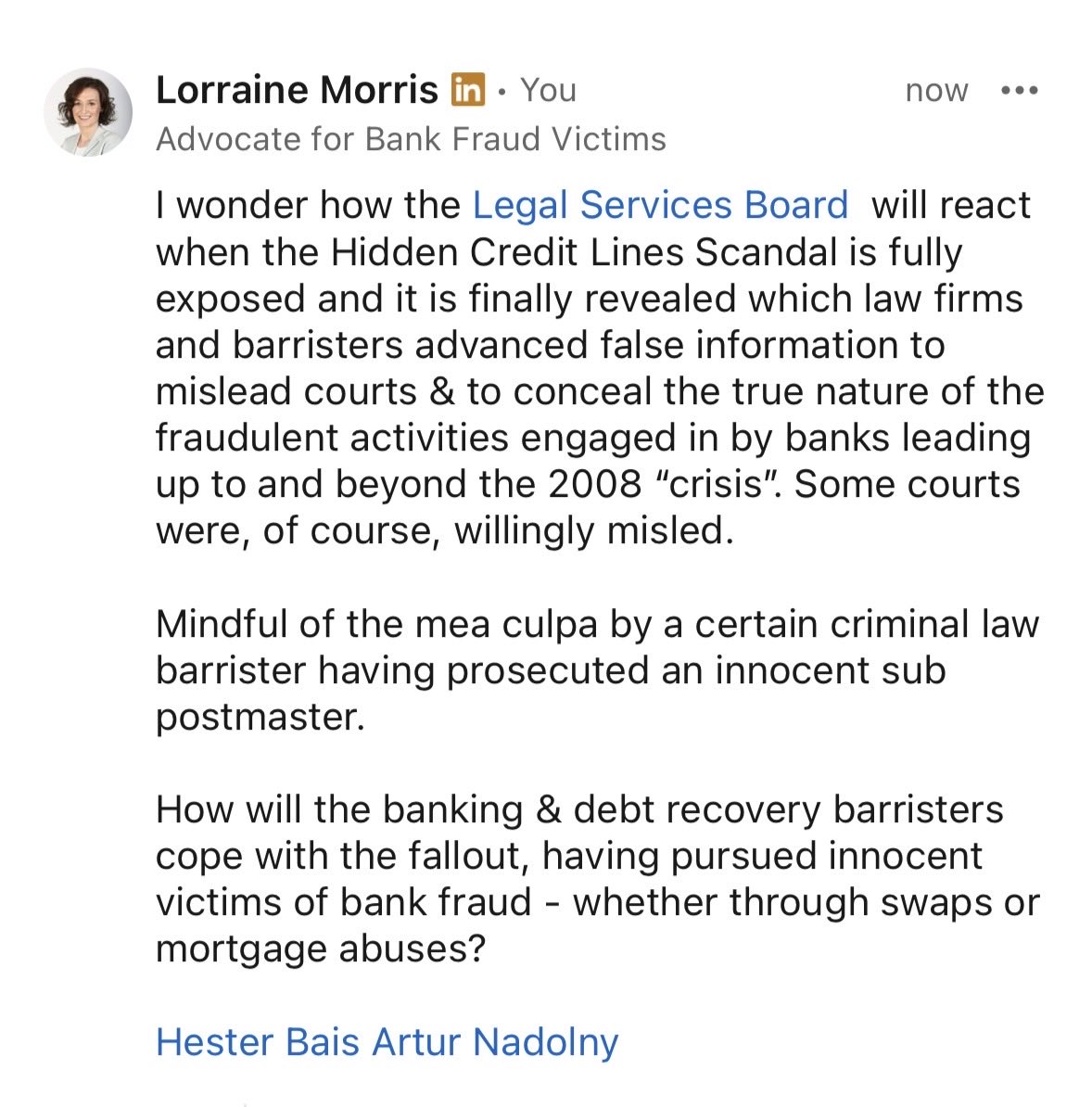


I think that's what many MPs are yet to realise, SMEs who were victims of the Hidden Credit Lines are still facing losing businesses & homes at present, whilst still owed substantial amounts of compensation. You cannot airbrush the undisclosed margin credit risk from derivatives in a derivative Review as @TheFCA did & then allow every bank to refuse consequential loss compensation because "the damage was not foreseeable". It was not only foreseeable, in many cases the harm was guaranteed & in most cases from 2008 on, the harm was intentional. The Hidden Credit Lines forcing Loan to Value breaches, leading to "management" fees in GRG & BSU & asset stripping via West Register or other means, was a pre-meditated asset grab, to hide the size of the balance sheet holes in @NatWestGroup & @LloydsBank that @TheFCA & @bankofengland dare not tell the public about. If they'd been honest & said it's not £42b to save @NatWestGroup & @LloydsBank but more like £400b, who would have agreed to that...? They would have had to nationalise them & the crimes, like the @UlsterBankNI & @LloydsBank FRL frauds would have been exposed. Bankers & likely Regulators would have faced criminal sentences, that might and still should happen now... @BankConfidenti1 @MLorrM @Wftproof @efgbricklayer @TransparencyTF @CarshaltonArt @james_glanville @mickmor16921994 @bleating_lamb

Rumours are swirling that Angela Rayner could replace Rachel Reeves as Chancellor. It would be one of the most extraordinary appointments in modern British politics. Rayner left school at 16, pregnant, with no qualifications. No university. No background in financial services. She later rebuilt her life studying part-time, learning British Sign Language, gaining an NVQ, and working her way into politics. Now she could be handed the keys to the UK economy. Supporters will call it a story of grit and resilience. Critics will ask whether experience matters when it comes to running the country’s finances. Which matters more — life experience or financial expertise?


🗣️ “For some reason, the carbon tax… has become the piñata in rural Ireland,” says @think_or_swim. #TonightVMTV