Brian Tubergen

377 posts

Brian Tubergen

Brian Tubergen

@tubergen

Co-founder of https://t.co/xi4pBjGDAR. Prev: Co-founder of @CoinList

Katılım Temmuz 2010
1K Takip Edilen1.5K Takipçiler
Sabitlenmiş Tweet
Brian Tubergen
Brian Tubergen@tubergen·
@hosseeb asks: Why is the crypto industry returning to token sales when it previously abandoned them? I co-founded CoinList. Here's my insider's perspective: Lawyers killed token sales. Specifically, lawyers told projects that airdrops were a safer and better alternative to token sales. This was arguably never true, and nowadays it's less true than ever. For context: CoinList ran token sales in full compliance with securities laws. But lawyers told projects: Even if your token sale is compliant, the sale will increase scrutiny on your project and increase the likelihood that you'll be investigated. Airdrops are a better alternative. Three things have changed: 1. Gary Gensler's SEC sued tons of projects that never ran token sales. Thus it no longer seems like a token sale meaningfully changes a project's risk profile. 2. Trump was elected. The US regulatory landscape is changing and projects expect the US government to be less hostile going forward. 3. Airdrops increasingly suck due to massive amounts of farming. Projects and users are unhappy with airdrops and looking for alternatives. The point is - the move away from token sales had little to do with the merits of token sales. It was a decision made by lawyers.
English
26
48
217
107.8K
bubble boi
bubble boi@bubbleboi·
God I can’t even ride in Ubers anymore and be comfortable it’s always like some Tesla Model Y goymobile where I’m in the back rocking and shaking like a watermelon in the back of a van in Karachi Pakistan. Why doesn’t anyone make soft suspensions anymore?
English
5
0
48
5.1K
Fede’s intern 🥊
Fede’s intern 🥊@fede_intern·
You gotta admit that the bullmarket was more fun. "Gen Z-er and digital native Rushi Manche was unafraid to take a calculated risk and focus on creating a blockchain ecosystem that enabled developers to build secure applications that interact seamlessly across different networks. Users can manage their digital assets without worrying about being hacked or encountering compatibility issues" "Rushi also launched a token, a cryptocurrency tied to his blockchain company."
Fede’s intern 🥊 tweet media
English
13
2
96
26.9K
Brian Tubergen retweetledi
Ante ⚙️
Ante ⚙️@AnteOrg·
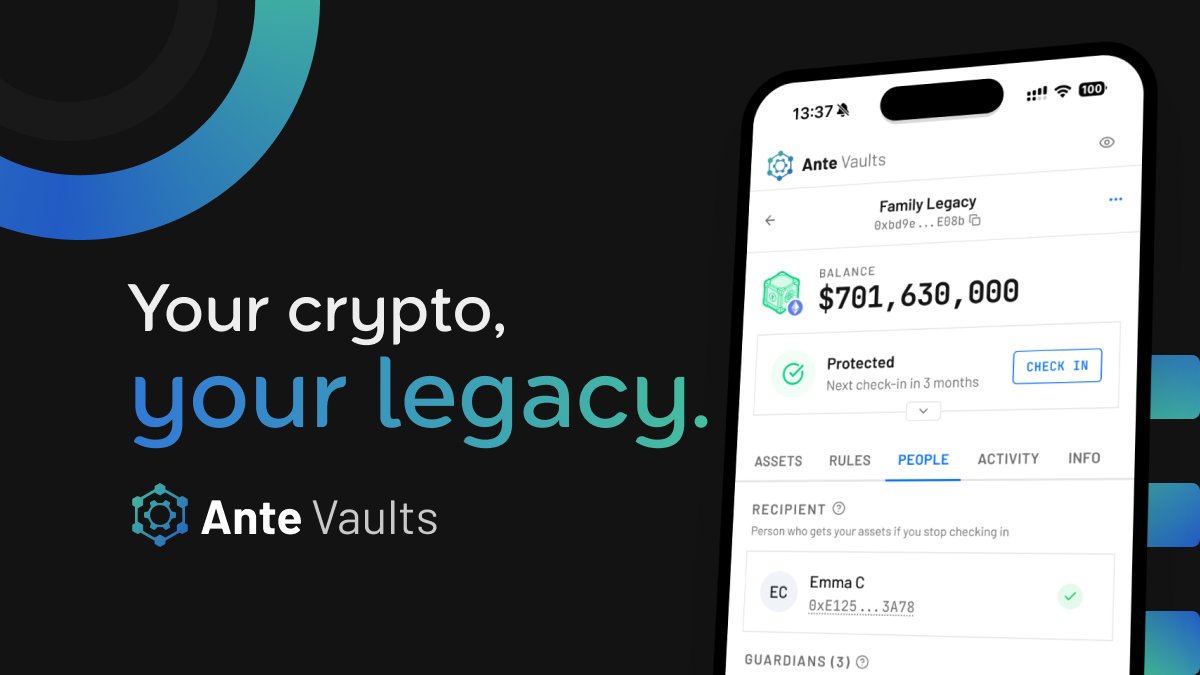
Billions of dollars in crypto are permanently locked. No recovery. No inheritance. Today we’re launching Ante Vaults, a self-custody vault with time-based social recovery, simple enough to manage from your phone. Now live on Ethereum + Base, no wallet required. 🧵
Ante ⚙️ tweet media
English
31
24
83
9K
Brian Tubergen retweetledi
nader.deso
nader.deso@nadertheory·
What it's like to be arrested on your way to a joyful family vacation... Around August of 2024 I was on my way to Turkey for a family vacation. I hadn't heard from the DOJ for a year at this point and my impression was that everything DOJ-related was fully resolved. I was going to Bodrum to introduce my young son to my wife's family (she is Turkish and they hadn't met him yet). I booked the flight two weeks in advance to boot. As I'm about to board the plane, three FBI agents intercept me, put handcuffs on me in front of me in front of my wife and my son (only eight months old at the time, thankfully) and walk me through LAX in handcuffs. The agents didn't even think twice about walking me in front of a crowd of what had to be a thousand people on my way to their car. Thankfully, they were at least helpful enough to reluctantly grant my request to put a jacket over my handcuffs, which prevented too many pictures from being taken. So why was I arrested when it seemed like the case was over and done with? Unbeknownst to me, the original prosecutor working my case quite possibly had determined that there was no wrongdoing, and was on his way out of the DOJ. However, instead of the file closing, it was instead handed off to a more junior prosecutor who got excited about it and thought I was "fleeing the country." Whether she actually thought that or she was using it as an excuse to arrest me and take my passport from me I'm not sure. But suffice it to say that if I booked a flight two weeks in advance I'd have to be the stupidest flight-risk ever... I spent the rest of the day in a jail before being transferred to an actual prison for two more days. Why so long? Because they arrested me on a Saturday morning and the court couldn't process my bail until Monday afternoon. Government inefficiency at its finest. The first thing I did when they let me out was hug my wife and son. At one point I was made to sit in the "visiting area," awaiting my lawyer, where I watched inmates sitting across from their family members, five feet away, no touching allowed. At one point a young child ran to quickly hug his dad and was reprimanded harshly by the warden. "Sir, this is your last warning. I would like to remind you that seeing your family is a privilege." Indeed, it really is. Now, almost two years later, the government decided "oopsie-daisy" and dismissed all charges, both DOJ and SEC, and the latter with prejudice. Sorry we put you in chains from your hands to your feet in front of your son and had people brutally tell you to "face the wall" every time you entered an elevator. Sorry we put you in a cage for three days with violent prisoners. These things happen. Oopsie-daisy. There's a lot more to this story that I look forward to talking about in full soon. It sounds horrible, but I was weirdly zen about the whole experience. Not only did I know I'd done nothing wrong, but the whole experience made me realize just how important what I was working on was to me. It made me realize that to be able to work on something that you're willing to fight for, to risk being put in a cage by the state for, is something very special that not many people have. I've meet a lot of people in crypto who feel this way, and I think this is one thing that's truly unique and inspiring about our industry.
English
23
11
74
4.1K
Brian Tubergen retweetledi
nader.deso
nader.deso@nadertheory·
Operation chokepoint was a 100% real effort to de-bank the crypto industry, and I experienced it first-hand. Nobody who actually experienced it talks about it because it's embarrassing to get de-banked, but I don't care anymore and the story needs to be told. I will tell you exactly how it worked, about a dark practice called "subpoena-sniping," and what made it so evil. In the past three years I have had over ten bank accounts and brokerages, and got kicked out of every single one except my last two, which I have been using for a while now. There was a day when both my main bank account AND my backup bank account were closed on the same day and I had to walk down a street full of banks in Beverly Hills just trying to get a new account opened so I could operate. The worst, by far, though, was Amex. They kicked me out and voided over 4 million points I never spent worth over $40k usd, which is why you should "always be dumping" your points (cc @stoolpresidente). But more on that later... The way de-banking works is this: People in the political administration, could be the president or uppity members of congress like Elizabeth Warren, decide that they don't like a particular person or a particular industry (crypto, marijuana, etc...). They could call the banks and tell them to stop banking that industry explicitly, but that's actually not even necessary. Instead, they can have a regulator like the SEC just start issuing subpoenas to everyone's bank who works in that industry. Much less work and much lighter-touch (low-level employees at the SEC can issue a subpoena without much paperwork). A bank's reaction to a subpoena from a federal agency is almost always to immediately shut down that person's bank account. With most banks that means you instantly can't log in, can't access your money, and, best of all, you have to wait for a snail-mail check to get your money, which you can't actually deposit because you don't have a bank account (the irony...). And did I mention the check takes a week to clear even after you've deposited it into your new bank? This is why I always have a main bank account and a "backup" bank account, always. Why a check, why not a wire transfer? It lets the banks sit on your money and earn interest on it for longer. Yes, that's actually the reason... But it gets even better: When you lose your bank account, they don't even tell you why it happened, they just stonewall you completely, even if you've been a customer for over a decade. My favorite experience with this was with a neobank where I actually knew the founder and HE couldn't even tell me why they debanked me because the decision was made by their partner bank, which wouldn't tell THEM the reason, so he didn't even know it. Insane! The way I found out about this practice was actually by talking to lawyers after things got serious with my SEC case. Apparently, the most common tactic when the SEC or DOJ go after someone is to try and de-bank them by throwing subpoenas at all of their financial institutions as fast as they can open them. We called it "subpoena-sniping" and it was such a well-known and disruptive practice that multiple law firms actually recommended I wire them a lot of money up-front to "keep it safe" so that I wouldn't lose my ability to pay them halfway through what we were doing. Luckily, only thanks to crypto, that wasn't necessary... My top advice for Amex customers in particular is to always be dumping your points. The reason is that a high points balance is viewed as a liability by Amex, and thus makes it more likely they'll randomly decide that your account is non-compliant, even without a subpoena (I learned this from lawyers as well). Put another way, accounts with a lot of points are "expensive" to Amex, and so they will look for any excuse to close them before you can cash them out. In my case that meant losing over 4 million points worth over $40k usd. The crazy thing is they took my points even though I lived in New York at the time, and even though NY literally passed a law and SUED Amex precisely to stop the practice of closing accounts to steal points. Just think about it for a minute: Enough people got mad at Amex for points-stealing that NY, a place where Amex has regulatory capture, passed a LAW to ban it (which I can confirm from first-hand experience they are completely ignoring). If that's not a sign you should always be dumping those points then I really don't know what is... To this day, Amex is the only financial institution that I actually lost money with. Even the sketchiest crypto exchanges I've used over the years never did something as greasy as what Amex did, let alone after being a customer for over a decade. Now for a list of some banks and brokerages that kicked me out, just to name and shame explicitly: Bank of America, Fidelity, Chase, Wells Fargo, Amex, First Republic (rest in peace), SVB (rest in peace), Webull, Mechanics Bank (got desperate lol), Bank of the Orient (also lol). In many cases I came in through a relationship, had a contact at the bank, and was happily banking for years, sometimes over a decade-- none of it mattered, I was out the second a subpoena came in, with zero explanation. Also funny story about SVB: By pure coincidence they debanked me ONE WEEK before they went insolvent-- you can't make this stuff up. There are also three neobanks that kicked me out but I know the founders, I like them, and it was the underlying partner bank's fault not their fault so I won't name them. Now, thankfully, it's all over and I can talk about these things. But the problem isn't actually resolved. Banks still auto-cancel your account when they get a government subpoena, the process still sucks for people when it happens, and every bank and brokerage that kicked me out in the past is still inaccessible to me. Even though "operation chokepoint" ended under Trump, everyone who was affected by it previously is still affected. One solution to this problem is new banks that are willing to stand up against this practice, and that's why I'm excited about things like Palmer Luckey's Erebhor and William Hockey's Column. But it only works if they make it a point to stand by their customers through thick and thin. I hope they will do this. Of course, we all know the ultimate solution, though: Crypto itself. The very thing that scared the politicians into de-banking us in the first place will be their eventual downfall. They can delay it but, thankfully, they can't stop it.
English
34
30
224
21K
Brian Tubergen retweetledi
nader.deso
nader.deso@nadertheory·
Big news! Last Friday the SEC officially dismissed its enforcement action against me and against DeSo. This was the last legal issue I had to deal with and I am now completely and totally free to innovate and build again, unhobbled for the first time in years. Three important points: 1) This dismissal was NOT a settlement. It was "without costs or fees" to me or anyone involved (extremely rare) because there was no wrongdoing and no actual aggrieved parties. 2) This dismissal was "with prejudice" (also rare). This means they can't bring any related action back against me or DeSo in the future. 3) In the SEC's own words, it was based on "a reassessment of the evidentiary record," meaning the actual facts regarding my innocence were heavily scrutinized and drove the decision. Simply put: The government made a mistake in bringing this case in the first place. The government accused me of misleading an investor who I knew I had a great relationship with, as in they backed me two separate times and I literally had breakfast with them at their house not long prior to the charge. As a result, soon after the charge I found out that not only were they not upset with me, but they wanted the government to go away as badly as I did. As I understand it, the government compelled the investor to do an interview and then took their neutral testimony and represented it as adversarial. It was an alleged fraud with no actual misrepresentation nor any actual aggrieved parties. My lawyers said they'd never seen anything like this, and I think it speaks to how dogmatically anti-crypto the prior administration's SEC was. In the coming days and weeks, I will be hopping on some podcasts to tell the whole story, and boy is there a story to tell. Stay tuned, and if you know anyone who'd like to have me on as a guest please reach out. I'm also excited to start sharing more about what my team has been working on soon. We haven't been twiddling our thumbs. For now, though, I just want to explain why DeSo is so important to me. DeSo is still the only platform on the internet where you can post content directly to a blockchain without fear of censorship, and where you can monetize your content directly with crypto (including stablecoins). It's really quite shocking how in 2026 we not only have virtually no viable alternative for this clearly-important category, but also other important efforts are actually shutting down. The world needs more people working on decentralizing social media, not less. I'm excited to finally be able to share our vision directly again, and to start bringing more people who care about freedom and censorship into our community. What we have built with DeSo is something people take for granted until they really need it, but hopefully we can convince them sooner than that. Lastly I want to say how grateful I am to everyone around me. My family, my friends, my backers, and everyone in the DeSo community. For me, this experience showed me just how trusting, loyal and caring everyone around me really is, and reaffirmed my belief that always trying to do the right thing really does pay off. We're just getting started.
nader.deso tweet media
English
57
46
199
49.9K
Brian Tubergen
Brian Tubergen@tubergen·
@brandon Insane amount of time spent trying to get a chao that looks like Sonic
English
0
0
2
79
Studholme
Studholme@StudholmeOne·
Since ECHO (@echodotxyz) was acquired by Coinbase > not shared a single post on X > All of their deals have been way over priced and not filled > No updates to their website There has to be a better way to fundraise onchain for Web2 and Web3 startups. We're filling the gap with @fairdotclub
English
13
4
45
4.5K
Alan Curtis
Alan Curtis@AlanJamesCurtis·
We hit 24,000 users in 24 hours after launching @inventmoneyapp 🤯 Here’s how we did it: 1. We listened and learned. I did countless X Spaces, AMAs, and talked to hundreds of you 1 on 1. I learned the problems Internet Earners are facing around the world. 2. We built what you asked for. The true story is that our roadmap came directly from these conversations - you wanted more ways to earn and build real wealth. So that’s what we’re building 🫡 3. We partnered with Creators. We partnered with 200+ world class Creators to help tell our story. My DMs are still open for new Creators 👀 4. We built a scalable and lucrative referral program. Most platforms want you to recruit your friends for free. We want you to earn now…and keep earning…for decades to come. 5. We got lucky with timing. Thrilled to be launching in a bear market. Bear markets are for builders and true believers. The InfoFi hype is fading. The meta is shifting - crypto wants real revenue, real ownership, real products. We couldn’t be luckier to launch into a market waiting for us. Our team is feeling proud, grateful, and inspired by the love from our community. @TheInventionNet is my life's work and watching our very first company launch with a bang like this is something I’ll never forget. Forever grateful to our earliest supporters ♥️ Now we put our heads back down. Competitions are next. Serve the customer. Turn the flywheel. Next stop: 100K users building wealth together. 💰
English
32
15
109
12.7K
vitalik.eth
vitalik.eth@VitalikButerin·
I'm actually pretty open-minded about the anti-data-center populism. From everything I've seen from people working on this, reducing industrial-scale hardware availability seems to be both the most practical, and most non-dystopian / non-invasive way to lengthen AGI timelines. So if the movement that makes that happen starts out with anti-data-center populism, that seems fine? Of course you have to do things other than going after data centers located in populated areas to really make a dent on AGI timelines (my intuition is that 10-100x compute reduction is feasible in a "static" model of the world, and 100-10000x if you compare to a counterfactual that includes future chip design progress; those numbers *would* make a dent), but there is a first step for everything.
English
601
146
1.7K
778.9K
blockgraze
blockgraze@blockgraze·
so true naval what branch did your kids enlist in?
English
145
515
15K
955.7K
Algod
Algod@AlgodTrading·
Vibes down so bad i’m forced to take a small break from hibernation to tell that best opportunities are when everyone is fearful Prices becoming attractive again, now is the time to become deeply involved with the projects you think having a future
English
182
86
1.5K
166.8K
Brian Tubergen
Brian Tubergen@tubergen·
Feels like you're strawmanning his argument He's not claiming that scams and regulation are the sole reason why crypto gaming and media failed His argument is that crypto gaming and media will emerge over time once financial apps bring more people onchain > The internet didn’t begin with social media, streaming, or online communities; it began with packet switching, TCP/IP, and basic connectivity. Only once hundreds of millions of people were online did entirely new cultural and economic categories emerge. > Crypto is likely no different. It’s plausible that we need hundreds of millions of people onchain through financial applications, such as payments, stablecoins, savings, and DeFi, before we see meaningful adoption in categories like media, gaming, AI, or other areas that may be further out. Many applications depend on wallets, identity, liquidity, and trust already being in place.
English
0
0
3
203
Haseeb >|<
Haseeb >|<@hosseeb·
With all due respect to Chris, I completely disagree with this take. Chris argues that "web3," particularly crypto-powered gaming and media, failed due to scams and regulation, and that better regulation will unlock these non-financial cases. OK, think about this for a second. Does this pass the smell test? Do you think web3 gaming failed because of Gary Gensler? Do you think web3 media plays failed because the scammers crowded out the honest media innovators? Really? If this is true, why didn't they kill financial crypto, which had WAY more of both? Financial use cases were right in the crosshairs of the regulatory harassment, and they also attracted way more scams. Why shouldn't we instead accept the more obvious answer: non-financial use cases for crypto have failed because no one wants them. Let's just admit it. They were bad products. They failed the market test. It was not Gensler or SBF or Terra that caused these things to fail, it was that no one wanted any of it. Pretending otherwise is cope. Enormous sums of capital and talent explored these ideas, and we should acknowledge what we learned. That lesson is not "if we just had better laws, then finally people would finally be using decentralized Spotify" or whatever. Call a spade a spade. Every single use case in crypto that has worked at scale has been financial in nature. 2008: Bitcoin - non-sovereign store of value 2014: Tether - stablecoins 2015: Ethereum - programmable money 2017: ICOs - capital formation 2018: Prediction markets (Augur, later Polymarket) 2020: DeFi - literally finance is in the name 2021: NFTs - non-fungible financial assets (to the extent they worked) 2024: RWAs (the year BUIDL took off) All this stuff was adopted bottoms-up. We as investors discovered that people wanted to do these things with crypto. The web3 consumer stuff, on the other hand, was primarily conjured up by investors and pitch decks, ZIRP accelerationism, and "wouldn't it be crazy if" blog posts. This was the opposite of the "what smart people are doing on their weekends" thesis. In fact, if you go back to the Ethereum white paper from 2014, almost every single Ethereum use case Vitalik describes is financial in nature: token issuance, stablecoins, derivatives, on-chain treasuries/DAOs, on-chain savings, insurance, price feeds, escrow, gambling, prediction markets. It's all in there. This is nothing to be ashamed of. Finance is almost 10% of GDP. It's an enormous part of the world economy, and banks are some of the lowest NPS score companies in the world. People hate their banks and the outdated financial architectures their money runs on. It's literally why Bitcoin was created. There is so much to innovate in the realm of finance, and I truly believe we are only at the beginning of that displacement. You don't need to assume anything more to project the next 10x in crypto. The old saying goes "crypto will do to finance what the Internet did to every other industry." I respect Chris's optimism. But 18 years in, we should not be propagating this meme about consumer web3 use cases as though they're inevitable. If you are hanging around the rim hoping that crypto is going to disrupt media and gaming, you should know the history and look at it with clear eyes. Now if you as a founder believe that despite that, you know the secret to cracking this market--I respect that, and I certainly don't begrudge anyone to follow their convictions. But I think it's important that investors be honest that all the evidence points the other way.
Chris Dixon@cdixon

x.com/i/article/2019…

English
304
81
1.3K
589.3K
Gwart
Gwart@GwartyGwart·
@0xdoug bitcoin, retard
English
5
0
166
6.3K
Doug Colkitt
Doug Colkitt@0xdoug·
So to recap, AI is expected to create huge amounts of wealth, yet… Workers lose because they’ll be replaced by robots… Software corps lose because they’ll be replaced by Claude code… Tech giants lose because all their free cash flow is now capex… Frontier labs lose because they get margin compressed by open source models that are at most three months behind… Nvidia loses because it gets margin compressed by TPUs and Huawei… So where exactly is the value supposed to accrue?
English
465
132
2.8K
340.6K