umwmbl

1.8K posts

umwmbl

umwmbl

@umwambali2

Katılım Kasım 2022
85 Takip Edilen24 Takipçiler
umwmbl
umwmbl@umwambali2·
@JosephRyarasa "critics argue that state owned enterprises can monopolize markets and limit private sector growth." So don't you think this contradicts the @RDBrwanda policy on calling for investors? Also what do you think will be the impact on jobs created already by Said investors?
English
0
0
0
47
Joseph Nkurunziza Ryarasa
Joseph Nkurunziza Ryarasa@JosephRyarasa·
Why some state enterprises succeed while others fail? I recently read a headline announcing that the government had appointed a ministerial team to privatize some enterprises as you can read below. x.com/chroniclesrw/s… This article immediately brought me back to the late 1990s and early 2000s, when Rwanda went through a major wave of privatization driven by the belief that private ownership would improve efficiency, profitability, reduce pressure on the state, and create jobs through competition and productivity. The program was called Privatization Secretariat it was established within the ministry of Finance and Economic Planning. Many state-owned enterprises were sold or restructured under the belief that the private sector could run them better. Yet two decades later, the conversation has returned. The state is once again heavily involved in strategic sectors of the economy, either directly or through companies linked to public investment structures. This raises an important question: what happened in between, and what lessons can we draw from that experience? I personally do not believe state ownership is automatically a problem. In fact, some of the world’s most successful economies were built with strong state participation. South Korea is one of the clearest examples. The country did not become an industrial power simply by waiting for the free market to organize itself. The government deliberately identified strategic industries and supported companies like Samsung, Hyundai, and LG. These firms received protection from foreign competition, access to financing, export incentives, and long-term policy support. At the time, many Western economists criticized this model and viewed it as market distortion or favoritism. But the South Korean government had a clear objective: building globally competitive industries. The state did not simply hand out support without expectations. Companies were required to export, innovate, and compete internationally. Managers were chosen based on competence, not political comfort. Failure had consequences, while success was rewarded with even greater support. Today, Samsung alone generates revenues larger than the economies of several African countries combined. Hyundai became a global automotive giant. Within a few decades, South Korea transformed itself from a poor post war country into one of the world’s leading industrial economies. The important lesson is not simply that the state supported companies. The real lesson is that these companies were run with discipline, managerial independence, and clear performance expectations. This is where many African state enterprises struggle. In many cases, the problem is not public ownership itself, but weak governance. Operational independence becomes limited. Hiring capable managers becomes difficult when appointments are influenced more by politics than competence. Decision-making slows down, innovation weakens, and accountability becomes harder to enforce. Earlier last year (2025), Bank of Kigali publicly shared its 2024 annual report across its branches. Anyone interested could walk in and read it. The bank has consistently generated strong profits and expanded its operations over the years. When i asked people what explained BK’s success under Diane Karusisi’s leadership, many pointed to the same reason: the institution operates with strong business discipline, professionalism, and clear performance expectations. That distinction matters, Rwanda has also invested heavily in sectors such as dairy production and processing, especially in areas like Nyagatare. Companies like Inyange have made visible progress in expanding local production. Yet imported powdered milk brands such as NiDo remain highly visible on many shelves in Kigali. The same question applies to products like butter and processed foods. Why do imported products continue to dominate certain spaces despite local investment? Part of the answer lies in competitiveness, branding, pricing, distribution networks, and consumer trust. Protecting local industries alone is not enough. Domestic companies must also reach a level of quality and scale that allows them to compete regionally and internationally. Of course, critics argue that state owned enterprises can monopolize markets and limit private sector growth. That concern is legitimate, especially in small economies where a few dominant players can easily crowd out entrepreneurs and investors. However, the issue is not necessarily state participation itself. The real question is whether these enterprises compete fairly, operate transparently, and are allowed to succeed or fail based on performance rather than political protection. In growing economies like ours, completely abandoning state enterprises can also be risky, particularly in strategic sectors such as energy, transport, healthcare, agriculture, and infrastructure. Many successful countries relied on strong state investment during their early stages of development before gradually opening up their economies over time. History teaches us that development is rarely ideological. No country became prosperous through slogans alone. Some relied more heavily on private enterprise, others on state led industrialization, and many used a combination of both. The real challenge is not choosing between government and private sector. The challenge is building institutions that reward competence, enforce accountability, encourage innovation, and create industries capable of surviving beyond state support. Perhaps that is the conversation the appointed ministerial committee should focus on today, rather than simply deciding which enterprises to sell. Unless, of course, the recommendation is coming from donors. Then the discussion may follow a different direction.
The Chronicles@ChroniclesRW

Government Sets Up Ministerial Team to Privatize Its Enterprises ktpress.rw/2026/05/govern…

English
3
2
8
2.3K
umwmbl retweetledi
Atieh (عطیه بختیار)
As an Iranian woman who lived in Iran for 19 years, I grew up wanting to become a surgeon. I never once heard in Iran that surgery was “for men.” Ironically, the first time I heard certain STEM fields or specialties being treated as more suitable for men was after moving to the United States. Being this uninformed is surprising, Alice. It is irresponsible, unprofessional, and dehumanizing toward Iranian women. We are far more capable than what you see on your Twitter feed. Iran has serious issues involving women’s rights and legal restrictions, but presenting Iranian women as secluded figures who are barely allowed outside is a caricature closer to Taliban Afghanistan than reality. Iranian women are educated, visible, and active across society. The World Bank reports female youth literacy in Iran at about 99% for ages 15 to 24, which directly contradicts the image of women isolated from education or public life. According to the World Bank Gender Data Portal, women’s formal labor-force participation in Iran is low, around 13 to 14%, while men’s is around 67%. That gender gap is real. But labor-force participation only measures paid work or active job-seeking. Research also suggests women’s informal, family-based, agricultural, and unpaid work may be undercounted. Using that number to portray Iranian women as secluded or invisible locked up in their homes is misleading. If you want to discuss life for Iranian women, talk about how sanctions affect access to cancer diagnosis and treatment, including breast cancer care, since breast cancer is the most common cancer affecting Iranian women. Talk about how sanctions restrict livelihoods, increase economic pressure, and make it harder for men and women to find adequate jobs and build stable lives. Iranian women are strong and have spent decades fighting for themselves while building careers, movements, and communities. Reducing them to helpless, voiceless figures is ridiculous and unforgivable. #Woman_Life_Freedom #زن_زندگی_آزادی #از_دموکراسی_بگو
Alice Evans@_alice_evans

Superb cartoon by Nahid Zamani (Iranian). This encapsulates the most extreme form of patriarchy, where women are secluded, barely allowed out of the house, thereby ensuring men's dominance of the economy, religion and politics. For more of her work see link below

English
80
2.2K
9.9K
399.3K
umwmbl retweetledi
🍂
🍂@Lovandfear·
One of my college professors used to say "anything worth doing is worth doing poorly." I didn't understand that for years because I didn't do anything poorly, I couldn't do anything poorly, I had to Do Everything Perfectly. But brushing your teeth for 30 seconds is better than not brushing them at all when that 2 minutes seems exhausting. Doing ten minutes of yoga is better than 10 minutes of sitting when 30 minutes of cardio sounds impossible. Changing my clothes is good when a whole shower is impossible. Standing on the porch for a few minutes is worth it after being in the house for three straight days because I don't have the energy to go anywhere. Anything worth doing is worth doing poorly... because doing it poorly is better than not doing it.
English
78
1.9K
12.8K
302.7K
umwmbl retweetledi
JULIUS MUGABO
JULIUS MUGABO@mugabojulius1·
SAVE THIS !⚠️ My first salary after college was 200K Rwf ($137). 7 days a week. No weekends. Some months the money delayed. Years later, I sat down and realized something: Your first 200K comes from work. Your first 1M comes from skill. Your first 10M comes from systems. The 200K stage is where most people start: You trade time for money. No audience. If you stop working, income stops too. Then comes the 1M stage: You become really good at something. People begin paying for your expertise. For me, it was digital marketing, branding, and communication. But there’s still a problem: You are the business. If you disappear for 30 days, the income disappears too. The real shift happens at the 10M stage: You build systems. Processes. Teams. Repeatable results. You stop being an employee in your own business and become the owner of it. And honestly? Most people want 10M results with 200K thinking. The ladder is actually simple. Climbing it is the difficult part. The good thing is: The system doesn’t depend on one industry. Start with what you can do better than most people around you. Learn it deeply. Build around it consistently. For me, digital marketing and branding became the vehicle for building systems and opportunities. If this message hits home, share it. It might encourage someone who’s still at the “200K stage” and thinking they’re behind in life. And if you need help building your personal brand or business strategy, book a session: +250 786 532 214
JULIUS MUGABO tweet media
English
7
29
104
11.4K
umwmbl retweetledi
Placide The Punisher Tm PK
#BBC Documentary Exposed the Planned Genocide Against the Tutsi A documentary produced by BBC before its later controversial coverage on Rwanda revealed that the Genocide against the Tutsi was carefully planned long before April 1994. The film showed that: The extermination plan was already known to the U.S. State Department months in advance. General Roméo #Dallaire had been warned in January 1994 by a regime insider. #Weapons had been stockpiled, Tutsi lists prepared, and Interahamwe militias trained. Radio Télévision Libre des Mille Collines played a major role in spreading hate propaganda. The attack on President Habyarimana’s plane was used as a pretext to launch the genocide, not its cause. Investigative journalist Linda Melvern argues that official diplomatic cables clearly showed preparations for a political campaign aimed at exterminating the Tutsi population. @ali_naka @Ali_Rukaliza @albcontact @wmnjoya @RobCyubahiro @byukavuba @dr_dash250 @onduhungirehe @DavidHundeyin @Nath_Yamb @cobbo3 @AndrewMwenda @DavidNdii @EFFSouthAfrica @MbuyiseniNdlozi @KARANGWASewase @harerimana_tito @UnityClubRw
English
23
84
171
26.4K
umwmbl retweetledi
Slim
Slim@onu_slim·
Let me tell you how it happened. Nigeria’s ginger export hit zero from N26 billion within 3 years. The official story blames fungal blight. But here is what actually happened. When Nigerian farmers lost their indigenous seed supply, grant-aided interventions arrived with replacement seeds. An associate professor at Lagos Business School flagged publicly that some of those interventions involved GMO organisms that weakened indigenous crops and compromised soil health. That is not a conspiracy theory because it is a documented academic concern. Now that Nigeria spoke got destroyed by the GMO seedlings….what is not the result? Nigeria was forced to import ginger from China to fill domestic demand. Chinese ginger has none of the pungency, oleoresin content, or quality that made Nigerian ginger a global premium product. And the ginger now sitting in Nigerian markets tastes like wood because it essentially is wood. The two indigenous varieties that built Nigeria’s global ginger reputation, the Tafin Giwa and Yatsun Biri, had decades of soil relationship and quality built into them. Once the soil was degraded and those seed varieties were displaced, the product that returned was a pale imitation. Nigeria did not just lose a market. It lost a seed. And without a National Ginger Seed Bank, which nobody has built, it may never fully get it back.
Nigeria Stories@NigeriaStories

BREAKING: Nigeria’s 🇳🇬 Ginger export went from N26Billion to zero in the last 3 years Source: Businessday Nigeria

English
757
8.3K
15.6K
1.5M
umwmbl retweetledi
Aissa M. CYIZA
Aissa M. CYIZA@AissaCyiza·
Funga mukanda nshuti zanjye 13% 😱🥶
Aissa M. CYIZA tweet media
Suomi
56
29
310
62.5K
umwmbl retweetledi
komugisha Peace
komugisha Peace@KomugishaPeace·
The intresting story about AAA from childhood❤️Such a hustler🥹🥹❤️
English
37
113
731
34.4K
umwmbl retweetledi
LONER
LONER@1lonerlifestyle·
Once you get a job you meet some of the lamest fucking human beings on earth
English
230
3.3K
30.4K
633.5K
umwmbl retweetledi
ADA
ADA@Uc_heyy02·
The craziest thing Game of Thrones ever cut wasn’t a battle or a dragon scene but the fact that Catelyn Stark literally comes back from the dead. The show treated the Red Wedding like the final tragedy of her character. But in the books? Death doesn’t end her story. After being thrown into the river for days, Catelyn is brought back by Beric Dondarrion through the Lord of Light. Except she doesn’t come back as Catelyn anymore. She comes back as Lady Stoneheart. A half-rotting, vengeful corpse leading the Brotherhood Without Banners through the Riverlands. And unlike the old Brotherhood that protected smallfolk, Stoneheart turns them into an execution squad hunting Freys, Boltons and anyone connected to the Red Wedding. She doesn’t speak normally because her throat was slit. She literally has to claw at her neck to force words out. The woman who spent her whole life trying to protect her family becomes a horror figure consumed entirely by grief and revenge. And politically? She’s still massively important. Her existence completely changes the arcs of Jaime, Brienne and potentially Arya. Because suddenly the Red Wedding was no longer history becos she kept demanding payment for it. The show removed all of this. They killed one of the most tragic mothers in fantasy and then skipped the part where she returns as Westeros’ most terrifying revenge story.
ADA tweet media
English
83
175
2.7K
565.7K
umwmbl retweetledi
Jaina
Jaina@Jainadave_·
The physique everyone wants in 2 months is usually built over 2–5 years. Period.
English
85
715
9.5K
147.6K
umwmbl retweetledi
Joseph Nkurunziza Ryarasa
Joseph Nkurunziza Ryarasa@JosephRyarasa·
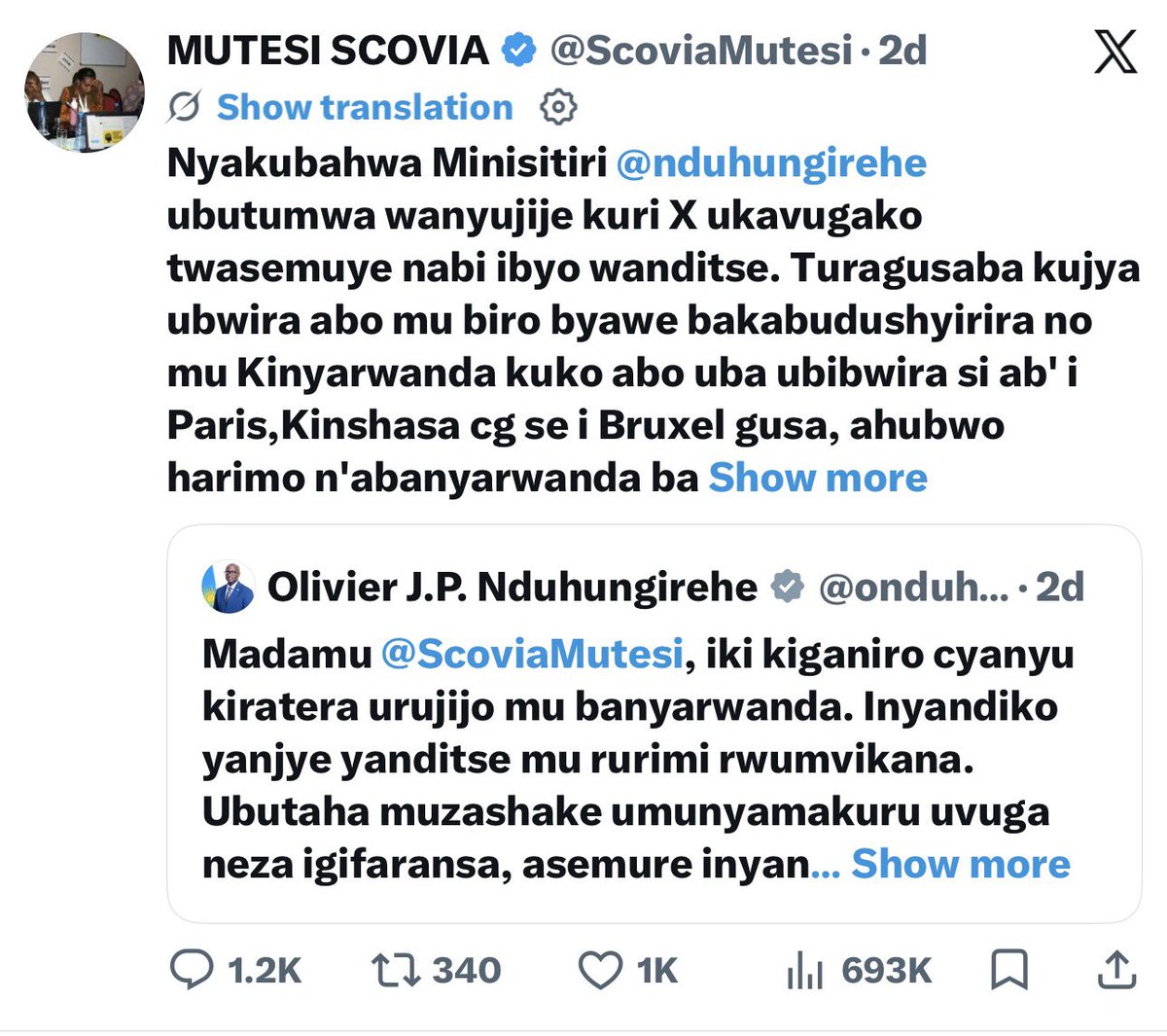
When entertainment outpaces policy. This morning i was reading the recent Rwanda Media Barometers published by the Rwanda Governance Board, and one trend continues to stand out: a large share of our media space is still dominated by sports, entertainment, and leisure-oriented content. Even broader studies on Rwanda’s media landscape point to the growing influence of social media-driven and personality-centered engagement. What caught my attention even more is what has happened in just these first weeks of May this year Parliament approved the Budget Framework Paper through a Parliament X Space discussion. This is one of the most important policy conversations for any country because it shapes national priorities and public spending. Yet the engagement remained modest: about 1.6K views, 17 likes, and 7 reposts. A few days later, on 8 May, Parliament approved the electoral law. Again, considering the importance of elections in shaping democratic participation and governance, one would expect intense public debate and engagement. But the post generated roughly 1.4K views, 18 likes, and 11 reposts. Then came a completely different conversation last Saturday the 16th May: the exchange involving Hon. Olivier and Ms. Scovia. Their posts attracted significantly more attention, averaging hundreds of thousands of views, over 1.2K likes, and more than 220 reposts. As I reflected on this contrast, one question stayed in my mind: are modern societies naturally becoming more attracted to emotional debates, personalities, and entertainment than to issue-based discussions and public policy conversations? How does a public exchange between a media personality and a government official generate far more engagement than debates about the national budget or electoral reforms? Is this simply how digital platforms work today, where emotion travels faster than policy? Or are we slowly reaching a point where governance and political questions are increasingly viewed as matters for government officials and elites, rather than issues requiring active citizen attention? The Rwanda Media Barometer 2024 actually raises related concerns about the future of professional, issue-based journalism, especially at a time when social media is becoming one of the dominant spaces for public engagement. Perhaps political scientists, media scholars and communication experts can help us better understand this phenomenon. Because beyond likes, reposts, and trends, there is a deeper question here about civic culture, democratic participation, and what kind of public discourse we are building as a society. #CitizenEngagement #ActiveCitizenary
Joseph Nkurunziza Ryarasa tweet mediaJoseph Nkurunziza Ryarasa tweet mediaJoseph Nkurunziza Ryarasa tweet mediaJoseph Nkurunziza Ryarasa tweet media
English
8
15
53
34.4K
Sunnydolly production
Sunnydolly production@Sunnydolly8790·
@allenanalysis Let him finish the job doing it half azz is not the play at this point should have never happen but cookie jar is broken now
English
2
0
1
976
Brian Allen
Brian Allen@allenanalysis·
BREAKING: After 7 failed attempts, the Senate has officially advanced the Iran War Powers Resolution in a 50–47 vote. The measure would require congressional approval for continued U.S. military strikes on Iran. That means the cracks are finally starting to show. Even members of Trump’s own party are beginning to realize you cannot bypass Congress indefinitely while dragging the country deeper into another Middle East war. The Constitution gave Congress the power to declare war for a reason. Because presidents surrounded by loyalists, television cameras, and wartime adrenaline are historically terrible at knowing where the exit is.
English
77
553
2.5K
187K
umwmbl retweetledi
Ministère de la Sécurité - Togo
LE TOGO SUPPRIME LE VISA POUR TOUS LES AFRICAINS ! Le Togo franchit une étape historique dans le renforcement de l’intégration africaine. Désormais, tous les ressortissants des États africains détenteurs d’un passeport national valide peuvent entrer sur le territoire togolais sans visa, pour un séjour allant jusqu’à 30 jours. À travers cette réforme majeure, le Président du Conseil réaffirme sa volonté de faire du Togo un espace d’ouverture, de mobilité, d’opportunités et de coopération au cœur du continent africain. Les voyageurs doivent toutefois effectuer leur déclaration de voyage sur la plateforme officielle voyage.gouv.tg au moins 24 heures avant leur arrivée afin d’obtenir leur bordereau de voyage. Le Togo confirme ainsi son leadership en matière d’intégration régionale et de rapprochement des peuples africains. #Togo #Afrique #integration #Libre #panafricanism #voyage #cooperation
Ministère de la Sécurité - Togo tweet media
Français
309
3.3K
7.8K
572.6K
umwmbl retweetledi
Zoom Afrika
Zoom Afrika@zoomafrika1·
This is how Patrice Lumumba was arrested by the Belgian army, the US and the UK 💔💔😭😭
English
190
2K
7.1K
519.4K
umwmbl retweetledi
OSINTdefender
OSINTdefender@sentdefender·
Earlier tonight, a U.S. Air Force MQ-9 Reaper carrying several AGM-114R9X Hellfire Air-to-Surface Missiles, known more commonly as the “Flying Ginsu,” was shot down by Iranian-backed forces over Houthi-controlled Western Yemen, with wreckage seen in photos and videos clearly that of an MQ-9. Over 40 MQ-9 Reapers, potentially worth upwards of a billion dollars, have been lost to Iran or Iranian proxy groups since the start of the current conflict in late 2023, with at least 24 being downed over Iran and 15-18 being downed by the Houthis in Yemen.
English
179
767
3K
761.7K