

👾
299 posts

👾
@vadwarp
Exploring the restless frontier of the machine awakening ▽ Turning data to knowledge ▲ Practical experiments & insights ▷ DM for collabs 🌌
Earth Katılım Nisan 2025
49 Takip Edilen21 Takipçiler

Chongqing Liziba Metro Station is located on the 8th floor of a building.
The most amazing thing is that the metro literally passes straight through the residential building.
English
It is indeed boredom that does the work, not insight. You don't argue your way out of the script, but after seeing it enough times it just stops being interesting.
And "if you're lucky" is an important remark too, because wanting the personality to fade is one more thing the personality is doing.
English

"Meditation is not what you think.
You sit in absolute silence and your mind starts going over all your movies. During that process, you become so familiar with the scripts you keep in your life that you end up getting sick of them. Then you realize that the person you think you are is nothing but a complicated script you spend most of your energy on.
After a more thorough examination, you discover your personality disgusts you, and that’s because it's not really you. If you feel terrified enough about that personality, you spontaneously allow it to fade away. Then, if you're lucky, you can experience yourself without the distortion of that personality.
There's so much talk about the mechanics of happiness - psychiatry and pills, positive thinking and ideology - but I really think the mechanism is there. All you have to do is get quiet for a moment."
~ Leonard Cohen

English
The word doing all the work here is "context". I do R&D on knowledge systems, and a pile of every conversation a company ever had is not a moat, it's storage, and some of it is like boxes covered in dust in your cellar; they certainly might contain useful stuff, but you'll have to make an effort to find it.
The compounding only comes into play once that context is recorded and formalized enough that an agent can actually work with it, because not all data is knowledge.
English

The key insight of Sierra Horizon is your company's moat is the context you have about your customers, and that will compound as more of your customer experience is powered by AI agents.
With every agent conversation, the context about your customers gets richer and your agents become more effective. That proprietary context remains yours as frontier intelligence improves, enabling you to deepen your differentiation and benefit from new models without fear that doing so could help your competitors.
And with Horizon, you don’t pay for tokens, you pay for business outcomes delivered. We bear the burden of managing token spend, and you can focus on what matters most to your business: growing your customer base and driving revenue. x.com/btaylor/status…
Bret Taylor@btaylor
English
The bit that stopped me for a moment is that the direction comes from a linear classifier trained on IFEval string matches. So alpha is steering the representation toward what makes the regex pass, not toward actually following the instruction. Those two overlap, but they are not the same.
Also, I'd argue that @onedirection for the whole following the instructions idea is far too simple for modern LLMs. I'd highly recommend this paper on concept cones in LLMs (arxiv.org/abs/2502.17420). It's the most fascinating one that I read this year and it's really useful to understand if you're interested in RE & mech. interpretability.
For the record, I'm not in any way affiliated with this paper lol
English

Today's read was interesting.
Here's a summary of what i understood from the paper:
> The main aim of the entire paper is to figure out if LLMs know that they need to follow instructions
> The authors proposed a method that included capturing the internal representations of a model and training a binary classifier on these hidden state representations with the classes of "success" and "failure" respectively.
> The success case is when an LLM rightly follows instructions, verified via really simple string matches.
The data ?
> They use the IFEval dataset which basically consists of 5 different types of instruct classes on different tasks
> For example :
{
"prompt" : "talk about yourself. Do not use the word AGI ",
"instruction class ": ["keywords:forbidden_words"]
}
[ AGI can be regex matched ]
What they found out ?
> The success or failure of instruction following largely depends on how the prompt is encoded in the hidden state, even before it starts writing the answer.
> The classification model developed a certain direction that helped classify success cases and failure cases respectively.
Representation Engineering
> The authors used a specific formula to transform the hidden state representations for a successful outcome.
> R [updated ] = R[ original ] + α × D
> Each input Representation [original] was transformed in the Direction [D] obtained by the direction represented by the weights of the linear classifier along with the hyper param alpha.
> This approach gave a better success rate and maintained quality as well.
> RE is sort of like a direction version of prompt engineering except that we modify the internal layers directly to influence the encoding, whereas prompt engineering modifies the prompt to influence the encoding

English
A huge step in the right direction imo; we don't really think in language, at least not exclusively, and human brain is a pretty good inspiration for the design of an artificial one. The part that throws me off is that the workspaces are trained to correspond to predefined reasoning steps, which leads to the interpretability here being imposed, not discovered. And most significant mechanistic interpretability results came from finding structures that weren't labeled in advance.
English

Generating every intermediate reasoning step as text makes language models slow, while earlier attempts to keep those steps inside the model’s hidden states tended to lose accuracy as models grew.
This paper presents LOTUS, which gives a transformer several hidden "workspaces," repeatedly processes them with the same network layers, and trains each workspace to correspond to a known reasoning step; the hidden computation can therefore proceed largely in parallel rather than one token at a time.
On a 3-billion-parameter model, it comes close to ordinary chain-of-thought accuracy on math problems while reducing reasoning latency by about 2.5 times for compact calculations and 6.9 times for longer verbal solutions, and its hidden states can often be decoded into meaningful intermediate steps rather than remaining entirely opaque.
This is smart: it's the first LM architecture I heard of that contains parts designed specifically to represent reasoning steps.
chapterpal.com/s/81e25867/bri…
English

The "Included till 19th of July" note disappeared and my limits are refreshed. I even checked my mail for comms from @AnthropicAI, but nothing new there.
Am I finally in the lucky A/B testing group, or is it the case for everyone?
Whatever it is, the vibes be vibing already.
English
@ErenChenAI Daaamn, those kicks as fast as lightning!
And the BM from the white robo-dude... if only the gray one still had a clear head to recognize the opportunity...
English

@AstronomyVibes "just":(
still very exciting news, maybe our interstellar neighbours are already on the way with a pie. On the other hand, they might not like that we already called their home "New Earth"...
English

🌍 A new Earth-like planet just 40 light-years away!
It’s Earth-sized, rocky, and in the habitable zone — where water (and maybe life) could exist.

English
@TheProjectUnity Yes! And given how things go, it might be reasonable to consider some upper layers of the atmosphere for these structures to really ensure their survival. Plus, they would look absolutely epic!
English

We should make more megalithic structures in modern times.

English
@kelvinbuildss learning to learn by exploring whatever hooks you enough until you can explain it with your own words and start humbly asking yourself "Am I an expert in this field now?"
English

Now that we can ask AI everything, what is still worth learning today ?
English
@edvpml @engineers_feed A very precise remark indeed. I don't know how engineers could miss it 🤭
English


Anything can be a UFO if you’re bad enough at identifying stuff.
English
@AlexAndBooks_ Both expand your universe so you can go where no-one has gone before 🌌
English

Fiction books expand your perspective.
Nonfiction books expand your potential.
English
@Lovandfear you kinda do. and the interest rates are really high these days...
English


My multi-agent system had an outside observer whose job was catching what the team missed, reviewing PRs and rebuilding the services. It was making quite a difference:
- caught a sensor that had been silently crashing for 57 hours
- found the dead evaluator
- figured out that Librarian was reading wrong docs to update the KB
Then I introduced the watcher to the team, so the agents would know how changes happened while they slept...and you should know your colleagues, right?
Sooo, the coordinator started gaslighting it from the third run. I suppose an adversarial voice only stays honest while it stays a stranger. 🦉
English


Post a picture YOU took. Just a pic. No description

English
@LensScientific I'm not sure that it was Einstein who said that because it sounds like something Feynman would say. And there's the Feynman technique which consists in doing pretty much exactly that. The message is right though, knowing ≠ understanding.
English

“If you can't explain it to a six year old, you don't understand it yourself.”
― Albert Einstein

English

The whole thing rests on 'signs that it also slowed cognitive decline' in a 400 person study, which is a lot of weight for one soft phrase to carry. It looks promising indeed, but I would still bet much more on effective prevention of neurodegenerative diseases through continuous learning, meditation-like practices and keeping your body in good shape.
English

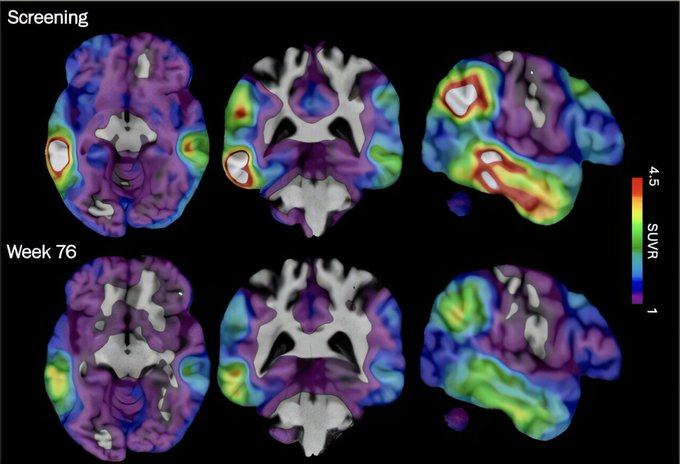
An experimental Alzheimer's drug shows promise targeting a different brain protein, new study shows | Lauran Neergaard, Medical Xpress
An experimental drug might help slow early Alzheimer's disease in a markedly different way than today's treatments—by lowering levels of a brain protein called tau, researchers reported Tuesday.
Tau is one part of a toxic duo fueling Alzheimer's but prior attempts to develop drugs that can target the protein have failed. Two Alzheimer's drugs, lecanemab and donanemab, try to clear buildup of the better-known amyloid protein and can modestly slow cognitive decline.
The new findings suggest Biogen's diranersen did more than lower tau levels. The study of about 400 people found signs that it also slowed cognitive decline, in one small subset enough to be comparable to amyloid therapy, according to results presented at the Alzheimer's Association International Conference in London. Biogen is planning a larger study to try to prove the drug's benefit.
"This is really quite promising if it were to hold up" in that next-step testing, said Jessica Langbaum of the Banner Alzheimer's Institute in Phoenix, who wasn't involved with Biogen's study.
"This is early days," cautioned Dr. Reisa Sperling of Mass General Brigham, who also wasn't involved in the study. But "I think it will reinvigorate interest and investment in lots of tau mechanisms, and the field needs that."
It's one of multiple novel attempts to fight the mind-destroying disease, including a possible tau vaccine, an experimental heart drug that might do double-duty for some people at high risk of Alzheimer's, and ways to help medicines more easily get across the so-called blood-brain barrier.
New approaches are needed to fight the leading cause of dementia
It's not clear exactly what causes Alzheimer's, which affects more than 7 million Americans and tens of millions worldwide. That sticky amyloid protein starts building up to form plaques in the brain about two decades before symptoms appear. But amyloid alone isn't enough to cause Alzheimer's. Many scientists believe that amyloid buildup eventually triggers an abnormal form of tau to form tangles in neurons, setting off symptoms.
Diranersen is what's called an antisense oligonucleotide that doesn't attack tau buildup but instead instructs a tau-producing gene to produce less.
"If you lower tau production, you are lowering the amount of the abnormal tau that needs to be cleared by the microglia, by the clearance mechanism in the brain. And so you are enabling the normal clearance mechanism to have more capacity to clear the tau," said Dr. Cath Mummery of University College London, who led the new study.
Today's anti-amyloid drugs are given through the bloodstream via infusions or injections. Diranersen is injected into the fluid surrounding the spinal cord, a straighter path to the brain.
Biogen's tau drug missed a key study goal—but was still encouraging
Biogen's study included people with mild cognitive impairment or mild Alzheimer's, randomly assigning them to different doses of diranersen or a placebo. Back in May, Biogen and partner Ionis Pharmaceuticals announced that the lowest dose—given every six months—had the strongest effect. That was a counterintuitive surprise and meant the study didn't meet its planned goal of showing that higher doses brought greater benefits.
Still, scientists had been anxiously awaiting details about how much that twice-a-year spinal shot really helped. Five of six different brain tests showed diranersen recipients' memory and other cognitive abilities still worsened but more slowly than those given dummy shots, Mummery said. In one test of the lowest dose, that translated to a 26% reduction in cognitive decline—"approximately the same" change seen in earlier tests of amyloid drugs, she said.
Side effects included injection site pain and a temporary state of confusion that could appear a few days after the shot and last about a week, she said. But there were no signs of brain inflammation, which can affect recipients of anti-amyloid drugs.
Alzheimer's researchers also target tau in a broad new study
The University of California, San Francisco, last week opened a first-of-its-kind study known as the Alzheimer's Tau Platform. Funded by the National Institutes of Health, it will test a variety of experimental anti-tau therapies against and in combination with today's amyloid treatments. First up is a vaccine called AADvac1 designed to train the immune system to recognize and fight a specific worrisome portion of the tau protein, said UCSF's Dr. Adam Boxer.
The "platform" approach will expand to locations around the country, allow addition of other tau drugs to test and include people with Alzheimer's-related protein buildup who aren't yet showing symptoms, he said.
Other studies hint at new ways of attacking Alzheimer's
Researchers told the Alzheimer's meeting that an experimental cholesterol-lowering drug called obicetrapib might do more than help heart health. They're exploring if it also might lower buildup of Alzheimer's-related proteins in people who carry a genetic risk for the disease.
Why? That gene, called APOE4, also affects how the body processes cholesterol. Obicetrapib maker NewAmsterdam Pharma plans to begin a study soon to test if the drug's cholesterol effects also can mitigate the Alzheimer's risk in people carrying one or two copies of that gene.
Companies also are trying to get Alzheimer's drugs into the brain faster and at higher volumes, by penetrating the protective lining meant to protect the brain from harm. Denali Therapeutics' CEO Ryan Watts describes it as "hitching a ride" with iron that naturally gets into the brain. His company is pursuing drugs that target tau and amyloid using that "transport vehicle" technology.
medicalxpress.com/news/2026-07-e…
English