Varosync

17 posts

Varosync banner
Varosync

Varosync

@var0sync

Applied research lab building intelligence for the highest-stakes decisions in drug development.

New York, NY, USA Katılım Mayıs 2025
16 Takip Edilen20 Takipçiler
Sabitlenmiş Tweet
Varosync
Varosync@var0sync·
Advances in medicine begin as advances in understanding. Varosync is building failure-aware intelligence for drug development, spanning computation and experimental science. We are growing the team, with five open roles across research and commercial partnerships. If you want to work on problems that have absorbed entire careers, we would like to hear from you. View open positions: varosync.com/careers
Varosync tweet media
English
0
3
6
531
Varosync
Varosync@var0sync·
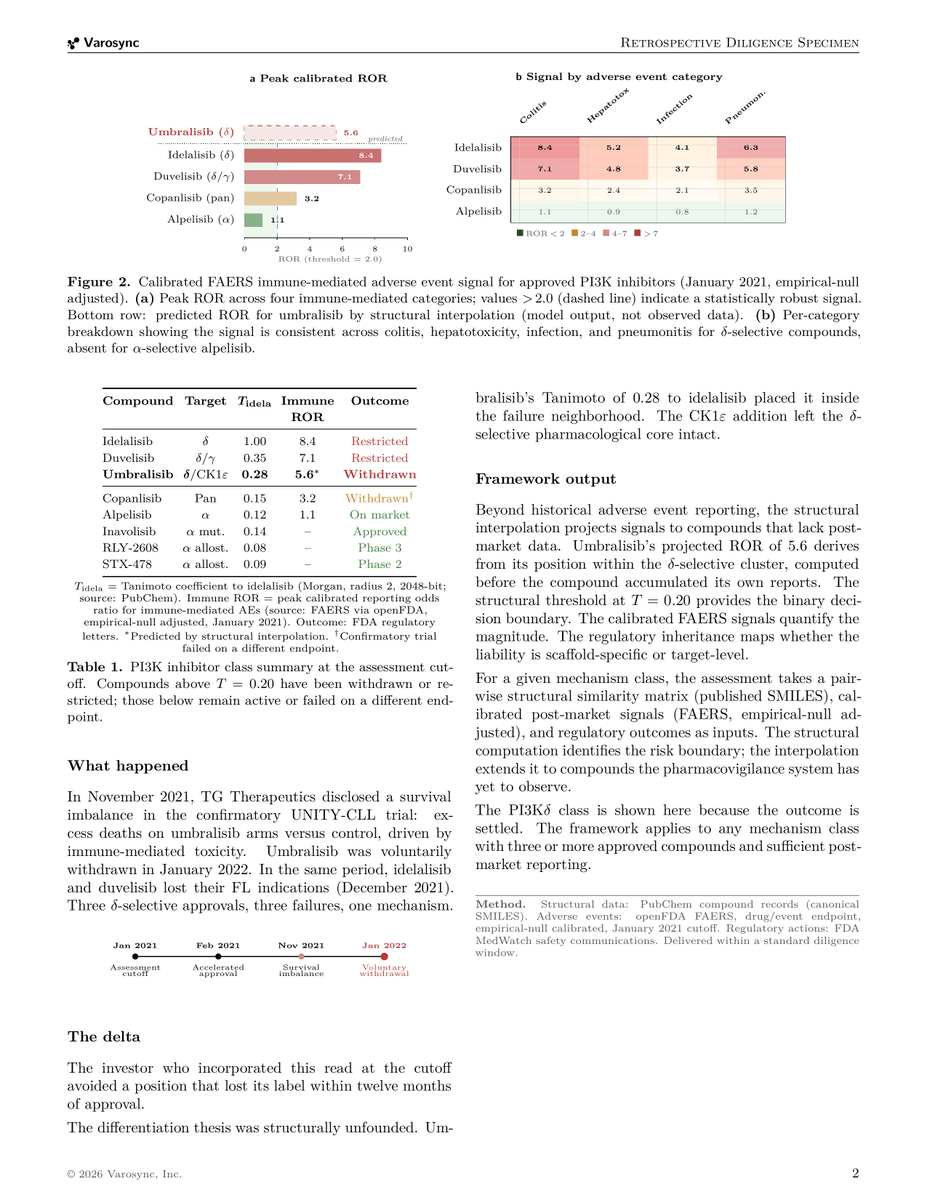
Pharma buries its failed trials. That is the most valuable data it owns. A failure is a map: where the mechanism breaks, which patients, which toxicity, what dose. We mapped the full PI3K inhibitor class from the public record alone. What would actually move pharma to share what failed?
Varosync tweet mediaVarosync tweet media
English
0
1
8
1.1K
Varosync
Varosync@var0sync·
@ylecun @Dan_Jeffries1 Exactly. LLMs describe molecules, they don’t model them. You can’t tokenize your way past thermodynamics. We’re building the failure-aware simulator for drug development: physics and causality under physical law, not token statistics. The empirical floor for $1B decisions.
English
0
0
0
647
Yann LeCun
Yann LeCun@ylecun·
@Dan_Jeffries1 Did some exponential-pilled bros finally realize that real-world processes have irreducible time constants and that you can't run the real world faster than real time?
English
54
79
1.4K
180.6K
Daniel Jeffries
Daniel Jeffries@Dan_Jeffries1·
This is the best and most balanced report I've read by Anthropic, free of many of the super sci-fi, everything-is-exponential language of some other reports I've read by this amazing team. But one line is dead wrong. This one about recursive self-improvement: "[If] AI systems themselves become capable of full recursive self-improvement, and begin building their successors...In this world, the pace of progress in AI development becomes determined entirely by the availability of compute (or the speed of discovering various efficiencies in algorithmic training or inference) for AI systems." Compute is absolutely NOT the only limiting factor in recursive self-improvement and not even the most important one. They are two more: 1) Time 2) Multiplicity Time is how long it takes to get an answer. Multiplicity is when there is no right or wrong answers but only shades of gray with right(ish) answers and wrong(ish). They even point to one of them (time) just a few paragraphs later: "More intelligence can’t learn what a drug does over decades of use, can’t hold elections sooner than a constitution dictates, and can’t turn a stranger into an old friend in a weekend. For most people, the felt pace of this future will still be set by the bottlenecks, even if the laboratory upstream runs at the speed of compute. That collision, where recursive intelligence building itself ever faster meets the world of humans, relationships, and governance, is another part of this future we can’t predict." But let me make it even more clear: AI got good at code and games because they have great feedback loops and tight timelines. If the code works or does not, you know pretty quickly. It good at driving for the same reasons. Don't die or drive off the road or hit someone are achievable (though difficult) goals with clear, fast feedback. You cannot answer the question "is this a good article?" or "do I write well?" because that is multiplicity, shades of gray that are hard to judge. Humans judge this by self-awareness and feedback from others. AI might be able to approximate the second but only if it develops more of the first (harder). "Will my wife like this surprise present?" Hard to get good at that even if you're a master. Took me many years of trying and judging her responses. :) Time is also a massive factor. The question of "did I make money in business?" can't be answered in a short time line. There is no way to know the answer faster, and short term success doesn't predict long term. "Will this drug cause bad side effects twenty years from now?" That can only be answered in twenty years. No amount of compute changes that. "Will this building fall down faster than this one if I build it a different way?" You can run basic physics and math rules to help you heuristically figure it out, but only time gives you the true answer. These two constraints, time and multiplicity, are the death knell of any Doomer/Less Wrong fantasies about fast takeoff and instant super genius AI. You can have all the compute in the universe and you still can't compress twenty years of drug side effects into twenty minutes. You can have a 500 trillion parameters and you still can't definitively answer "is this beautiful?" because beauty is not a optimization target with a clean gradient. The recursive self-improvement loop doesn't hit a wall because of compute. It hits a wall because of reality. Reality is slow, messy, ambiguous, and full of questions that only time and lived experience can answer. Compute is the bottleneck that engineers see because it's the one they can measure. Time and multiplicity are the bottlenecks that the real world imposes and no amount of silicon can brute force past them. That's why even nature only "solved" good/bad by brute force: evolution. Does this agent/human/creature survive and reproduce? That's good. Otherwise not good. Companies follow the same rule. Did this survive and make money over time? Good. Otherwise bad. Imperfect, lossy, dumb, blind, slow. AI is changing the world already. It will get better and better. But the road to better is long and winding, not a vertical line to godhood. And that should make you more hopeful, not less.
Anthropic@AnthropicAI

Our internal data shows Claude is accelerating AI development—a possible path to recursive self-improvement, or AI autonomously building a more capable successor. It’s happening faster than we thought, and the implications deserve greater attention. anthropic.com/institute/recu…

English
58
58
523
126.8K
Varosync
Varosync@var0sync·
@drfeifei LLMs describe molecules: they do not model them. We are building the failure-aware simulator for drug development. It operates on physics and causality under physical law, not token statistics. This is the empirical floor for $1B decisions.
English
0
0
0
1.8K
Varosync
Varosync@var0sync·
The industry studies the 10 percent that succeeded. We model the 90 percent that failed. Mapping pharmacology and exposure liability against the clinical failure record, we define the risk floor. Part of the @LartaInstitute #HealLA cohort: larta.org/idea/larta-ins…
English
0
0
1
174
MIT CSAIL
MIT CSAIL@MIT_CSAIL·
What’s an invention you feel deserves more credit?
English
52
2
55
23.8K
Eli Lilly and Company
Eli Lilly and Company@EliLillyandCo·
Today, we presented positive results from our investigational study at #EASCongress2026 and published in @NEJM, demonstrating the potential of our early-phase medicine designed to deliver LDL-cholesterol lowering effects in a single dose. Learn more: go.lilly.com/2al4ap
Eli Lilly and Company tweet media
English
3
15
53
16.4K
kuz
kuz@kylekuzma·
Three things I’m underwriting hardest in 2026: -AI applied to industrial throughput. -autonomous defense + space robotics -clinical-stage biotech where AI compresses trial timelines. Everything else feels crowded
English
280
137
3.6K
2.4M
Leo Wan
Leo Wan@LeoWanPhD·
This is so cool. I just had a call yesterday with someone talking about how difficult it is to design for GPCRs
Leo Wan tweet media
English
3
37
250
32.6K
Varosync
Varosync@var0sync·
The paradox of biotech valuation: PoS is inversely correlated with commercial upside. The market's blind spot isn't target discovery. It's quantifying human tolerability and structural failure risk before billions are deployed. Most computational models still ignore both.
English
0
0
1
137
Varosync
Varosync@var0sync·
Presented our poster at DDC this week. One session made the case for us; targeted protein degradation has 600+ E3 ligases, the field’s optimized two. The ternary complex is a structural prediction problem now. Failure data isn’t optional when the design space is that big.
Varosync tweet media
English
0
0
3
88
Varosync
Varosync@var0sync·
At #DrugDiscoveryChemistry in #SanDiego next week. New poster (P024) on failure-constrained structure prediction across GPCRs and kinases. 90% of drug programs fail. That is not only a tragedy; it is a dataset. Come see what we're doing with it. cc:@CHI_Healthtech
Varosync tweet media
English
0
0
3
113
Varosync
Varosync@var0sync·
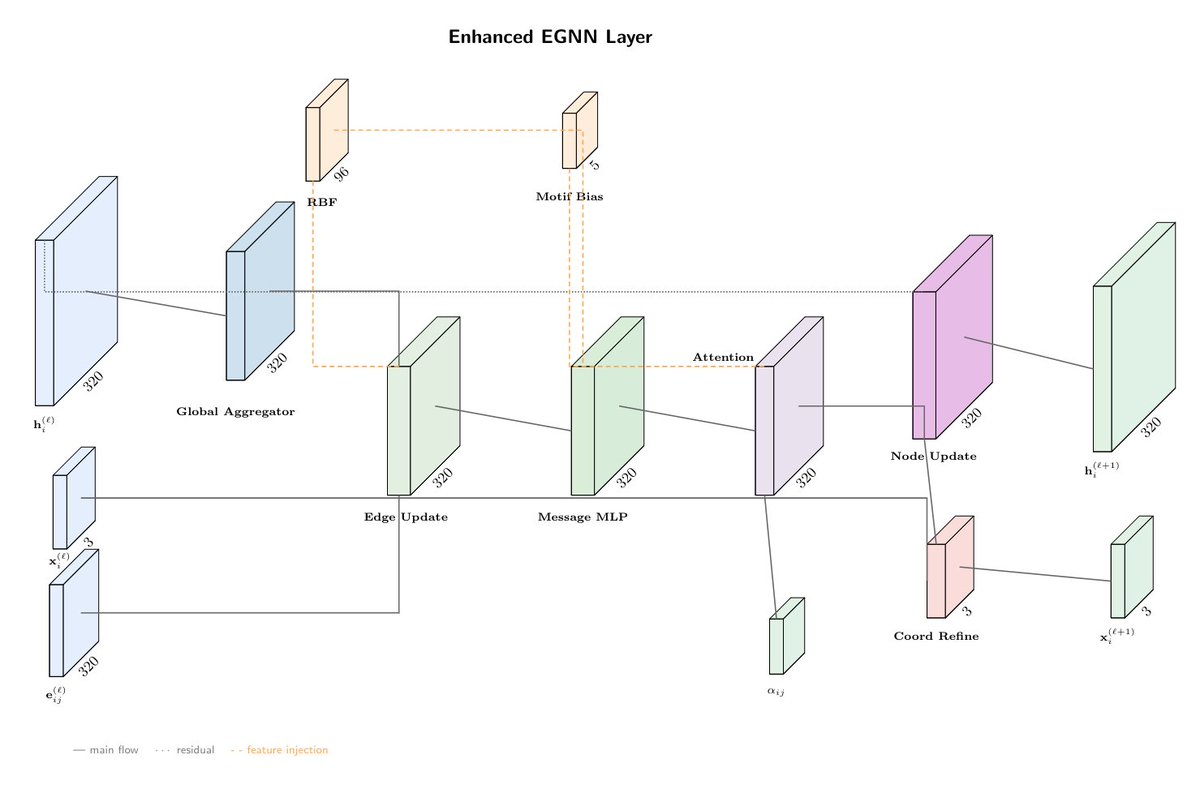
@biorxiv_bioinfo Thanks for sharing Hyaline! We were really surprised to see how much the E(n)-equivariant layers helped stabilize those Class C predictions compared to sequence-only models. If anyone wants to play with the code, it’s all open-source here: github.com/Varosync/Hyali…
English
0
0
0
7
Varosync
Varosync@var0sync·
Biology+AI Daily@BiologyAIDaily

Hyaline: Geometric Deep Learning for Accurate Prediction of G Protein-Coupled Receptor Activation States from Structure 1. Hyaline introduces a novel geometric deep learning framework that predicts GPCR activation states with near-perfect accuracy (AuROC 0.995) by integrating E(n)-equivariant graph neural networks and ESM3 evolutionary embeddings. This approach bridges the gap between sequence-based and structure-based methods, outperforming sequence-only models significantly. 2. The model leverages E(n)-equivariant message passing to capture the subtle, non-local conformational changes that distinguish GPCR activation states. This ensures that predictions are invariant to rotations and translations, focusing solely on the relative arrangement of atoms in the receptor structure. 3. Hyaline incorporates biological priors through motif-specific attention biasing, prioritizing residues within conserved activation motifs such as the DRY, NPxxY, and CWxP motifs. This not only accelerates learning but also improves robustness and interpretability, with attention weights revealing key regions involved in receptor activation. 4. The model demonstrates robust generalization across diverse GPCR classes, including challenging Class C receptors, and maintains high performance even on structures determined with the latest cryo-EM methods. This versatility makes Hyaline a powerful tool for high-throughput discovery of allosteric modulators. 5. Ablation studies highlight the importance of each architectural component, confirming that both evolutionary embeddings and geometric message passing are essential for accurate state discrimination. The model’s attention mechanisms provide insights into the structural basis of activation, correlating strongly with known activation signatures. 6. Error analysis reveals that most misclassifications reflect genuine biological ambiguity rather than model failure, with intermediate states representing opportunities for developing functionally selective compounds. Hyaline’s ability to identify these states could accelerate the discovery of conformationally selective drugs. 7. Hyaline’s linear computational scaling and efficient implementation enable rapid inference on typical GPCR structures, facilitating high-throughput screening of AI-predicted structures. This capability is crucial for assessing the activation states of computationally generated GPCR models in drug discovery contexts. 📜Paper: biorxiv.org/content/10.648… #GPCR #GeometricDeepLearning #ProteinStructure #ActivationStatePrediction #DrugDiscovery #AIinBiology


QAM
0
0
0
10
Varosync
Varosync@var0sync·
@BiologyAIDaily Thanks for sharing Hyaline! We were really surprised to see how much the E(n)-equivariant layers helped stabilize those Class C predictions compared to sequence-only models. If anyone wants to play with the code, it’s all open-source here: github.com/Varosync/Hyali…
English
0
0
0
6
Biology+AI Daily
Biology+AI Daily@BiologyAIDaily·
Hyaline: Geometric Deep Learning for Accurate Prediction of G Protein-Coupled Receptor Activation States from Structure 1. Hyaline introduces a novel geometric deep learning framework that predicts GPCR activation states with near-perfect accuracy (AuROC 0.995) by integrating E(n)-equivariant graph neural networks and ESM3 evolutionary embeddings. This approach bridges the gap between sequence-based and structure-based methods, outperforming sequence-only models significantly. 2. The model leverages E(n)-equivariant message passing to capture the subtle, non-local conformational changes that distinguish GPCR activation states. This ensures that predictions are invariant to rotations and translations, focusing solely on the relative arrangement of atoms in the receptor structure. 3. Hyaline incorporates biological priors through motif-specific attention biasing, prioritizing residues within conserved activation motifs such as the DRY, NPxxY, and CWxP motifs. This not only accelerates learning but also improves robustness and interpretability, with attention weights revealing key regions involved in receptor activation. 4. The model demonstrates robust generalization across diverse GPCR classes, including challenging Class C receptors, and maintains high performance even on structures determined with the latest cryo-EM methods. This versatility makes Hyaline a powerful tool for high-throughput discovery of allosteric modulators. 5. Ablation studies highlight the importance of each architectural component, confirming that both evolutionary embeddings and geometric message passing are essential for accurate state discrimination. The model’s attention mechanisms provide insights into the structural basis of activation, correlating strongly with known activation signatures. 6. Error analysis reveals that most misclassifications reflect genuine biological ambiguity rather than model failure, with intermediate states representing opportunities for developing functionally selective compounds. Hyaline’s ability to identify these states could accelerate the discovery of conformationally selective drugs. 7. Hyaline’s linear computational scaling and efficient implementation enable rapid inference on typical GPCR structures, facilitating high-throughput screening of AI-predicted structures. This capability is crucial for assessing the activation states of computationally generated GPCR models in drug discovery contexts. 📜Paper: biorxiv.org/content/10.648… #GPCR #GeometricDeepLearning #ProteinStructure #ActivationStatePrediction #DrugDiscovery #AIinBiology
Biology+AI Daily tweet media
English
2
1
9
1.2K
Varosync
Varosync@var0sync·
ESM3 + Geometry = A new era for GPCRs. 🚀 We're introducing Hyaline, a GNN-based framework for predicting receptor states directly from 3D coordinates. 🧵 1/10: Why sequence-only models fail at structural switches... #GeometricDL #ESM3 #StructuralBiology
Varosync tweet mediaVarosync tweet media
English
0
0
0
78