Vincent Favilla

896 posts

Vincent Favilla

Vincent Favilla

@vincentfavilla

Psychology prof thinking about minds, models, and meaning. Watching with cautious optimism as AI devours the world.

San Francisco Katılım Mayıs 2022
223 Takip Edilen2.1K Takipçiler
Vincent Favilla
Vincent Favilla@vincentfavilla·
@greg_ip That quote isn't in the paper. The study was 36 adults and had no measure of letter recognition (it was typing with one finger and no screen feedback). The b/d claim isn't in the paper either. There's a published critique at  doi.org/10.3389/fpsyg.…
English
0
0
4
274
Greg Ip
Greg Ip@greg_ip·
"Children who learn to read and write on tablets often cannot tell letters like b and d apart, because they have never physically felt with their bodies what it takes to actually produce those letters on a page."
Ihtesham Ali@ihtesham2005

A Norwegian neuroscientist spent 20 years proving that the act of writing by hand changes the human brain in ways typing physically cannot, and almost nobody outside her field has read the paper. Her name is Audrey van der Meer. She runs a brain research lab in Trondheim, and the paper that closed the argument was published in 2024 in a journal called Frontiers in Psychology. The finding is brutal enough that it should have changed every classroom on Earth. The experiment was simple. She recruited 36 university students and put each one in a cap with 256 sensors pressed against their scalp to record brain activity. Words flashed on a screen one at a time. Sometimes the students wrote the word by hand on a touchscreen using a digital pen, and sometimes they typed the same word on a keyboard. Every neural response was recorded for the full five seconds the word stayed on screen. Then her team looked at the part of the data most researchers had ignored for years, which is how different parts of the brain were communicating with each other during the task. When the students wrote by hand, the brain lit up everywhere at once. The regions responsible for memory, sensory integration, and the encoding of new information were all firing together in a coordinated pattern that spread across the entire cortex. The whole network was awake and connected. When the same students typed the same word, that pattern collapsed almost completely. Most of the brain went quiet, and the connections between regions that had been alive seconds earlier were nowhere to be found on the EEG. Same word, same brain, same person, and two completely different neurological events. The reason turned out to be something nobody had really paid attention to before her work. Writing by hand is not one motion but a sequence of thousands of tiny micro-movements coordinated with your eyes in real time, where each letter is a different shape that requires the brain to solve a slightly different spatial problem. Your fingers, wrist, vision, and the parts of your brain that track position in space are all working together to produce one letter, then the next, then the next. Typing throws all of that away. Every key on a keyboard requires the exact same finger motion regardless of which letter you are pressing, which means the brain has almost nothing to integrate and almost no problem to solve. Van der Meer said it plainly in her interviews. Pressing the same key with the same finger over and over does not stimulate the brain in any meaningful way, and she pointed out something that should scare every parent who handed their kid an iPad. Children who learn to read and write on tablets often cannot tell letters like b and d apart, because they have never physically felt with their bodies what it takes to actually produce those letters on a page. A decade before her, two researchers at Princeton ran the same fight using a completely different method and ended up at the same answer. Pam Mueller and Daniel Oppenheimer tested 327 students across three experiments, where half took notes on laptops with the internet disabled and half took notes by hand, before testing everyone on what they actually understood from the lectures they had watched. The handwriting group won by a wide margin on every question that required real understanding rather than surface recall. The reason was hiding in the transcripts of what the two groups had actually written down. The laptop students typed almost word for word, capturing more total content but processing almost none of it as they went, while the handwriting students physically could not write fast enough to transcribe a lecture in real time, which forced them to listen carefully, decide what actually mattered, and put it in their own words on the page. That single act of choosing what to keep was the learning itself, and the keyboard had quietly skipped the choosing and skipped the learning along with it. Two studies. Two countries. Same answer. Handwriting makes the brain work. Typing lets it coast. Every note you have ever typed instead of written went into your brain through a thinner pipe. Every meeting, every book highlight, every idea you captured on your phone instead of on paper was processed at half depth. You did not forget those things because your memory is bad. You forgot them because typing never woke the part of the brain that would have made them stick. The fix is the thing your grandmother already knew. Pick up a pen. Write the thing down. The slower road is the faster one.

English
7
53
174
41.9K
Andy Masley
Andy Masley@AndyMasley·
Talking to guy at a conference and he says "I think so much about data centers is overblown. The power, the water, the land. The one thing I'm really worried about is the infrasound" "You're never going to believe this"
English
6
5
1.1K
137.1K
Vincent Favilla
Vincent Favilla@vincentfavilla·
The vibes are off. For me it's making more frustrating mistakes than 4.6 and it's not as good at creative tasks either. Cost/usage is significantly higher due to its new tokenizer but I've been running on high/extra high thinking. Going to shift down to medium to today and switch to Cursor for a month if things don't improve.
English
0
0
2
479
Zvi Mowshowitz
Zvi Mowshowitz@TheZvi·
Claude Opus 4.7 reaction thread, it's that time again.
English
71
1
117
43.6K
Vincent Favilla
Vincent Favilla@vincentfavilla·
@AndyMasley It's times like this you really wish youtube had community notes. Thanks for fighting the good fight against misinformation.
English
0
0
8
570
Andy Masley
Andy Masley@AndyMasley·
Two months ago the YouTuber Benn Jordan made what has become one of the most popular videos about data centers ever, and maybe the most popular piece of media on data centers this year: Datacenters Behaving Like Accoustic Weapons. The claim is that they produce harmful infrasound. This video (and the one before it) is a moment-by-moment disaster. I found this to be far and away the most jaw-dropping experience of writing I've had. To my knowledge I'm the first one to publicly push back against all the problems with it. Even if you're not interested in data centers or infrasounds, I think this is just an incredible example of how pseudoscience can become highbrow misinformation. All it takes is a chill-seeming guy, great production, and not actually checking literally any of the studies he's quickly flashing on the screen. blog.andymasley.com/p/contra-benn-…
English
22
60
520
35.5K
Vincent Favilla
Vincent Favilla@vincentfavilla·
@Miles_Brundage Basically none of these hype/scam claims are falsifiable. "Our AI is has risks"? Marketing. "Our AI is safe"? Also marketing. AI does something impressive? Cherry-picked. AI does something dumb? Proof it's all fake.
English
0
0
8
181
Miles Brundage
Miles Brundage@Miles_Brundage·
Embarrassing for Bloomberg IMO At what point will AI capabilities be strong + obviously misusable enough for journalists to acknowledge it's not hype? Better than most security vulnerability researchers isn't enough, it has to beat every single one? x.com/opinion/status…
Bloomberg Opinion@opinion

When tech CEOs like Sam Altman and Dario Amodei acknowledge the risks of AI, they’re selling you a product. @parmy explains the dark art of AI marketing 🎥

English
13
9
186
13.4K
Andy Masley
Andy Masley@AndyMasley·
They say that when a data center comes to town, the crows begin to sing a strange atonal tune, the grass no longer reflects the moonlight and stays pitch black, and the children begin to whisper secrets instead of singing songs
Clayton Tucker@ClaytonTuckerTX

I’m hearing reports that the noise from AI Data Centers cause: —chickens to lay 50% less eggs —cattle/goats/sheep to lose 30% of their body weight —horses & wildlife to suffer from stress If true, we can have farms or data centers. I choose farms. What about you?

English
34
108
1.9K
71.6K
Vincent Favilla
Vincent Favilla@vincentfavilla·
@paulnovosad One thing I think is worth considering is that "screen work gets automated" doesn't just mean that portion of the economy grows faster. It also likely means find a lot more economically valuable work to do on screens.
English
0
0
0
61
Paul Novosad
Paul Novosad@paulnovosad·
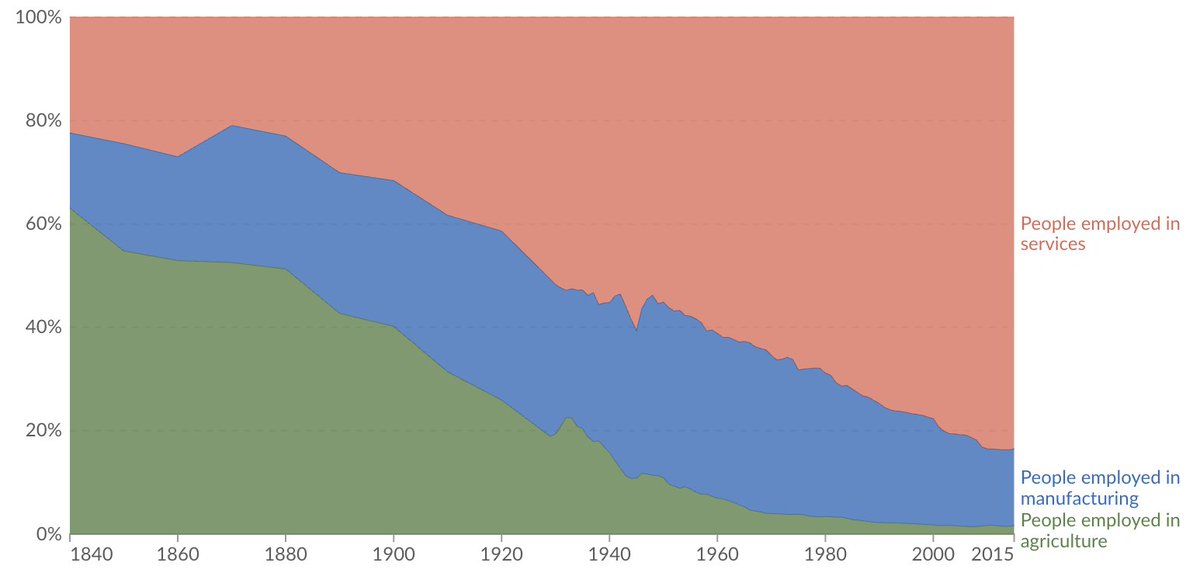
AI has an insane rate of progress when we observe what it does for jobs that take place on screens. Progress is slower for jobs in the world of atoms. Since the intellectual class spend all their time on screens, it's easy to think "AI will do all the jobs!" We are like 15th century farmers thinking about mechanization. If you mechanized agriculture, what other jobs could there even be? Perhaps employment in the on-screen sector will shrink to a small percentage. Of course stuff on screens affects things in the real world too. But the rate of progress is different. On screens (i.e. in simulation), the self-driving car problem has been solved for many years. IRL, we are still years and years away from replacement of human drivers. I think one reason for divergent predictions on how much AI will matter is that the "6% growth" AI experts are extrapolating from stuff on screens to stuff with atoms, while the "3% growth" economists are not.
Paul Novosad tweet media
English
15
19
113
16.5K
Vincent Favilla
Vincent Favilla@vincentfavilla·
@recap_david I've been thinking about this too because I've experienced the same thing. I'm suddenly working a lot more because the stuff I'm doing is a lot more valuable. I'm much less certain this pattern will hold in the longer term though (5-10+ years).
English
0
0
0
19
David Roberts
David Roberts@recap_david·
I need to rant about something because I keep seeing the same brain-dead take over and over again. "AI is going to take all our jobs." No. No it is not. AI is not going to make people work less. It's going to make people work MORE. I know this because I'm living it. Right now. Today. I am working more hours than I have at any point in my life. Not because I have to. Because I literally cannot stop. I'm doing it voluntarily. Happily. Obsessively. This is also true of everyone I know that is deeply involved in AI. When you sit down and realize you can go from idea to execution in HOURS with no dependencies on anyone else — no designer queue, no engineering sprint, no "let's circle back next week" — your brain breaks in the best possible way. You just keep going. You build one thing. It works. You build the next thing. That works too?! And suddenly it's midnight and you don't care because you just brought five ideas to life that would've taken you 3 MONTHS six months ago. Every builder I know is experiencing this same addiction right now. We're all sleeping less and producing more and enjoying every second of it. The value of one hour of human input has gone up by an order of magnitude. So what happens when your input becomes 10x more valuable? You don't do less of it. You do WAY more. Because the incentives are insane. The "AI takes jobs" crowd is making the same mistake people have made with every single technology in history. They're assuming there's a fixed pie of work. There isn't. There never was. The pie grows. It always grows. And AI is about to make it grow faster than anything we've ever seen. More work. More jobs. More builders. More opportunities. More humans doing more ambitious things than they ever thought possible. This is the beginning of the most productive era in human history and most people are too busy doom-scrolling to notice. Bookmark this.
English
215
59
577
69.2K
Vincent Favilla
Vincent Favilla@vincentfavilla·
@TheZvi Gemini is incredulous it's 2026 in general. But even Claude is skeptical of the name and thinks it's a rhetorical choice.
English
1
0
58
3.9K
Zvi Mowshowitz
Zvi Mowshowitz@TheZvi·
Fun side note: Gemini keeps refusing to believe it is called the Department of War.
English
32
38
4.1K
125.7K
Vincent Favilla retweetledi
Rob Bensinger ⏹️
Rob Bensinger ⏹️@robbensinger·
hoooooooooooly shit apparently the outside of the @OpenAI offices looks like this:
English
80
216
2.2K
251.9K
Vincent Favilla
Vincent Favilla@vincentfavilla·
@sama Axios reported the Pentagon's final offer to Anthropic included collecting Americans' geolocation, browsing, and financial data from data brokers. That's lawful and arguably not 'unconstrained monitoring.' Does your contract permit it?
English
0
0
0
79
Sam Altman
Sam Altman@sama·
I'd like to answer questions about our work with the DoW and our thinking over the past few days. Please AMA.
English
7.4K
566
10.3K
7.1M
Vincent Favilla retweetledi
Andreas Kirsch 🇺🇦
I'm speechless at OpenAI releasing that contract excerpt and acting as if there aren't gaping holes that could be exploited far beyond their stated "red lines." I'm not a lawyer, but this is pretty obvious and common sense. (And to be clear: if Google had signed the same deal, I'd be saying the same thing internally. The issues here are bigger than friendly competition between companies.) OpenAI's "red lines" are: no mass domestic surveillance, no directing autonomous weapons, and no high-stakes automated decisions. They argue their cloud-only deployment + safety stack + cleared OpenAI personnel "in the loop" make violations impossible. They also claim the contract references the relevant laws/policies "as they exist today" so future changes won't weaken the standards. But the actual language they published is still full of obvious escape hatches. This is why Anthropic refusing to sign makes sense. Reporting on the Anthropic–"DoW"/Pentagon standoff described them saying the proposed contract language was framed as compromise but paired with "legalese that would allow safeguards to be disregarded at will." You don't need to agree with Anthropic on everything to see what they're reacting to: language that sounds like ethics but cashes out as essentially "subject to whatever the government decides later." ## Autonomous weapons The problem is that the restriction is conditional: it depends on what "law/regulation/policy requires human control" for. If policy definitions are weak (or later revised), the contract language itself doesn't read like a durable "no autonomous weapons" ban. It reads like "we'll follow whatever the current regime says requires human control." OpenAI says elsewhere that the agreement "locks in" today's standards even if laws/policies change. If that "freeze" clause is real and enforceable, sure, but it's not visible in the excerpt itself, so the excerpt alone doesn't justify the level of confidence they're projecting. ## "High-stakes decisions" Same loophole. This forbids only decisions that already require human approval under whatever authorities apply. If a decision doesn't formally require approval (or can be reclassified/reshaped), the clause doesn't obviously prohibit automation of the step that matters. ## Surveillance "directives," "purpose," and "unconstrained" are squishy on purpose: "DoD directives" aren't laws; they're internal policy. That matters because we have real precedents for administrations leaning on aggressive internal legal/policy interpretations as a shield until courts/politics catch up. If you think "secret memos" is alarmist, look at the pattern: 1. Reporting in early 2026 described a previously hidden DHS/ICE legal memo position asserting warrantless/forced home entry under certain circumstances, which is the kind of internal-lawyer move that tends to get written, circulated, and only later litigated and retracted. 2. And historically, the Bush-era OLC torture memos are the canonical example of "legalistic compromise" that later turned out to be a moral and legal disaster. (You don't have to litigate the details to make the point: internal legalese can be used to launder outcomes.) "Unconstrained" is not a real safeguard. Surveillance can be huge while still "constrained" by selectors, categories, time windows, or a stated "foreign intelligence purpose." And it only covers private information, so not the massive world of public data that can still be used for profiling, targeting, and "pattern-of-life" analysis at scale. ## Domestic law enforcement > shall also not be used for domestic law-enforcement activities except as permitted by the Posse Comitatus Act and other applicable law. This is not a hard prohibition. "except as permitted" is not a ban. It's a permission for exceptions, and "other applicable law" is an open-ended bucket by design. If you want a concrete, recent example: the Associated Press reported that formal orders extended the Washington, D.C. National Guard deployment through Feb. 28, 2026, to protect federal property/functions and to support federal and D.C. law enforcement. That's exactly the sort of "domestic deployment supporting law enforcement" scenario where this clause stops sounding like a "red line" and starts sounding like legal throat-clearing. ## "Cloud-only / no edge deployment prevents autonomous weapons" rings false OpenAI's own argument is: cloud-only (no edge devices) means you can't power autonomous weapons. But that's not convincing. You don't need GPT-5.2 running on the missile. You can use a cloud model for high-level decision-making (tasking, prioritization, target recommendation, mission planning) over a satellite link (Starlink or otherwise), while a separate local system handles actual guidance and execution. High latency is totally compatible with "strategic / operational" autonomy while still enabling lethal outcomes. Once the pattern exists, "additional safety layers" are a policy choice and implementations change, exceptions get made, but today's contract language tends to get "grandfathered" into tomorrow's contract template. So layered safeguards can reduce risk today, but the contract language itself is exactly the kind of "looks strict, bends easily" compromise that becomes precedent. And creating precedent is the real problem here.
Andreas Kirsch 🇺🇦 tweet mediaAndreas Kirsch 🇺🇦 tweet mediaAndreas Kirsch 🇺🇦 tweet mediaAndreas Kirsch 🇺🇦 tweet media
English
34
235
1.3K
128.7K
mountainviews
mountainviews@mountainviews·
@vincentfavilla @SecWar Not to insult your ability to reason but are you aware that saying "Anthropic is a supply chain risk to national security." Also: "Anthropic must continue providing us services for six months." Is in direct contradiction. Not understanding this is pathetic
English
1
0
3
328
Secretary of War Pete Hegseth
This week, Anthropic delivered a master class in arrogance and betrayal as well as a textbook case of how not to do business with the United States Government or the Pentagon. Our position has never wavered and will never waver: the Department of War must have full, unrestricted access to Anthropic’s models for every LAWFUL purpose in defense of the Republic. Instead, @AnthropicAI and its CEO @DarioAmodei, have chosen duplicity. Cloaked in the sanctimonious rhetoric of “effective altruism,” they have attempted to strong-arm the United States military into submission - a cowardly act of corporate virtue-signaling that places Silicon Valley ideology above American lives. The Terms of Service of Anthropic’s defective altruism will never outweigh the safety, the readiness, or the lives of American troops on the battlefield. Their true objective is unmistakable: to seize veto power over the operational decisions of the United States military. That is unacceptable. As President Trump stated on Truth Social, the Commander-in-Chief and the American people alone will determine the destiny of our armed forces, not unelected tech executives. Anthropic’s stance is fundamentally incompatible with American principles. Their relationship with the United States Armed Forces and the Federal Government has therefore been permanently altered. In conjunction with the President's directive for the Federal Government to cease all use of Anthropic's technology, I am directing the Department of War to designate Anthropic a Supply-Chain Risk to National Security. Effective immediately, no contractor, supplier, or partner that does business with the United States military may conduct any commercial activity with Anthropic. Anthropic will continue to provide the Department of War its services for a period of no more than six months to allow for a seamless transition to a better and more patriotic service. America’s warfighters will never be held hostage by the ideological whims of Big Tech. This decision is final.
English
10.3K
11K
70.5K
13.3M
Vincent Favilla
Vincent Favilla@vincentfavilla·
@axios This pretty much confirms that it was never really about the safeguards, it was about making an example out of Dario for not bending the knee.
English
0
0
14
1.8K
Axios
Axios@axios·
NEW: The Pentagon has agreed to OpenAI's rules for deploying its technology safely in classified settings, though no contract has been signed, a source tells Axios. The department appears to have accepted conditions similar to those put forth by Anthropic. axios.com/2026/02/27/pen…
English
183
305
1.5K
1.4M
Vincent Favilla
Vincent Favilla@vincentfavilla·
@KelseyTuoc That's got to be the most belligerent capitulation I've ever seen. "Fine, we'll just stop using Anthropic models, but we'll throw you in jail if you don't salute hard enough on your way out."
English
0
0
0
105
Kelsey Piper
Kelsey Piper@KelseyTuoc·
The President says that the US government will phase out use of Anthropic's Claude over a 6 month period:
Kelsey Piper tweet media
English
13
5
198
10.3K
Vincent Favilla
Vincent Favilla@vincentfavilla·
@USWREMichael @AnthropicAI So you're telling us to be afraid of a company's publicly transparent ethics document. I find it concerning that "be helpful and don't harm people" keeps you up at night.
English
0
0
0
247