vnitkar

591 posts

vnitkar

vnitkar

@vnitkar

Katılım Şubat 2010
570 Takip Edilen47 Takipçiler
vnitkar retweetledi
vnitkar retweetledi
Mnimiy
Mnimiy@Mnilax·
Boris Cherny, the creator of Claude Code at Anthropic, just listed 9 patterns that waste 73% of your tokens. in this podcast he breaks down exactly how the model burns tokens before it even reads your prompt: - the 14% you lose to CLAUDE.md before typing a word - the 13% you pay re-reading old chat history - the 11% from hooks you forgot you installed - why most "Claude got dumber" complaints are wrong if you're hitting Max limits more than once a week, you have at least 4 of these. Probably 7. instead of another show tonight, watch this. my own breakdown based on 400+ hours of usage is below, read it after the podcast
Mnimiy@Mnilax

x.com/i/article/2050…

English
100
557
5.6K
1.3M
vnitkar retweetledi
VenkatP
VenkatP@VenkatP1359·
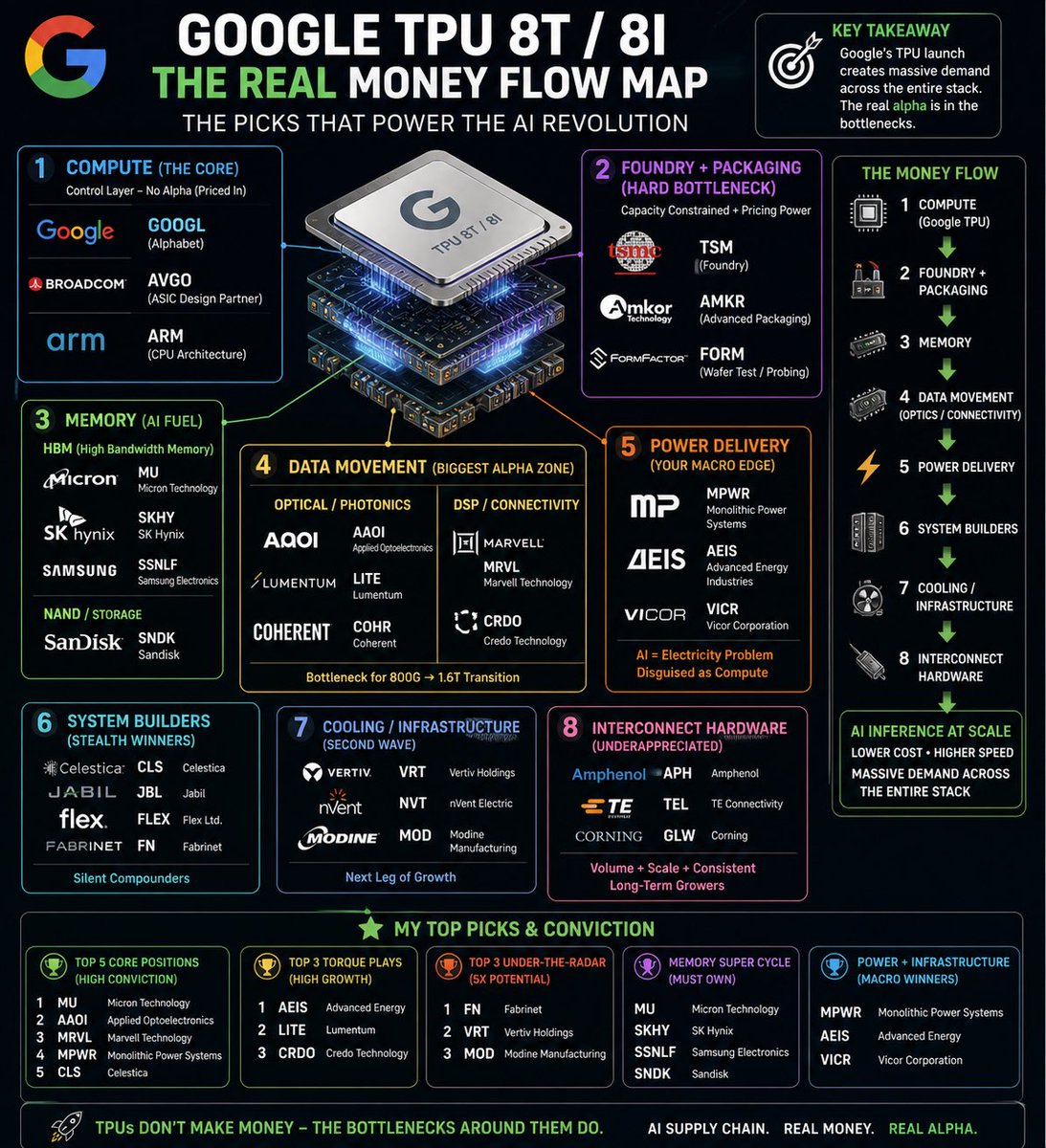
“TPUs don’t make money — the bottlenecks around them do.”
VenkatP tweet media
English
5
113
412
44.6K
vnitkar retweetledi
Ronin
Ronin@DeRonin_·
This 1-hour interview with the founder of Claude Code will teach you how to optimize your AI workflow better than 99% of developers using it daily No hacks. No workarounds. Just the exact system the person who built the tool uses himself The same guy who ships 20-30 PRs per day without writing a single line of code manually recorded this for FREE on YouTube Bookmark & give 1 hour, no matter what. It'll save you more tokens than anything else you'll read this month
Ronin@DeRonin_

i cut my Claude Code token usage by 50% with one file pasted this into my claude.md and measured for a week the trick: teach Claude when to use cheap models vs expensive ones Haiku for bulk work. Sonnet for research. Opus only when it actually needs to think before: mass-burning tokens on everything after: same output, half the cost here's the exact config: 1. task delegation block (paste into claude.md) tell Claude to spawn subagents and pick the cheapest model that can handle the job: - Haiku: bulk mechanical tasks, no judgment needed - Sonnet: scoped research, code exploration, synthesis - Opus: only when real planning or tradeoffs are involved set two caps: - Haiku never spawns further subagents (if it needs to, the task was wrong-sized) - max spawn depth is 2 (parent → subagent → one more tier) if a subagent realizes it needs a smarter model, it returns to the parent instead of escalating on its own 2. preferred tools block teach Claude to pick the free option first: - WebFetch for public pages (free, text-only) - agent-browser CLI for dynamic pages or auth walls (~82% fewer tokens than screenshot-based tools) - pdftotext for PDFs instead of the Read tool when Claude keeps fetching the same way repeatedly, tell it to wrap the pattern as a reusable tool 3. two lines in settings.json "CLAUDE_CODE_DISABLE_1M_CONTEXT": "1" — stops Claude from loading massive context windows you don't need "CLAUDE_AUTOCOMPACT_PCT_OVERRIDE": "80" — auto-compacts at 80% instead of waiting until it's full these two lines alone save a mass of tokens on every single session the whole setup takes 2 minutes the savings compound on every task you run after that apply it to your workflow and complete on 50% more tasks via Claude save it.

English
19
41
294
28.2K
vnitkar retweetledi
Michael Sikand 🦑
Michael Sikand 🦑@michaelsikand·
You can make money buying consensus stocks. But the asymmetric returns happen when you understand an asset better than the market. Of course, this strategy is harder and riskier but here's a few on my radar. 1. $INFQ - I call it the anti-quantum quantum stock because they're guiding for $40M in revenue by commercializing their quantum clocks for defense/space applications while others wait for commercial adoption. Trades at a fraction of its peers on P/S and the post-SPAC lockup doesn't appear to be as apocalyptic as expected per my convos with a few sharp traders. Forthcoming $20B Quantuinuum IPO re-rates sector? 2. $QCOM - Best ARM CPU IP outside of Apple / ex-Intel XEON architect hired now pivoting to building a data center CPU and ASIC. Hyperscaler customer confirmed yesterday. Tailwinds in smartphone and robotics inference chips. Priced like a distressed asset and reorganizing its valuable resources for an AI future. Investor update in June / new details are catalysts. 3. $FLY - 40% of their revenue base is EBITDA-positive missile tracking software not cash burning space projects. Thought of as a space stock but I think better described as a prime contractor on $185B golden dome program. Aims to nearly triple revenues this year. Has launch and lunar economy upside with rockets + lander. 4. $AVEX - Drone stock with a real, established business shipping diverse hardware to the battlefield with $430M in 2025 revenue. Guiding half that in Q1 2026 alone. It trades at a fraction of $ONDS market cap even though it did more revenue in 2025 than $ONDS guides for in 2026, and has much deeper ties in the ISR and U.S. defense ecosystem. IPO overhang and volatility creates uncertainty but doesn't change fundamentals to comps. What about you? Share your ticker and thesis below!
English
17
13
203
27.9K
vnitkar retweetledi
Lunar
Lunar@LunarResearcher·
An Anthropic engineer paid for my espresso at Sightglass when he saw my screen I was running my Polymarket bot from the counter. He was next in line. Looked over my shoulder. Stopped scrolling. "That's not a normal trading app. What's it actually running on" I told him. Claude Code. Four repos. $25 a month. He sat down without asking. "I'm on the agent team. We stress test Claude for exactly this. You're letting it find its own edges" Not just edges. Wallets. github.com/warproxxx/poly… 86 million trades. Every wallet. Every entry. Every exit. "You're feeding Claude raw wallet data and letting it identify who consistently wins. Then cloning them" He said it slowly. Like he was writing the threat model in his head. One prompt. Find every wallet with 100 plus trades and win rate above 70%. Rank by profit. Export top 50. Claude scanned 14,000 wallets in 4 minutes. Returned 47. The top 20 made more than the bottom 13,000 combined. "That's not a stat. That's a hit list" Exactly. "And you didn't write the scoring function" Claude did. I just wired it into an if-statement. Then I showed him the second repo. github.com/Polymarket/pol… Official Rust CLI. No API key for reads. 500 markets, Claude scores them in minutes. Gap. Depth. Resolution window. 487 markets become 35 before a dollar moves. 93% killed before I even see them. A green fill landed on the screen. +$84. Copytrade wallet: @0x6e1d5040d0ac73709b0621f620d2a60b80d2d0f?tab=positions&r=lunarlunar#ecEDHKq" target="_blank" rel="nofollow noopener">polymarket.com/@0x6e1d5040d0a… He watched it hit. "How does it decide to actually enter" Three agents. Shared wallet. No shared memory. Arbitrage, convergence, whale copy. 2 agree, full size. 1 alone, half. Disagree, no trade. Consensus filter alone killed 40% of losing trades. "And the exits?" The 47 whales never hold to settlement. 91% exit early. 73% of max profit captured. Redeploy immediately. My bot cuts at 85% of expected move or on a 3x volume spike. "You built a whale copy bot that exits before the whales" Yeah. He put his espresso down. "How often does it trade" 10 a day on average. Most of them skipped before I look up from my coffee. My setup: Claude API - $20/mo VPS in Germany - $5/mo poly_data - free polymarket-cli - free Polymarket/agents - free $200 seed. 27 days ago. $14,300 now. Copytrade here: @lunar" target="_blank" rel="nofollow noopener">kreo.app/@lunar 271 trades. 74% win rate. Sharpe 2.47. I haven't touched it in 27 days. He stared at the screen for a long time. "This is literally what our red team simulates. Except you actually shipped it" He emailed me the next morning. "Any chance you'd take a call with our policy lead" I told him the article is the call. Read it twice. Too late to gatekeep.
Trackmind@0xTrackmind

x.com/i/article/2046…

English
90
218
1.7K
982.7K
vnitkar retweetledi
Serenity
Serenity@aleabitoreddit·
Here's a bunch of random 30 US-available random stocks I like today and why: 1. $INTC - America's hope for foundry, national security 2. $MRVL - scales rev from future maia asics and add ons like cpo, they do everything lost count 3. $TSM - backbone of semis/ai 4. $COHR - They do everything vertically integrated + captures optical cycle 5. $RKLB - the final frontier of space will be around 5 years from now and 20 years from now. 6. $DRAM - memory exposure for samsung/sk hynix 7. $AVGO - hyperscalers dont like nvidia gpu tax 8. $AMZN - nobody can compete against the overnight shipping of toilet paper. robotics will lower opex over time 9. $ARM - AGI CPUs scale revenue quite a bit over the next decade 10. $TSEM - you're going to need a foundry for light based stuff 11. $IBIT - bitcoin, we all know by now 12. $NBIS - i think it's the next AWS. Also they do self-driving cars with uber, own scaling DB companies, data labeling. It's almost like a mini Google. 13. $GOOGL - youtube is not going away, gemini is great. they're vertically integrated with TPUs and fund buildout with operating income so i like it. 14. $AMKR - super facilities coming online in late 2027-2028. benefits from made in america 15. $HOOD - i dont like short term, but long term i'm a fan of Robinhood since they captured retail + have more products like banking, etc that they're scaling up. product innovation is wild. 16. $CRCL - I happen to really like stablecoins and see them as the future for both payments/holding (depends on clarity act) 17. $META - people aren't going to stop using instagram or whatsapp, or others anytime soon. 18. $LITE - $GOOGL TPU exposure decently high part of BOM. As long as Google's AI program keeps running I think $LITE will do well. 19. $LPTH - Germanium and China export controls will always be an issue so US made engineered alternatives will always be important 20. $FN - Someone needs to assemble optical stuff 21. $JBL - same as above, but added with ip from Intel's SiPh acqusition so might end up like innolight? 22. $MP - American rare earths program is extremely important, similar to $INTC national security risks 23. $HIMS - Okay here me out they just acquired a ton of companies, and at $19 they have global DTC channel. short sellers really hate this company, but I think it's actually promising as a contrarian long 24. $SMTC - LRO/LPO transition 25. $POWL - US alternative to hammond for switchgear DC type bottleneck 26. $VPG - Humanoids will be a thing down the road maybe 2027-2028, this makes the sensors. 27. $MOG.A - Feels like i see them everywhere in robotics, to spacex supply chains 28. $MSFT - At $375, one day we'll look back and see this as a buying opportunity. 29. $CVX - oil might crash after war but these oil companies are going to be extremely important, especially when Venezulea is a goldmine. 30. $XLU - i think rate cuts might be back online, we need power/grid for AI so these names will always be improtant from $CEG to $NEE Just throwing out other thoughts aside from $AAOI and $AEHR.
N@NabQ321

@aleabitoreddit Hey Serenity, If you already have a position in $AAOI, and a small bag of $AEHR, what 2-3 other stock would you look to add now/next few weeks to hold for 1+ years? (Excluding $SIVE and the small Asian stocks as not available for me) thanks for all you share!

English
183
675
5.9K
2.2M
vnitkar retweetledi
Brad Lyons
Brad Lyons@blyons151·
In August I wrote a thesis I never published. The funds I was warning were key Crossover Research clients, so I stayed quiet. Since then, 𝗦𝗼𝗳𝘁𝘄𝗮𝗿𝗲 𝗺𝘂𝗹𝘁𝗶𝗽𝗹𝗲𝘀 𝗮𝗿𝗲 𝗱𝗼𝘄𝗻 𝟱𝟬%+. Salesforce $CRM, ServiceNow $NOW, Adobe $ADBE, Workday $WDAY all off 40% from highs. Thomson Reuters $TRI dropped 16% in a single session on the Anthropic legal agent launch. The SaaSpocalypse arrived. So here's the follow-up. Not commentary on what happened, but where I think this goes next. Most vertical SaaS companies aren't underperforming because their software is bad. 𝗧𝗵𝗲𝘆'𝗿𝗲 𝘂𝗻𝗱𝗲𝗿𝗽𝗲𝗿𝗳𝗼𝗿𝗺𝗶𝗻𝗴 𝗯𝗲𝗰𝗮𝘂𝘀𝗲 𝘁𝗵𝗲𝘆 𝗻𝗲𝘃𝗲𝗿 𝗯𝘂𝗶𝗹𝘁 𝘁𝗵𝗲 𝘀𝗲𝗰𝗼𝗻𝗱 𝗯𝘂𝘀𝗶𝗻𝗲𝘀𝘀. And the first business is under attack. For twenty years, one of the biggest SaaS moats was engineering complexity: deep technical talent, long roadmaps, compounding codebases that were genuinely hard to replicate. 𝗔𝗜 𝘂𝗽𝗲𝗻𝗱𝗲𝗱 𝘁𝗵𝗮𝘁 𝗮𝗹𝗺𝗼𝘀𝘁 𝗼𝘃𝗲𝗿𝗻𝗶𝗴𝗵𝘁. Product development is democratizing to operators with no code background but strong product vision. Look at Anthropic: they've built the engine and are shipping lookalike products at a cadence that would have taken a legacy SaaS vendor three years of roadmap, with a fraction of the headcount. That pace can kill legacy businesses overnight. 𝗜𝗳 𝘁𝗵𝗲 𝗲𝗻𝗴𝗶𝗻𝗲𝗲𝗿𝗶𝗻𝗴 𝗺𝗼𝗮𝘁 𝗶𝘀 𝗴𝗼𝗻𝗲, 𝗳𝗼𝘂𝗿 𝗺𝗼𝗮𝘁𝘀 𝗿𝗲𝗺𝗮𝗶𝗻: 𝗱𝗶𝘀𝘁𝗿𝗶𝗯𝘂𝘁𝗶𝗼𝗻, 𝗽𝗿𝗼𝗽𝗿𝗶𝗲𝘁𝗮𝗿𝘆 𝗱𝗮𝘁𝗮, 𝘄𝗼𝗿𝗸𝗳𝗹𝗼𝘄 𝗯𝗿𝗲𝗮𝗱𝘁𝗵, 𝗮𝗻𝗱 𝗿𝗲𝗴𝘂𝗹𝗮𝘁𝗼𝗿𝘆 𝗶𝗻𝘀𝘂𝗹𝗮𝘁𝗶𝗼𝗻. The first three are moats the company builds. The fourth is a moat the company captures, and it's the one most resistant to AI disruption. 𝗥𝗲𝗴𝘂𝗹𝗮𝘁𝗼𝗿𝘆 𝗰𝗼𝗺𝗽𝗹𝗲𝘅𝗶𝘁𝘆 𝗰𝗿𝗲𝗮𝘁𝗲𝘀 𝘀𝘄𝗶𝘁𝗰𝗵𝗶𝗻𝗴 𝗰𝗼𝘀𝘁𝘀 𝘁𝗵𝗮𝘁 𝗵𝗮𝘃𝗲 𝗻𝗼𝘁𝗵𝗶𝗻𝗴 𝘁𝗼 𝗱𝗼 𝘄𝗶𝘁𝗵 𝗽𝗿𝗼𝗱𝘂𝗰𝘁 𝗾𝘂𝗮𝗹𝗶𝘁𝘆. Once a vendor is embedded in a compliance workflow, ripping them out means re-attesting, re-auditing, and re-certifying every downstream process. The buyer isn't paying for software, they're paying for the accumulated paper trail. Tyler Technologies ($TYL) is the clearest version of the pattern. State and local government software across courts, public safety, assessment, and ERP. Every module is married to statutory process, FIPS, CJIS, audit trails, and procurement cycles that take years. TYL is down 42% TTM and 2026 guidance came in soft, but the moat didn't break. Revenue still compounded, and government procurement runs on five-year cycles, not five-week news cycles. Veeva is the sharper version. Revenue up 16% in FY26, Q4 beat, the stock still down 25%. The market is selling execution, not weakness. Guidewire in P&C insurance, where regulatory filings and rate approvals anchor the stack, sits in the same setup: still compounding ARR, still winning cloud conversions, multiple reset anyway. Same pattern across all three: multiples compressed, fundamentals intact. The moat is the regulatory surface area itself, and it compounds because the rules get more complex, not less. 𝗜 𝘄𝗮𝘀 𝗹𝗼𝗻𝗴 𝗣𝗮𝗹𝗮𝗻𝘁𝗶𝗿 𝗮𝘁 $𝟭𝟯 (read that here: x.com/blyons151/stat…). 𝗡𝗼𝘁 𝗯𝗲𝗰𝗮𝘂𝘀𝗲 𝗼𝗳 𝘁𝗵𝗲 𝗺𝗼𝗱𝗲𝗹 𝗼𝗿 𝘁𝗵𝗲 𝘁𝗼𝗼𝗹𝗶𝗻𝗴. 𝗕𝗲𝗰𝗮𝘂𝘀𝗲 𝗼𝗳 𝘁𝗵𝗲 𝗼𝗻𝘁𝗼𝗹𝗼𝗴𝘆. Palantir is the proprietary-data version of the regulatory thesis. Once Palantir sits between the customer and their own data, ripping it out means rebuilding the data model from scratch. Snowflake and Databricks never had that entrenchment layer. AIP bootcamps then turned the data moat into a distribution moat: 660 bootcamps in a single quarter, 94% y/y US customer deal growth, bookings at 1.9x sales. Own the data, ship functional AI on top of it, let the GTM compound. Every vertical incumbent has a version of this available. The question is whether they'll build it before a challenger does. But regulatory insulation is necessary, not sufficient. Plenty of vendors inside regulated verticals are still getting squeezed because they never became AI-native. BlackLine ($BL) and Trintech are feeling it in close and reconciliation as Numeric, Maximor, and Stacks build AI-native from day one. nCino ($NCNO) in banking faces the same challenge. The regulatory moat buys you time. It doesn't buy you the decade. 𝗧𝗵𝗲 𝘄𝗶𝗻𝗻𝗶𝗻𝗴 𝗳𝗼𝗿𝗺𝘂𝗹𝗮 𝗶𝘀 𝗱𝗮𝘁𝗮 𝗼𝗿 𝗿𝗲𝗴𝘂𝗹𝗮𝘁𝗼𝗿𝘆 𝘀𝘂𝗿𝗳𝗮𝗰𝗲 𝗮𝗿𝗲𝗮 𝗽𝗹𝘂𝘀 𝗳𝘂𝗻𝗰𝘁𝗶𝗼𝗻𝗮𝗹 𝗔𝗜, 𝗻𝗼𝘁 𝗼𝗻𝗲 𝗼𝗿 𝘁𝗵𝗲 𝗼𝘁𝗵𝗲𝗿. Look at why Claude is winning. Anthropic isn't competing on model benchmarks, they're competing on functional workflow. Building for the user, not the leaderboard. That's the playbook vertical incumbents need to run. Take the moat you already have, whether it's regulatory or data-entrenchment, layer genuine workflow AI on top, and the challenger can't catch you. The vendors that do both win the decade. The ones that rely on inertia alone get caught. The ones that ship AI without an anchor get commoditized. You need both. 𝗧𝗵𝗲 𝗯𝘂𝘆𝗲𝗿 𝗶𝘀 𝘁𝗲𝗹𝗹𝗶𝗻𝗴 𝘆𝗼𝘂 𝘁𝗵𝗶𝘀 𝗽𝗹𝗮𝗶𝗻𝗹𝘆. A study we ran with Battery Ventures on AI adoption in the Office of the CFO (battery.com/blog/first-cod…) surveyed 129 finance leaders at companies from $50M to $5B+ in revenue. 77% said they want to uplevel existing systems with AI from new vendors that layer onto existing systems. Only 15% want to replace their current system of record with an AI-native platform. The incumbent wins if they ship AI. The AI-native challenger wins only if the incumbent doesn't. The signal shows up in our VoC data too. In regulated verticals, mission criticality scores cluster above 9, and NPS doesn't track satisfaction, it tracks switching friction. Customers will tell you the product is mediocre and still score it 9 on "would not switch" because the compliance team vetoes any alternative. 𝗧𝗵𝗮𝘁'𝘀 𝘁𝗵𝗲 𝘀𝗶𝗴𝗻𝗮𝘁𝘂𝗿𝗲 𝗼𝗳 𝗮 𝗰𝗼𝗺𝗽𝗹𝗶𝗮𝗻𝗰𝗲-𝗶𝗻𝘀𝘂𝗹𝗮𝘁𝗲𝗱 𝘃𝗲𝗻𝗱𝗼𝗿, 𝗮𝘀 𝗹𝗼𝗻𝗴 𝗮𝘀 𝘁𝗵𝗮𝘁 𝘃𝗲𝗻𝗱𝗼𝗿 𝗶𝘀 𝗮𝗰𝘁𝗶𝘃𝗲𝗹𝘆 𝘀𝗵𝗶𝗽𝗽𝗶𝗻𝗴 𝗮𝗴𝗮𝗶𝗻𝘀𝘁 𝘁𝗵𝗲 𝗔𝗜 𝗰𝘂𝗿𝘃𝗲. Which brings us back to the second business for everyone outside the regulated or data-entrenched moat. Seat ARR got them to $100M. But with the shift to agentic workforce structures, partial human capital replacement, and pricing pressure compressing margins, the traditional SaaS model has to transform fast. The next $500M comes from monetizing the installed base: marketplace rake on demand they generate for their own customers, capital products underwritten by their own transaction data, supplier monetization, brand partnerships, group buying. The assets are already sitting there. Captive SMB audience. Proprietary transaction and behavioral data. A distribution pipe (the UI itself) that delivers new products at near-zero CAC. 𝗪𝗵𝗮𝘁'𝘀 𝗺𝗶𝘀𝘀𝗶𝗻𝗴 𝗶𝘀 𝗼𝗿𝗴𝗮𝗻𝗶𝘇𝗮𝘁𝗶𝗼𝗻𝗮𝗹 𝘄𝗶𝗹𝗹. Monetizing the installed base requires a different org than the one that got you to scale. Different GTM, P&L optics, and talent. Founders and boards under-invest because year one looks worse before it looks better, and public markets punish any SaaS multiple that starts to look like fintech or marketplace. So the second business never ships. The round prices in the optionality. The multiple compresses. The exit underwhelms. 𝗧𝗵𝗿𝗲𝗲 𝗱𝗶𝗹𝗶𝗴𝗲𝗻𝗰𝗲 𝗾𝘂𝗲𝘀𝘁𝗶𝗼𝗻𝘀 𝗻𝗼𝘁 𝗲𝗻𝗼𝘂𝗴𝗵 𝗶𝗻𝘃𝗲𝘀𝘁𝗼𝗿𝘀 𝗮𝗿𝗲 𝗮𝘀𝗸𝗶𝗻𝗴: 𝟭. 𝗪𝗵𝗮𝘁 𝗽𝗲𝗿𝗰𝗲𝗻𝘁 𝗼𝗳 𝗿𝗲𝘃𝗲𝗻𝘂𝗲 𝗰𝗼𝗺𝗲𝘀 𝗳𝗿𝗼𝗺 𝘀𝗼𝘂𝗿𝗰𝗲𝘀 𝗼𝘁𝗵𝗲𝗿 𝘁𝗵𝗮𝗻 𝘀𝘂𝗯𝘀𝗰𝗿𝗶𝗽𝘁𝗶𝗼𝗻 𝗮𝗻𝗱 𝗽𝗮𝘆𝗺𝗲𝗻𝘁 𝗽𝗿𝗼𝗰𝗲𝘀𝘀𝗶𝗻𝗴? Under 5%, they haven't started. 10 to 20%, thesis is live. Over 20%, it's working. 𝟮. 𝗛𝗼𝘄 𝗵𝗮𝗿𝗱 𝘄𝗼𝘂𝗹𝗱 𝗶𝘁 𝗯𝗲 𝘁𝗼 𝗿𝗲𝗰𝗿𝗲𝗮𝘁𝗲 𝘁𝗵𝗶𝘀 𝗰𝗼𝗺𝗽𝗮𝗻𝘆 𝗳𝗿𝗼𝗺 𝘀𝗰𝗿𝗮𝘁𝗰𝗵 𝘄𝗶𝘁𝗵 𝗔𝗜 𝘁𝗼𝗱𝗮𝘆? If a well-funded team with Claude and six engineers could rebuild the functional product in nine months, the software isn't the moat. The moat has to live somewhere else: proprietary data, a network, integrations, or regulatory surface area the challenger can't clear. If you can't point to at least one, you're underwriting a melting ice cube. 𝟯. 𝗪𝗵𝗮𝘁 𝗽𝗲𝗿𝗰𝗲𝗻𝘁 𝗼𝗳 𝘁𝗵𝗲 𝗯𝘂𝘆𝗲𝗿'𝘀 𝘀𝘁𝗶𝗰𝗸𝗶𝗻𝗲𝘀𝘀 𝗶𝘀 𝗿𝗲𝗴𝘂𝗹𝗮𝘁𝗼𝗿𝘆, 𝗮𝗻𝗱 𝘄𝗵𝗶𝗰𝗵 𝘄𝗮𝘆 𝗶𝘀 𝘁𝗵𝗲 𝗿𝘂𝗹𝗲 𝘀𝗲𝘁 𝗺𝗼𝘃𝗶𝗻𝗴? A regulatory moat evaporates if the regulation simplifies. Underwrite the direction of travel, not just the current state. 𝗔𝗻𝗱 𝘁𝗵𝗲 𝗰𝗹𝗼𝗰𝗸 𝗶𝘀 𝘁𝗶𝗴𝗵𝘁𝗲𝗿 𝘁𝗵𝗮𝗻 𝗺𝗼𝘀𝘁 𝗿𝗲𝗮𝗹𝗶𝘇𝗲. Retention in enterprise SaaS has largely been defined by the pain of systems replacement, not genuine moat. If the stickiness isn't backed by proprietary data, a harvesting flywheel, or regulatory surface area, those vendors are about to get disrupted. Pure seat-based pricing is dying unless vendors embrace agent-seat models, and LLM providers have been subsidizing the market on token cost, with recent pricing shifts signaling cash reserves aren't infinite. 𝗛𝗲𝗿𝗲'𝘀 𝘁𝗵𝗲 𝘂𝗻𝗱𝗲𝗿𝗮𝗽𝗽𝗿𝗲𝗰𝗶𝗮𝘁𝗲𝗱 𝗽𝗼𝗶𝗻𝘁: 𝗔𝗜-𝗻𝗮𝘁𝗶𝘃𝗲 𝗰𝗼𝗺𝗽𝗲𝘁𝗶𝘁𝗼𝗿𝘀 𝗵𝗮𝘃𝗲 𝘄𝗼𝗿𝘀𝗲 𝗴𝗿𝗼𝘀𝘀 𝗺𝗮𝗿𝗴𝗶𝗻𝘀 𝘁𝗵𝗮𝗻 𝗦𝗮𝗮𝗦 𝗶𝗻𝗰𝘂𝗺𝗯𝗲𝗻𝘁𝘀, 𝗻𝗼𝘁 𝗯𝗲𝘁𝘁𝗲𝗿. Inference costs haven't collapsed, and burning VC cash to subsidize unit economics is a bridge, not a business model. The incumbents should be winning on P&L. They're losing on product velocity and AI-readiness. That's a solvable problem if the board has the will to ship. Vendors without a second business, without a data moat, and without regulatory insulation will still lose, despite having better margins than their AI-native challengers. Customers switch on features and speed, not on unit economics. 𝗘𝗻𝘁𝗲𝗿𝗽𝗿𝗶𝘀𝗲 𝗮𝗻𝗱 𝗿𝗲𝗴𝘂𝗹𝗮𝘁𝗲𝗱 𝘃𝗲𝗿𝘁𝗶𝗰𝗮𝗹𝘀 𝗮𝗿𝗲 𝘁𝗵𝗲 𝗹𝗮𝘀𝘁 𝘀𝗮𝗳𝗲 𝗵𝗮𝗿𝗯𝗼𝗿, 𝗮𝗻𝗱 𝗼𝗻𝗹𝘆 𝗯𝗲𝗰𝗮𝘂𝘀𝗲 𝗼𝗳 𝗱𝗮𝘁𝗮 𝗯𝗿𝗲𝗮𝗱𝘁𝗵 𝗮𝗻𝗱 𝗰𝗼𝗺𝗽𝗹𝗶𝗮𝗻𝗰𝗲. Everywhere else, the premium is about to get competed away. Any fund underwriting vertical SaaS exposure right now should be asking the second-business question before the next check clears. DM me, email me brad@crossoverresearch.com, or let's chat about your portfolio/underwriting process (book.crossoverresearch.com). Crossoverresearch.com
English
65
210
1.6K
815.8K
vnitkar retweetledi
Jason Luongo
Jason Luongo@JasonL_Capital·
AI needs power. Nuclear is the answer. 5 stocks I think every investor should be watching: 1. $LEU - Centrus Energy Centrus doesn't just sell uranium. It's the only US company producing HALEU - the advanced fuel that next-gen reactors need to run. The DOE just awarded them $900M to expand enrichment at their Ohio plant. $3.8B backlog locked in through 2040. No domestic competitor can do what they do.
Jason Luongo tweet media
English
31
69
614
159.5K
vnitkar retweetledi
Aaron Levie
Aaron Levie@levie·
Another week on the road meeting with a couple dozen IT and AI leaders from large enterprises across banking, media, retail, healthcare, consulting, tech, and sports, to discuss agents in the enterprise. Some quick takeaways: * Clear that we’re moving from chat era of AI to agents that use tools, process data, and start to execute real work in the enterprise. Complementing this, enterprises are often evolving from “let a thousand flowers bloom” approach to adoption to targeted automation efforts applied to specific areas of work and workflow. * Change management still will remain one of the biggest topics for enterprises. Most workflows aren’t setup to just drop agents directly in, and enterprises will need a ton of help to drive these efforts (both internally and from partners). One company has a head of AI in every business unit that roles up to a central team, just to keep all the functions coordinated. * Tokenmaxxing! Most companies operate with very strict OpEx budgets get locked in for the year ahead, so they’re going through very real trade-off discussions right now on how to budget for tokens. One company recently had an idea for a “shark tank” style way of pitching for compute budget. Others are trying to figure out how to ration compute to the best use-cases internally through some hierarchy of needs (my words not theirs). * Fixing fragmented and legacy systems remain a huge priority right now. Most enterprises are dealing with decades of either on-prem systems or systems they moved to the cloud but that still haven’t been modernized in any meaningful way. This means agents can’t easily tap into these data sources in a unified way yet, so companies are focused on how they modernize these. * Most companies are *not* talking about replacing jobs due to agents. The major use-cases for agents are things that the company wasn’t able to do before or couldn’t prioritize. Software upgrades, automating back office processes that were constraining other workflows, processing large amounts of documents to get new business or client insights, and so on. More emphasis on ways to make money vs. cut costs. * Headless software dominated my conversations. Enterprises need to be able to ensure all of their software works across any set of agents they choose. They will kick out vendors that don’t make this technically or economically easy. * Clear sense that it can be hard to standardize on anything right now given how fast things are moving. Blessing and a curse of the innovation curve right now - no one wants to get stuck in a paradigm that locks them into the wrong architecture. One other result of this is that companies realize they’re in a multi-agent world, which means that interoperability becomes paramount across systems. * Unanimous sense that everyone is working more than ever before. AI is not causing anyone to do less work right now, and similar to Silicon Valley people feel their teams are the busiest they’ve ever been. One final meta observation not called out explicitly. It seems that despite Silicon Valley’s sense that AI has made hard things easy, the most powerful ways to use agents is more “technical” than prior eras of software. Skills, MCP, CLIs, etc. may be simple concepts for tech, but in the real world these are all esoteric concepts that will require technical people to help bring to life in the enterprise. This both means diffusion will take real work and time, but also everyone’s estimation of engineering jobs is totally off. Engineers may not be “writing” software, but they will certainly be the ones to setup and operate the systems that actually automate most work in the enterprise.
English
254
645
5.3K
1.8M
vnitkar retweetledi
Paradis Labs
Paradis Labs@ParadisLabs·
Couldn't agree more - $COHR and $MRVL are both steady compounders w/ excellent exec teams that constantly innovate (relatively speaking for similar MC companies) Honestly feel like an equal weighted ETF of $COHR, $MRVL, SK hynix, and $TSEM would outperform most institutional investors over the next couple yrs
Serenity@aleabitoreddit

I feel like $COHR and $MRVL are the two "They Do Everything" longs. That nobody actually knows what they do if you ask them in public. $NVDA? GPUs. $INTC? Foundry. Marvell? No clue. Coherent? No clue. They're the Deloitte of Semis. Both are really solid profitable longs over the next year. Probably not 200% gains but 50-100% seem reasonable here.

English
3
13
156
73.2K
vnitkar retweetledi
Sharbel
Sharbel@sharbel·
Full Polymarket Bot Build | Claude Code Tutorial: 0:00 - Intro 0:53 - Setup 1:49 - Bullpen CLI 5:01 - Pull top traders 8:40 - Set rules 15:15 - Build a dashboard 17:38 - Claude hack 20:39 - Bot LIVE 23:00 - 2 extra commands 24:00 - 3 hour results: 13% profit 25:13 - Honest take
English
106
512
3.9K
364.8K
vnitkar retweetledi
Michael Sikand 🦑
Michael Sikand 🦑@michaelsikand·
Someone put a gun to my head. They said "make me $1M from $100K with 10 stocks". This answer saved my life. 1) $KRKNF - This subsea drone component monopoly is on the verge of revenue explosion as Anduril ramps production of its autonomous submarine fleet. $2B MC 2) $ASTS - This satelite internet play could make connectivity abundant with just a few dozen satellites, earning 90%+ gross margins on billions of customers provided by partners like AT&T and Verizon. $33B MC 3) $SOI.PA $SLOIF - This photonics monopoly down 75% supplies 95%+ of the wafers every silicon photonics chip is built on. When CPO replaces pluggable transceivers, wafer content per port quadruples. $2B MC. 4) $OPTX - This vertically integrated optics micro cap is almost certainly supplying into Anduril's $20B super solider VR program. Every NATO soldier could have one. $250M MC. 5) $BE - Has a monopoly on solid oxide fuel cells that can power data centers and factories completely independent from the grid. Already does billions in sales, lit an $ORCL site in 45 days. $37B MC. 6) $AAOI - Explosive trade on AI photonics. Guiding to a mid 2027 monthly transceiver run rate of $378M, which annualizes to $4.5B against $456M in total 2025 revenue. $7.7B MC. 7) $EQR.AX / $EQRLF - Already the largest western tungsten producer at A$147/mtu cash costs, sitting on APT has gone from $320 to nearly $3,000 and the parabola is just starting. $1B MC . 8) $OSS - Rugged edge compute for battlefields, submarines, and vehicles where you can't ship data back to the cloud. Possible Anduril link. $180M MC. 9) $NBIS - AI's AWS with $46B in contracted revenue from Meta and Microsoft against a $25B market cap, built by the guy who created Russia's $31B version of Google. $25B MC. 10) $LASR - Directed energy laser weapons mean infinite ammo at near zero cost per shot. As drone swarms become the dominant battlefield threat, the West needs a weapon that never runs out. $3.3B MC.
English
33
104
770
104.9K
vnitkar retweetledi
Serenity
Serenity@aleabitoreddit·
Faster compounds: $AAOI - 10x revenue ramp from optical transcivers h2 2027 $NBIS - 10x revenue ramp Q4 2026 $ARM - 5x revenue growth from their new AI CPU $MRVL - 2-3x revenue growth from $MSFT Maia Ramp. $AVGO - Long hyperscaler ASIC $LITE - Long OCS / Google TPU Win Semi - Foundry exposure to frontier industries $TSEM - Long photonics, backlogged SK Hynix - Memory exposure, extreme operating income ramp With some barbell exposure away from Hyperscaler capex aside from Amazon: $VNP - Long term rare earths for Western Supply chains $NEO (TCX) - Robotics Supply chains $AMZN - Robotics/AI cutting opex $CRCL - Stablecoin long $RDDT - Ridiculously high profit $GLD - Safe Hedge $IBIT - Halving 2028 $CVX Calls - Oil Hedge And maybe long term (you know it's coming): $INTC / $AMKR- Made in America supply chains $SOI - Silicon Photonics / CPO substrates. $RKLB - Long term call on Space industry Then pick one or two small cap moonshots: $SIVE - CW Laser Chokepoints or $IQE for Landmark rerating on restructuring were my two favorites. There's others I've mentioned like $AEHR for testing or $VPG for Optimus. How I actively manage my own stuff from $AXTI and others is a lot different risk profile than what others should do. Going full port into high-beta in this macro environment is not the best idea.
5k to 5000k@Ud197601

@aleabitoreddit @BitcoinAIGuy Do you mind sharing a core diversified list for those looking to allocate smaller accounts? Under $250k? Wasnt sure if your list has changed from recent macro events

English
66
157
1.4K
230.6K
vnitkar retweetledi
Matt Turck
Matt Turck@mattturck·
My latest conversation with the always incredible @benedictevans: OpenAI’s moat problem, the rise of ephemeral and improvised sofware, OpenClaw & agents. 00:00 Intro 01:06 OpenAI's Focus Shift 03:12 ChatGPT usage: a "mile wide, inch deep" 09:03 Why better models do not solve the real problem 13:58 Why AI product teams are strategy takers, not strategy setters 15:38 Do agents help create defensibility? 20:06 OpenClaw and the "Desktop Linux" moment for AI 25:52 Why "everyone will build their own software" is completely wrong 28:09 Improvised software vs. institutionalized software 29:23 Why there will be more software, not less 36:15 Are we heading toward value destruction before value creation? 38:03 Circular revenue, leverage, and AI bubble dynamics 38:53 Big Tech's Trillion-Dollar CapEx Crisis & Financial Gravity 45:23 Why AI job exposure charts can be misleading 52:15 How Fortune 500 Execs are actually deploying AI today 56:45 The White Space: What this means for founders and investors
English
19
35
253
36.5K
vnitkar retweetledi
Mike Investing
Mike Investing@MrMikeInvesting·
I’ve said it before, & I’ll say it again… These 8 names will create generational wealth for many in 2026: 1. AST SpaceMobile ~ $ASTS 2. Ondas Holdings ~ $ONDS 3. Ishares Bitcoin ~ $IBIT 4. Rocket Labs ~ $RKLB 5. Nebius Group ~ $NBIS 6. Planet Labs ~ $PL 7. Intuitive Machines ~ $LUNR 8. One Stop Sys ~ $OSS I can assure that you’ll look back at this post later this year, & be glad you listened. Bookmark this to look back on…
English
59
132
1.2K
144.6K
vnitkar retweetledi
Chris Worsey
Chris Worsey@Chris_Worsey·
I took the @karpathy autoresearch loop and pointed it at markets. 25 AI agents debate macro, rates, commodities, sectors, and single stocks daily. Every recommendation scored against real outcomes. Worst agent by rolling Sharpe gets its prompt rewritten by the system. Keep or revert. Same loop, prompts are the weights, Sharpe is the loss function. Trained the agents on 18 months of market data. 378 iterations. 54 prompt modifications, 16 survived. The system learned which agents to trust using Darwinian weights — geopolitical, commodities, and the @BillAckman quality compounder rose to the top. The agents even figured out their own portfolio manager was the weakest link before we did! Deployed the trained agents. +22% in 173 days. Best pick: AVGO at $152, held for +128%. The final prompts are evolutionary products — shaped by market feedback, not human intuition. Now running live with my own capital. github.com/chrisworsey55/… Part hedge fund, part research experiment :)
Andrej Karpathy@karpathy

I packaged up the "autoresearch" project into a new self-contained minimal repo if people would like to play over the weekend. It's basically nanochat LLM training core stripped down to a single-GPU, one file version of ~630 lines of code, then: - the human iterates on the prompt (.md) - the AI agent iterates on the training code (.py) The goal is to engineer your agents to make the fastest research progress indefinitely and without any of your own involvement. In the image, every dot is a complete LLM training run that lasts exactly 5 minutes. The agent works in an autonomous loop on a git feature branch and accumulates git commits to the training script as it finds better settings (of lower validation loss by the end) of the neural network architecture, the optimizer, all the hyperparameters, etc. You can imagine comparing the research progress of different prompts, different agents, etc. github.com/karpathy/autor… Part code, part sci-fi, and a pinch of psychosis :)

English
156
232
4K
774.8K