ONEXO

3.7K posts

ONEXO banner
ONEXO

ONEXO

@web3shop

ONEXO.btc | ₿ miners⛏️ | 🟧₿itmap | 🟧BNS Investor | 🟧Ordinals | 🟧BRC20 | 😀EMOJIS | 🌐 ₿itEarth

654.bitmap Katılım Mart 2022
245 Takip Edilen267 Takipçiler
Sabitlenmiş Tweet
ONEXO
ONEXO@web3shop·
⬇️ What will grow EXPONENTIALLY in 2025-2026? ⬇️ @RaoulGMI @bns_community @one_bns @unstoppableweb youtube.com/watch?v=AsuDXq…

YouTube video
YouTube
BNS One | Empowering Your Digital Identity@one_bns

GM! 👨‍🚀🚀 @DTAPCAP: “What’s growing exponentially that we’re not focused on?” @RaoulGMI: “Probably the biggest of all - Digital ID, proof-of-AI, proof-of-humanity.” The future is identity. BNS is ready. 🔐 🎥 youtu.be/AsuDXq7ozW8?si…

English
1
1
7
5.1K
ONEXO retweetledi
Casmir.x
Casmir.x@casmir_dot_x·
Hey @mattgould, how does a "Bait & Switch" fit into your ICANN RSP Evaluation? 1. RAA Section 3.7 requires "high standards of ethical conduct." Selling "No Renewal" Web3 domains and then pivoting to 99% Web2 DNS is the opposite of ethical. 🚩
English
1
6
24
648
ONEXO retweetledi
eriq.btc | eriq.x
eriq.btc | eriq.x@instoppabile·
@OnchainDomainer @mattgould You are in the game bc you made a lot of money milking your friends. We know you are another puppy managed by Sandy. You can only say yes to your masters.
English
0
2
9
349
ONEXO retweetledi
BitcoinAIGuy
BitcoinAIGuy@BitcoinAIGuy·
$IREN Twitter Space Summary — Dan Roberts, Bitcoin Butcher & Frans What This Was A retail investor community space where co-CEO Dan Roberts fielded questions from two prominent IREN retail advocates. The tone was respectful but pointed — investors clearly wanted clarity on capital deployment, site development, and deal timing. Key Topics & Takeaways 💰 The $6B ATM (At-The-Market Equity Facility) Dan was direct and composed on this. His core message: establishing a $6B ATM ≠ issuing $6B of stock. Key points: It's optionality, not obligation — could have been $100B, the number is irrelevant until drawn The Microsoft contract is already effectively fully funded 50,000 new GPUs don't require payment until 30 days post-shipment (H2 2026) They've raised $9.3B in 8 months via prepayments, convertibles, GPU leasing/financing — ATM is a last resort, not a first move He explicitly framed equity issuance as accretive (you get cash) not dilutive in isolation Read between the lines: He was clearly well-prepared for this question and wants to neutralize retail panic. The framing was disciplined and confident — not defensive. 🖥️ The 50,000 B300 GPU Purchase Framed around "time to compute" — securing GPU allocation now in a supply-constrained market Delivery in H2 2026, payment 30 days after shipping Financing to be determined, but customer prepayments are expected against this purchase No customers explicitly named, but Dan strongly implied hyperscalers and large enterprises are actively engaged — "there aren't many AI cloud users we're not talking to" Read between the lines: The word "already spoken for" was carefully avoided, but the implication was clear — you don't order 50,000 GPUs without visibility on who's buying compute from them. 🌡️ Air Cooling vs. Liquid Cooling — The Big Strategic Pivot This was arguably the most substantive part of the call. Childress (TX) is now being designed for air-cooled deployment — a change from earlier liquid-cooled renderings Drivers: significantly lower cost, faster time to market, and — notably — hyperscalers are explicitly requesting air-cooled deployments Texas heat concern acknowledged: may need "incremental retrofits" for intake temperatures during peak summer The retrofit playbook mirrors Prince George — remove miners, roll in GPU racks, add UPS/generators John Grose (newly hired, VP Chair of ASHRAE) brought in specifically for high-density data center design expertise Read between the lines: The pivot to air-cooled at Childress looks like it was customer-driven, not internally initiated. Multiple hyperscalers are asking for it. This is a very bullish signal — customers are pulling them toward faster deployment, not the other way around. 📍 Site-by-Site Intelligence Childress (TX) Air-cooled retrofit underway, leveraging the Prince George playbook Multiple hyperscalers interested in air-cooled capacity here Full site was originally modeled for liquid cool — that's still the long-term design, but air-cooled is the near-term path 50,000 B300s split between McKenzie and Childress (33K/17K referenced by Butcher) Canal Flats miners running until ~September — miners stay in until GPUs are ready, no premature idle time Read between the lines: The speed of execution here is the key variable for 2026 revenue. If air-cooled retrofits are as fast as Prince George, meaningful ARR could land in Q3-Q4 2026. McKenzie (BC) Referenced as "next in line" after Prince George 33,000 of the new B300s likely destined here Less detail shared — likely still in earlier planning stages relative to Childress Sweetwater (TX) — The Most Interesting One 1,400 MW confirmed for Sweetwater 1, 600 MW for Sweetwater 2 — ARCOT (grid energization) confirmed, no issues anticipated Timeline shifted from "April" to "Q2" — Dan clarified "April is also part of Q2" (a subtle but important deflection) Franz noted satellite imagery shows broad site preparation across both sides of the road — suggesting parallel construction planning, not a single data center footprint Two primary substations already visible Dan was asked directly: air cool or liquid cool at Sweetwater? His answer: "I don't know" — genuinely open, framed as a dynamic market decision Dan would not bite on hyperscaler exclusivity/ROFR questions but acknowledged those conversations happen "almost every day" Oklahoma filing referenced a data center design modeled after Sweetwater — implying a site blueprint already exists Read between the lines: Sweetwater is the crown jewel and Dan is holding cards tightly. The ROFR/exclusivity discussion implies hyperscalers are pushing hard for lock-up of the site. The fact that he won't commit to air vs. liquid suggests he either has or is close to having a customer who is dictating specs. The satellite imagery Franz described — broad multi-track site prep — suggests they're preparing for parallel builds, which only makes sense if you have or anticipate large contracted capacity. Prince George (BC) 10 MW liquid-cooled data center described as a "1,000 GPU proof of concept" — Dan downplayed it significantly Said it became less relevant after the 76,000 GPU Microsoft deployment proved liquid cool at scale May convert to air-cooled instead — "stay tuned" Read between the lines: This site is essentially a rounding error now. Dan wasn't trying to hide anything — it just genuinely isn't material to the thesis anymore. 🟢 Bullish Signals Hyperscalers requesting air-cooled deployments — demand is pulling them, not pushing Contract durations trending to 3-5 years as customers gain confidence in IREN's execution Customer prepayments remain a standard feature of negotiations Dan's confidence on Sweetwater energization — zero hedging on grid access GPU market remains supply-constrained globally — "no GPUs sitting idle in data centers" IREN owns and controls construction (no EPC outsourcing) — speed and cost advantages compound over time APAC expansion quietly underway (Sydney office, AFL sponsorship, Australian roots) John Grose hire signals serious institutional data center engineering capability Dan's tone on Sweetwater hyperscaler conversations was notably calm and unworried 🔴 Bearish / Risk Signals Air-cooled at Childress in Texas heat introduces execution risk — they acknowledged needing potential incremental cooling retrofits H2 2026 GPU delivery is vague — could be October, November, or December, pushing meaningful revenue into 2027 No named customer, no disclosed deal — the "when deal" question remains unanswered Macro environment is brutal (stock near ~$34 at time of call, down significantly) ATM overhang is real psychological weight even if economically rational Canal Flats removed from ARR guidance until after September mining wind-down Every data center generation introduces new delays — Dan acknowledged "Groundhog Day" syndrome across the industry Bottom Line Read Dan Roberts came across as calm, prepared, and strategically coherent. He wasn't defensive, didn't over-promise, and gave more color than expected on the ATM and air-cooling pivot. The most important unspoken message: Sweetwater hyperscaler conversations are serious and active — the ROFR/exclusivity dynamic he described doesn't happen unless multiple large players are at the table. The air-cooled pivot at Childress looks like a customer-driven acceleration, which is the most bullish data point of the call. The key risk remains execution timing — H2 2026 GPU delivery and retrofit speed will determine whether 2026 ARR guidance is achievable. Thanks @Proof_Of_Fib for the summary. Good job @FransBakker9812 @bitcoinbutcher1 @danroberts0101
Frans Bakker@FransBakker9812

$IREN Weekly Space 3/8/2026 Recording Thank you all for joining our space. Especially thanks to co-CEO of IREN @danroberts0101 for joining us tonight to give us an update on the business. Listen to the recording here: x.com/FransBakker981… Dan starts around the 30 minute mark

English
24
44
362
59.8K
ONEXO retweetledi
BNS One | Empowering Your Digital Identity
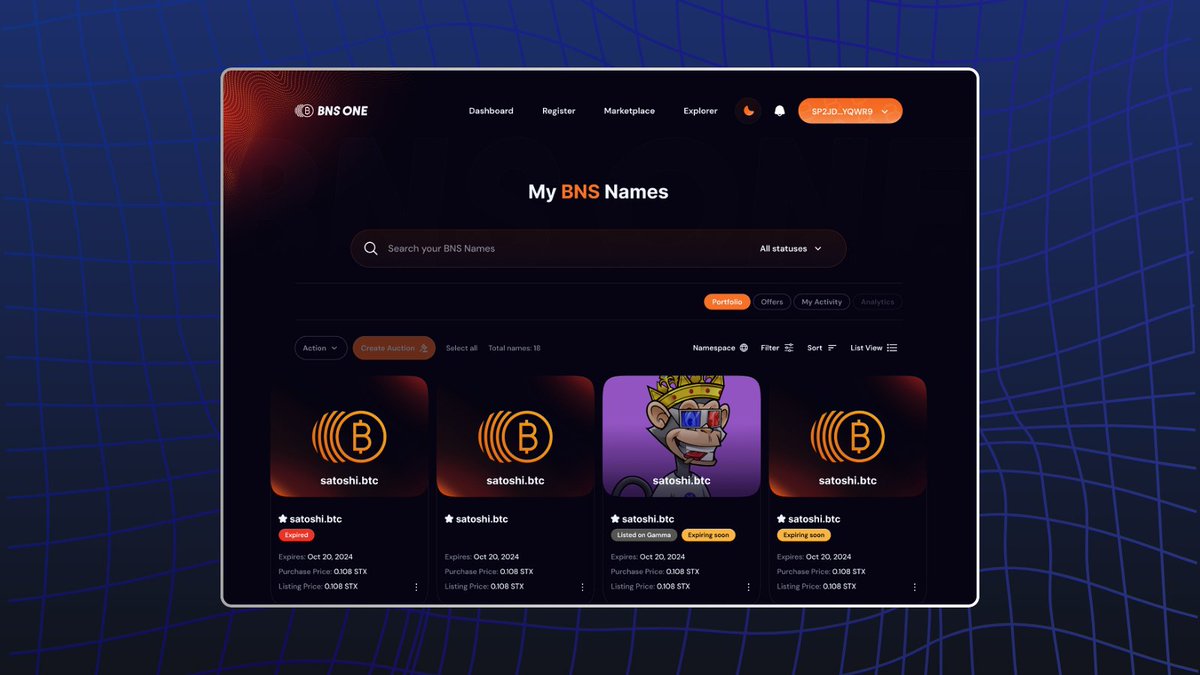
Sneak peek at the new BNS One dashboard. 👀 A smoother, more powerful way to manage your BNS names is coming. The upgrades we’re building will change the game for Web3 naming platforms. ⚡🫡
BNS One | Empowering Your Digital Identity tweet media
English
4
6
18
333
ONEXO retweetledi
matthew sigel, recovering CFA
matthew sigel, recovering CFA@matthew_sigel·
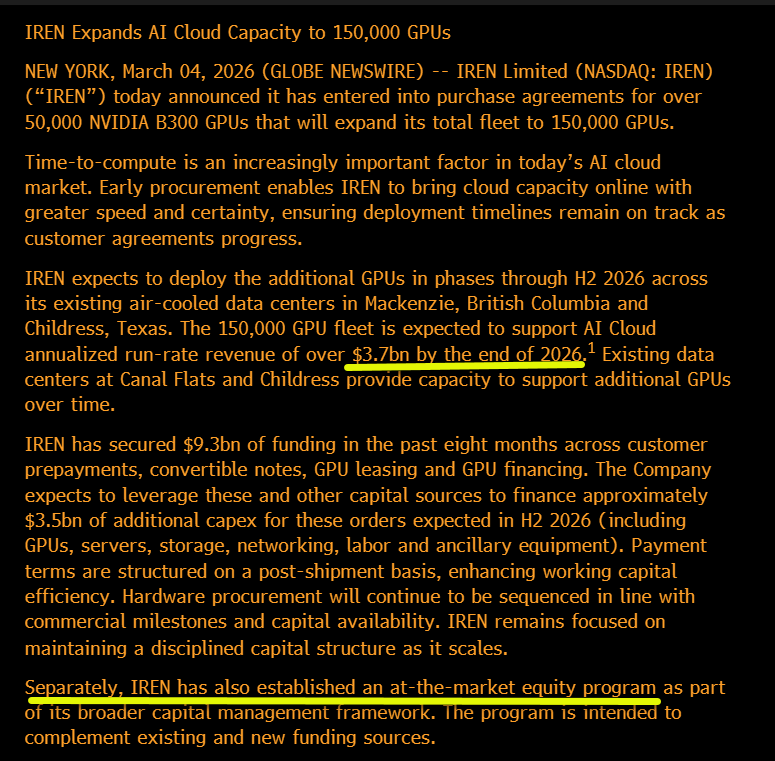
$IREN expands AI cloud capacity to 150K GPUs, says can support $3.7B ARR by end of 2026. Also announces a new ATM but no details on size.
matthew sigel, recovering CFA tweet media
English
23
28
312
86.9K
ONEXO retweetledi
Big Degen 🇦🇺
Big Degen 🇦🇺@TheBigDegen·
$IREN BULL CASE IN ONE POST 👀 🔥 Soon will be flipping the switch on 1.4 GW of fresh SWEET power - NVDA GPUs included. Nobody else is bringing anything close in 2026. 🔥 $3.4B ARR target by EOY using just 10% of their 4.5 GW secured portfolio 🔥 $9.7B MSFT deal already signed, $1.9B cash upfront - real revenue, real fast! 🔥 Preferred NVDA partner + proprietary liquid cooling = first dibs on the hottest silicon 🔥 Full vertical stack: owns the land, power, build, hardware, ops. This isn’t colocation landlord theater. This is own-the-stack, capture-every-margin AI infrastructure 🔥 And now MSCI USA index inclusion ✅ Any BIG red days in current choppy market? Buy $IREN! This thing prints millionaires 🔥🔥🚀🚀
English
8
15
143
11K
ONEXO retweetledi
ONEXO retweetledi
eriq.btc | eriq.x
eriq.btc | eriq.x@instoppabile·
Testing an AI appraisal tool for the @one_bns Send me a name and will reply with agent response Crypto.btc $12000, Given its strong semantic meaning as a crypto-related term and previous high sales, 'crypto.btc' commands an ultra-rare premium value.
English
2
2
9
289
ONEXO retweetledi
Danny Marques | Investing Informant
Danny Marques | Investing Informant@Invst_Informant·
Oobit’s DTR Integration is a Strategic Win for Bakkt $BKKT What makes the Oobit and DTR integration interesting is not that another wallet added an off-ramp. Wallets add features every week. What matters here is who controls the settlement layer and what that implies if it scales. From the beginning, @Akshay_Naheta stated ambition for Bakkt has been to sit at the connective layer between digital asset infrastructure and the regulated financial system. Stablecoins have already proven that they can move value at global scale (>$30T annually by most estimates) with hundreds of billions clearing each month. But moving value onchain and settling value inside bank accounts are not the same thing. Liquidity is one half of the equation. Regulated settlement is the other. Distributed Technologies Research (DTR), which Bakkt has under a potential acquisition, is the infrastructure that addresses that second half. Oobit’s new wallet-to-bank capability runs on DTR’s routing engine. Under the hood, that engine handles FX conversion, liquidity management, compliance routing, and connectivity into domestic payment rails such as SEPA, ACH, SPEI, PIX, and InstaPay. In other words, it does the unglamorous but essential work of turning programmable dollars into regulated bank deposits. The flow itself is simple. 1. A user holds stablecoins in self-custody inside the Oobit wallet 2. When they initiate a transfer, DTR converts crypto into a USD-equivalent stablecoin amount 3. That value moves into DTR’s settlement engine 4. DTR executes foreign exchange where required and routes the payout through the appropriate domestic rail (SEPA, ACH, SPEI, PIX, InstaPay) 5. Funds arrive in a local bank account as a standard deposit The user never leaves the Oobit interface. There is no redirection to an exchange, no separate custodial transition, no visible intermediary. That embedded, white-labeled architecture matters because in much of crypto, users are pushed out of wallets into third-party on- and off-ramps, introducing friction, compliance duplication, and abandonment risk. Here, onboarding, KYC, account creation, and settlement are integrated inside the Oobit wallet experience. The customer may not even know DTR is operating in the background. From a distribution standpoint, that is powerful. Equally important is the use of named accounts on the on-ramp side. In Europe (EUR), the UK (GBP), and the United States (USD), users can move money directly from their bank accounts into the Oobit wallet through accounts held in their own names at DTR. Banks see transfers between individuals rather than transfers to a crypto exchange. That structural detail reduces the probability of blocking and reportedly drives transaction success rates >99%. Combine the on-ramp in Europe with the off-ramp in Mexico and you have a full loop: euros enter from a regulated bank account, stablecoins move across blockchain rails, pesos exit into another regulated bank account. Each leg can generate economics. The feature introduces a corridor that previously didn’t exist. From Bakkt’s perspective, the significance lies in the economics of how this gets orchestrated. While payments is a ~$1.8T global revenue pool, cross-border flows remain fragmented and inefficient. Correspondent banks, acquirers, card networks, and FX desks each take their share. Yes, stablecoins give you fast, global liquidity but they do not eliminate the need for compliance, FX, and domestic rail access. That orchestration layer is where DTR operates. It’s a volume-based business model. Assume a settlement layer captures 50-100 bps of TVL. On $1 billion of annual flow, that’s $5-$10M of revenue. At $5 billion, it becomes $25-$50M. At $20 billion, the math scales quickly. The precise take rate will vary by corridor and competitive dynamics, but the elasticity is the point. Once compliance frameworks, liquidity pools, and rail integrations are built, incremental volume can carry improving marginal contribution. Oobit reportedly serves tens of millions of users. Even modest adoption of on- and off-ramp flows across that base can generate meaningful throughput. They provide the distribution, and DTR monetizes the settlement. If and when DTR formally sits under Bakkt’s umbrella, those settlement economics fully accrue to Bakkt. The broader implication is that the bottleneck in crypto has not been transaction volume, it’s been conversion into the regulated banking system. Stablecoins already move value 24/7. What they’ve lacked is frictionless integration with domestic payment rails at scale. If DTR becomes a preferred routing engine across multiple wallet and fintech partners, Bakkt would not need to win the consumer wallet war. It would need to win the infrastructure layer and it can do that by embedding its routing infrastructure across multiple distribution surfaces. Each additional integration compounds throughput without incremental customer acquisition cost. If that architecture can scale, it doesn’t stop at remittances. By operating at the convergence between two monetary systems, the global, onchain dollar economy and, the regulated domestic banking system, Bakkt can position itself to eliminate the friction that’s historically made the interoperability been slow, expensive, and opaque. If the handoff between the two can become seamless, predictable, and embedded, the implications can extend beyond remittances to payroll, SME treasury, and cross-border commerce. And, once settlement is trusted, adjacent products follow naturally: yield, credit, treasury optimization, programmable commerce, etc. There’s a massive opportunity and TAM for any business that can operate the conversion point between digital liquidity and bank money. The onchain dollar economy is already here. Winners will be companies that make those two systems interoperate at scale. Own that conversion layer and you own the doorway between both. That’s what DTR was built to do and that’s what Oobit is integrating.
Danny Marques | Investing Informant tweet media
English
10
20
63
16.9K
ONEXO retweetledi
eriq.btc | eriq.x
eriq.btc | eriq.x@instoppabile·
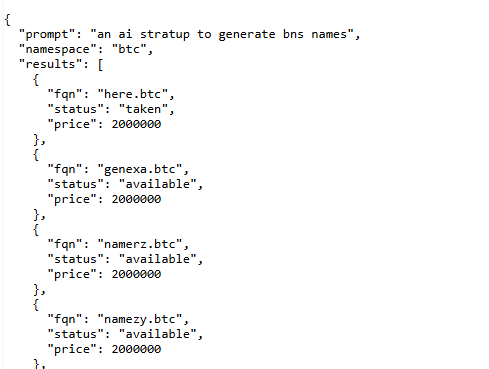
The wait for the perfect BNS name is almost over. ⏳ We’re integrating a local Llama 3.2 to bring AI-powered suggestions directly to our engine. 🧠🚀 🔹 Instant, smart branding 🔹 Real-time availability Coming soon. Get your wallet ready. 💎 cc: @Ollama @one_bns
eriq.btc | eriq.x tweet media
English
2
5
15
517
ONEXO retweetledi
Eric Jackson
Eric Jackson@ericjackson·
BTC didn't fail as an asset. It succeeded as an ETF. And that's the problem. From $126K to $63K. Every time IGV sells off, BTC sells off with it. That's not a store of value. That's a high-beta tech position with a different logo. IBIT changed who owns Bitcoin. In 2021, the marginal buyer was ideological. No allocation limits. No risk budget. No rebalancing. In 2026, the marginal buyer is institutional. Same desks that own IGV. Same desks that de-risk on the same day. The thing that was supposed to make BTC mainstream is the thing that made it correlated. Why didn't retail save it? Because retail went to NVDA. To PLTR. To HOOD. The crypto-native buyer already bought. There's no second wave walking through the door. Meanwhile, gold is up 47%. Gold's holder base doesn't get margin called on tech selloffs. Central banks don't rebalance into quarters. Sovereigns don't panic sell at 2am. When "store of value" is actually tested, the market picks the one with 5,000 years of track record. Not 15. So when does this turn? Watch two things: 1. IGV stabilizes. Not bounces - stabilizes. BTC won't decouple until the desks that own both stop selling both. 2. Stablecoin supply starts expanding. That's new money entering crypto, not existing holders rotating. Right now, it's flat. But here's what the bears are missing. Every cycle, the weak hands get filtered out. And every cycle, what replaces them is longer-duration capital. 2017: retail sold at $20K. 2021: funds sold at $69K. 2025: ETF allocators are selling at $63K. What comes next? Sovereign wealth funds. Corporate treasuries. Pension capital. Money that doesn't rebalance into quarters. Money that doesn't correlate to IGV. Money that holds for decades, not cycles. The institutional exit isn't the end of the BTC thesis. It's the purification of it. Here's the math most people won't do. Gold's holder base is sovereign-heavy. Gold is a $22 trillion asset. BTC's supply is fixed at 21 million coins. If BTC's next holder base even partially resembles gold's - sovereign, pension, corporate treasury capital that measures in decades, not quarters - then the asset that trades at $63K during an ETF shakeout is the same asset that trades at $1M when the holder base finally matches the thesis. Every prior cycle, the ceiling was set by who was buying. Retail gave you $20K. Funds gave you $69K. Institutions gave you $126K. Sovereigns don't have ceilings. They have mandates. BTC doesn't go to $1M because of halving math. It goes to $1M because the last class of sellers gets replaced by the first class of permanent holders. That's not a prediction. That's the structure. Infrastructure doesn't fail. Holder structures evolve.
English
131
199
1.5K
181K
ONEXO retweetledi
mon
mon@moninvestor·
$IREN AI needs power. A lot of it. Global data center electricity demand is set to quadruple over the next decade. The companies that own the power infrastructure are going to win this cycle. IREN controls 4.5 GW of power capacity and has only monetized around 10% of it so far. The upside here is enormous. I believe, this is one of the most underappreciated setups in the entire AI infrastructure trade right now.
mon tweet media
English
14
24
210
27.4K
ONEXO retweetledi
eriq.btc | eriq.x
eriq.btc | eriq.x@instoppabile·
🛠️ The new @one_bns Explorer is coming soon! Currently building a powerful way to track all BNS name activity 👇 🔍 registrations 🛒 listings ♻️ renewals 💰 offers 🏷️ auctions With advanced name search baked in. Still coding… but it’s gonna be worth it 👀
eriq.btc | eriq.x tweet media
English
5
4
13
206
ONEXO retweetledi
Daniel Roberts
Daniel Roberts@danroberts0101·
Another quarterly update completed for $IREN. We published our Q2 update earlier today, and interest was strong enough to briefly overwhelm the site at release. If you missed the deck, it’s available here: 👉 iren.gcs-web.com/static-files/0… The past few months have seen continued progress across capacity, customers, and capital. Demand remains the strongest we’ve seen and, importantly, we’re building the infrastructure and capital structure required to deliver against it. We’re still at an early stage of our AI Cloud build-out, but have already scaled ARR under contract to more than $2.3bn. Our $3.4bn ARR target utilizes only a portion of our now 4.5GW secured power portfolio. More detail below 👇
English
85
148
1.2K
171.3K