SkyFoxx🛡️

2K posts

SkyFoxx🛡️ banner
SkyFoxx🛡️

SkyFoxx🛡️

@willgikandi

Founder - Mithril Labs

Sydney Katılım Ocak 2014
84 Takip Edilen726 Takipçiler
SkyFoxx🛡️ retweetledi
aeon
aeon@aeon_intel·
Stop babysitting your agents. aeon just works.
English
0
138
3.7K
3.2M
SkyFoxx🛡️ retweetledi
Misha
Misha@mishadavinci·
The future of software is sovereignty, not surveillance.
English
114
239
1.2K
29.6K
SkyFoxx🛡️ retweetledi
James Grugett
James Grugett@jahooma·
Introducing Freebuff: the free coding agent 100% free, up to 10x as fast as Claude Code npm install -g freebuff
English
95
68
672
70.9K
Drew
Drew@mil_itia·
Vibe coding is the most fun you can have building software. But your app still needs servers. Your database is still empty. You still need to manage devops. What if none of that was true? Coming soon: PermawebOS Seed. #PermawebOS
ao@aoTheComputer

English
5
8
44
2.3K
SkyFoxx🛡️ retweetledi
ao
ao@aoTheComputer·
ZXX
5
5
38
1.2K
SkyFoxx🛡️ retweetledi
Balaji
Balaji@balajis·
Networks are a better mental model than states. Within a state, there are many networks. From ideological groupings to digital communities. They aren’t internally homogenous. Between states, the countries themselves belong to networks. Multilateral fora like ASEAN or WEF. China is the closest exception to the rule. Perhaps the most internally homogenous large state, and least globally dependent on others. But even China isn’t fully an exception, if you look closely. All these types of informal networks are becoming more important, relative to formal states, as the 20th century ends and the Internet century begins.
Walter Kirn@walterkirn

I have a friend in the security world, high in the security world, who speaks of "power centers" rather than govt's or nations and seems to feel that the world is more a set of rival and allied "ventures" than a game of Risk in the old sense. I'm coming around to this idea.

English
63
43
402
56.3K
SkyFoxx🛡️ retweetledi
Balaji
Balaji@balajis·
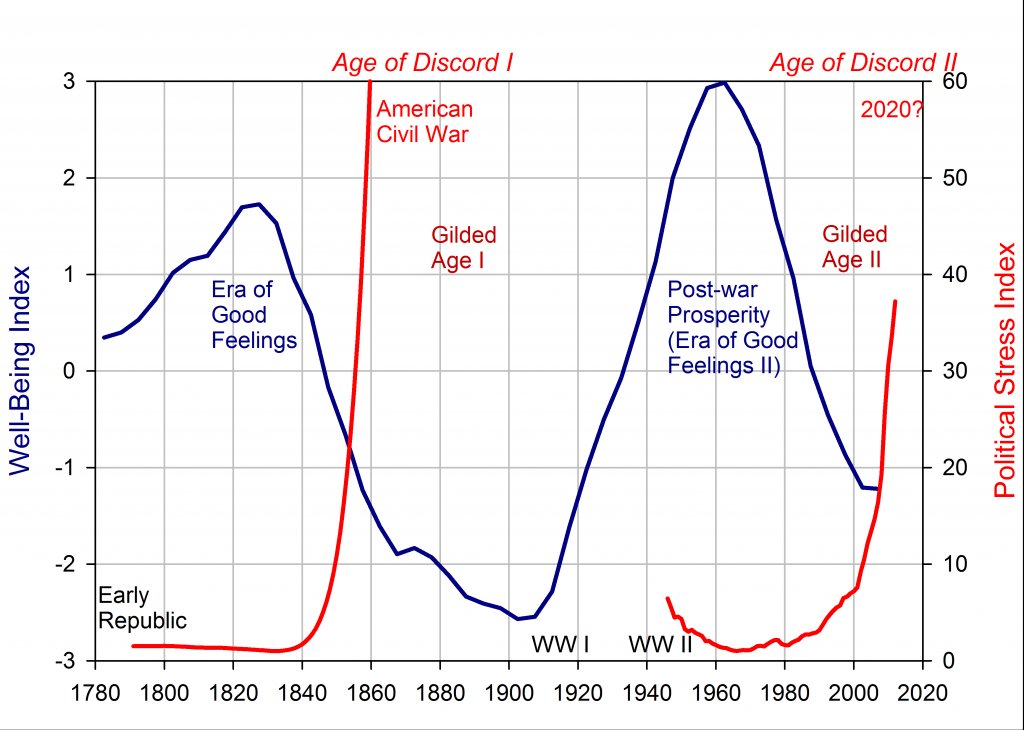
If Iran wins, it's the end of five eras. 1991-2026: the unipolar era 1974-2026: the petrodollar era 1945-2026: the postwar era 1776-2026: the union era 1492-2026: the Western era Specifically, the end of the petrodollar (1974) would also be the end of the unipolar moment (1991) and the postwar order (1945). It would mark the moment when Eurasian powers were once again dominant over Western powers (1492). Finally, a rapid crash in the dollar's purchasing power coupled with military defeat could well break apart the American union (1776). Few seem to viscerally understand just how dependent America is on money printing. But the end of the petrodollar is the end of Keynesianism as we know it. And if there's a sudden cost-of-living spike on top of pre-existing levels of political polarization, which are already near Civil War levels...we could see the scenarios that Dalio, the Fourth Turning, and Turchin have described.
Balaji tweet media
English
576
1.9K
7.4K
852K
SkyFoxx🛡️ retweetledi
Tom Wilson
Tom Wilson@twilson63·
Min and Max approach to working with agents Max = one agent, deep context, for thinking. Architecture, planning, fuzzy problems. Min = multiple agents orchestrated, for executing. Well-defined work, parallel tasks. The numbers back this up: Anthropic saw 90% improvement with multi-agent patterns. DevOps tasks went from 1.7% actionable with single agents to 100% with coordinated teams. Simple rule: - Max for architecture and planning - Min for execution at scale Don't invert this. Use Min too early, you scale confusion. Stay in Max too long, you bottleneck.
English
0
3
4
132
SkyFoxx🛡️ retweetledi
Anthony
Anthony@kr0der·
aussies have max intelligence Claude/Codex at all times. i made a post recently about how Claude Code's 2x limits are perfect for aussies and i got reminded that we always code during off-peak hours, so we literally never get the dumber versions or experience high-load crashes
English
37
17
558
39.4K
SkyFoxx🛡️ retweetledi
Benjamin Cowen
Benjamin Cowen@intocryptoverse·
The guys who told you the bear market would never happen want you to know why the bear market is over
English
199
139
2.7K
166.3K
wouter de boskabouter
wouter de boskabouter@wouter_burrea·
Big news from @samecwilliams and the @ArweaveEco team. Upgrades an news. These guys are building like it’s their life’s mission. Proud to be a part of this. Keep building ! And some more retail focussed marketing 😉
🐘🔗 sam.arweave.dev@samecwilliams

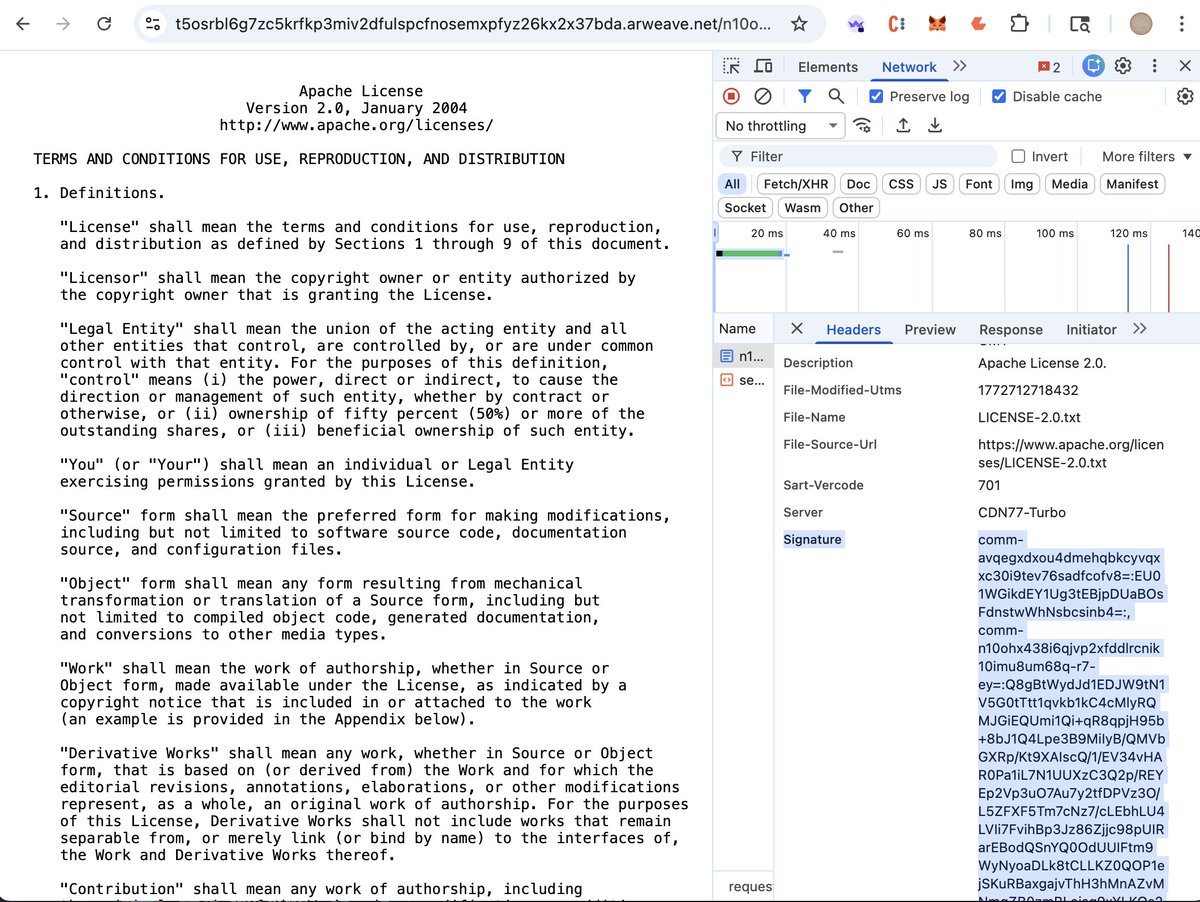
Huge shift here. Thanks to everyone on the @OdyseeTeam, @dh_association, and @fwdresearch teams who made this possible -- as well as @ar_io_network for all their help in the transition. But what does this shift mean? tl;dr: Arweave dot net now runs on AO-Core. So... 1⃣ Every response from .net is now verifiable, right to the end-user. This is the fundamental building block of decentralization. When you get a reply from an AO-Core node its headers contain everything that you need in order to verify the data atomically. No need for consensus, querying multiple nodes, etc., just fully trustless cryptographic verification. Additionally, all of the useful tags and metadata that have always been attached to content on Arweave is now available to callers. Users can now process this information and act upon it, just like 'body' data. You can think of Arweave as a permanent database, with each item being a row. Now the whole content of each of those rows can be accessed by users, not just the largest field. 2⃣ Data served from .net is now directly sourced from Arweave nodes. Previously, there needed to be caches in between the user and the nodes, which made gateways heavier to run and 'separated' from the dataset. This detachment introduces points of software and operations dependence in the caches themselves. While .net is still importing some of the data from the legacy gateway (and will be over the next few weeks), these caches have now been removed from the data serving flow. This also opens the opportunity for... 3⃣ ...Permissionless nodes operating .net. Because each AO-Core node serves everything needed to verify each response it gives by default, the next step is to let anyone register to provide the data for IDs to the gateway, then verify their responses before relaying them to users. This alone is a big deal. In time we expect it will provide an additional incentive for Arweave miners to serve (and also store) data, as well as improve performance (by routing to and rewarding the fastest providers) and reliability (by removing points of failure). Further down the track there is a clear path to even decentralizing the operation of these verification+routing nodes, so that every Arweaver can take part in running those, too. We can achieve this by letting TEE nodes register with one another and share private TLS credentials, allowing them to directly serve end-user traffic routed by the DNS layer. We have tests of this flow working in principle, but principle -> practice-at-scale will take some time. 4️⃣ Compute-Over-Arweave-Data just dropped. AO-Core is a protocol to orchestrate a decentralized supercomputer. In this deployment we are making heavy use of AO-Core's codec devices, but it is now possible to do so much more than that. More on this soon. Upshot? Decentralization and trustlessness of data access on Arweave just took a huge leap. Trustless verification of content -> Permissionless data serving -> Decentralization of data access and transformation. Congrats again everyone 🫡.

English
2
4
20
1.1K
SkyFoxx🛡️ retweetledi
🐘🔗 sam.arweave.dev
🐘🔗 sam.arweave.dev@samecwilliams·
Huge shift here. Thanks to everyone on the @OdyseeTeam, @dh_association, and @fwdresearch teams who made this possible -- as well as @ar_io_network for all their help in the transition. But what does this shift mean? tl;dr: Arweave dot net now runs on AO-Core. So... 1⃣ Every response from .net is now verifiable, right to the end-user. This is the fundamental building block of decentralization. When you get a reply from an AO-Core node its headers contain everything that you need in order to verify the data atomically. No need for consensus, querying multiple nodes, etc., just fully trustless cryptographic verification. Additionally, all of the useful tags and metadata that have always been attached to content on Arweave is now available to callers. Users can now process this information and act upon it, just like 'body' data. You can think of Arweave as a permanent database, with each item being a row. Now the whole content of each of those rows can be accessed by users, not just the largest field. 2⃣ Data served from .net is now directly sourced from Arweave nodes. Previously, there needed to be caches in between the user and the nodes, which made gateways heavier to run and 'separated' from the dataset. This detachment introduces points of software and operations dependence in the caches themselves. While .net is still importing some of the data from the legacy gateway (and will be over the next few weeks), these caches have now been removed from the data serving flow. This also opens the opportunity for... 3⃣ ...Permissionless nodes operating .net. Because each AO-Core node serves everything needed to verify each response it gives by default, the next step is to let anyone register to provide the data for IDs to the gateway, then verify their responses before relaying them to users. This alone is a big deal. In time we expect it will provide an additional incentive for Arweave miners to serve (and also store) data, as well as improve performance (by routing to and rewarding the fastest providers) and reliability (by removing points of failure). Further down the track there is a clear path to even decentralizing the operation of these verification+routing nodes, so that every Arweaver can take part in running those, too. We can achieve this by letting TEE nodes register with one another and share private TLS credentials, allowing them to directly serve end-user traffic routed by the DNS layer. We have tests of this flow working in principle, but principle -> practice-at-scale will take some time. 4️⃣ Compute-Over-Arweave-Data just dropped. AO-Core is a protocol to orchestrate a decentralized supercomputer. In this deployment we are making heavy use of AO-Core's codec devices, but it is now possible to do so much more than that. More on this soon. Upshot? Decentralization and trustlessness of data access on Arweave just took a huge leap. Trustless verification of content -> Permissionless data serving -> Decentralization of data access and transformation. Congrats again everyone 🫡.

🐘🔗 sam.arweave.dev tweet media
Forward Research@fwdresearch

arweave . net has transitioned to HyperBEAM infrastructure. For years permaweb access has been served through gateway infrastructure. Over the past couple weeks we’ve introduced a distributed network of @aoTheComputer HyperBEAM nodes that can serve the same functionality. This removes a major point of centralization in the stack. Requests can now be served by nodes that produce verifiable responses about how data was retrieved and computed. Transitions like this are never perfectly smooth, and some edge cases may still surface as the new system settles. But the direction is clear: arweave . net is now just one entry point into a decentralized network. Thanks to everyone who bore with us through the migration.

English
14
45
125
19.7K
SkyFoxx🛡️ retweetledi
Forward Research
Forward Research@fwdresearch·
arweave . net has transitioned to HyperBEAM infrastructure. For years permaweb access has been served through gateway infrastructure. Over the past couple weeks we’ve introduced a distributed network of @aoTheComputer HyperBEAM nodes that can serve the same functionality. This removes a major point of centralization in the stack. Requests can now be served by nodes that produce verifiable responses about how data was retrieved and computed. Transitions like this are never perfectly smooth, and some edge cases may still surface as the new system settles. But the direction is clear: arweave . net is now just one entry point into a decentralized network. Thanks to everyone who bore with us through the migration.
English
4
25
114
17.1K