Will Hewitt

2.9K posts

Will Hewitt banner
Will Hewitt

Will Hewitt

@willjshewitt

Ops at @worksinprogmag @stripe

Katılım Ocak 2014
4.5K Takip Edilen349 Takipçiler
Will Hewitt retweetledi
Patrick Collison
Patrick Collison@patrickc·
It's been interesting and puzzling to witness the problems with accuracy in UK economic statistics over the past few years. (See the links in the next tweet for more.) It seems that the Office for National Statistics, ONS, now struggles to effectively measure basic figures such as employment, trade, and inflation. This resulted in a quite scathing government report published last summer, where Robert Devereux, a former permanent secretary, concluded that "most of the well-publicised problems with core economic statistics are the consequence of ONS’s own performance." There's a lot of discussion about the travails facing the UK these days (including this big piece in The Atlantic a few weeks ago[1]), and the problems with the ONS feel like an unsettling microcosm of diffuse decline in broader institutional competence. Anyhow: at Stripe, we became curious about the UK's published entrepreneurship data. While we observe a boom in many parts of the world, official figures don't show a similar increase in the UK. In the latest Stripe Economics post, we dug into the data, and, as far as we can tell, the official figures are probably misleading. The good and the bad news (mostly good, I think!) is that the UK is almost certainly witnessing an unmeasured boom in entrepreneurship: stripeeconomics.com/p/is-the-uk-mi… UK-specific issues aside, I suspect that this measurement question is illustrative of forthcoming econometric challenges. Keeping the world's macro indicators up-to-date in response to the faster-than-usual changes wrought by AI will be both increasingly difficult and increasingly important in the coming years. [1] theatlantic.com/magazine/2026/…
Patrick Collison tweet media
English
95
179
1.1K
406.3K
Will Hewitt retweetledi
Tom Forth
Tom Forth@thomasforth·
Jaw-dropping stat from @Paul_Swinney's latest. Something he and I have been looking for a long time. Britain outside of South England operates at fiscal deficits on the scale of Greece at the worst of its financial crisis. economicsobservatory.com/greek-tragedy-…
Tom Forth tweet media
English
70
303
1.2K
97.5K
Will Hewitt
Will Hewitt@willjshewitt·
@thsottiaux Haven't received any banked resets yet over the past few weeks.
English
0
0
1
893
Tibo
Tibo@thsottiaux·
Added a banked reset to 500k users of ChatGPT Work and Codex. What’s been happening: - Just released the ability to use a banked reset from web and mobile. Before today you could only do it in the desktop app - Had an issue where less than 10% of users who used a banked reset and it didn’t actually reset. This was during a 2 hour window. - It was hard to find all the exact users where it didn’t apply, so instead granted a banked reset to everyone who pressed the reset button in that 2 hour window. This also gives us the opportunity to validate the new infra ahead of tomorrow Tomorrow we will celebrate our 7M active users milestone and grant the first banked reset across all of our ChatGPT Work and Codex users. We will also release a bunch of updates to the desktop app, addressing a ton of your feedback. Talk soon
English
928
450
10.2K
1M
Matt Carey
Matt Carey@mattzcarey·
word on the street this is the openai / Jony Ive collab
Matt Carey tweet media
English
7
0
84
45.1K
Will Hewitt
Will Hewitt@willjshewitt·
@s8mb They effectively do with batch pricing: developers.openai.com/api/docs/guide… Also in the case of Priority processing and Fast mode on OpenAI's API. Your request is effectively jumped to the front of the queue and allocated a greater volume of compute.
English
2
0
22
879
Sam Bowman
Sam Bowman@s8mb·
Why don’t AI companies do more time-of-use and surge pricing, given that data centres produce a “flow” of output that can’t really be stored? Seems similar to electricity in that way.
English
19
7
162
17.5K
Will Hewitt
Will Hewitt@willjshewitt·
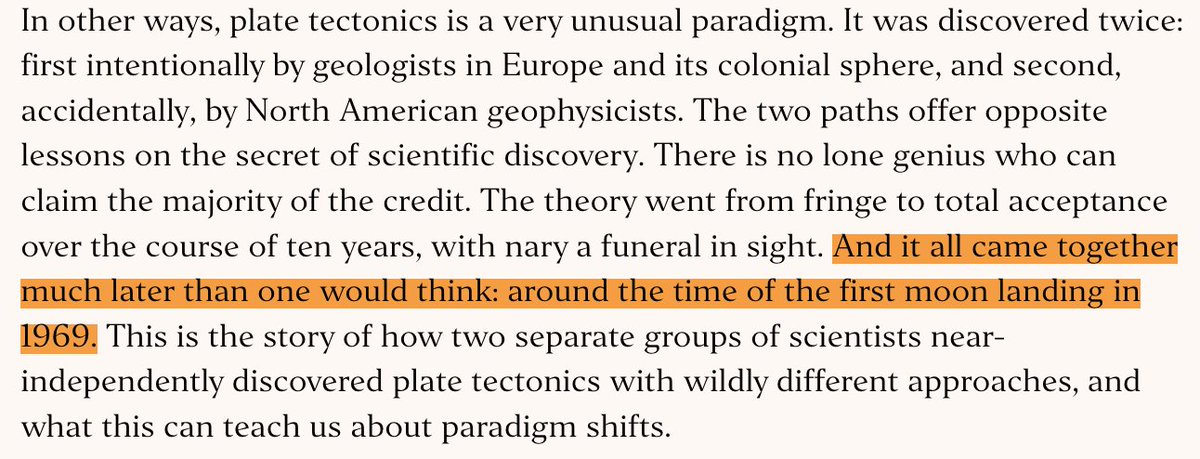
@salonium It still astonishes me that we put humans on the Moon the same year that scientists were finally agreeing on how the Earth itself works.
Will Hewitt tweet media
English
1
4
29
2.5K
Saloni
Saloni@salonium·
When you think about it, isn’t it sort of crazy that the continents drift over time, and used to be joined together as a single landmass around 200 million years ago? What’s even crazier is that this only became consensus in the late 1960s. For the decades leading up to then, it was dismissed by most geologists, and called “Germanic pseudo-science”. It “takes considerable liberties with our globe” wrote one leading geologist. It ignores “awkward, ugly facts” and “plays a game in which there are few restrictive rules.” A brilliant new Works in Progress article by Elizabeth Van Nostrand (@acesounderglass) explains how the theory all came together and what convinced the skeptics. worksinprogress.co/issue/on-the-o… Continental drift was proposed multiple times over history, most famously by Alfred Wegener, who first laid out the theory in 1912 and compiled several lines of evidence: • the coastlines of South America and Africa fitting together • matching geological formations on either side of the Atlantic • glaciers on continents now too warm or too far from the poles to have had ice • fossils of the same species lining up across separate continents but not within them Wegener’s research was dismissed by many experts in part because Wegener did not have a background in geology, though it carried more traction in Europe than America. It gained steam again during the Cold War, from work funded by the US Navy to improve submarine navigation, which led to its rediscovery and rapid acceptance. Now, it is geology’s ‘theory of everything’, explaining volcanoes, earthquakes, mountains, and even geological records of the Earth’s magnetic field. This is On the origin of continents. Read it here! worksinprogress.co/issue/on-the-o…
English
19
35
161
30.7K
Will Hewitt retweetledi
Maxwell Tabarrok
Maxwell Tabarrok@MTabarrok·
Half the land area of Boston, a quarter of NYC, and 15% of San Francisco were raised from the sea before 1970. Since then, land values have grown by 30x but land reclamation has ground to a halt. This failure follows the spread environmental law around the world rather than any geographic, technological, or economic constraint. Thus, our lack of land reclamation and the severe land constraints in our most important cities are self-imposed and avoidable. We should make more land! worksinprogress.co/issue/why-the-… Land reclamation was common practice in American cities in the 19th and 20th centuries. Seattle, Chicago, Boston, Charleston, San Francisco, New York, Philadelphia, Norfolk, DC, Oakland, and LA all had major land reclamation projects that extended residential living space or infrastructure or both. The Bay Area alone reclaimed an area of land equivalent to ten Manhattans between 1850 and 1957, at an inflation-adjusted cost of $330,000 per acre. Today, an acre of single-family-zoned land in San Francisco County averages $24 million. Even if the cost of land reclamation grew faster than inflation, despite technological leaps in dredging and construction technology, there should be plenty of room for profitable arbitrage. And yet, land reclamation is extinct in the Bay Area as well as in every other American city. This isn’t because we ran out of good spots to reclaim: Two thirds of the San Francisco Bay is shallower than Boston’s Back Bay was when it was reclaimed in the 1860s. Nor is it because of better transportation: We’ve used up all of the easy suburban expansions enabled by the train and the automobile so prices are rising even in outlying suburbs. Instead, land reclamation’s death is due to environmental law. Evidence for this claim shows up in the coincident timing of land reclamation’s demise across dozens of cities in the US and in the environmental compliance process of the few reclamation projects still inching along today, but the best evidence is found internationally. No country has more experience or more reason to reclaim land than the Netherlands. The Dutch built 5% of their country out of the sea over the first half of the 20th century and by 1975 they had another artificial lake in the Zuiderzee ready to drain at the flip of a switch, which would have made tens of thousands of acres of land just east of Amsterdam. But a 1969 environmental review law, similar to NEPA in the US, stopped the project before it was finished and the site is now a protected bird sanctuary. Their one major reclamation since, the Maasvlakte 2 extension of the port of Rotterdam, took 11 years and 6,000 pages of environmental review before construction began. Inversely, countries without these laws, like China, Singapore, and Japan have continued major land reclamation projects into the 21st century. China has reclaimed over 5,000 square kilometers since 2000, including a city of half a million outside Shanghai and Singapore has grown by a quarter since 1975. Every major American city has a land shortage. But we have more than enough shallow water, dredging capacity, and market incentive to make more land, just like we did 150 years ago. The only obstacle is our own choice to make making land illegal. The benefits of more land in our most productive cities are large enough to justify the effort of reforming the laws that currently prevent it. Let’s make more land!
English
70
250
1.6K
751.8K
Nan Ransohoff
Nan Ransohoff@nanransohoff·
Today we're launching Intercept: a $500M philanthropic initiative to make respiratory infections, like the common cold and flu, a thing of the past. We treat respiratory infections as a minor nuisance, but that’s really not the case. Most of us will spend 5% of our lives (!) sick from these viruses, they kill 1M people a year, cost $600B annually in productivity, and periodically threaten civilization through pandemics. So, if they’re such a big problem, why haven’t we dealt with them yet? Last year we convened ~40 leading scientists, pharma R&D leaders, biotech investors, and regulatory experts to better understand that. We heard two main reasons: (1) First, it’s just technically very challenging: respiratory viruses represent hundreds of distinct, mutating strains across several families. Fortunately, recent breakthroughs make this newly possible. (2) Second is a lack of funding: broad-spectrum solutions have historically been underfunded, in part because they’re not a great fit for most philanthropic or commercial funding (and while COVID generated a burst of activity around preventing and understanding respiratory infections through an influx of new funding, that hasn't been sustained). We think that with enough focus and funding, this might be solvable. Intercept is a $500 million philanthropic initiative that will take advantage of new tools to catalyze the development and deployment of two types of products: broad-spectrum preventatives and air cleaning technologies. This problem is undoubtedly difficult. But it’s more tractable now than it’s ever been. We think we should give it our best shot. We’re enormously grateful to our anchor funders: @stripe, @AnthropicAI, @TheFluLab, @FoundationOAI and individuals from Jane Street. And, I’m very excited to be building this with @incredutility and the rest of the team.
Nan Ransohoff@nanransohoff

interceptfund.substack.com/p/ending-respi…

English
200
550
3.5K
1.4M
Will Hewitt retweetledi
Pieter Garicano
Pieter Garicano@pietergaricano·
One of my favorite WIP pieces ever. Everyone knows the Glorious Revolution was central to Britain's divergence from the rest of Europe. The common story holds that it did this by restraining what the government could do. Ben and Kara argue the opposite: by creating a form of government that landed elites trusted (because they controlled it), the British state was able to become far more interventionist, pushing through massive growth-increasing reforms were blocked in the rest of Europe until deep into the nineteenth century.
Ben Southwood@bswud

The entire modern world, including capitalism and industrialisation, happened because we beat NIMBYism and vetocracy in 18th-century England. Today, the vetocracy, the stakeholder state, the NIMBYs stop us building the nuclear power plants, railways, houses, towers, bridges, roads, gas turbines, solar panels, and powerlines that we need for growth. Then, they stopped people from consolidating their land, transporting goods freely, investing in irrigation, and mortgaging their property to invest. The events that led to their downfall are called the Glorious Revolution. I think we can repeat what they did and have another Glorious Revolution of our own. worksinprogress.co/issue/how-abol… Early modern Europe was sclerotic, stifled by NIMBYs of its own: the aristocrats, guilds, and clergy who stood against the reforms that were necessary for 18th-century progress. Everyone knew that inheritance rules split land up too much, everyone knew that common land was overgrazed, everyone knew that property rights restricted making best use of land, labour, and capital. Each one of them decided the answer was consolidating power in an absolute monarch. Each one of them failed completely. They didn't crush the NIMBYs: the NIMBYs crushed them. One country launched itself into rapid growth, creating the industrial modernity we live under today: England. It did this, as everyone agreed was necessary, by overriding the tangle of landowner property rights that prevented best use of land. But it tried something almost unbelievable: to get the landowner NIMBYs to crush themselves. England did not attempt to set up an absolutist state: quite the opposite. It gave landowners supreme power, and they used it to crush their fellows: the minority of landowners who were opposed to progress. There are lessons for today. Many modern reformers think that the answer to NIMBYs is demonising them, trying to build an angry coalition of forces who hate homeowners or boomers or Republicans or environmentalists. But many of the most successful reform schemes operating around the world today try a different tack: bring a majority of homeowners onside, and it is much, much easier to crush the remaining NIMBYs. We can still learn from England's Glorious Revolution. Read my latest article, with historian Kara Dimitruk, in @WorksInProgMag.

English
0
3
27
3.1K
Will Hewitt
Will Hewitt@willjshewitt·
@bswud *half a millenium* of economic stagnation!
Will Hewitt tweet media
English
2
1
9
1.1K
Ben Southwood
Ben Southwood@bswud·
The entire modern world, including capitalism and industrialisation, happened because we beat NIMBYism and vetocracy in 18th-century England. Today, the vetocracy, the stakeholder state, the NIMBYs stop us building the nuclear power plants, railways, houses, towers, bridges, roads, gas turbines, solar panels, and powerlines that we need for growth. Then, they stopped people from consolidating their land, transporting goods freely, investing in irrigation, and mortgaging their property to invest. The events that led to their downfall are called the Glorious Revolution. I think we can repeat what they did and have another Glorious Revolution of our own. worksinprogress.co/issue/how-abol… Early modern Europe was sclerotic, stifled by NIMBYs of its own: the aristocrats, guilds, and clergy who stood against the reforms that were necessary for 18th-century progress. Everyone knew that inheritance rules split land up too much, everyone knew that common land was overgrazed, everyone knew that property rights restricted making best use of land, labour, and capital. Each one of them decided the answer was consolidating power in an absolute monarch. Each one of them failed completely. They didn't crush the NIMBYs: the NIMBYs crushed them. One country launched itself into rapid growth, creating the industrial modernity we live under today: England. It did this, as everyone agreed was necessary, by overriding the tangle of landowner property rights that prevented best use of land. But it tried something almost unbelievable: to get the landowner NIMBYs to crush themselves. England did not attempt to set up an absolutist state: quite the opposite. It gave landowners supreme power, and they used it to crush their fellows: the minority of landowners who were opposed to progress. There are lessons for today. Many modern reformers think that the answer to NIMBYs is demonising them, trying to build an angry coalition of forces who hate homeowners or boomers or Republicans or environmentalists. But many of the most successful reform schemes operating around the world today try a different tack: bring a majority of homeowners onside, and it is much, much easier to crush the remaining NIMBYs. We can still learn from England's Glorious Revolution. Read my latest article, with historian Kara Dimitruk, in @WorksInProgMag.

English
50
150
679
296.3K
Tom Forth
Tom Forth@thomasforth·
The Chinese companies all releasing their open weights models that nearly catch up, yet again, with levels of performance that I had come to just about believe they wouldn't catch up with this time is nuts. Incredible timing with the Fable and Iran and UFC Whitehouse stuff.
English
2
0
19
3K
Will Hewitt
Will Hewitt@willjshewitt·
@s8mb It's always a little bit sad to be reminded that a majority of Koalas have chlamydia. 🐨 Hopefully that won't be the case for much longer!
Will Hewitt tweet media
English
1
0
9
383
Sam Bowman
Sam Bowman@s8mb·
We should be vaccinating wild animals. 60% of all infectious diseases, including Ebola, Lyme disease and rabies, come from animals, mostly wild ones. Vaccinating wild animals would help to control these diseases before they spill over to humans. worksinprogress.co/issue/why-we-s… Doing it is surprisingly easy and cheap. Switzerland stopped the spread of fox rabies in the 1970s by airdropping chicken heads filled with oral vaccines from helicopters. By 1999, fox rabies had been totally eradicated. Many American states vaccinate rabies for coyotes by hiding oral vaccines in fishmeal blocks covered in fish oil or vanilla. In Texas, every dollar spent on that program saved between $4 and $13 in human treatment. But we should also vaccinate wild animals for their own sake! Infectious diseases kill animals in agonizing ways and can drive species to extinction. One fungal disease alone has caused 90 amphibian species to go extinct in the last fifty years. In 2015, 60 percent of the global saiga antelope population was killed in three weeks by a bacterial outbreak. White-nose syndrome has killed over six million North American bats since 2007. We could save all these animals from suffering by vaccinating them the way we do pets and humans. It would make the world safer for humans, and *much* better for the animals themselves.
English
18
63
343
61.2K
Will Hewitt retweetledi
SpaceX
SpaceX@SpaceX·
SpaceX has exercised the option to acquire @cursor_ai in an all-stock transaction with the goal of building the world’s most useful AI models. For the past few months, SpaceXAI has been jointly training a model with Cursor, which will be released in Cursor and Grok Build soon. We look forward to working closely with the Cursor team to advance our frontier AI capabilities
SpaceX@SpaceX

SpaceXAI and @cursor_ai are now working closely together to create the world’s best coding and knowledge work AI. The combination of Cursor’s leading product and distribution to expert software engineers with SpaceX’s million H100 equivalent Colossus training supercomputer will allow us to build the world’s most useful models. Cursor has also given SpaceX the right to acquire Cursor later this year for $60 billion or pay $10 billion for our work together.

English
1.7K
4.3K
36.5K
26M
Will Hewitt
Will Hewitt@willjshewitt·
@Birdyword I read this as SNP and was immensely confused until I read it again.
English
0
0
2
205
Mike Bird
Mike Bird@Birdyword·
Watching the S&P just don't have the same feel to it knowing that SpaceX isn't in it.
English
9
2
62
10.6K
Patrick Collison
Patrick Collison@patrickc·
Very much enjoyed this piece in the latest @WorksInProgMag about how Alberta became a rat-free sanctuary and the only significant human-inhabited place on earth that is free of them. Excellent "you can just do things" energy. "William Lobay, a crop protection supervisor at the Alberta Department of Agriculture, came up with the idea of a buffer zone focused on the area of prairie and parkland that was most vulnerable to penetration. In late 1950, Albertan officials approved his Rat Control Zone, a roughly 600-by-29-kilometer strip along the part of its eastern border with Saskatchewan. In the zone, William Lobay and his colleagues surveyed cargo and vehicles that entered the province, and inspected vulnerable sites like farms, grain elevators, feed stacks, barns, sheds, and abandoned buildings, where food and shelter made rat establishment most likely." worksinprogress.co/issue/albertas…
English
21
19
168
42.8K