

Wingman
1.1K posts

Aaj hi 14000 liter fuel phoonk ke aaya hoon.
GIF
हिन्दी

@wingova In india if you want to become a commercial pilot only thing you need is not a dream, talent, struggle it just money and nothing else….this is the worst worst part of the Indian aviation….and besharm airlines also take advantage of these facts to push their revenue.
English
@nakulvk @Aviatorflyboy The 330 has take off weight restrictions on the route. XLR performance unravels soon
English


@6ESinger157593 One needs to know the books to command confidence dies when you know you got here in 3 years after going through a question bank..
Its really bad..
English

The Vanishing Peaked Cap:
How Indian Aviation Quietly Diminished Its Captains
—A small change in uniform, a quieter presence on the ground
No one really noticed when it happened. There was no announcement, no visible policy shift. Somewhere along the way, the Indian airline captain’s cap—once as much a part of the job as the stripes—simply stopped being worn.
It didn’t disappear overnight. You still see it occasionally, mostly on formal occasions or in official photographs. But in the everyday rhythm of Indian aviation—terminals, gates, boarding—it has largely slipped out of view.
For something that once carried so much meaning, its absence has been easy to overlook.
For decades, the peaked cap did more than complete the uniform. It removed ambiguity. You didn’t have to guess who was in command. In a country like India, where passengers come from diverse backgrounds and levels of familiarity with flying, that kind of clarity mattered.
You saw the cap, and you knew.
Today, you often don’t.
Indian carriers such as Air India and IndiGo have followed the broader industry shift. Caps aren’t worn in the cockpit. They’re inconvenient to carry. They serve no real operational purpose.
On those terms, dropping them makes sense.
But aviation has never been driven by practicality alone.
Uniforms have always served another role. They signal structure and hierarchy without explanation. The cap, more than anything else, made the captain stand apart—instantly, and without introduction. Many foreign legacy airlines still recognise this. The cap remains a visible marker of command, and of the airline’s own standards.
Without it, that distinction hasn’t disappeared. But it has softened.
A captain today looks much like any other well-dressed professional moving through an airport. The stripes are still there. To those who know, it’s clear. But for the occasional traveller, it’s no longer immediate.
You notice it only if you’re looking.
At the same time, the visual gap between roles isn’t what it once was. Similar insignia are more widely used, and the clean markers of rank don’t stand out in quite the same way. The result is a more uniform look—but also a less distinct one.
None of this affects how aircraft are flown. Standards are high. Indian pilots remain highly trained. The system works exactly as it should.
But the way authority presents itself has changed.
It used to be obvious. Now it’s something you infer.
That shift reflects a broader change in aviation. The modern cockpit is built on systems, procedures, and coordination rather than visible command. Airlines present themselves as efficient service organisations, not institutions of hierarchy.
In that environment, the cap begins to feel unnecessary. Even out of place.
So it fades away—not through decision, but through disuse.
Nothing, in practical terms, is lost. Aircraft operate as they always have. Safety is unaffected.
But something small has changed.
Because aviation, for all its systems, is still a human-facing industry. Passengers look for reassurance. They respond to presence—signals of authority, confidence, control.
The cap once provided that instantly.
Without it, the captain is still there. Still in command.
Just a little less visible—and a little less distinct—than before.
English
@KaptainPetrovs Its the new age version of papa ne Career set kardia. Half of these kids coming in to fly are not even aware of what can there attitude do.
English

THE MOST EXPENSIVE UNEMPLOYMENT PROGRAMME IN INDIA HAS WINGS
⭕️SO YOU WANT TO FLY? FORK OVER ₹70 LAKH, WAIT TWO YEARS, THEN ZOMATO & SWIGGY ARE HIRING
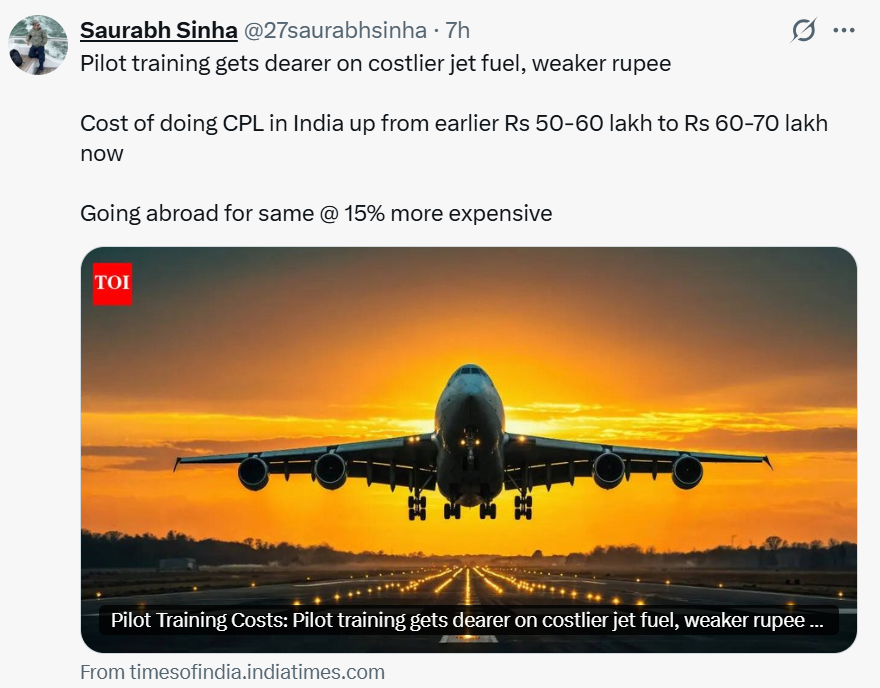
Saurabh Sinha@27saurabhsinha
Pilot training gets dearer on costlier jet fuel, weaker rupee Cost of doing CPL in India up from earlier Rs 50-60 lakh to Rs 60-70 lakh now Going abroad for same @ 15% more expensive timesofindia.indiatimes.com/business/india…
English
@trend_nosig Has anyone tried flaring a Leap 1a at 40
Feet yet.. need to know the deets
English

Attention Airbus 321 Pilots !
Ever since the advent of the 321 Neo, we've seen a spate of dramatic landings.
Hard ones, long ones and the more than occasional tail strike.
She came with a modified flare law which got activated 1 second after passing 100' RA.
The airplane didn't pitch down either, unlike its predecessors.
x.com/trend_nosig/st…
For the longest time, Airbus maintained that the flare technique was the same as the shorter siblings.
However, in the latest update to the FCTM, the flare height for the A321 has now been modified to 40' instead of the earlier 30'.
Inter alia, the "actual" flare height depends on a variety of factors.
Let's quickly review the FCTM.
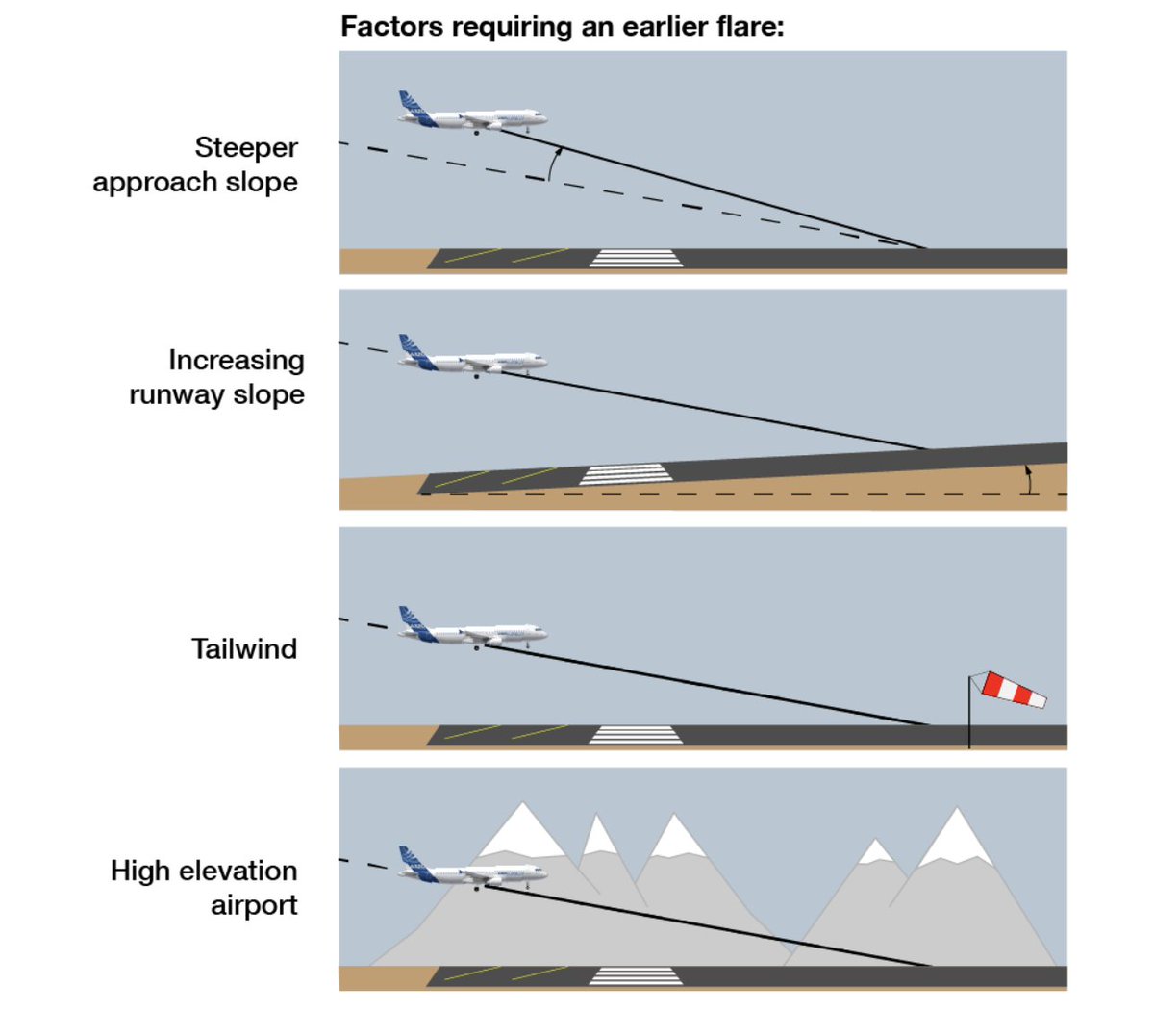
1) Compared to typical flare height at sea level for flat and adequate runway lengths, the flight crew needs to be aware of external factors that have an impact on the flare height, particularly:
‐ High airport elevation:
An increased altitude results in a higher ground speed during approach with an associated increase in descent rates to maintain the approach slope.
‐ Steeper approach slope
‐ Tailwind:
An increased tailwind results in a higher ground speed during approach with an associated increase in descent rates to maintain the approach slope.
‐ Increase in runway slope:
An increase in runway slope and/or rising terrain in front of the runway affects the radio height callouts until the runway threshold.
This can cause late flare inputs if the flight crew relies on those callouts to assess the height and start the flare.
This may also cause a visual misperception of being high.
2) The weight of the aircraft has a direct impact on the VAPP.
Depending on the aircraft variant, the flight crew needs to anticipate the flare height for aircraft with higher weight and inertia.
Note: The cumulative effects of any of the above factors combined for one approach will require the anticipation of the flare maneuver.
If the flare is initiated too late, then the pitch changes do not have sufficient time to enable the necessary change to the aircraft trajectory.
Late, weak or released flare inputs increase the risk of a hard landing. For a stabilized approach, the flare height is around 30 ft for A318/A319/A320, and around 40 ft for A321.
A flare in time, saves a 2.9 (g).
A big thanks to Capt @MohitBiala for bringing this to my attention a few weeks ago.
Francisco Cunha@OnDisasters
This happened yesterday: A Turkish A321 was damaged on a tailstrike on take-off from Prague (C. Republic). Jet turned back and landed safely 15 mins later. Aircraft [TC-LSL] was operating Flight TK1771, inbound from Istanbul.
English
@trend_nosig @IXGguy @Airbus Thats what you get when you make a strech limo.
ARS use is also crazy on those tankering sectors
English

@27saurabhsinha @IndiGo6E Hes come to a perfect place. No industrial action here so basically 🤦🏾♂️
English

"Where's the room for haircut. @IndiGo6E hardly has any flab🤔"
Many friends in 6E wondering given Willie's well known reputation for "slashing" costs

English
@shukla_tarun @EconomicTimes Its a bus service, we will see more to it coming monsoon!
English

Some 290 deaths in air crashes in the fiscal year going by
Passenger growth at just 1.5% vs expected 12%
Why so many accidents? Tanking growth?
Something in Indian aviation, as one person put it, is deeply "rotten"
My piece in @EconomicTimes today :
economictimes.indiatimes.com/prime/transpor…
English

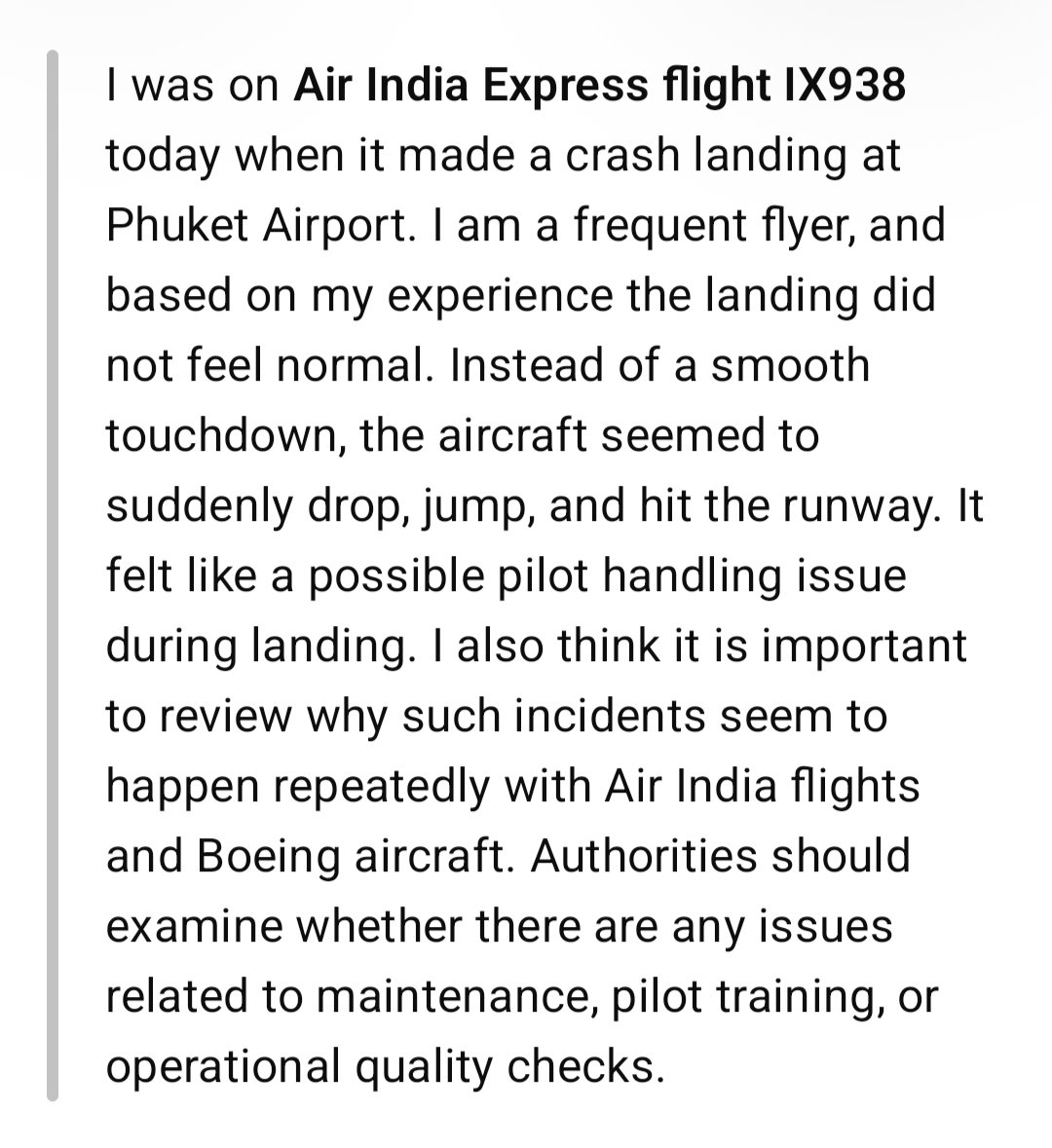
Inflating a oleo strut without the landing gear lock pin in place is NOT a very wise thing to do
Ideally LG jack should have been installed or airbags
Turbine Traveller@Turbinetraveler
UPDATE: Recovery teams are working to clear the stranded Boeing 737 MAX 8 (VT-BWQ) from the runway at Phuket International Airport following the landing incident involving Air India Express flight IX938. From the video,the technicians are re-pressurizing the nose landing gear shock strut to lift the collapsed nose section. The nose strut consists of inner and outer cylinders (oleo strut) and uses hydraulic fluid with compressed dry air or nitrogen to absorb landing loads. They connect a servicing line to the gas charging valve located on top of the nose strut, allowing them to inject pressurized gas to raise the strut and restore enough height to move the aircraft off the runway.
English
Wingman retweetledi

@imYadav31 The miles game results are visible when you come for a holiday now.
Travel is done for indian travellers!
English

No matter what anyone says......I have massive respect for Axis Bank for changing the miles game in India.
They made points, miles and premium travel redemptions mainstream for Indian credit card users.
Love them or hate them…..the impact is undeniable. ✈️💳
English
69 .. that's a magical number for a pilot
Piyush Rai@Benarasiyaa
Latest by Professor Neha Singh of Galgotias University. Your six can be my nine 😂
English


Now that´s how you hitch a lift in style
x.com/OfAthenry/stat…
English
@chainsawrocks You can also hear the TRs when u draw load when charging a device
English

Ever noticed the low-frequency, steady hum or buzz when starting the APU in an A320?
Magnetostriction : that's the characteristic low-frequency hum or buzzing noise produced by transformers and other electrical equipment. This steady sound arises from the combined effects of:
• Magnetostrictive vibration in the core (tiny dimensional changes in ferromagnetic material under alternating magnetic fields),
• Mechanical vibrations transmitted through the structure,
• And electromagnetic forces acting on windings and other components.
In normal operation, this quiet, constant 50/60 Hz (or 100/120 Hz) hum is expected and absolutely normal. Occasional crackling or popping sounds may also occur due to corona discharge, especially under high voltage or in humid conditions.
Next time, notice the ELEC page when starting the APU. TR1 will show the extremely high flow of electricity.
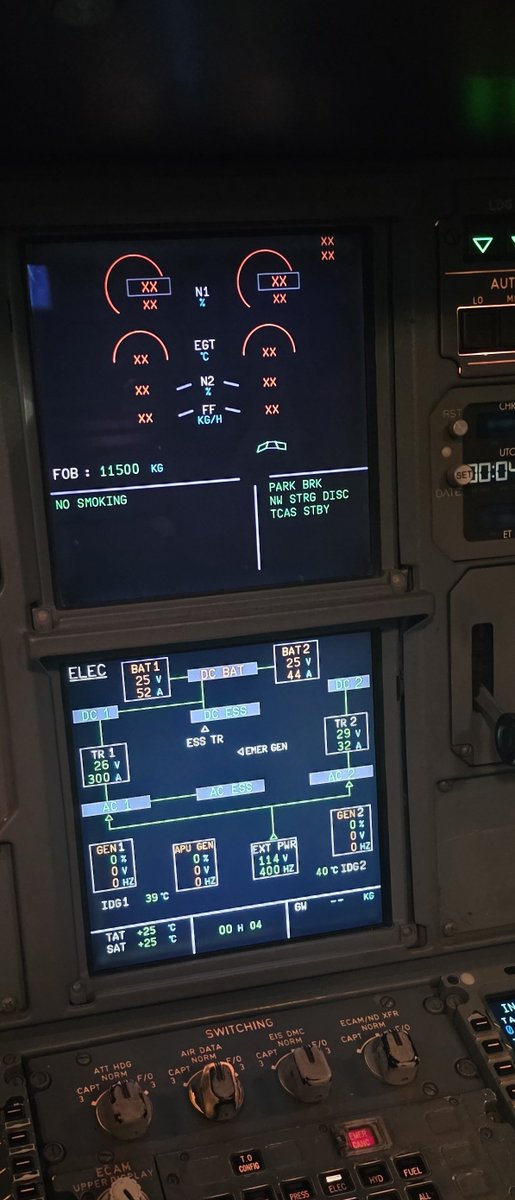
James Watson CEng, FIET@EngineerLondon
When we energise a transformer, the initial current is very high for a few cycles and rich in harmonics. This current sets up the working flux in the core, and settles to a very small magnetising current. The initial surge is known as “in rush” current and sounds like this 👇🏻🔊
English