wunderwho

4.7K posts

wunderwho banner
wunderwho

wunderwho

@wunderyogi

Legally navigating the gray areas. Tweeting into the void with a mandatory side of learning and optional opinions. 🪃

Planet Earth Katılım Ekim 2009
4.1K Takip Edilen6.5K Takipçiler
wunderwho retweetledi
Microsoft Learn
Microsoft Learn@MicrosoftLearn·
Officially 3 weeks until #MicrosoftBuild! Did you register? Here are some of the sessions we're looking forward to: • KEY010 | Opening keynote with Satya Nadella • LIVE101 | Scott and Mark learn to Vibe Check with Scott Hanselman and Mark Russinovich from Microsoft • BRK200 | Why your AI code doesn't ship: Closing the gap to production with Mario Rodriguez and Evan Boyle from GitHub • BRK207 | GitHub Copilot in Visual Studio: Agents that Debug, Profile, and Test with Nik Karpinsky and Mads Kristensen from Microsoft Plus many more sessions — join us June 2–3 in San Francisco or online: msft.it/6014vugzG
English
3
18
134
10.1K
wunderwho retweetledi
Google
Google@Google·
We’re heading back to the stage for #GoogleIO — and our latest updates and breakthroughs are finally ready to meet the world. What do you think we’ll be announcing this year? Drop your guesses ⬇️
English
284
284
2.9K
328.2K
wunderwho retweetledi
Notion Developers
Notion Developers@NotionDevs·
Install ntn, the Notion CLI. It brings the entire Notion API to your terminal, plus everything you need to build and deploy Workers. Built for humans and coding agents alike. Install with: curl -fsSL ntn.dev | bash
English
123
298
3.4K
1.5M
wunderwho retweetledi
Sundar Pichai
Sundar Pichai@sundarpichai·
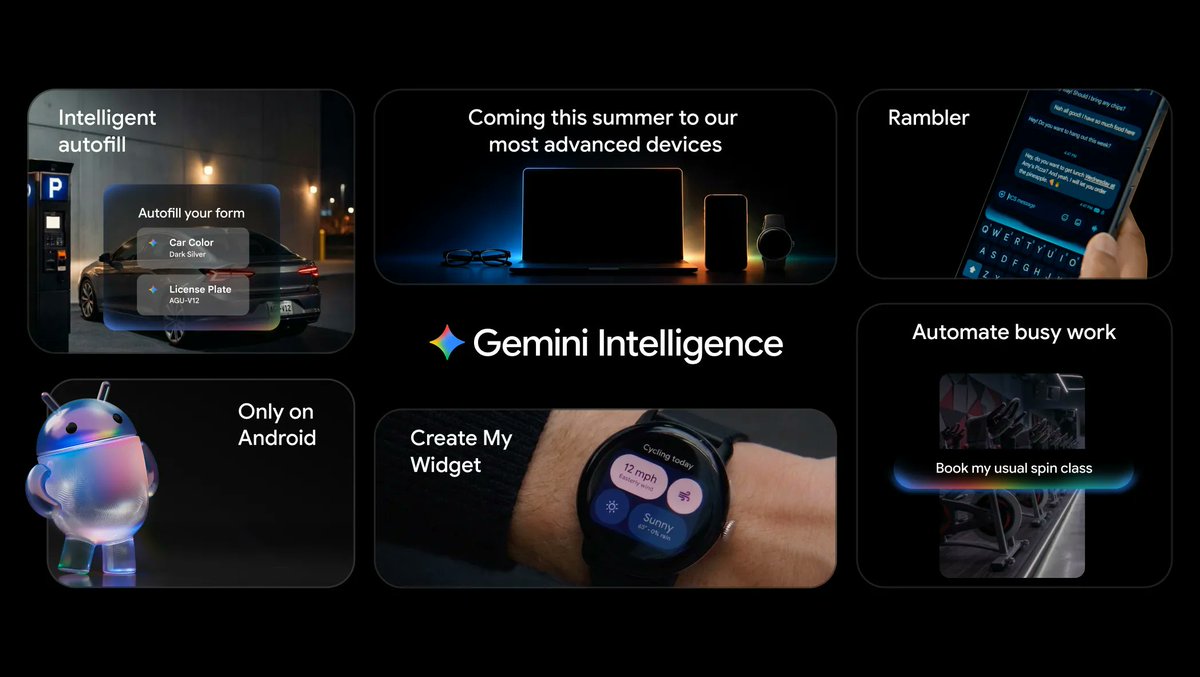
Today at the @Android Show (I/O edition) we announced Gemini Intelligence - bringing the best of Gemini to our most advanced devices. Automate multi-step tasks across apps and Chrome, fill out forms in a single tap, turn spoken thoughts into polished text with Rambler, build custom widgets & loads more.
Sundar Pichai tweet media
English
315
474
5K
301.7K
wunderwho retweetledi
Google DeepMind
Google DeepMind@GoogleDeepMind·
We’re reimagining a 50-year-old interface - the mouse pointer - with AI. 🖱️ These experimental demos show how people can intuitively direct Gemini on their screens using motion, speech, and natural shorthand to get things done 🧵
English
461
1.1K
8.6K
1.6M
wunderwho retweetledi
Andrew Ng
Andrew Ng@AndrewYNg·
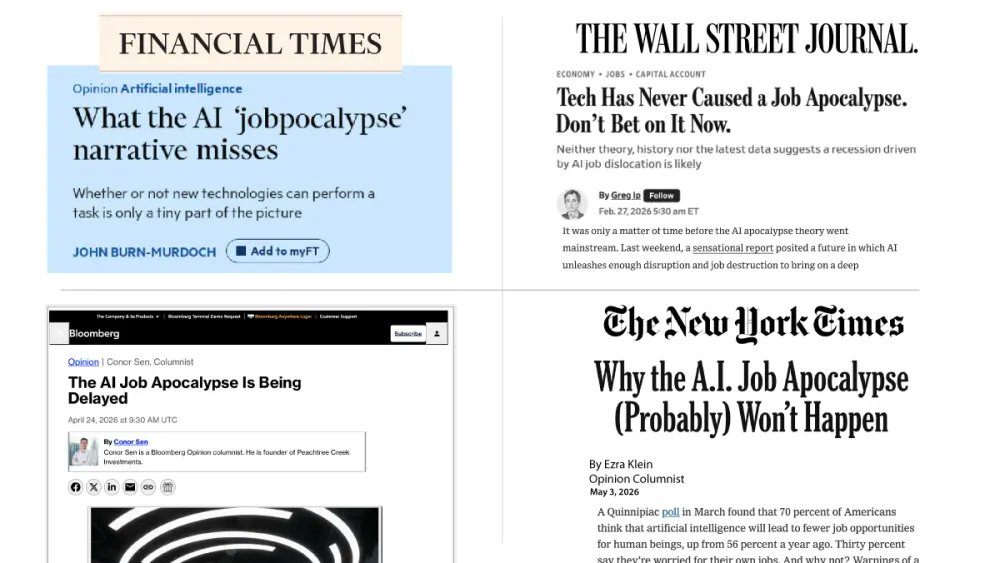
There will be no AI jobpocalypse. The story that AI will lead to massive unemployment is stoking unnecessary fear. AI — like any other technology — does affect jobs, but telling overblown stories of large-scale unemployment is irresponsible and damaging. Let’s put a stop to it. I’ve expressed skepticism about the jobpocalypse in previous posts. I’m glad to see that the popular press is now pushing back on this narrative. The image below features some recent headlines. Software engineering is the sector most affected by AI tools, as coding agents race ahead. Yet hiring of software engineers remains strong! So while there are examples of AI taking away jobs, the trends strongly suggest the net job creation is vastly greater than the job destruction — just like earlier waves of technology. Further, despite all the exciting progress in AI, the U.S. unemployment rate remains a healthy 4.3%. Why is the AI jobpocalypse narrative so popular? For one thing, frontier AI labs have a strong incentive to tell stories that make AI technology sound more powerful. At their most extreme, they promote science-fiction scenarios of AI “taking over” and causing human extinction. If a technology can replace many employees, surely that technology must be very valuable! Also, a lot of SaaS software companies charge around $100-$1000 per user/year. But if an AI company can replace an employee who makes $100,000 — or make them 50% more productive — then charging even $10,000 starts to look reasonable. By anchoring not to typical SaaS prices but to salaries of employees, AI companies can charge a lot more. Additionally, businesses have a strong incentive to talk about layoffs as if they were caused by AI. After all, talking about how they’re using AI to be far more productive with fewer staff makes them look smart. This is a better message than admitting they overhired during the pandemic when capital was abundant due to low interest rates and a massive government financial stimulus. To be clear, I recognize that AI is causing a lot of people’s work to change. This is hard. This is stressful. (And to some, it can be fun.) I empathize with everyone affected. At the same time, this is very different from predicting a collapse of the job market. Societies are capable of telling themselves stories for years that have little basis in reality and lead to poor society-wide decision making. For example, fears over nuclear plant safety led to under-investment in nuclear power. Fears of the “population bomb” in the 1960s led countries to implement harsh policies to reduce their populations. And worries about dietary fat led governments to promote unhealthy high-sugar diets for decades. Now that mainstream media is openly skeptical about the jobpocalypse, I hope these stories will start to lose their teeth (much like fears of AI-driven human extinction have). Contrary to the predictions of an AI jobpocalypse, I predict the opposite: There will be an AI jobapalooza! AI will lead to a lot more good AI engineering jobs, and I’m also optimistic about the future of the overall job market. What AI engineers do will be different from traditional software engineering, and many of these jobs will be in businesses other than traditional large employers of developers. In non-AI roles, too, the skills needed will change because of AI. That makes this a good time to encourage more people to become proficient in AI, and make sure they’re ready for the different but plentiful jobs of the future! [Original text in The Batch newsletter.]
Andrew Ng tweet media
English
586
1.2K
5.4K
794.1K
wunderwho retweetledi
Andrej Karpathy
Andrej Karpathy@karpathy·
The hottest new programming language is English
English
2.2K
8.8K
71.8K
12.5M
wunderwho retweetledi
Microsoft
Microsoft@Microsoft·
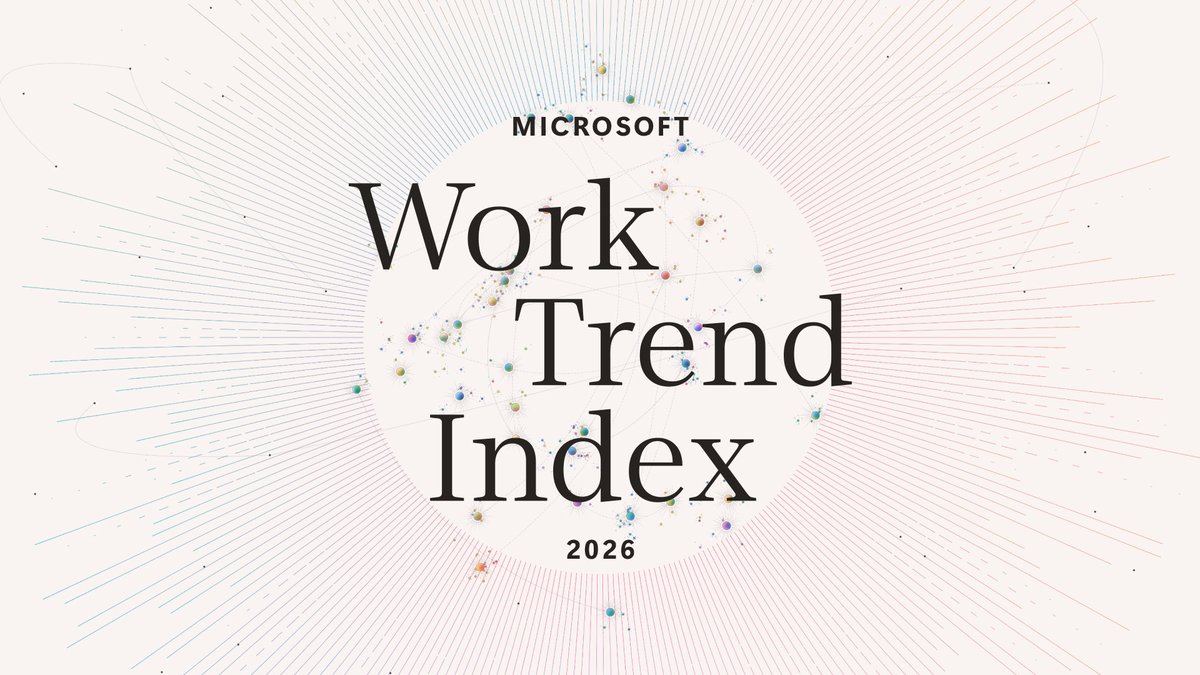
As AI and agents take on execution, our own agency expands. The question is whether organizations are built to capture it. The 2026 #WorkTrendIndex Report is now live: msft.it/6009vKCx5
Microsoft tweet media
English
148
76
304
61.1K
wunderwho retweetledi
Charles Lamanna
Charles Lamanna@clamanna·
In the last month, people have been using Copilot Cowork to do amazing things – from building inbox workflows to sales campaigns. And I’m excited to share three big updates to help you accomplish even more: 1) mobile on iOS and Android so you can delegate work from anywhere, 2) skills to help you reuse and scale how work is done and 3) new plugins + connectors to bring your data into the flow of work. I’ve been testing these updates out – here’s a quick demo of how I’ve been using mobile in my daily work.
English
47
91
595
138.8K
wunderwho retweetledi
Satya Nadella
Satya Nadella@satyanadella·
Every firm will need to reconceptualize work as they build agentic systems. As AI and agents take on more of the execution, the opportunity is to expand human agency and redesign how work gets done. An in-depth look from the team at what this shift means and key considerations for every business: microsoft.com/en-us/worklab/…
English
249
372
2.1K
247.7K
wunderwho retweetledi
Elias Al
Elias Al@iam_elias1·
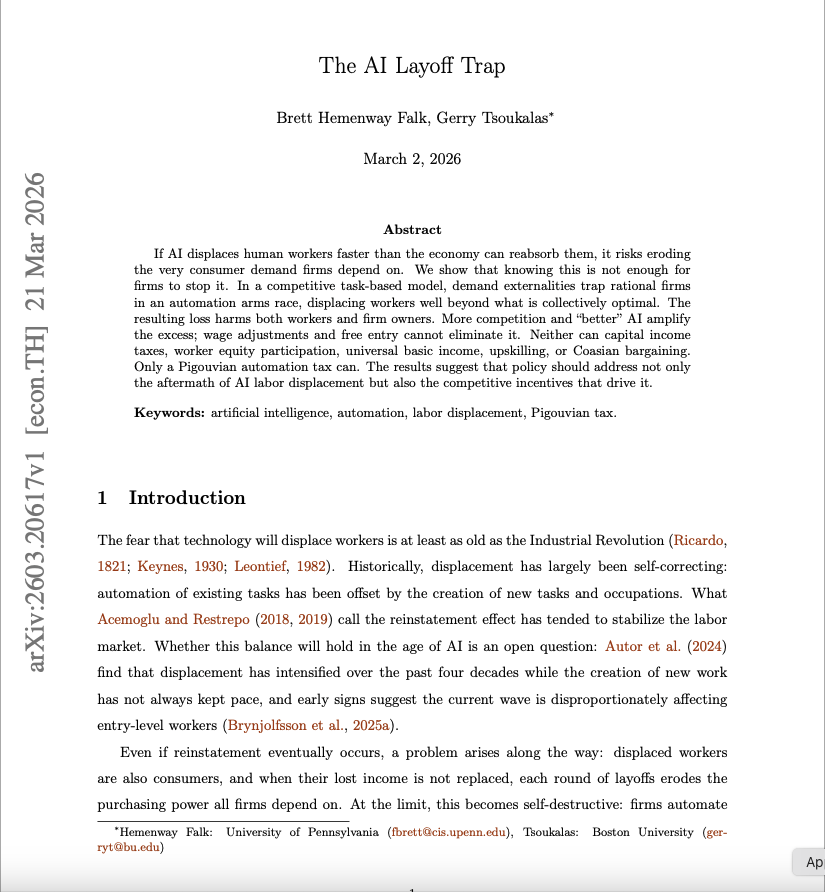
Two economists just published a mathematical proof that AI will destroy the economy. Not might. Not could. Will — if nothing changes. The paper is called "The AI Layoff Trap." Published March 2, 2026. Wharton School, University of Pennsylvania. Boston University. Peer reviewed. Mathematically modeled. The conclusion is one sentence. "At the limit, firms automate their way to boundless productivity and zero demand." An economy that produces everything. And sells it to nobody. Here is how you get there. A company fires 500 workers and replaces them with AI. A competitor fires 700 to keep up. Another fires 1,000. Every company is behaving rationally. Every company is following the incentives correctly. And every company is building a trap for itself. Because the workers who were fired were also customers. When they lose their jobs faster than the economy can absorb them, they stop spending. Consumer demand falls. Companies respond by cutting costs — which means automating more workers — which means less spending — which means more falling demand — which means more automation. The loop has no natural exit. The researchers tested every proposed solution. Universal basic income. Capital income taxes. Worker equity participation. Upskilling programs. Corporate coordination agreements. Every single one failed in the model. The only intervention that worked: a Pigouvian automation tax — a per-task levy charged every time a company replaces a human with AI, forcing them to price in the demand they are destroying before they pull the trigger. No government has implemented this. No major economy is seriously discussing it. Meanwhile the numbers are already tracking the curve. 100,000 tech workers laid off in 2025. 92,000 more in the first months of 2026. Jack Dorsey fired half of Block's workforce and said publicly: "Within the next year, the majority of companies will reach the same conclusion." Nobody is doing anything wrong. Companies are following their incentives perfectly. That is exactly the problem. Rational behavior. At scale. Simultaneously. With no mechanism to stop it. Two economists built the math. The math leads to one place. Source: Falk & Tsoukalas · Wharton School + Boston University · arxiv.org/pdf/2603.20617
Elias Al tweet media
English
1.1K
3.9K
9.9K
1.4M
wunderwho retweetledi
Satya Nadella
Satya Nadella@satyanadella·
Agent 365 is now generally available! We’re extending the systems customers already use for identity, security, governance, and management to every AI agent and their interactions across the enterprise. microsoft.com/en-us/security…
English
137
173
1K
280.8K
wunderwho retweetledi
Vercel
Vercel@vercel·
We’ve identified a security incident that involved unauthorized access to certain internal Vercel systems, impacting a limited subset of customers. Please see our security bulletin: vercel.com/kb/bulletin/ve…
English
696
2.4K
8.8K
10.6M
wunderwho retweetledi
Andrej Karpathy
Andrej Karpathy@karpathy·
LLM Knowledge Bases Something I'm finding very useful recently: using LLMs to build personal knowledge bases for various topics of research interest. In this way, a large fraction of my recent token throughput is going less into manipulating code, and more into manipulating knowledge (stored as markdown and images). The latest LLMs are quite good at it. So: Data ingest: I index source documents (articles, papers, repos, datasets, images, etc.) into a raw/ directory, then I use an LLM to incrementally "compile" a wiki, which is just a collection of .md files in a directory structure. The wiki includes summaries of all the data in raw/, backlinks, and then it categorizes data into concepts, writes articles for them, and links them all. To convert web articles into .md files I like to use the Obsidian Web Clipper extension, and then I also use a hotkey to download all the related images to local so that my LLM can easily reference them. IDE: I use Obsidian as the IDE "frontend" where I can view the raw data, the the compiled wiki, and the derived visualizations. Important to note that the LLM writes and maintains all of the data of the wiki, I rarely touch it directly. I've played with a few Obsidian plugins to render and view data in other ways (e.g. Marp for slides). Q&A: Where things get interesting is that once your wiki is big enough (e.g. mine on some recent research is ~100 articles and ~400K words), you can ask your LLM agent all kinds of complex questions against the wiki, and it will go off, research the answers, etc. I thought I had to reach for fancy RAG, but the LLM has been pretty good about auto-maintaining index files and brief summaries of all the documents and it reads all the important related data fairly easily at this ~small scale. Output: Instead of getting answers in text/terminal, I like to have it render markdown files for me, or slide shows (Marp format), or matplotlib images, all of which I then view again in Obsidian. You can imagine many other visual output formats depending on the query. Often, I end up "filing" the outputs back into the wiki to enhance it for further queries. So my own explorations and queries always "add up" in the knowledge base. Linting: I've run some LLM "health checks" over the wiki to e.g. find inconsistent data, impute missing data (with web searchers), find interesting connections for new article candidates, etc., to incrementally clean up the wiki and enhance its overall data integrity. The LLMs are quite good at suggesting further questions to ask and look into. Extra tools: I find myself developing additional tools to process the data, e.g. I vibe coded a small and naive search engine over the wiki, which I both use directly (in a web ui), but more often I want to hand it off to an LLM via CLI as a tool for larger queries. Further explorations: As the repo grows, the natural desire is to also think about synthetic data generation + finetuning to have your LLM "know" the data in its weights instead of just context windows. TLDR: raw data from a given number of sources is collected, then compiled by an LLM into a .md wiki, then operated on by various CLIs by the LLM to do Q&A and to incrementally enhance the wiki, and all of it viewable in Obsidian. You rarely ever write or edit the wiki manually, it's the domain of the LLM. I think there is room here for an incredible new product instead of a hacky collection of scripts.
English
2.9K
7.2K
59.2K
21.2M
wunderwho retweetledi
Ruben Hassid
Ruben Hassid@rubenhassid·
26 Claude shortcut hacks for faster prompts: (worth saving for later) Add one of these at the very start of your prompt. —— /CLEAR clears conversation history and resets context. /COST shows token usage for the current session. /COMPACT [instructions] compresses the conversation and lets you specify what to keep. /RESUME [session] reopens a previous conversation by ID or name. /BRANCH [name] creates a new branch from the current conversation. /REWIND rolls the conversation and/or code back to an earlier point. /RENAME [name] renames the current session. If no name is given, one is generated. /EXPORT [filename] exports the conversation as plain text. /MODEL [model] switches to another model, such as Sonnet, Opus, or Haiku. /USAGE shows plan usage limits and current rate-limit status. /EXTRA-USAGE enables extra usage when standard limits are reached. /INIT initializes the project with a CLAUDE.md guide. /MEMORY edits CLAUDE.md memory files and controls auto-memory. /ADD-DIR adds a working directory for file access during the session. /DIFF opens a diff viewer for uncommitted changes and per-turn diffs. /SECURITY-REVIEW checks pending changes for security issues. /PLAN [description] enters plan mode, optionally starting with a task. /PERMISSIONS manages allow, ask, and deny rules for tool access. /AGENTS manages agent and sub-agent configurations. /SKILLS lists all available skills, built-in and custom. /PLUGIN manages Claude Code plugins. /RELOAD-PLUGINS reloads active plugins without restarting. /MCP manages MCP server connections and OAuth authentication. /CONFIG opens settings for theme, model, output style, and preferences. /THEME changes the color theme, including light, dark, and accessible options. /COLOR [color] sets the prompt bar color for the current session. —— After months of testing Claude, I built a single prompt library with every prompt I personally use. To access it, complete these 4 steps: 1. Subscribe (for free) → how-to-ai.guide. 2. Open my welcome email. 3. Hit the automatic reply button inside. 4. Receive your prompt library + bonus video.
Ruben Hassid tweet media
Ruben Hassid@rubenhassid

x.com/i/article/2041…

English
29
61
462
46.6K
wunderwho retweetledi
Chris Laub
Chris Laub@ChrisLaubAI·
This paper from Google DeepMind, Meta, Amazon, and Yale University quietly explains why most “AI agents” feel smart in demos and dumb in real work. The core idea is simple but uncomfortable: today’s LLMs don’t reason, they react. They generate fluent answers token by token, but they don’t explicitly plan, reflect, or decide when to stop and rethink. This paper argues that real progress comes from turning LLMs into agentic reasoners systems that can set goals, break them into subgoals, choose actions, evaluate outcomes, and revise their strategy mid-flight. The authors formalize agentic reasoning as a loop, not a prompt: observe → plan → act → reflect → update state → repeat. Instead of one long chain-of-thought, the model maintains an internal task state. It decides what to think about next, not just how to finish the sentence. This is why classic tricks like longer CoT plateau. You get more words, not better decisions. One of the most important insights: reasoning quality collapses when control and reasoning are mixed. When the same prompt tries to plan, execute, critique, and finalize, errors compound silently. Agentic setups separate these roles. Planning is explicit. Execution is scoped. Reflection is delayed and structured. The paper shows that even strong frontier models improve dramatically when given: • explicit intermediate goals • checkpoints for self-evaluation • the ability to abandon bad paths • memory of past attempts No new weights. No bigger models. Just better control over when and why the model reasons. The takeaway is brutal for the industry: scaling tokens and parameters won’t give us reliable agents. Architecture will. Agentic reasoning isn’t a feature it’s the missing operating system for LLMs. Most “autonomous agents” today are just fast typists with tools. This paper explains what it actually takes to build thinkers.
Chris Laub tweet media
English
61
192
712
81.5K
Shubham
Shubham@SHUBHAM91234·
@samlambert I just saw someone in a post he said, Notion sucks.
English
1
0
0
321
Sam Lambert
Sam Lambert@samlambert·
notion have been cooking lately.
English
13
0
65
47.2K
wunderwho retweetledi
City of Rockingham
City of Rockingham@RockinghamCity·
Celebrate Australia Day with great entertainment and fireworks at the Rockingham Foreshore on Sunday January 26 from 5pm to 8.45pm. Bluey and her sister Bingo will make a special appearance, and there will be lots of fun activities for the whole family. bit.ly/3YIhCnz
City of Rockingham tweet media
English
1
1
1
236
wunderwho retweetledi
PerthNow
PerthNow@perthnow·
The popularity of a WA hotspot has sparked fears of ‘over-tourism’ from locals feeling the strain of the overwhelming numbers coming each year. perthnow.com.au/news/over-tour…
English
2
1
0
2.4K