Ezra Kessler
1.3K posts

Ezra Kessler
@yahudkessler
Post October 7th Liberal. Anti-Authoritarian.
עולם המחשבה Realm of the Mind Katılım Mart 2020
733 Takip Edilen2.4K Takipçiler

@zerainstitute @MaralSalmassi Can you put your podcasts on podcast clients and not just YouTube please?
English

We keep talking about terrorism.
But that’s not the whole story.
If you only focus on attacks, you miss the ideology behind them—and the structures quietly shaping Western societies from within.
In this episode of Arguably (powered by Zera Institute), @MaralSalmassi speak with anthropologist @FBBlackler, who has been researching this for over 30 years.
Full conversation now on YouTube: youtu.be/QjtFb9nOve4
Please subscribe & like to support the channel.

YouTube
English

@MaralSalmassi No way you just made that up as you were talking. You must have been reading it off the screen. Even so, well done, well done. Congratulations. That was pretty good.
English

@Mr_Andrew_Fox yeah something along these lines. punishment for the gulf states... makes sense, unless you want to see the americans as totally idiots.
English

Ok, here’s an argument presented by a mate that I’ve not had put to me before. We've all discussed Hormuz - error or oversight - and we've all discussed Trump’s desire to leverage oil against China. However, this is a different and vastly more cynical perspective.
Thoughts?
“The core argument is that the disruption of the Strait of Hormuz was not an oversight or strategic failure by the United States, but a deliberate (or at least acceptable) outcome aligned with a broader objective.
Rather than prioritising a clean, limited military victory against Iran, the US may have been pursuing a larger structural goal: tightening control over global energy flows and reinforcing the dominance of the dollar by choking off the Gulf states.
Constraining or destabilising Gulf energy supply disproportionately harms competitors, particularly China, while strengthening US economic leverage. The recent strengthening of the dollar is supporting evidence that this strategy may already be yielding effects.
From this perspective, short-term political costs, such as midterm electoral losses, regional instability, or global financial pain are secondary to longer-term strategic positioning. The assumption is that US leadership is focused on the next presidential cycle and enduring global power dynamics rather than immediate optics.
Consequently, the idea that Washington overlooked Hormuz is rejected outright; instead, the argument is that policymakers accepted or even leveraged the disruption of Hormuz because they were operating toward a different end state than conventional war-winning metrics.”
English

So far I have refrained from engaging with Citrinowicz's analyses. But they keep popping up on my feed (even though I don't follow him), and it's something peope seem to talk about on this platform, so I'll say a few words about them in general, using the quoted post as a case study.
These analyses all have the same very reliable pattern; once you read two or three, you have more or less read all of them. Here's how it goes.
Step 1: Identify a problem that the US and Israel face in the war against Iran.
Step 2: Offer two alternative solutions to the problem, a hawkish one that involves some kind of escalation, and a dovish one that in effect consists in ending the war.
Step 3: The first option is presented as guaranteed to fail, because it won't cause the desired behavior on Iran's part.
Step 4: Therefore, by exclusion we are stuck with the second option. The second option is presented as admittedly unattractive, but the least bad allowed by the war's path-dependence so far.
The tone is always measured, professional, devoid of sarcasm, and uses the familiar, room temperature geopolitical jargon. So, it passes the smell test of impartial, hard-nosed analysis. The only stylistic tell is the common use of 'reality', which in the mouth of left-leaning Israeli commentators is often a code word for "just give up".
However, there are recurring problems with Citrinowitz's analyses.
Step 1 is often presented as an unavoidable dilemma, with no clear third option. But more often than not, this is just wrong. For example, in this case, Citrinowitz doesn't explain why Trump couldn't simply live with high oil prices on the Asian markets for a while. (Don't argue me on this point, it's just one example; I'm not saying he should do that. I'm saying that the situation is misrepresented as a dilemma between two extremes, when in fact there are intermediate options.)
The framing of Step 2 typically assumes that Israel and the US face hard choices, while Iran's behavior is pre-determined and completely unresponsive to incentives. The implicit assumption is that the allied forces must fold, because... well, because Iran won't. Why is that, though? Perhaps Iran is in an even more difficult position? Perhaps squeezing it some more will force it to face very uncomfortable dilemmas, too? Iran is an actor with agency, and it isn't immune to behavioral incentives.
Step 3 usually either includes a logical jump or stops before thinking the game through a few more steps further. In this case: sure, let's assume that Iran chooses further escalation. What then? Certainly, they can cause more pain both to the Gulf states and to global energy markets. This is a consideration, but is it decisive? Does Iran have nothing more to lose at that point? Citrinowitz tacitly assumes the answer to these questions, but doesn't argue for them.
Ultimately, this last issue boils down to values, and it depends on how much importance is placed on the war's objectives vs. the costs that result from the fallout. Perhaps defanging Iran is worth a very high cost?
In Citrinowitz's universe, the US and Israel need to adapt to Iran's behavior, but Iran's own behavior is a fixed parameter, completely rigid and unresponsive to incentives. The US and Israel must carefully consider Iran's responses, but Iran doesn't need to fear how the US and Israel might respond to its retiliatory steps.
Citrinowitz's Iran isn't a real country with decision makers, objectives, economic realities, munition constraints, and its own tendencies toward poor decision making. It's an elaborate jungle of dead man's switches, pre-set by a bored God who wants the US and Israel to enact Wile E. Coyote, who despite its elaborate scheming always ends up a victim of his own inaptitude, and Iran to play the Road Runner, who in his cluelessness somehow always emerges unscathed.
English

@citrinowicz Actually, I'm having a harder time understanding how you can have something new to say every half hour.
English

It is increasingly difficult to understand where the administration ultimately wants this conflict to go.
What is clear, however, is that despite past rhetoric, Washington now appears willing to consider engagement with the current Iranian regime.
The administration is facing a strategic dilemma. On one hand, it has limited ability to influence Iran’s leadership, which despite significant blows has shown little sign of changing its position. On the other hand, it is becoming increasingly clear that regime change cannot be achieved from the air.
This leaves Washington with two main options: escalate the conflict further with all the risks and costs that entails, in the hope of forcing either regime change or Iranian capitulation, which is unlikely; or move toward ending the conflict, either through a unilateral declaration or through an agreement that will be extremely difficult to achieve.
Israel and the US has undoubtedly been highly effective in damaging Iran’s strategic capabilities. But even here, Iran will likely rebuild many of those capabilities over time.
The nuclear issue also looms in the background. If the war ends while the current regime remains in power and Iran still holds roughly 440 kg of uranium enriched to 60%, the situation will remain extremely complex — particularly given the possibility that Mojtaba Khamenei may reconsider Iran’s nuclear strategy.
The situation is therefore far from resolved. In fact, the most dangerous phase may still lie ahead, especially if the conflict expands to energy infrastructure.
Operationally, the administration may have had a clear entry point into this campaign. What remains far less clear is whether there was ever a defined end state or exit strategy once it became evident that Iran would not capitulate.
#iran
Laura Rozen@lrozen
@citrinowicz Do you see signs the US trying to scale back to just complete the military objectives and leave Iran governance for Iran to sort out itself?
English

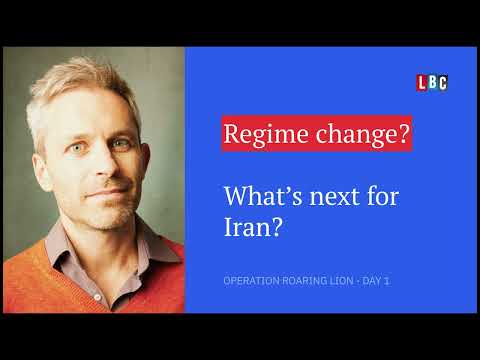
An interview I gave @LBC on Saturday morning when the war started. youtube.com/watch?v=istJdV…

YouTube
English

@GThrassaki @citrinowicz Why is collapsing the Iranian state and removing Iran from the geopolitical chessboard a monstrous goal?
English

@citrinowicz Israel is forced to lie about its real intentions: state collapse and simply removing Iran from the geopolitical chessboard. It has to make lies about regime change that it can’t possibly enact to hide the monstrosity of its true goal that will anger the Gulf, Europe, Americans.
English

Strategy Built on “Complex” Assumptions
President Trump’s reported remarks — suggesting that the United States had identified potential successors to Ali Khamenei, only for them to be eliminated in the opening wave of strikes — illustrate the degree to which current U.S.–Israeli strategy rests on highly complex, and potentially fragile, assumptions.
The notion that external actors can effectively “install” or shape leadership succession in Iran misunderstands the nature of the Islamic Republic’s political architecture — particularly in a post-Khamenei scenario.
Iran is not a system built around a single personality alone. It is a layered structure composed of the Supreme Leader’s office, the Assembly of Experts, the Islamic Revolutionary Guard Corps (IRGC), clerical networks, and parallel security institutions — all embedded within a deeply ideological framework. Succession is structured, contested, and internally managed. It is not externally engineered.
Without entering into the debate over Khamenei’s targeted killing, it is worth noting that he was, paradoxically, a figure with whom transactional arrangements were possible — provided they respected his defined red lines. His centralized authority enabled strategic decision-making and policy coherence. His absence, by contrast, may produce greater decentralization and internal bargaining among power centers, complicating engagement with any single, decisive interlocutor.
Attempting to influence regime composition during active conflict — particularly against an ideologically rigid system — is strategically hazardous. The Iranian political system also operates under a strong norm of continuity and institutional loyalty. Any successor perceived as externally anointed or deviating sharply from established ideological parameters would face immediate legitimacy challenges.
There is also a fundamental ambiguity in U.S. objectives:
Is the goal to catalyze mass unrest and systemic collapse?
Or to elevate a more pragmatic insider capable of recalibrating policy while preserving regime continuity?
These are distinct strategic pathways requiring different tools, timelines, and risk tolerances. Conflating them increases the likelihood of strategic incoherence.
A further concern is analytical overconfidence. Misreading the internal mechanics of the Iranian system can generate unrealistic expectations — particularly the belief that kinetic pressure combined with selective targeting can produce controlled political outcomes.
History suggests otherwise. External force can weaken, deter, and disrupt. It is far less effective at precisely engineering succession within cohesive authoritarian systems — especially those forged through revolution and hardened by decades of external pressure.
The danger is not merely analytical error. It is strategic drift: escalating military engagement in pursuit of political outcomes that lack realistic pathways.
English

@GThrassaki @citrinowicz Oh wow, what an amazing insight. You're such a genius.
English

@RachelGur @havivrettiggur Can someone please remove the Leatherman from the desk?
English

Yes we are recording.
Stay tuned for a new episode of Ask Haviv Anything. @havivrettiggur

English

מסגדים ברחבי סוריה השמיעו באופן חריג הילולים לאלוהים המושמעים בעיד אל-אדחא ועיד על-פיטר בשביל לחגוג את הרג ח'מנאי. סרטון זה הוא מאדלב ששטחים נרחבים ממנה נכבשו ונבזזו בעבר על ידי מיליציות שיעיות זרות, שלאחר מכן הקימו בה מפקדות והיו סוחטים סוחרים שהעבירו סחורה לאדלב.
عمر مدنيه@Omar_Madaniah
تكبيرات العيد في مساجد ادلب الان فرحاً بخبر مقتل خامنئي
עברית

@yudapearl Yes because this idea of AGI is marketing bs for LLM corporations
English


@BowTiedBull Ridiculous manner of living unbelievable stupidity
English

Hilarious way to live but important lesson on choosing the right peer group early (20s range)
Pankaj@the2ndfloorguy
English

this is a journalist, supposedly. what does that even mean? "Country literally built on terror". Is there a country on earth that was not delimited and defined through a agonistic, often violent, often genocidal, struggle/project? what a fucking jew hating scum you are.
Thomas Fazi@battleforeurope
The country is literally built on terror.
English

@BowTiedBull Ai can’t do arbitrary, which is the magic of human thought. Get into the arbitrary decision making business, or die.
English

AI means that the only value is in two things: forecasting future trends which it can’t do and marketing is basically predicting what will move emotion in the *future*
All AI is hindered by relying on the past, hence why it is bad at investing
x.com/bowtiedbull/st…
Stefan Georgi@StefanGeorgi
@BowTiedBull What led to you making this prediction back in 2022? What was the reasoning?
English