

Rompo
902 posts

Rompo
@yeahlad_dw
refer to @zac_vigar’s bio
Perth, Western Australia Katılım Mayıs 2018
141 Takip Edilen60 Takipçiler

Kevin Xu
- $HIMS was a loss ❌
- $QS was a loss ❌
- Gave up on $IREN ❌
- Multiple pumping post to buy while only risking .5% of his own port
Who is paying $199 a month for this clowns sub? Shameless
Kevin Xu@kevinxu
Call me crazy, but I just made a new trade and its an even bigger banger.
English
@TheRealDavey2 The equity released and used to buy the 2 new properties would have the new rule applied to that debt but okay
English

> be Aus boomer property investor
> bought a shitbox for $1m 20 years ago
> now worth $3m
> only $1m mortgage, $2m equity
> Gov bans negative gearing going forward
> negative gearing grandfathered on my shitbox
> boomer gigabrain kicks in
> increase mortgage on shitbox to $3m
> massive negative gearing
> take the $2m extra and buy 2 more properties with no mortgage
> mfw I now have 3 properties all effectively negatively geared

English
Because help with the cost of living is our number one priority.
English
@JEChalmers You are a fucken disgrace. How can you stand there and promise something not to be done pre-eledtion and do it anyway? Should be a crime
English

This is the most important and ambitious Budget in decades.
Important because the world is throwing a lot at us – and this Budget is about helping Australia deal with these challenges.
And ambitious because we have so much going for us – and this Budget is about Australia seizing those opportunities.
This Budget is ambitious in the face of adversity.
It’s a responsible Budget, and a reforming Budget, which builds resilience and bolsters our economy.
There is more cost of living relief, more Medicare and more aged care, and more housing.
It makes the tax system fairer and stronger for workers, businesses, first home buyers and future generations –
Responding to the pressures of the here-and-now while embracing our intergenerational responsibilities.
We are responding to the biggest oil shock in history with a comprehensive $14.8 billion plan to secure more fuel, strengthen our supply chains, build resilience, and take the sting out of prices.
Immediate relief from the fuel crisis is coupled with lasting and responsible cost of living measures.
Tonight, we are proud to be delivering another round of ongoing tax cuts for Australian workers.
We will put more money into the pockets of 13.3 million workers with a new $250 Working Australians Tax Offset.
It will begin from the second half of 2027 and be paid each year, ongoing and automatically in your tax return just like the instant deduction we’re rolling out as well.
The $6.4 billion tax offset is the biggest cost of living measure in this Budget –
But it’s not all we’re doing to support families under pressure.
As a Labor government, we will always invest in Medicare, cheaper medicines and public health so Australians get the care they need, when they need it.
Australia’s longstanding housing shortage is making homes unaffordable.
This challenge hits young workers and families hard and we’re addressing it from every responsible angle.
The reforms in this Budget will lift our total investment in housing to a record $47 billion.
We’re levelling the playing field for first home buyers with 5 per cent deposits and tax reform to help more young Australians into their own home.
These housing reforms go to the core of our Budget strategy.
Dealing with the very real pressures on people right now –
While taking responsibility for the challenges facing the next generations.
The challenges coming at us, the opportunities ahead of us and the better future that Australians deserve, will not wait for a time when all is quiet in the world.
That’s why this Budget invests in resilience and reform, to grow our economy the right way and lift living standards over time.
This productivity package will help us attract and absorb more investment, make it easier and quicker to build, and slash compliance costs.
This Budget includes the most significant tax reform package in more than a quarter of a century.
This is about tax relief and tax reform to make our economy work for more Australians, businesses and future generations.
We’re delivering a fairer tax system for workers, first home buyers and young people.
We’re building a better tax system for businesses, with over $3.5 billion in new measures that lower taxes, to encourage investment and innovation.
Our tax reforms will help workers, create a fairer housing market, and drive more productive investment across our economy.
Debt is lower and the budget position is stronger in every year of the medium term because of our savings.
The medium-term budget position is much stronger and more sustainable as a consequence, creating more room for future tax relief.
Against a backdrop of global uncertainty, this Budget invests in Australia’s resilience, economic sovereignty and national security.
At a time when Australians are under pressure, this Budget delivers more help with the cost of living and new tax cuts for workers.
And in an era where people feel like the system no longer works for them, this Budget doesn’t just acknowledge that – it acts on it.
No other budget in the 2000s has set out this much responsible Budget repair and this much economic reform.
These are difficult decisions to ensure a stronger bottom line every year, to give us greater insurance in uncertain times.
At the same time as we build a more resilient, productive and competitive economy.
This is a strategy which helps shield people from the harshest consequences of a global oil crisis –
Stabilises our economy and our Budget at a time of extreme uncertainty and volatility in the world –
And strengthens Australia for the next shock.
Tonight, we choose the hard road of reform, not the path of least resistance.
By responding to the pressures Australians confront today.
And fulfilling our obligations and responsibilities to the generations to come.
English

Today $AMD has closed at $421.47
That’s up 100X from $4.2, when I entered $AMD in 2014
The ups and downs have been brutal
But fundamentals have prevailed
Thank you all for being here 💙

English
We're building a more resilient economy that works for every Australian.
English
Rompo retweetledi

🚨 THE BILLION-DOLLAR OPPORTUNITY FOR $HIMS THAT WALL STREET IS "SLEEPING" ON
@davidmaris - six-time #1 ranked pharma analyst, founder of Phalanx Investment Partners
02:56 - Compounded semaglutide pill saga
05:49 - The "steelman" for why Hims launched the pill
07:29 - Novo deal economics
14:29 - MEDVi scandal and wild west of GLP-1s
18:19 - Peptides going mainstream
25:57 - July FDA meeting
31:27 - TRT = billion-dollar opportunity
35:31 - Sleep Sleep Sleep Sleep
37:26 - Friction in getting diagnosed
38:04 - The CPAP supply chain problem
39:17 - How Hims could revolutionize sleep
43:04 - Eucalyptus and going global
46:16 - Cruise engineers (wtf are they building?!)
50:25 - Short interest still out of control
55:05 - Voting control and insider selling
59:46 - Valuation and Q1 warning signs
01:03:48 - Should Hims buy a teletherapy?
01:07:12 - Why Maris is long Hims 🔥
Not financial, legal, or medical advice
English
Rompo retweetledi
this is the guy who called peptides early in 2024
he got into $HIMS at $15
he breaks down his entire mental model and explains why AI<>Biology is bigger than anything
few will watch before it’s too late
Antonio Linares@alc2022
peptides can’t be regulated. trying to is like regulating code. 100 million can be synthesized. the value is in the AI that knows which one you need. that system is a digital twin of your body. this is Palantir at $7. same thesis. same upside.
English
Rompo retweetledi

Today, we took long-overdue action to restore science, accountability, and the rule of law.
In September 2023, the Biden FDA pushed a number of peptides into Category 2 — “Bulk Drug Substances that Raise Significant Safety Risks” — driving a dangerous black market that puts Americans at risk.
Now, after nominators withdrew 12 peptides, the FDA will remove them from Category 2 and will bring them to PCAC at its next two meetings, beginning in July—where independent experts will rigorously evaluate each substance on its scientific merits using full clinical, pharmacological, and safety evidence.
• BPC-157
• Thymosin beta-4 fragment (LKKTETQ)
• Epitalon
• GHK-Cu (injectable)
• MOTS-c
• DSIP (Emideltide)
• Dihexa Acetate
• Ibutamoren Mesylate
• Melanotan II
• KPV
• Semax (heptapeptide)
• Cathelicidin LL-37
This action begins to restore regulated access and will immediately begin shifting demand away from the black market.
We will follow the science, enforce the law, and deliver the clarity patients, providers, and pharmacies deserve.
English
Rompo retweetledi
I have been asked by several people what I meant when I said “we are in a world war” in my most recent note. To be clear, I didn’t mean to convey that I expect a shooting war between the U.S. and China (or any of the great powers) anytime soon. What I meant is that we are in the phase of the Big Cycle when major powers are in military wars and that the various wars happening now are interrelated, hence we are in a “world war," with the sides lined up as I described and with the implications for each of the main players and the whole unfolding in relatively classic interrelated ways that I describe as a progression of the Big Cycle.
For example, it is now widely believed that if the U.S. fails to open the Strait of Hormuz to have free shipping and to protect its Gulf Allies from attacks, countries all around the world (most importantly in Asia) will conclude that the U.S. might not be the strong ally and countervailing force to China that they thought it would be. which will lead some to tilt economically and geopolitically more toward China in a number of ways - e.g. to buy less U.S. debt (which is what happened to the British in the Suez Crisis, bringing about the ultimate end of their Empire) - and it could lead others to build up their military capabilities. As I complete my nearly three-week trip in Asia, I can convey that what I am saying is based on a lot more than conjecture.
The reason I do not expect a U.S.-China military war soon, but I do expect a lot of brinksmanship, is because both nations realize that such a war would be devastating and that it would be impossible to fully win over the other, at the same time as they won’t want to give much. Also, each country believes in its own economic and political systems and that the outcomes of those systems will determine their relative powers. And both nations have critically important domestic issues to deal with. Some people in leadership positions, especially in China, believe that the relative health, wealth, and power levels between countries is not as important as their own absolute health, wealth, and power levels, and that helping each other build these rather than tear them down is most important. For example, they believe that the world will be a dangerous place if the U.S. and China don't have AI cooperations and controls, and they are concerned that AI can be weaponized. Most countries know that most wars in history were won by one of the sides secretly developing new technologically advanced weapons and showing them to their opponents.
So, I believe that both sides think that their wars will be non-military wars that will yield evolutionary changes in relative powers. As for how the Chinese will fight, and how the world order related to it will evolve, it will probably look more like the type of war described in the “Art of War” (which I suggest you read if you haven't), and for how the new international world order will evolve, to the extent that it is influenced by the Chinese, it will evolve to be more like the tribute system (which I suggest you understand if you don’t) than the existing world order.
At the same time, I expect that there will continue to be trade, capital, technology, cyber, and geopolitical influence wars between these great powers and that both will continue to have justifiable fears of being cut off from essential goods, services, and capital that will necessarily will greatly reduce imbalances and interdependencies as well as efficiencies in production and trade of goods, services, and capital. I also believe we will increasingly see these two powerful nations pressure each other because there is no other way to resolve disputes now that the rules-based multilateral world order has been replaced by a power-based, self-serving world order.
Said differently, I expect that China will be very strong in its defense without being very aggressive in its offense. That is not just for tactical reasons; it is also because China has strong cultural inclinations to be that way.
I hope this is helpful in clarifying my thinking and as always I'd be happy to answer any other questions or hear your thoughts.
Ray
English
Rompo retweetledi

Leopold Aschenbrenner sold every share of Nvidia and Broadcom last quarter. Took the money and bought fuel cells, Bitcoin miners, and power companies.
Today Oracle signed a 2.8 GW fuel cell deal with his largest holding. The stock jumped 15% after hours.
This is the most contrarian AI trade on Wall Street right now, and the math behind it is wild.
Leopold wrote a 165-page essay in 2024 arguing AGI arrives by 2027. Then he translated that prediction into a pure energy play.
His logic: scaling from GPT-4 to superintelligence requires data centers consuming more electricity than most American cities. You can order 100,000 GPUs and get delivery in six months. You cannot add 500 megawatts to the grid in six months. The binding constraint on who builds AGI first is watts per rack.
So while AI funds stacked Nvidia at 30x revenue, Leopold built the opposite portfolio. Bloom Energy, his largest position at 15% of the fund, makes solid oxide fuel cells that can power a data center in 55 days. Grid interconnection takes 2-3 years.
He entered 2026 with $876 million in Bloom Energy. That position has more than doubled. His fund went from $254 million in equity positions in Q4 2024 to $5.5 billion by Q4 2025. Beat the S&P by 47% in its first six months.
He's 24. Got fired from OpenAI two years ago. Zero prior fund management experience. The Collison brothers and Nat Friedman backed him anyway.
Today's Oracle deal validates the entire thesis. Oracle contracted 1.2 GW immediately, with a pipeline to 2.8 GW, because Bloom delivered a fully operational system in 55 days last year. A month ahead of schedule. Oracle needs power faster than any grid can supply it.
GPU supply is expanding on a known curve. Electricity supply isn't. Leopold bet his entire net worth on the gap between those two curves, and so far the gap is only getting wider.


English
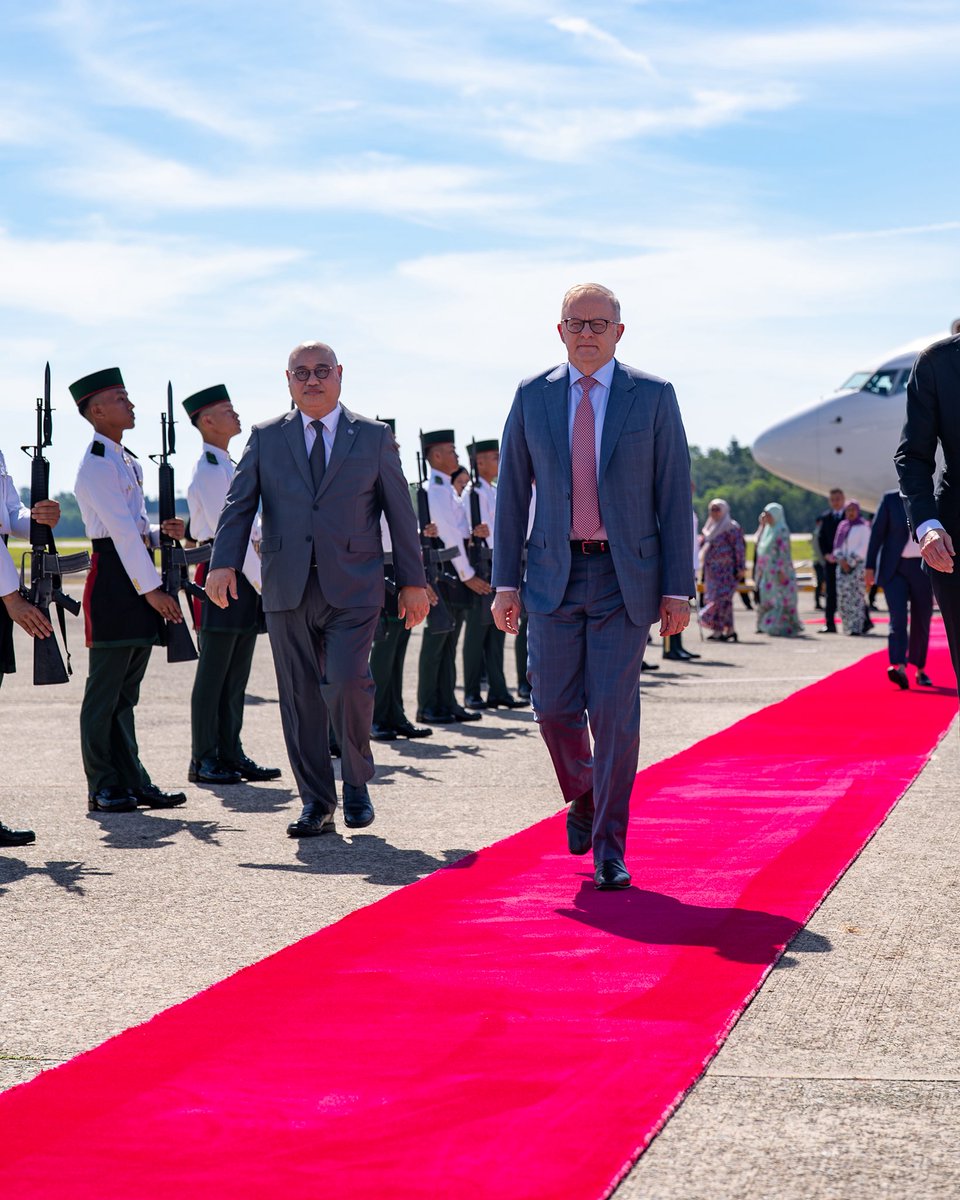
Now more than ever, we have to work with our international partners to deliver for Australians back home.
I’m in Brunei to help secure our fuel and fertiliser supply, and to keep Australia moving.
English
Rompo retweetledi

Think you can predict what gold will be worth on December 1?
Over A$6,000 in Perth Mint gold goes to the closest guess. One prediction. 30 seconds. Free to enter.
Entries close 31 Aug. Aus 18+ only.
English