
Ryan Y Yi

6.3K posts

Ryan Y Yi banner
Ryan Y Yi

Ryan Y Yi

@YI_LON

founder @onchaingroup_ • past @cbventures @coinfund • NFA

NYC Katılım Haziran 2009
2.5K Takip Edilen4.8K Takipçiler
Ryan Y Yi retweetledi
Unchained
Unchained@Unchained_pod·
🗳️ DAOs were supposed to solve governance. So why do founders keep saying they can't run a business through one? @laurashin, @yi_lon, and @theiaresearch on where DAOs actually work, where they fail, and what comes next. youtu.be/l_9ko6V6n0E

YouTube video
YouTube
English
0
1
5
378
Ryan Y Yi retweetledi
Laura Shin
Laura Shin@laurashin·
I asked @YI_LON and @TheiaResearch about the @AcrossProtocol token-to-equity conversion, and Felipe flagged something worth watching: management teams have every incentive to suppress token price before announcing a conversion deal. They profit from the premium. 👀 youtu.be/l_9ko6V6n0E
YouTube video
YouTube
English
2
1
8
2.5K
Ryan Y Yi
Ryan Y Yi@YI_LON·
ICE x OKX deal tea leaves: - Product: CFTC is opening a path to onshore perps and ICE wants to launch it. OKX has the “know-how” and can help ICE build the product. - Distribution: Tokenized equities PMF is with international users (see Ondo’s Binance distribution). ICE gets a GTM partnership into OKX userbase. - Reputation: OKX was fined by DoJ over money laundering last year. By having ICE on the Board, OKX cleans reputation perception and differentiates them from Binance (their largest competitor) while opening a path to U.S. market.
English
5
1
30
3.3K
Ryan Y Yi
Ryan Y Yi@YI_LON·
Token IR exists, we just haven’t figured out the right form factor yet. Public companies: • report quarterly • mature businesses • dedicated IR / CFO Token projects: • fundamentals update 24/7 (onchain) • earlier stage (“pre-Series A/B”) • founders rarely talk to investors The result: the market gets constant data but almost no narrative.
English
1
2
16
1.2K
Ryan Y Yi
Ryan Y Yi@YI_LON·
Given Aave’s business structuring chapter seems to be resolved, let’s look to the next catalyst in the category, which is… The Fee Switch for Morpho Blue. The Vault model is brilliant because it creates competition for liquidity, reshapes risk companies into fund / AUM business models, and regulation prevents front-ends from bundling that activity. The protocol benefits, but eventually has to monetize, which will directly impact margins for the Vault category. Watching the protocols navigate this topic is what I’ll pay attention to going fwd.
English
3
0
20
1.4K
Ryan Y Yi retweetledi
Larry Sukernik
Larry Sukernik@lsukernik·
If you’re ex-IB/PE/MBB and want to help develop crypto capital markets, please DM me Very cool role opened up at a special company
English
4
1
12
1.7K
Solana
Solana@solana·
BREAKING: @coinbase to allow users to trade all Solana tokens through a DEX , without listings 🔥
English
488
528
2.8K
379.7K
Nemil Dalal
Nemil Dalal@nemild·
I'm joining @ycombinator as a Visiting Partner, with a focus on crypto. If you're an ambitious founder building in crypto that's interested in applying, ping me (DMs open). Y Combinator has been critical to foundational crypto builders: from @coinbase to @axiomexchange to @opensea (and 70 more). In the next decade, we expect there to be hundreds more companies building on blockchains: defi protocols, social networks, new blockchains, stablecoin-powered financial apps, games, infra, wallets and more. They'll need to navigate security, regulatory, global expansion, token issuances, onramps/offramps, usability, and more. In the past, I've supported founders with everything from brainstorming initial company ideas (@OpenSea) to auditing their smart contracts (@dYdX) to helping lead some of their most innovative bets (@coinbase). On a personal level, YC was transformational for me in 2012, giving me the hard lessons to build ambitious early stage ideas. It served me well when helping nurture products like USDC, @coinbasedev, and x402. Excited to give back to the YC community that has given me so much.
Nemil Dalal tweet media
English
147
28
806
105.3K
Kate Aksay
Kate Aksay@kate_onchain·
I am leaving Coinbase to join Agora as Head of Engineering! I am so thankful for my 5 years at Coinbase, most of which I spent building the Coinbase Developer Platform and Base, and for everything I learned from transformational leaders like @brian_armstrong , @jessepollak , and @willrobinson23 . I am carrying those lessons forward as I step into this next chapter of my career. Agora's mission is to transform how money moves. Stablecoins will underpin a new financial fabric, one that is faster, more global, and more efficient than today’s siloed systems. AUSD and the Agora stack, is an institutional-grade full service platform that makes issuing, managing, and integrating stablecoins seamless: whether you’re a developer, fintech, or multinational. With AUSD, stablecoins become programmable, composable, and ubiquitous by default. Agora also makes it simple for institutions to roll out their own branded stablecoins. Agora’s focus on the global market, where dollar access, payments, and inflation protection can truly change lives, really hits home for me. And the timing could not be better for Agora. Crypto infrastructure is finally ready to scale. Regulatory clarity is forming, cross-border payments are rapidly growing, and institutional hesitation is turning into active demand for stablecoins. I can’t wait to dive in and build alongside @Nick_van_Eck, @drakeevans, and the Agora team. The team has been absolutely crushing it, built a strong foundation, and recently closed a $50M round led by Paradigm alongside Dragonfly. This is just the beginning, and the momentum is only growing. If you are interested in scaling stablecoins with us, check out @withAUSD's open roles below!
Kate Aksay tweet media
English
99
6
538
57.5K
Jay
Jay@jayhinz·
there are certain words a person can just say to let you know how long they’ve been in crypto. a type of shibboleth
English
39
1
93
16K
TBPN
TBPN@tbpn·
BREAKING: Coinbase’s Head of Corp Dev @_aklil0 and Bridge’s Head of Marketing @zdave15 are engaged
TBPN tweet media
English
25
3
218
160.9K
Ryan Y Yi retweetledi
Laura Shin
Laura Shin@laurashin·
Coinbase, Robinhood, Stripe, Telegram, Binance: The new Mag 5 of crypto? @Steven_Ehrlich & @yi_lon break down: 📈 How Base is reshaping Coinbase’s business 🪙 What it means that Stripe is launching its own blockchain 🌍 Robinhood’s play for 24/7 tokenized assets 💸 TON as Telegram’s financial lifeline 🔥 Why BNB might be the “final boss” of crypto tokens Timestamps: 🎬 0:00 Intro 🌍 0:57 Why distribution is the key battleground for the next wave of crypto adoption 🏗️ 4:28 How #Coinbase is rearchitecting its platform around #Base 🔑 7:46 What the upcoming Base token and Base app could unlock for users 📱 11:17 How #Robinhood is competing in crypto—and why it might have an edge 💳 18:00 What the tokenization trend means for Robinhood’s future 💼 19:56 Why #Stripe is building a crypto tech stack of its own 💬 27:06 Why #Telegram’s #TON token is central to its survival and growth 📉 33:44 What’s behind TON’s lagging price performance 🔥 37:17 How #Binance uses the #BNB token as a cornerstone of its entire ecosystem 🚀 44:47 Why going fully onchain could be the defining strategy for the next generation of companies
English
27
16
49
6.8K
Ryan Y Yi
Ryan Y Yi@YI_LON·
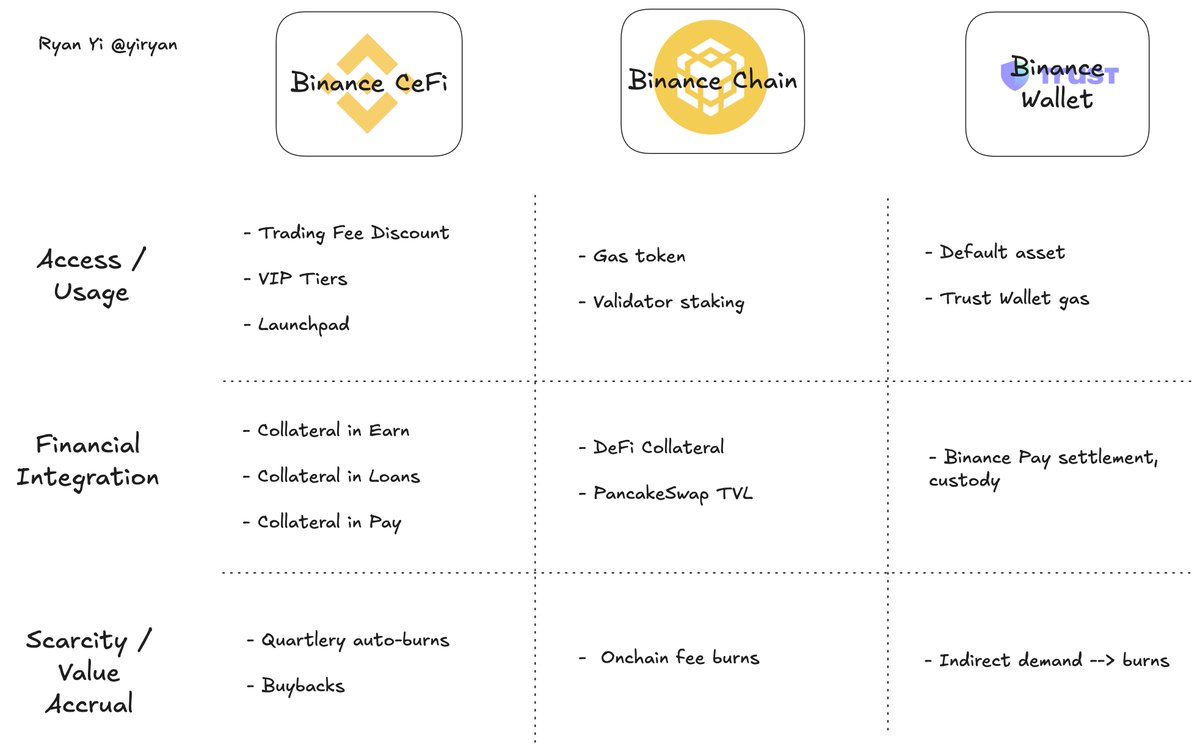
The #Onchain5 Part 5 - Binance This is a repost of an @Unchained_pod article I authored which was released on October 01 2025. TLDR – BNB is Binance’s onchain equity proxy. Burns mimic buybacks, exchange profits drive its value, and embedded utility makes it the loyalty glue across Binance’s ecosystem. Binance is the largest global crypto exchange by spot and derivatives volume, with deep roots in non-Western markets. Its strengths are scale, liquidity, and a full-stack product suite. But it also faces legal and regulatory pressure across certain jurisdictions. Without equity or bank-based financing — outside of a $2 billion investment from an Abu Dhabi-based investment firm — Binance must primarily use onchain mechanisms to share profits and fund itself and reinforce its position as the gravitational hub of crypto liquidity. BNB as Binance Equity Analog Binance has been the world’s most successful crypto exchange since 2017. It has held that title through numerous crypto bull and bear markets and seen would-be competitors wither away. While it’s a privately held company, BNB acts as a proxy to equity — which might be one of the drives for token holders. That, in effect, is also how Binance has gotten millions of people onchain (a rough estimate is that around 50M total unique addresses hold Binance-wrapped onchain assets). Binance owns a large portion of BNB tokens, and BNB auto-burns around 20% of the exchange’s profits per quarter, which would put the 2024 annual profit to sit somewhere around ~$22 billion. BNB’s value relationship is primarily to the exchange’s trading revenues. In 2024, Binance’s auto-burn program destroyed ~$4.4 billion worth of BNB — almost entirely funded by trading profits. By contrast, all onchain fee burns since BNB Chain’s inception account for less than 3% of supply reduction. The reality is clear: BNB functions as a financial mirror of Binance’s core trading business. Exchange volumes and profitability drive BNB’s scarcity, while alternative value dimensions like chain-fee burns are marginal in comparison. $BNB is now valued at $139.6B on a fully diluted basis, and is up 42.04% in 2025 and is currently a bit above $1,000, not far from its all-time high of $1,079.07. BNB Embeds Utility Across the Ecosystem to Lock In Users Beyond its financial role, BNB functions as the connective tissue of Binance’s product suite. On the exchange, it unlocks fee discounts, VIP tiers, Launchpool, and Launchpad access. In CeFi services like Earn, Loans, and Pay, it acts as collateral and a settlement asset. Additionally, the token has familiarized its user base with onchain activities, even if the products are on its exchange. Products like Binance Launchpool, for example, allow users to familiarize themselves with crypto native actions like yield farming. Binance users pledge $BNB into the project’s DeFi liquidity pools earning rewards on centralized and decentralized platforms, and they access new income and rewards and earn ownership in new tokens that Binance plans to support. In 2024, Launchpool programs awarded over $1.75 billion to users. Similarly, Binance Launchpad allows Binance users to use $BNB and participate in token sales of imminent listings. This is effectively the crypto-native / token version of Robinhood’s pre-IPO products, which familiarize retail investors with new and upcoming investment opportunities. Launchpad (plus Earn) has generated around $215 million in net fees in 2025 so far. The net result too is that Binance users are incentivized to hold and stake their $BNB to access the broader Binance financial services ecosystem. BNB Chain + Binance Wallets Act as Consumer Platforms Binance serves as an onramp for BNB Chain, Binance’s EVM chain, which has existed for 5+ years. Today, BNB Chain is host to over 650M+ unique wallets on BNB Chain (similar to the ~600M unique wallet count on Base), settled over 9B transactions (vs 4B on Base), and current holds over $7.8B in total value locked (vs $5B on Base). PancakeSwap, which is the native DEX of BNB Chain, currently custodies over $2.4B in total value locked (vs Aerodrome’s $500M in TVL which is Base’s native DEX). On BNB Chain, $BNB serves as a gas and validator stake, while in wallets it underpins Binance Pay and Trust Wallet. Therefore, $BNB is unique among exchange tokens because it anchors both Binance’s balance sheet and its L1 chain, while other rival exchange tokens do discretionary burns (vs programmatic) or serve as reward points within far smaller ecosystems. Each utility may be modest in isolation, but collectively they ensure that anyone engaging deeply with Binance inevitably touches BNB. This embedded utility drives loyalty and retention, turning BNB into both a value-accrual mechanism and a user relationship anchor. Takeaway: BNB serves as the onchain equity substitute. By mimicking buybacks through burns and embedding itself across the Binance ecosystem, BNB ensures Binance can fund itself, lock in users, and remain the center of global crypto liquidity without access to traditional markets. Risk: Reliance on BNB ties Binance’s solvency and valuation tightly to market cycles. Additionally, If regulators classify BNB as an unregistered security or clamp down on burn mechanics, Binance’s equity substitute model could unravel, leaving its financial destiny fragile.
Ryan Y Yi tweet media
English
0
0
2
249
Ryan Y Yi
Ryan Y Yi@YI_LON·
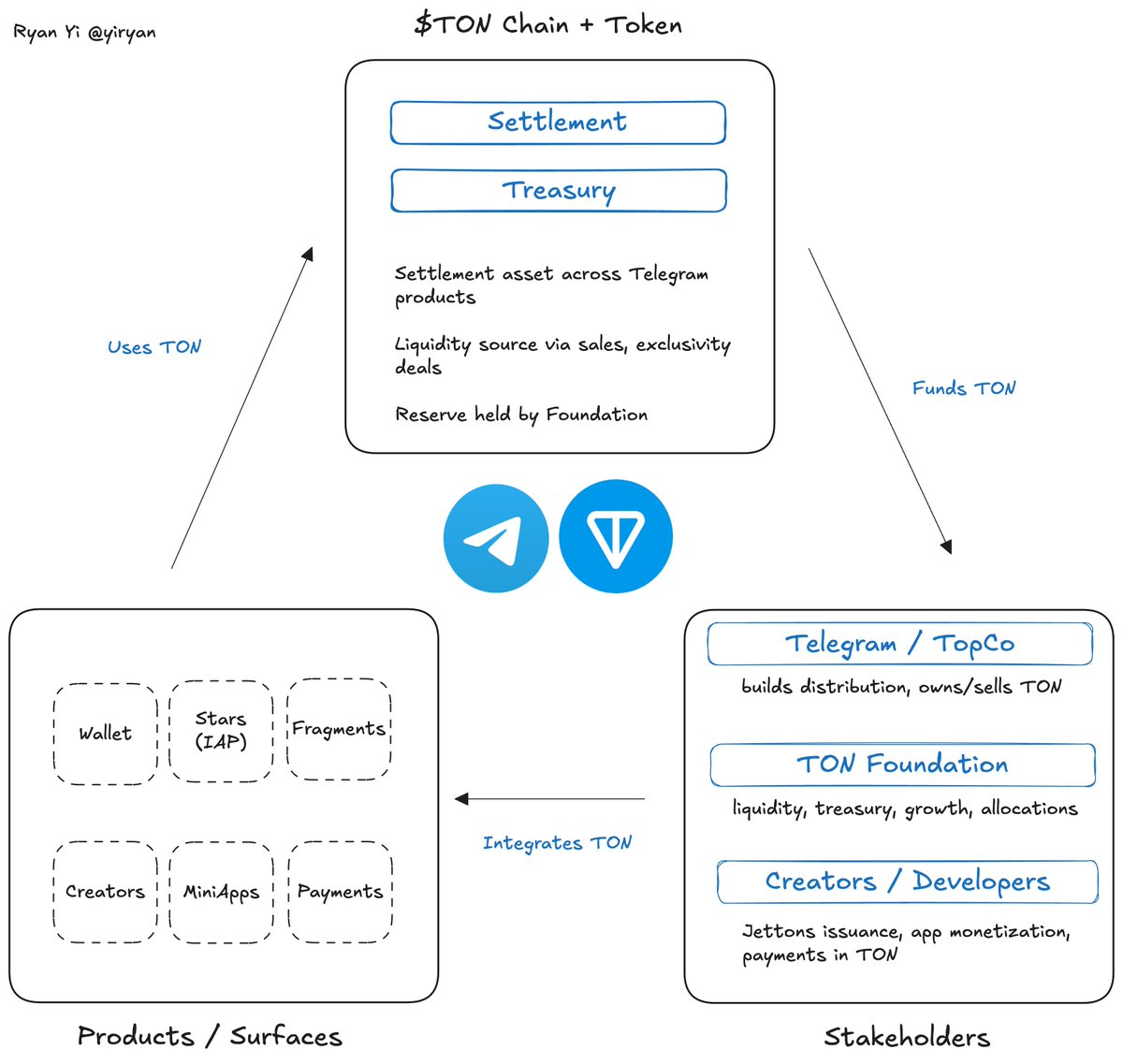
The #Onchain5 Part 4 - Telegram This is a repost of an @Unchained_pod article I authored which was released on October 01 2025. TLDR – Telegram is global and growing, but its in-app economy is still in its early stages, and it must finance itself under the weight of debt and political baggage. TON addresses these constraints by functioning as Telegram’s balance-sheet asset, settlement rail, and developer platform — turning solvency and platform growth into the same strategy. Telegram has ~1 billion MAUs and is concentrated in markets such as Eastern Europe, India, and Latin America. Its brand is anchored in privacy and autonomy, and its product surface is now extending well beyond messaging into channels, groups, and mini-apps (a web app that runs directly within Telegram). But it also comes with certain structural constraints — it rejects data-driven ad monetization, its founders face political baggage that blocks certain Western capital markets, and its monetization story has only recently begun and has had to keep up with its debt financing. In December 2024, the New York Times reported that the company was on track to make its first corporate profit in history. For the app to meet its grander ambitions beyond messaging, Telegram needs an alternative liquidity path and an aligned economic model for developers. History of TON The Open Network (TON) was originally launched by Telegram in 2019 but handed off to the community in 2020 after the SEC blocked its original GRAM token sale, which raised $1.7 billion in one of the largest ICOs in history. Mining began in July 2020, with most of the supply distributed in the beginning stages, although independent analysis shows that a large portion of TON’s supply was mined by groups affiliated with the TON Foundation. Today $TON’s fully diluted valuation is $13.6B, marking it as a top 20 crypto asset by market valuation. According to Dune, TON chain stats include 2.8B transactions, 49M activated wallets, 822K tokens deployed, and 152M smart contracts deployed, with $37M in lifetime gas fees paid to contracts deployed. However, its token price has failed to keep up with the market’s rather bullish 2025. It is currently down 51.94% YTD. TON Is a Financial Lifeline for Telegram Telegram has primarily financed operations through debt as it figures out its monetization path. TON now fills that gap by functioning as a balance-sheet asset. In 2023, Telegram generated ~$342M in revenue with a net loss of $173M. In 2024, revenue rose to ~$1.4B with ~$540M profit — but over half came from TON-related flows, including ~$700M in token sales and a $225M exclusivity subsidy from the TON Foundation. These token injections flipped Telegram from loss-making to profitable on paper, allowing it to refinance $2.4B in debt and raise another $1.7B bond in 2025. TON is effectively Telegram’s bridge financing substitute. TON Powers Telegram’s In-App Economy Telegram’s monetization today is still early — subscriptions, gifts, and creator tools generate revenue, but these value flows do not go back into the ecosystem. This changes with TON being embedded as the default backend. A native crypto wallet (built by TopCo) gives users instant access to TON and stablecoins; Telegram Stars are an in-app virtual currency, allowing users to buy digital goods and services from bots and creators, and effectively serve as a fiat on-ramp, which has driven ~$44M in gaming app revenue; Fragments are tokenized Telegram usernames, which have generated ~$490.7M in volumes; Creator subscriptions and rewards settle directly in TON. This integration allows Telegram to recycle value inside its ecosystem, turning microtransactions, mini-apps, and cross-border flows into token demand that anchors growth to its balance sheet. The platform saw a surge in usage in mid-late 2024 as tap-to-earn games became popularized on Telegram, where users could obtain TON for playing simple mini-dapp games that rewarded attention. Two popular ones were Notcoin and Hamster Kombat. For TON and Telegram to meet these broader ambitions, usage will need to grow again and be spread out among a wider variety of applications. TON Aligns Telegram’s Developer Strategy With Value Capture To date, Telegram’s developer ecosystem revolves around external code plugged into simple widgets and experiences, without deep integration into Telegram’s core payments or data. Popular crypto trading bots, for example, let users buy tokens through a Telegram interface, but none of those flows or assets were actually captured by Telegram itself. TON becomes the opinionated backend for crypto apps — effectively making all mini-apps into crypto apps. Developers can issue tokens and build programmable flows that keep value on-platform. And because Telegram’s wallets are integrated directly into the app, users can seamlessly interact with these mini-apps without needing external infrastructure. Every transaction is routed through TON. Developer success is tied directly to TON velocity, aligning ecosystem growth with Telegram’s token economy and balance sheet. Takeaway: Onchain lets Telegram convert TON into both its financing substitute and its platform engine. By making TON its balance-sheet asset, embedding it into the in-app economy, and enforcing it as the developer backend, Telegram aligns solvency and platform growth into the same strategy. Risk: That synthesis cuts both ways. Telegram leans heavily on TON sales for solvency, blurring the line between true monetization and financial engineering. If TON adoption stalls beyond speculative trading, or if regulatory and political baggage limit mainstream uptake, Telegram’s balance sheet and its platform ambitions could unravel together.
Ryan Y Yi tweet media
English
1
0
2
322
Ryan Y Yi
Ryan Y Yi@YI_LON·
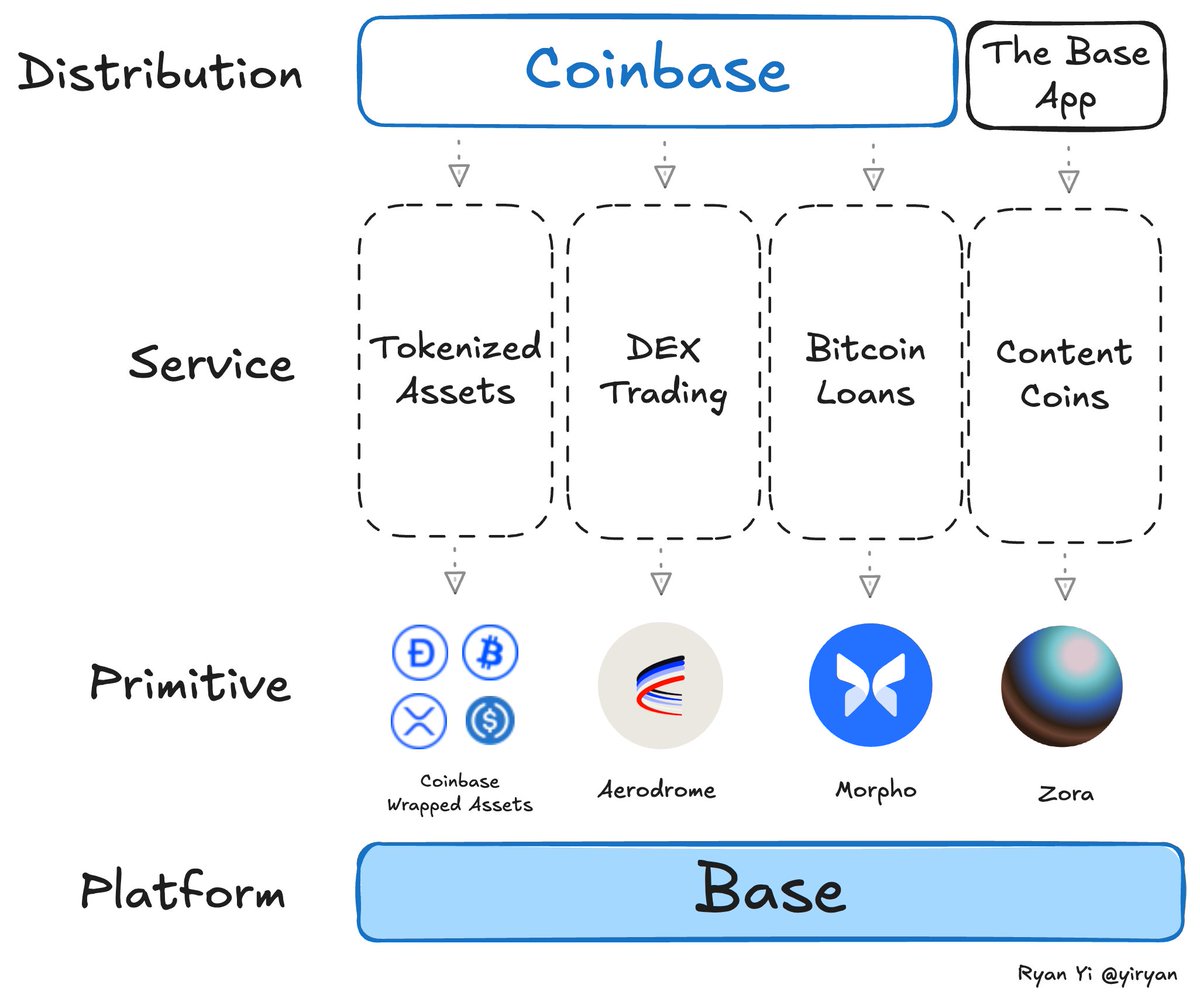
The #Onchain5 Part 1 (Intro + Coinbase) This is a repost of an @Unchained_pod article I authored which was released on September 10 2025. I will be releasing the rest of the series throughout the remainder of this week. Crypto is entering a new phase of adoption where distribution will matter the most. This means that centralized entities with strong brand loyalty will be the biggest players in bringing users onchain. Although this phase has barely started, it is already shaping up to have its own version of a Mag7, which I’ll call the Onchain5. These companies need to have a few key characteristics: > Expansive distribution and market leadership in their various sectors > A clear signal of investment into developing and adopting blockchain technology > Excellent UX/UIs for customers that can extract blockchain mechanics from front-end customer experiences > Clear and necessary use cases for incorporating digital assets into their businesses The firms chosen for this initial cohort are not necessarily the five biggest players in crypto, though they are sizable. They have been selected due to their ability to meet each of these criteria and because their business models target different sections of the online, and onchain, economy. The Onchain5 series debuts today with the release of the list’s first name. The #Onchain5 are Coinbase, Robinhood, Stripe, Telegram, and Binance. --- 1. Coinbase Coinbase: Uncle Sam’s Onramp Coinbase’s DNA has always been the trusted onramp into crypto, holding over $245 billion of assets in custody for over 8.7 million monthly users. With a market capitalization of $77.6 billion, Coinbase is also the only pure crypto firm in the S&P 500. With Base, a layer 2 blockchain launched in August 2023 built on the Optimism tech stack, it flips from a reactive custodian into an origination platform, gaining new distribution leverage across listings, developers, and users for everything from trading and lending to shopping. Base is home to 200M total crypto addresses, holds $4.8B of assets onchain, and has generated almost $150M in sequencer revenue. Coinbase’s mission is to increase economic freedom in the world, and crypto is the technology to service that mission. If Coinbase’s products showcase crypto as investments and crypto as financial services, then Base helps showcase crypto as an application platform as part of the Coinbase mission and strategy. Base Scales Coinbase Financial Services Base lets Coinbase scale its financial services offerings that augment its existing centralized stack without the overhead that might stall them in a centralized framework, while tying back into Coinbase’s brand and user base. One example is credit. Coinbase has historically run into issues launching borrow/lend products, which are both regulatorily and operationally complex. In 2021, the SEC threatened to sue Coinbase over the USDC Lend product, which did not end up launching, claiming that it would have been tantamount to issuing an unregistered security. On the operational side, Coinbase itself would have also needed to source and balance liquidity on both the borrower and lender sides. Today, through Coinbase’s Crypto-Backed Loans, the firm offloads that complexity to Base’s onchain liquidity pools powered by DeFi protocol Morpho that are akin to offerings from credit protocols like Aave or Compound. Through this arrangement, Coinbase simply provides the trusted front-end for users to access the product. This offering has grown to over $1.3 billion in open loan collateral with almost $900 million in loans originated. Payments Another example is payments. Coinbase Smart Wallets on Base offer a gasless experience for sending USDC, cbBTC (a wrapped version of BTC), and EURC (Circle’s euro-denominated stablecoin), meaning that users will not have to pay transaction fees on Base. Coinbase sponsors the gas payments for users that onboard to Base via the Coinbase Wallets, which leads to a seamless user experience. Trading Lastly, there is DEX trading. Today, every new crypto asset requires Coinbase to evaluate custody, infra costs (nodes, security, keys), and regulatory thresholds before listing. This makes token support slow, opaque, and difficult to scale – especially for small-cap tokens. While the rollout of Coinbase DEX trading is still minimal and growing, ever since the August 2025 announcement, Coinbase users have traded at least $6 million in volume across 10K+ transactions across 100+ tokens. Most notably, most of the tokens traded are not listed on Coinbase’s centralized exchange. Of the ~1,000 tokens traded so far, only 13 are Base tokens currently listed on Coinbase.* As a result, Coinbase can host issuance, settlement, and trading directly on Base — enabling faster listings, deeper liquidity, and revenue diversification from onchain activity. Base Gives Coinbase a Builder Go-to-Market Funnel Builders have long been treated as issuers, and Coinbase’s relationship with them has been mostly transactional: projects launch elsewhere and eventually list on Coinbase. Base changes that dynamic by becoming a go-to-market funnel for builders, where new projects can build directly on Coinbase’s rails. This unlocks two major advantages. First, Coinbase can capture developers earlier in the lifecycle and cross-sell them into other products (like business accounts and APIs). Second, Base gives Coinbase a way to own the developer relationship, who otherwise might build on alternative ecosystems – where Coinbase would never see them until it’s time to list. According to Electric Capital’s Developer Report, Base has around 1.6K+ monthly active developers, with 8K total repos, and 2 million total commits. With Base, those same teams build inside Coinbase’s orbit, making the company stickier with developers and extending its relationship moat. So far, Base has become a home for new projects (like Clanker, a memecoin launchpad), institutional projects (like JPM, a deposit token issued by JPMorgan), and owns the leading share for projects issued across multiple chains (like Morpho and Virtuals). For example, Morpho’s total value locked in $7.8 billion, with $4.7 billion on Ethereum L1, followed by $1.7 billion on Base. Base Jumping And now, the push into Base is now about to go into overdrive. In July, the company revamped its non-custodial Coinbase Wallet product to become the new Base App (currently in Beta), which puts Base front-and-center for its users. The new “super app”, as described by a Coinbase spokesperson in an interview with Unchained, even includes messaging and gaming features. Furthermore, the wallet’s waitlist has surged to over 1 million people. Over time, Base will aim to continue making inroads with builders and new users, while also powering Coinbase user products. For one, we can expect Coinbase’s continued investment into expanding the financial services that rely on Base. Secondly, products like Coinbase Onramp / Pay help connect a Coinbase user’s account to the non-custodial Base App wallet. Lastly, because the wallets that power the Coinbase onchain experiences are compatible with the non-custodial Base App wallets, it results in a cohesive custody flow that blends the seamless onchain experience with the offchain on-ramp. Can Coinbase Avoid Playing Favorites? As Coinbase tries to build its user base on Base, it will have to navigate some potentially tricky optics. Historically, its flagship centralized exchange is not meant to play favorites and supports as many tokens and blockchains as possible in a responsible manner. But as it expands the “onchain mullet” strategy of offering a centralized front-end (Coinbase) powered by a decentralized back-end (Base), it will be interesting to see how much of their onchain efforts will exclusively support Base as the only chain. The tension comes from the fact that, on one hand, the strategic case makes sense because it bolsters Base’s value proposition as an attractive home for developers seeking to access Coinbase’s distribution. However, this can lead to tradeoffs in terms of Coinbase’s resources into supporting alternative ecosystems for its onchain products. For example, users have reported negative experiences when dealing with Solana token deposits, withdrawals, and USDC support on Coinbase. Armstrong addressed this perceived inconsistency in an August roundtable by saying, “Think of Base and Coinbase as different brands. So Coinbase is neutral. We are chain-agnostic, so we’re going to support every chain that our customers want. Base is its own separate organization and has a different brand for a reason.” He further said that while the new iteration of the Base App will be “Base first,” it can also “plans to make Base into a hub that has interoperability to Solana and other things.” * We queried the CoinGecko API for all unique token contract addresses from Dune’s Coinbase DEX data to identify which tokens are officially listed on Coinbase.
Ryan Y Yi tweet media
English
7
2
22
1.8K
Ryan Y Yi retweetledi
TylerD 🧙‍♂️
TylerD 🧙‍♂️@Tyler_Did_It·
Coinbase crossed $1,000,000,000 in Bitcoin-backed loan originations today 🔵🟠 From 0-> $1B in less than 9 months
TylerD 🧙‍♂️ tweet media
English
25
9
90
4.5K