
Arthur
255 posts


Arthur
@yourkingarthur1
the only way out is through. https://t.co/tEqipDseZU
Camelot Katılım Nisan 2022
267 Takip Edilen1.2K Takipçiler
@sapphycrypto already made back my initials just sleeping on bags
English


someone made a meme coin that gives spcx to its holders, so far $spacemoon has given 100,000$ in spcx to its holders
buy a meme coin, get your dividend every few mins holds for 30 years and retire off spcx from a meme coin! NFA
dexscreener.com/bsc/0x3e4f42af…

English


THE WAIT IS FINALLY OVER
EARLY ACCESS IS NOW LIVE 🔥
A new era of Polysights is here.
v1.polysights.xyz
English
Arthur retweetledi

We started building Paraloom in March 2025. Privacy Cash didn't exist yet - it launched in August 2025, five months later. So this was never a copy of anything.
The goal from day one was a fully distributed, fully decentralized privacy system with a low hardware barrier: run a validator on a Raspberry Pi or an old laptop. Many validators, spread across the world, no single machine to seize.
Tornado-style protocols and Privacy Cash all share one weak spot - a single operator behind the system. That's the door governments knock on. Tornado's dev got arrested. Privacy Cash advertises "OFAC compliance" because they can be pressured. Paraloom is built to have no such door - same reason no government can shut down Zcash or Bitcoin: nobody sits at the head of it.
And here's the kicker. Privacy Cash works and the volume is real - it just crossed $300M in cumulative private transfers, and it's accelerating ($100M→$200M took 69 days, $200M→$300M only 52). The fees run on a 0.35% withdrawal cut.
Now look at where all of that goes: Holders Revenue $0, validators' share $0. The entire fee stream flows to one operator, behind one contract and one relayer - not to the network. The bigger it gets, the bigger the single target.
That's the world we're trying to fix. Privacy isn't broken; privacy works. What's broken is that one person writes a contract, runs a server, collects every cent of the fees, and is a single point a government can shut down.
Paraloom routes that exact same fee stream to a permissionless validator set instead. Same privacy, lower fee (0.25% vs 0.35%), but no one at the head of it - and the rewards go to whoever runs a node.
English
Arthur retweetledi

recently , @paraloomlabs caught my attention
it is a new privacy L2 built for Solana using real zkSNARKs
It’s trying to bring real privacy to Solana without killing the speed
no new blockchain, no forced token, everything settles directly on Solana
you generate zk proofs in your browser or wallet and validators verify them super quickly
shielded pool + encrypted notes = your transactions stay private, but you still get full Solana speed and composability with defi protocols like Jupiter etc
what makes it cool is that validators can run on normal hardware (even Raspberry Pi), it’s fully permissionless and 100% of fees go to validators in SOL
it’s also open source and devnet is already live with external validators joining
their competitors are:
Light Protocol: ZK compression for cheaper apps (not full privacy L2)(83m mc)
Monero (6.4b mc) and Zcash (8.7b mc)
$paraloom is currently at 400k mc
I believe that it’ll be repricing soon
ca: Br1JxELQYP34YdRW4gbEPLasHEtyz8eCmT2FvmnYpump
English
the same jupiter trade - but your wallet never appears on it.
today: you swap → the chain says "C8Uar4 = you," forever.
the goal: a fresh address acts for you → "9xQp, not you."
same liquidity, same price. your identity off the public record.
the shielded pool is already live on devnet. this swap flow is what we're building next.

English
most "privacy" on solana = a program with a stub verify.
paraloom on devnet today:
- 19 validators on-chain (15 external, permissionless registration)
- real groth16 proof (192B, depth-32)
- 7-of-10 BFT quorum on every withdrawal
- on-chain settlement, no shortcuts
explorer.paraloom.io
English

Video react to this tweet with what you're building on Solana
We'll RT the best ones
English
@akaleviack @paraloomlabs one day we’ll wake up and it’ll be at 10m
English

I’m calling out to those who believe in Solana projects and to the smart money.
$Percolator, $Opal, $Three, $Zinc and other projects. These are already running.
$Paraloom @paraloomlabs hasn’t even started its main run yet and is still heavily undervalued. It’s a privacy L2 protocol that’s been in development on Solana for 15 months.
Decentralization + privacy bridge + privacy swap + Paraloom wallet + the ability for low-spec laptops to run nodes and become validators.
Its fair market value right now should already be over 10M mcap.
The rises of Zcash and Near are no coincidence. In today’s world, the importance of privacy is increasing — and it has to.
Paraloom@paraloomlabs
0. financial privacy. Three of us spent a year building exactly that on Solana, on commodity hardware, with zkSNARKs. 33k LOC Rust. 407 tests. Open source.
English
Arthur retweetledi

I have never seen so many people capitulating out of $ETH or crypto.
Some are writing blogs and essays explaining why it failed, mainly naming how other chains won the race, measured by fees taken in.
Some of my thoughts, in these hard times:
Time will tell, but I think many people are mistaken in treating $ETH like an end-stage $AMZN, as if the main question is already about mature margins, fees, and cash flows.
In reality, Ethereum is still very much earlier in its economies-of-scale phase, with nearly all metrics in the top right corner and growing at mid double digits to tripple.
Furthermore, most of the market is focused on the wrong battle: who can become the fastest and cheapest payment processor.
Lower fees, higher throughput, faster settlement. But that is likely a race to commoditization, similar to the payment processors crash over the last years.
If the only value proposition is speed and cost, then the moat gets thinner over time, easy disruptable. Someone can always be faster. Someone can always subsidize fees lower. Someone can always optimize one narrow use case.
The real value may not be in the transaction fee itself.
The real value is likely in the amount of economic activity secured by the network, the credibility of that security, the neutrality of the base layer, and the difficulty of replacing it once enough assets, applications, institutions, and users depend on it.
That is where Ethereum seems different to me and why so many institutions are choosing $ETH.
Most other projects still feel replaceable. They may have better performance in one area, better UX in another, or lower fees in the short term. But if their advantage is mainly technical efficiency, that advantage can be copied, competed away, or made irrelevant.
The newest hottest thing today is replacing the hottest thing from last quarter.
Ethereum’s bet appears to be much larger: become the most secure, decentralized, credibly neutral settlement layer for the internet economy.
Not the cheapest rail.
The hardest rail to replace.
In the end, the most valuable network may not be the one with the lowest transaction costs. It may be the one people trust most to secure the highest-value assets and applications over the longest period of time.
If $ETH can retain its market share while continuing to scale through upgrades that improve speed, throughput, and fees, its potential remains significant, especially if AI agents become truly crypto-native.
If it combines all of the above and earn the crown as the leading value-secured network, then $ETH could eventually be viewed as something like a truly decentralized, inflation-adjusting global bond: securing the world’s assets, free from political meddling, and deserving of a premium market cap because of the value it protects on top of the deflationary pressures create incentives to stake, get yield and trust the equivalent of buybacks and griwth in value secured to provide additional value.
Keep in mind over 1/3 of $ETH is now staked!
In that scenario, $ETH would not just be another asset to hold. It could become one of the only truly neutral and secure bonds for the digital economy.
... But sure, lets compare it to $SOL with 6% inflation, no moat, no security, massive outages, decreasing validator nodes and alike.
it just all feels like people are getting lost in short term fees and the easiest valuation attempt rather than what $ETH is actually built for, all while its testing its bottom range and players go full portfolio into AI.
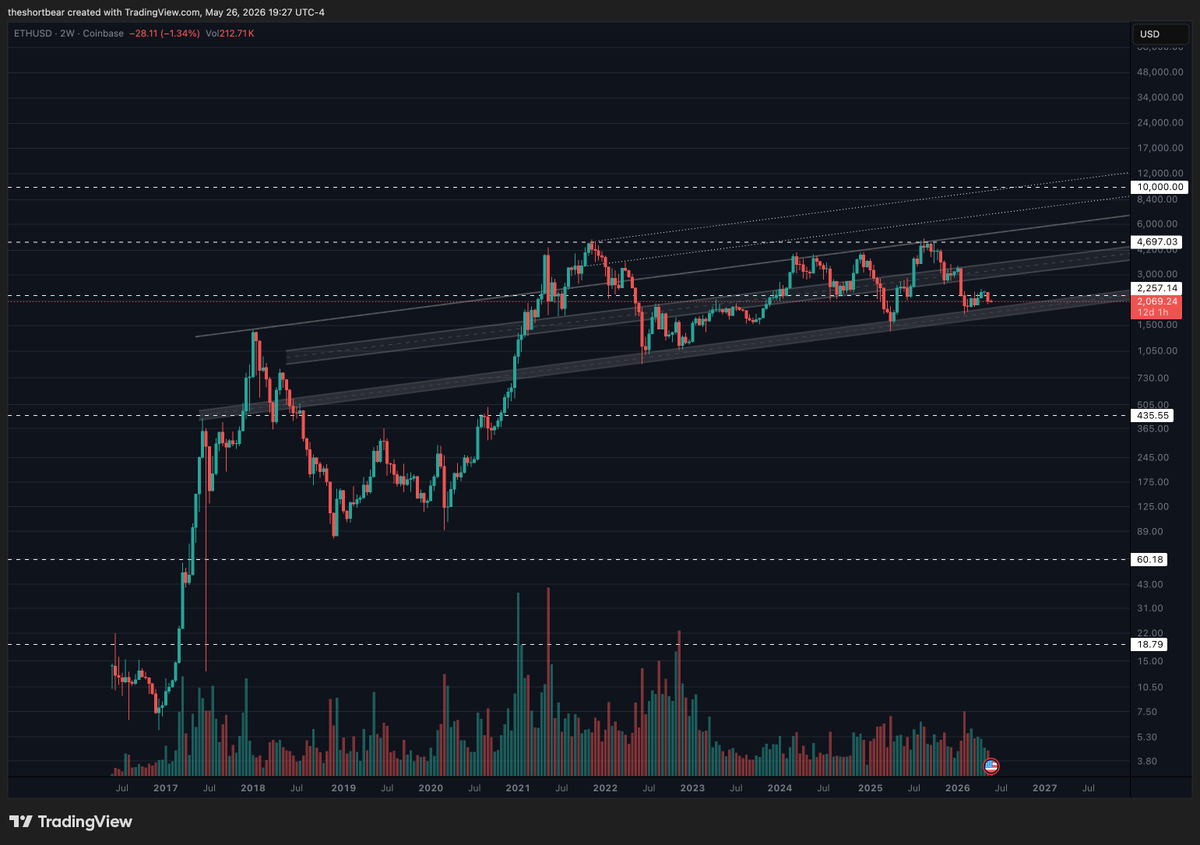
English
Arthur retweetledi
@mert Started a year ago when no one was watching.
Now we're shipping while everyone else is starting.
docs.paraloom.io
English
Arthur retweetledi

Arthur retweetledi

Arthur retweetledi

Imagine $TROLL is at 100m and now they’re begging a Troll emoji after finding out @elonmusk is going to add the LOL emoji as an official reaction to X posts.
$TROLL 100m
$LOL 3m
One meme is severely undervalued, I wonder which one. 😂

Elon Musk@elonmusk
@MoEthWhale @MatthewParrott Yeah, we seriously need to do that!
English



English

