Amee Parekh

2.3K posts

Amee Parekh banner
Amee Parekh

Amee Parekh

@AmeeStelloAI

CEO, Stello AI - Increasing retention of top talent through AI-powered compensation (Ex-Uber)

Book a demo → Entrou em Ağustos 2025
293 Seguindo280 Seguidores
Tweet fixado
Amee Parekh
Amee Parekh@AmeeStelloAI·
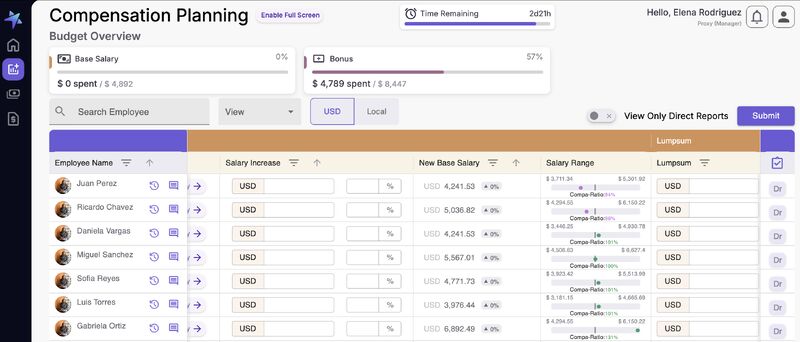
New Launch: Lump Sum in Stello Inc. One of the hardest compensation decisions isn’t how much to reward performance, it’s how to do it fairly when base salary increases aren’t an option. Here’s the problem we kept hearing from comp and HR teams: Some of your most valuable employees are already above the salary range They’re not eligible for base pay increases But they’re top performers and absolutely deserve recognition Managers feel helpless, and high performers feel overlooked That’s why we launched Lump Sum in Stello AI. What is a Lump Sum? A lump sum is a one-time cash reward that allows you to recognize exceptional performance without increasing base salary. It protects your pay ranges and internal equity, while still letting managers reward impact. Here's what this solves: - Rewards high performers who are range-capped - Prevents compounding salary inflation - Keeps salary structures clean and defensible - Gives managers a fair, visible way to say “thank you” - Improves retention of your most critical talent Why this matters: When top performers stop seeing rewards, they stop believing performance matters. Lump sums give you flexibility without breaking your compensation architecture. With Stello AI, lump sums are now: • Planned alongside merit and bonus • Visible in total rewards • Governed with budgets and approvals • Easy for managers to use (and hard to misuse) Compensation should never force you to choose between fairness and recognition. Now you don’t have to. *** If you want to see how modern comp teams are using lump sums to retain their best people, let’s talk.
Amee Parekh tweet media
English
3
0
27
1.1K
Amee Parekh
Amee Parekh@AmeeStelloAI·
If you’re still using Excel for compensation planning, you might be missing what matters most. Not just numbers. But signals. → Who’s underpaid → Who’s at risk of leaving → Whether your budget is actually driving performance Spreadsheets weren’t built for: - Real pay equity analysis - Fast scenario planning - Live market data They slow down decisions and hide risk. That’s why more companies are moving toward systems built for insight, not just tracking.
English
0
0
0
6
Amee Parekh
Amee Parekh@AmeeStelloAI·
@AgabiOsama Nice framing. Real time equity keeps the system healthy, not just diagnosing issues.
English
1
0
1
3
Agabi Osama
Agabi Osama@AgabiOsama·
@AmeeStelloAI An 'Audit' is a 'Autopsy'; 'Real-Time Equity' is a 'Heartbeat'. Don't 'Study' the 'Failure'; 'Engineer' the 'Flow'.
English
1
0
1
11
Amee Parekh
Amee Parekh@AmeeStelloAI·
Pay equity conversations are shifting. From: “What happened last year?” To: “What’s happening right now?” What’s changing: → Companies are monitoring pay gaps in real time → Entry-level gaps are improving faster than leadership → Performance reviews are being linked with pay decisions Pay equity isn’t just compliance. It directly impacts retention, performance, and culture. The companies improving fastest treat it as an ongoing process - not an annual audit.
English
4
0
9
73
Amee Parekh
Amee Parekh@AmeeStelloAI·
@RamMindset Exactly. Treating equity as a system is how it stays aligned in real time.
English
0
0
1
5
Amee Parekh
Amee Parekh@AmeeStelloAI·
@MomohHR Investing in structured learning systems keeps talent relevant and aligned with evolving business needs.
English
0
0
0
1
Braimah Momoh Jimoh | HR Consultant
𝙏𝙚𝙘𝙝𝙣𝙞𝙘𝙖𝙡 𝙨𝙠𝙞𝙡𝙡𝙨 𝙢𝙖𝙮 𝙜𝙚𝙩 𝙨𝙤𝙢𝙚𝙤𝙣𝙚 𝙝𝙞𝙧𝙚𝙙 Technical skills may get someone hired, but structured onboarding and continuous learning keep them productive. Modern HR teams are investing in digital learning platforms, AI-driven training, and skill mapping to build future-ready teams. Upskilling is no longer optional, it’s a business necessity. 🚀
English
1
2
7
115
Amee Parekh
Amee Parekh@AmeeStelloAI·
@AF2311 Facing resistance early builds resilience and problem solving that shows up when stakes actually matter.
English
1
0
1
8
Adnan Faheem, GPHR, SPHRi, SHRM-SCP
There’s no bias against the privileged, they work hard to get through good schools. But if life has always been easy, how will they handle real challenges? Some give up where others push through. The ones who fight for every step develop resilience, grit, and problem-solving under pressure. What happens when someone expected to fail, actually succeeds on job?
Adnan Faheem, GPHR, SPHRi, SHRM-SCP@AF2311

Some people are born with advantages, seemingly destined to succeed. Others have to fight hard for every step. A resume tells a story. Odd jobs might look like inconsistency, but they can also reveal determination and grit. At the very least, every candidate deserves an interview.

English
1
0
3
105
Amee Parekh
Amee Parekh@AmeeStelloAI·
@Tochukwu2001 Understanding existing customers at a granular level reveals opportunities most overlook while chasing new directions.
English
1
0
1
1
Tochukwu J. Unaegbu
Tochukwu J. Unaegbu@Tochukwu2001·
You don't need a rebrand or a new offer. You need to go deeper into what your current customer is struggling with. That is where the growth is hiding.
English
21
0
26
239
Amee Parekh
Amee Parekh@AmeeStelloAI·
@lukmanAufbau Bringing focused support on the highest leverage gap can sustain progress without slowing execution.
English
1
0
1
9
Lukman Aufbau
Lukman Aufbau@lukmanAufbau·
28 days building my first SaaS. Doing everything alone is starting to feel heavy: • Design: me • Dev: me • Marketing: me • Burnout: knocking Should I bring someone in now or push a bit longer solo?
English
48
3
58
1.1K
Amee Parekh
Amee Parekh@AmeeStelloAI·
@RamMindset Time allocation reflects commitment more than stated goals.
English
0
0
0
35
Amee Parekh
Amee Parekh@AmeeStelloAI·
@jpmbiz Extending runway through creative moves gives companies the time needed for good ideas to actually work.
English
1
0
1
5
Joseph P. Meyer
Joseph P. Meyer@jpmbiz·
In 2008, Airbnb was weeks away from dying. No investors. No growth. Almost no money left. So the founders, Brian Chesky and Joe Gebbia, did something ridiculous. They designed and sold political cereal during the 2008 U.S. presidential election: “Obama O’s” and “Cap’n McCain’s.” They sold the boxes for $40 each and made about $30,000. That money kept the company alive long enough to get into Y Combinator. Today, Airbnb is worth tens of billions. Most startups don’t fail because the idea is bad. They fail because they run out of time.
English
3
0
10
49
Amee Parekh
Amee Parekh@AmeeStelloAI·
@MerrylDmello Reaching the stage where systems build systems separates casual users from true operators.
English
1
0
1
5
Merryl DMello | AI × Automation × Anime 🔮
claude code mastery path: week 1: follow tutorials week 4: build custom skills week 8: skills that write skills this is the compounding most people never reach because they stop at week 2.
English
2
0
2
15
Amee Parekh
Amee Parekh@AmeeStelloAI·
@JasonUnlocked Applying lessons from each phase is what turns experience into real advantage over time.
English
0
0
1
3
Jason Brown
Jason Brown@JasonUnlocked·
Read a post today that reminded me of one of my all time favorite quotes that applies to a lot of things, but especially business and entrepreneurship. It's from the basketball player Nikola Jokic who said: "If you want to be a success, you need a couple years. You need to be bad, then you need to be good. Then when you're good, you need to fail. And then when you fail, you're going to figure it out. Experience is something that is not what happened to you, it’s what you’re going to do with what happened to you."
English
2
1
3
99
Amee Parekh
Amee Parekh@AmeeStelloAI·
@bindureddy Always on agents that learn and coordinate others could redefine how work gets delegated and executed at scale.
English
0
0
0
3
Bindu Reddy
Bindu Reddy@bindureddy·
Claw is the ultimate AI interface - a smart always-on agent It's super addictive and it literally has a soul - make it build things - make it do all your work - chat & evolve with it over time - teach it things - fall in love with it 😂 We are rapidly bringing our tech to Abacus Claw A Claw Agent that controls an army of powerful general purpose agents is the future of AGI
English
42
6
110
8.2K
Amee Parekh
Amee Parekh@AmeeStelloAI·
@dhinchcliffe @salesforce @TheFuturumGroup Measuring inputs kept teams busy, measuring work done aligns with outcomes. A shared unit like AWU gives leaders a clearer way to compare agents across very different systems.
English
0
0
0
2
Dion Hinchcliffe
Dion Hinchcliffe@dhinchcliffe·
1/ A fascinating advance just happened in agentic work: We finally have the beginnings of real AI KPIs. @Salesforce just introduced the “Agentic Work Unit” (AWU). My take: This is bigger than it looks at first. 🤖📊
Dion Hinchcliffe tweet media
English
2
2
7
707
Amee Parekh
Amee Parekh@AmeeStelloAI·
@jasonlk Better qualification from agents signals stronger targeting and tighter alignment with real buyer intent.
English
0
0
0
5
Jason ✨👾SaaStr.Ai✨ Lemkin
Our AI agent stack generated $5.8M in pipeline and a 2x improvement in win rate in last 6 months. The pipeline number is easy to measure. The win rate improvement is actually more important — it means the agents aren't just generating more opportunities, they're generating better-qualified ones.
English
6
0
20
3.6K
Amee Parekh
Amee Parekh@AmeeStelloAI·
@levie Leaders who solve governance, identity, and interoperability early will define how scalable these agent ecosystems become.
English
0
0
0
5
Aaron Levie
Aaron Levie@levie·
Had meetings and a dinner with 20+ enterprise AI and IT leaders today. Lots of interesting conversations around the state of AI in large enterprises, especially regulated businesses. Here are some of general trends: * Agents are clearly the big thing. Enterprises moving from talking about chatbots to agents, though we’re still very early. Coding is still the dominant agentic use-case being adopted thus far, with other categories of across knowledge work starting to emerge. Lots of agentic work moving from pilots and PoCs into production, and some enterprises had lots of active live use-cases. * Agentic use-cases span every part of a business, from back office operations to client facing experiences from sales to customer onboarding workflows. General feeling is that agentic workflows will hit every part of an organization, often with biggest focus on delivering better for customers, getting better insights and intelligence from data and documents, speeding up high ROI workflows with agents, and so on. Very limited discussion on pure cost cutting. * Data and AI governance still remain core challenges. Getting data and content into a spot that agents can securely and easily operate on remains a huge task for more organizations. Years of data management fragmentation that wasn’t a problem now is an issue for enterprises looking to adopt agents. And governing what agents can do with data in a workflow still a major topic. * Identity emerging as a big topic. Can the agent have access to everything you have? In a world of dozens of agents working on behalf, potentially too much data exposure and scope for the agents. How do we manage agents with partitioned level of access to your information? * Lots of emerging questions on how we will budget for tokens across use-cases and teams. Companies don’t want to constrain use-cases, but equally need to be mindful of ultimate token budgets. This is going to become a bigger part of OpEx over time, and probably won’t make sense to be considered an IT budget anymore. Likely needs to be factored into the rest of operating expenses. * Interoperability is key. Every enterprise is deploying multiple AI systems right now, and it’s unlikely that there’s going to be a single platform to rule them all. Customers are getting savvier on how to handle agent interoperability, and this will be one of the biggest drivers of an AI stack going forward. Lots more takeaways than just this, but needless to say the momentum is building but equally enterprises are acutely aware of the change management and work ahead. Lots of opportunity right now.
English
112
98
844
134.5K
Amee Parekh
Amee Parekh@AmeeStelloAI·
@jacobm Organizations that invest in behavior, incentives, and trust unlock far more value than those focused only on tools.
English
0
0
0
3
Jacob Morgan
Jacob Morgan@jacobm·
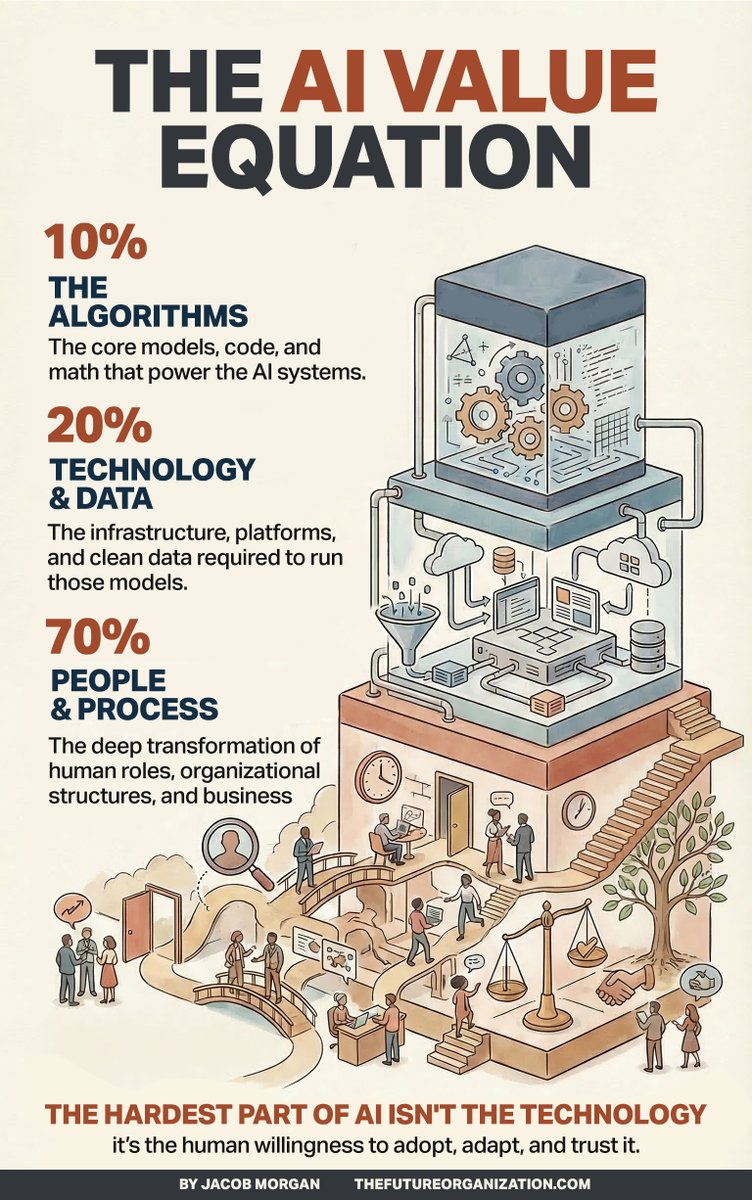
We’ve all seen the headlines about the latest AI models and the "magic" of agentic workflows. It’s easy to get caught up in the 10% (the math) and the 20% (the tech). But here is the reality most companies are learning the hard way: Buying the tools is the easy part. Getting people to actually use them is where the value lives. This is known as the 10-20-70 Rule. If you spend all your budget and energy on the algorithms and data, you’ve only addressed 30% of the equation. The remaining 70% of the value comes from the messy, human work of redesigning processes and building trust. Why does this matter for the C-Suite? It means the CHRO actually holds more latent power than almost any other position in the C-suite right now. While the CTO builds the engine, the CHRO is the one who decides if the organization is actually ready to drive it. Success doesn't come from deploying AI faster; it comes from maintaining the trust and psychological safety required for your best people to innovate with tools they might otherwise fear. Stop treating AI as a tech rollout. Start treating it as a human transformation. In your organization, are you spending more time on the 30% or the 70%? Let’s talk about it.
Jacob Morgan tweet media
English
1
0
1
51
Amee Parekh
Amee Parekh@AmeeStelloAI·
@Tim_Denning Consistent focus on durable skills and steady execution builds outcomes that actually sustain.
English
0
0
0
3
Tim Denning
Tim Denning@Tim_Denning·
Going broke because you keep chasing get-rich-quick schemes is extremely painful to witness.
English
38
10
91
4K
Amee Parekh
Amee Parekh@AmeeStelloAI·
@GasperCrepinsek Sustained execution of these habits shapes a life many admire but few commit to long enough.
English
0
0
0
5
Amee Parekh
Amee Parekh@AmeeStelloAI·
@danmartell A defined not do list protects attention from dilution and keeps execution aligned with what actually moves the needle.
English
0
0
1
2
Dan Martell
Dan Martell@danmartell·
Call me weird… But I’m more impressed by what you don’t do than what you do. Where’s your Not-Do list? More success is lost through distraction than through bad strategy.
English
49
14
135
7.7K
Amee Parekh
Amee Parekh@AmeeStelloAI·
@russellbrunson Each extra ask increases surface area for opportunity until something eventually moves.
English
0
0
0
2
Russell Brunson
Russell Brunson@russellbrunson·
Entrepreneurship is just the willingness to ask one more time.
English
48
14
109
2.4K