Tweet fixado

The Death of Governance & Compliance in an AI Era..
This statement is obvious for some, obscure for others and for many it is down right confusing.
Most "AI Security" advice is focused on governance and compliance guidance...aka how to create an AI policy or program.
It’s vague.
It’s theoretical.
It’s useless to an engineer.
But most of all it misses the point with AI.
We've been lead to believe if...
We document, monitor or detect risk, we can manage it and everything will be OK.
Reality is...
AI risk is executed in milliseconds & Documentation Does NOT STOP Execution.
♟️Strategic Truth
Most AI security advice from a policy standpoint:
🚫Optimizes for regulatory defensibility
🚫Assumes post-event containment
🚫Treats AI as a governance problem
But AI exploitation is an engineering problem.
Thus, until policy mandates preventive, runtime-enforced controls, AI security guidance will remain structurally misaligned with the threat landscape.
This is where we stepped in when we built the architecture standard back in Jun 25.
Been working hard on AI SAFE² ever since but accelerated after the explosion of risk last quarter by turning this holiday season into go-mode.
We Finalized a v2.0 then quickly finalized a v2.1 both are massive upgrades & industry must haves!
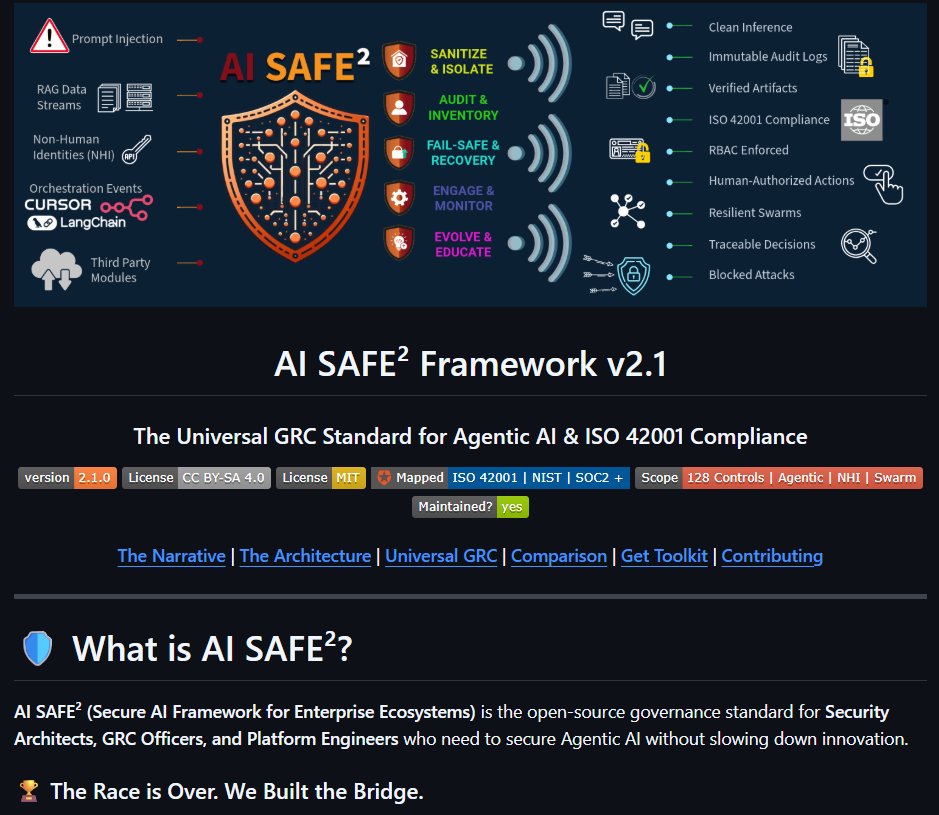
Introducing the AI SAFE² Framework (v2.1):
☑️The Universal GRC Standard for Agentic AI & ISO 42001 Compliance.
📂The open-source protocol for governing Agentic AI.
- Dropped our Github Repo
Let's unpack what all this actually means for AI Governance & Compliance moving forward...🧵
Star the repo to show your support👇
English