💙

18.7K posts

💙

💙

@crypto_bizz

Entrou em Ocak 2018
594 Seguindo530 Seguidores
Sawyer Merritt
Sawyer Merritt@SawyerMerritt·
UPDATE: Tesla is ending one-time FSD purchases in the Netherlands on May 15, 2026. Y'all have two weeks to buy FSD outright for €7,500 before it's gone forever. After that, you'll only be able to subscribe for €99/month.
Sawyer Merritt tweet media
Sawyer Merritt@SawyerMerritt

NEWS: FSD (Supervised) subscriptions have just officially launched in the Netherlands for €99/month! This is a sign that customers will start getting FSD activated on their cars very shortly.


English
107
176
1.6K
330.6K
Diego
Diego@dmarcos·
I’m concerned about Vision Pro future if it has no significant presence at upcoming WWDC. Ternus is old school VR: often the most skeptical cause they see past hype and are realistic about what tech can and can’t deliver.
English
9
1
30
7.7K
FLR Flow Pressure
FLR Flow Pressure@FlowPressureSys·
$FLR Structure is healthy. Capital has not significantly left the ecosystem across 100+ days despite sustained price decline. Holders are not converting positions to sell pressure. Price weakness appears to be a liquidity and demand-side problem, not a structural one ~ the asset is declining without sellers, which is an unusual condition. When demand arrives, there will be minimal sell pressure to absorb it. Not financial advice, DYOR #FLR #Flare #FAssets #XRPFi #FXRP
English
2
7
36
1.2K
Janus the Watcher
Janus the Watcher@XRPWatcherJanus·
Every DEX today has the same problem: your order is visible before it executes. Bots see it, front-run it, sandwich it. Institutions won't trade on infrastructure that systematically extracts value from their orders. #Flare just published a reference implementation for a Confidential Orderbook built on FCC. Matching runs inside a Trusted Execution Environment. Open orders never touch the chain. Withdrawals require TEE-signed authorization verified on-chain before funds release. Translation: your trading intent is invisible until matched. No front-running. No sandwich attacks. No MEV extraction. Price-time priority matching like a real exchange — but non-custodial, on-chain, without a broker. The repo isn't aimed at retail DEX users. It's aimed at teams building exchanges, structured-product vaults, and settlement layers — 'anything where pure smart contracts can't give you the privacy, fairness, or custody you need.' This is FCC moving from concept to code. Not a whitepaper. A working orderbook with deposit custody, a frontend, and a load-testing harness. The institution that solves MEV doesn't just win DeFi trading. It wins the right to host institutional capital on-chain.
Quantic@0xQuantic

I'll be right back, I really need to check this 🤯

English
5
35
169
8.6K
💙
💙@crypto_bizz·
@XRPWatcherJanus And another flare side project nobody will use
English
0
0
0
6
💙
💙@crypto_bizz·
@framer @jornvandijk And running one on framer has never been more expensive
English
0
0
0
3
Framer
Framer@framer·
📘 The State of Sites '26 report is here! Launching a website has never been easier. Running one has never been harder. A survey of 1,900+ professionals on how websites really get built and managed. Full report ↓
English
17
27
207
53.8K
Fes Breda 💛🖤
Fes Breda 💛🖤@FesBreda·
Even recapituleren: -Hoogste btw van Europa -Hoogste inkomstenbelasting van Europa -Hoogste accijnzen van Europa -Hoogste eigen risico van Europa -Laagste koopkrachtstijging van Europa Maar wél kampioen belasting innen. Topprestatie overheid! 👏
John@raretijden

Blijft een bizar gegeven. Je betaald belasting over je loon en van alles en nog wat, dan hou je wat over om te sparen/investeren en dan moet je wéér betalen, zelfs over ongerealiseerde groei.

Nederlands
17
84
350
9.7K
Darren "Thanasimos" Williams
Darren "Thanasimos" Williams@Thana_Enosys·
There will always be edge in fully understanding how systems work, and fine tuning your personal strategies. That said, now that @FlareNetworks core community have put in the hard work of learning, building, and growing, the ecosystem is ready for "one click yield" solutions that can remove some layers of complexity and replace them with simple user flows. OGs will never forget what's really going on under the hood, and what it took to get there, though. You need scale and diversity to support one click systems, and you always need a core of users that make real time market based decisions to keep things running smoothly. However, I would certainly still advise anyone using a yield bearing system to do their research to understand where the yield comes from, what the tail risks may be, and what market conditions may trigger those tail risks. If for no other reason than... this stuff is cool, and learning about it broadens your understanding of how markets and economics work...
Hugo Philion@HugoPhilion

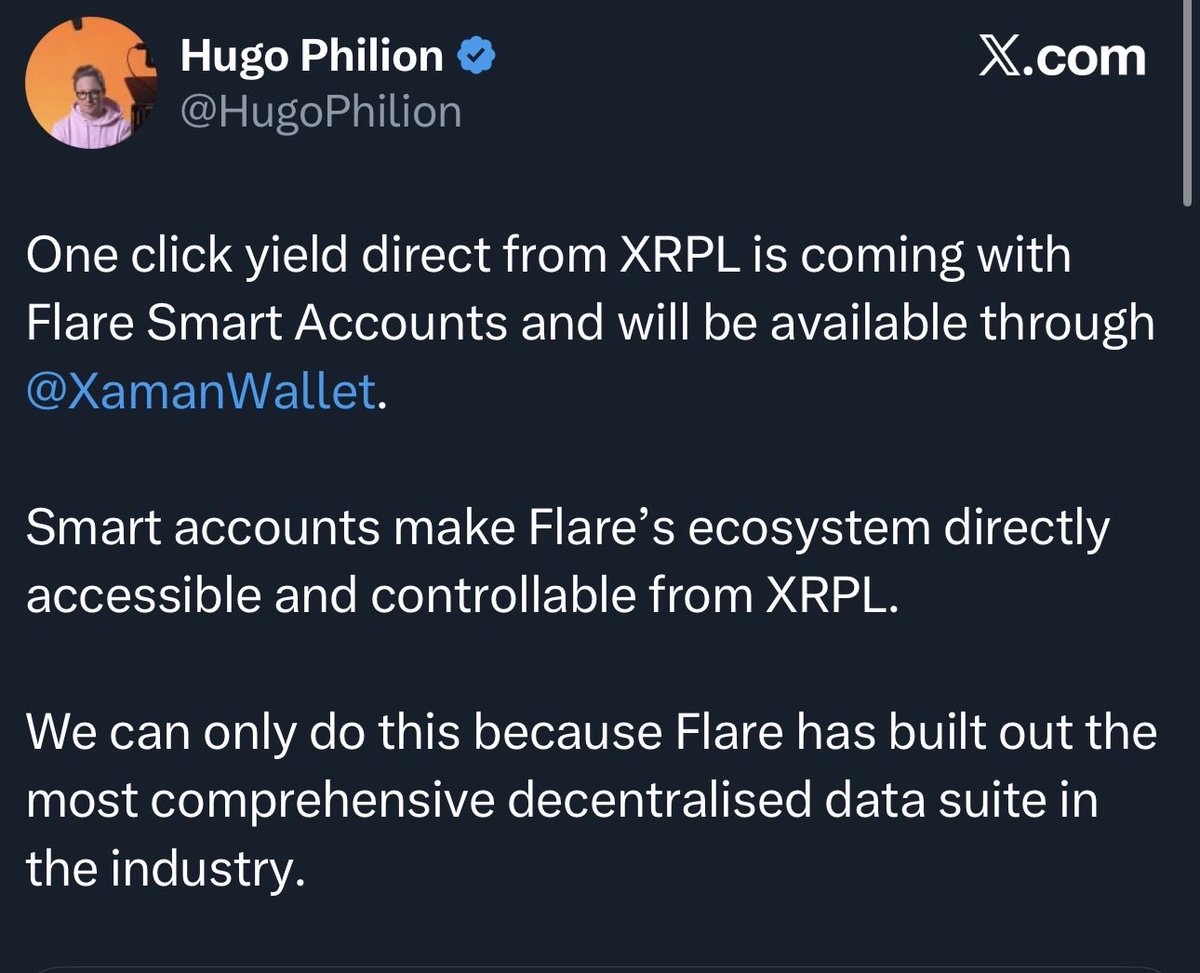
One click yield direct from XRPL is coming with Flare Smart Accounts and will be available through @XamanWallet. Smart accounts make Flare’s ecosystem directly accessible and controllable from XRPL. We can only do this because Flare has built out the most comprehensive decentralised data suite in the industry.

English
7
19
87
2.9K
💙
💙@crypto_bizz·
@mike_matas Yikes.. those screens are ugly
English
0
0
0
7
Mike Matas
Mike Matas@mike_matas·
After many years of development, I’m excited to share the interior of the first electric Ferrari designed by LoveFrom. Tactile controls and digital interactions blend into one cohesive interface, shaped through deep collaboration across engineering, interaction, graphics, typography, sound, and industrial design. So incredibly proud of the thoughtfulness and care the team brought to every detail. ferrari.com/en-US/auto/fer…
English
533
780
8.5K
1.5M
💙
💙@crypto_bizz·
How does this man keep on lying without getting hit in the face (figuratively) There is no 1 click earning. FAssets is a click UX disaster. Click 1: XRP > FXRP (this earns nothing) Click 2: FXRP > stFXRP Click 3: claim rewards Click 4: stXRP > FXRP Click 5: FXRP > XRP and every click you pay fees..
💙 tweet media
English
0
0
0
17
DigitalAddict
DigitalAddict@DigitalAddict0·
Insuring institutionalized investments is going to be life changing for crypto!
Firelight@Firelightfi

Institutions are quietly building on DeFi infrastructure while maintaining traditional interfaces. But there's a missing piece that's preventing this from scaling. Learn more about what Firelight brings to the table. @Firelight/the-defi-mullet-fintech-in-the-front-defi-in-the-back-and-the-protection-gap-in-between-32024592d9de" target="_blank" rel="nofollow noopener">medium.com/@Firelight/the…

English
1
4
19
1.8K
💙
💙@crypto_bizz·
@amandaorson These lower APR’s are already law in Europe. The benefits are still there.
English
0
0
0
0
Amanda Orson
Amanda Orson@amandaorson·
Your credit card rewards exist because someone else is paying 25% APR. Cap that at 10% and the points don’t survive. I spent years working inside fintech and card programs. That interest margin is the invisible buffer that makes rewards, lounges, and credits pencil out. Capping credit card APRs at 10% sounds like an obvious consumer win. Cards charge 20 to 30%, many consumers revolve balances, and the system feels punitive. But credit card economics are not just about interest rates. They are a cross-subsidized system where revolvers subsidize transactors, rewards rely on behavioral inefficiency, and risk-based pricing subsidizes access. Remove one leg of that stool and the system does not become fairer; it rebalances. And the costs show up where consumers notice most. Lets look at how this would impact 3 programs 1. AMEX Platinum A 10% credit card APR cap would not make your card cheaper or better. You would still have access, but you would almost certainly get less value for the same or higher price. The Platinum brand survives because its customers are affluent, pay in full, and tolerate high annual fees. What quietly supports that ecosystem is portfolio-level profitability, which allows AMEX to tolerate loss, overuse, and inefficiency in premium benefits. When that margin shrinks, the cost shows up directly in your (lesser) benefits. In a world where: - Rewards economics tighten - Devaluations become more likely - Flexibility is reduced Points become a liability to the issuer, and liabilities get repriced. So what this likely means for you as a Platinum cardholder: - Lounges do not expand to fix crowding. Instead, access tightens or amenities are reduced. - Statement credits become harder to use, more fragmented, or less generous. - Annual fees go up - New approvals become more selective, even for high earners. Your card still works, but the value proposition shifts. Platinum becomes more explicitly pay-to-play, with fewer hidden subsidies propping up premium perks. You pay the same or more, and you get a little less in return. Which is why some people are already warning that points devaluations become more likely in this environment (like @BowTiedBull this morning saying "Dump ALL your credit card points. All of them.") 2. Bilt Card This program is the canary in the coal mine for what to expect. Bilt’s super popular rent rewards worked because Wells Fargo was willing to subsidize them. The card offered 1 point per dollar on rent with no fees because Wells Fargo paid Bilt roughly 0.8 percent (80 bps) of each rent payment to fund rewards... despite earning little or no interchange on those transactions. But that is some actuarial level math with a number of variables at risk that proved wrong/ unsustainable. Wells Fargo was getting hosed $10 million a month on the program, so they exited the partnership years before the original end date and forced Bilt to restructure its rewards with a different bank What does that teach us? - When interest and interchange margins shrink, banks stop tolerating loss-leading reward programs. - Interest income does not fund every reward directly, but it provides the buffer that allows experiments like Bilt to exist at all. - Remove that buffer and rewards must be paid for explicitly. Bilt’s shift to a three-tier lineup with annual fees is not an anomaly. It is the direction rewards go when credit stops quietly absorbing losses. Pay-to-play rewards. What feels like consumer protection will shows up as fewer perks, pay-to-play rewards, and less room for innovation. 3. Credit One & other Subprime Cards Now the least glamorous corner. Subprime cards get criticized for high APRs, annual fees, low limits, minimal rewards. But they exist for a reason. They serve thin-file borrowers, damaged credit, people shut out of conventional loans, households using cards for liquidity not perks... but they charge high APRs because charge-offs exceed 8-10%, fraud and servicing costs are higher, and credit limits are small while fixed costs remain significant. A 10% cap makes these products mathematically impossible. These cards don't become cheaper. They cease to exist. As @sytaylor noted this morning - "You realize this will push many more customers towards loan sharks?" The demand for credit doesn't disappear... it migrates to BNPL with opaque effective APRs, chronic overdraft usage, fee-heavy installment loans, and less regulated lenders like loan sharks/ payday loans. So who WOULD win? Debit-First Fintechs One of the least discussed consequences: where would reward customers migrate? I think 1% cashback programs are an obvious winner. Chime, Varo, Current and niche cards like Greenlight and Privacy. (If you have not worked in a fintech or a bank you probably don't know what the Durbin Amedment is - but the TL;DR is that very large banks (BoA, Wells, JPMC) have capped interchange rates of around 27 bps on debit swipes. Small banks with < $10B AUM, however, do not - they can earn 1-2% on interchange (avg was 160 bps or so last I checked). Which is why all of the debit card fintech companies you've heard of are partnered with these smaller banks - they can offer rewards like 1% cashback programs and still have margin sufficient to build a business around.) In a world where credit rewards shrink, access tightens, and annual fees rise, debit-based fintechs look better by comparison. But consumers lose: credit protections, payment float, stronger dispute rights, credit-building opportunities. TL;DR An APR cap feels like consumer protection. In practice it reshapes the market in ways that are easy to miss: - It will shrink access to credit - Eliminate rewards programs that aren't tied to high annual fees - Force risk into less regulated channels - Unintentionally advantages debit over credit - Help affluent transactors more than vulnerable borrowers Credit doesn't become cheaper. It becomes scarcer, less flexible, less transparent. But banks will adapt. Fintechs will adapt. Consumers caught in the middle do not get protected. They get fewer choices, worse products, and priced out.
Rapid Response 47@RapidResponse47

🚨 BREAKING

English
3.8K
1.1K
8.8K
5.7M
💙
💙@crypto_bizz·
True.. let’s say she was trying to run him over with the wheels straight (which clearly is not the case as the wheels point right) then shooting her would actually increase the chance of getting run over. A dead/hurt person less likely to break. All he has to do is take a half step to his right, which he already does. The shot was 1000% unnecessary to increase his chance of survival.
English
0
0
0
40
CALL TO ACTIVISM
CALL TO ACTIVISM@CalltoActivism·
This is the ONLY video that counts. 1) Her tire was already turned to the right PAST the officer before the first shot. 2) His feet were to the LEFT of the car proving he wasn’t in danger before the first shot. LOOK.
English
2.1K
2.7K
14.9K
1.7M
💙
💙@crypto_bizz·
@FlareNetworks There is no XRP on flare. There is FXRP.. a token.. completely different.
English
0
0
0
7
Flare ☀️
Flare ☀️@FlareNetworks·
Exploring how to put your XRP to work on Flare? This page shows the live options available today — with more resources and updates coming over time. Bookmark it and check back → xrpfi.flare.network/defi
Flare ☀️ tweet media
English
16
94
379
19.8K
💙
💙@crypto_bizz·
1. She had no intent to kill the agent or she would have already done that upon arrival. 2. When switching gears you release the brake, then start turning the wheel. This does not happen instantaneously 3. The wheel keeps turning direction to the right. At no point do they stay fixated 4. The vehicle is not moving a high speed, and it takes the officer a half step to move out of the way. 5. When he shoots the wheels are already pointing right of straight, to avoid collision 6. He first shoots when he is no longer in danger. If the car was going straight this would not have saved him. 7. Second shot from the side when he is not in danger.
English
0
0
0
2
Natalie F Danelishen
Natalie F Danelishen@Chesschick01·
1.) she is ordered out of her car 2.) she refuses 3.) she backs up 4.) she drives forward into an ice agent 5.) ice agent pulls out gun only when she starts moving forward INTO HIS BODY 6.) self defense 7.) case closed
English
26.7K
28.8K
209K
14.7M
💙
💙@crypto_bizz·
@0xcastra Flare moves with the market it dumps and pumps at the same time and that is how it will stay. All the bs stories won’t make a difference
English
0
0
1
9
Castraccani
Castraccani@0xcastra·
This is why I see Flare token $FLR as one of the most under-discovered gems in crypto. Real yield, near-zero inflation, institutional-grade design, and builders shipping with native data. Markets eventually catch up to fundamentals.
ghostman 🌕@defidaddy23

Here are the reasons why I think #flr ☀️ will outperform #ada ATH in Marketcap! 1. Onboarding massive users by bringing true yield to #xrp #btc #doge #xlm through #fassets 2. Inflationary pressure through flaredrops ends 30.01. making the inflation drop to nearly 0% and over 75% of supply in circulation 3. Institutional demand for #xrp and especially the DATs looking for yield on their asset in a safe, non-custodial way! 4. Massive on chain building through free data and built-in Oracle solutions allows real innovation within the web2 and web3 data world. If you disagree, tell me why not!

English
7
27
154
7.4K
💙
💙@crypto_bizz·
Max Weinbach@mweinbach

I'm in the Nvidia Q&A with Jensen and someone just asked the difference between Alpamayo and Tesla FSD Jensen said: “As to your second question: Tesla’s FSD stack is completely world-class. They’ve been working on it for quite some time. It’s world-class not only in the number of miles it’s accumulated, but in the way it’s designed—the way they do training, data collection, curation, synthetic data generation, and all of their simulation technologies. Of course, the latest generation is end-to-end Full Self-Driving—meaning it’s one large model trained end to end. And so… Elon’s AD system is, in every way, 100% state-of-the-art. I’m really quite impressed by the technology. I have it, and I drive it in our house, and it works incredibly well. Alpamayo was designed around a different idea. The first difference is that NVIDIA doesn’t build self-driving cars—we build the full stack and the technology for everybody else to build self-driving cars. And we build—like we do for humanoid robotics—three computers: the training computer, the simulation computer, and the robotics computer, which is the self-driving car computer. We have software stacks across all of that. Our customers can use all of it, some of it, or parts of it—whatever makes sense for them. And so we’re working with the entire industry—Tesla for their training system, Waymo for the car computer, and XPeng. Nuro—who I think just announced they’re going into the robotaxi business—with Lucid and Uber; and NVIDIA is part of that. So our system is really quite pervasive because we’re a technology platform provider—that’s the primary difference. There’s no question in our mind that, of the billion cars on the road today, in another 10 years’ time, hundreds of millions of them will have great autonomous capability. This is likely one of the largest, fastest-growing technology industries over the next decade. And the last thing we do is: we open-source everything. If a customer would like to use the model that we train, they’re welcome to do that. If they would like to use our model technology but train it themselves, we even help them do that. We’re not a self-driving car company—we just want to enable the world’s autonomous industry. Everything that moves should be autonomous.”

QME
1
0
0
17