Sun Tzu said know the enemy and know yourself. The Pentagon only focuses on the first half of the equation.
The U.S. military has spent a decade improving the kill chain, making targeting cells 100x more effective. Meanwhile, back-end systems that track munitions, personnel, and readiness are disconnected and decrepit. The Pentagon doesn't really know itself—and it shows in a crisis.
The false dichotomy between "business systems" and "warfighting systems" has failed our military. Click through to learn the key to victory 👇🔗
The Last Mile of Reindustrialization Is Real Estate.
Building a gigafactory requires a fully entitled site with rail access, 300-plus megawatts of dedicated power, a water supply commitment, and a permitting timeline that won’t slip three years into the project because of a challenged environmental review.
Building an advanced semiconductor fab needs a workforce pipeline, a supply chain ecosystem in the same region, and a state government sophisticated enough to coordinate across a dozen agencies without dropping the ball.
@kenbiberaj has criss-crossed the country helping industrial companies select factory sites. Today in First Breakfast he talks about what it takes to rebuild American manufacturing—and why some of the most important fights are happening at the state and local level, not in Washington.
🔗👇
We in the West face a stark reality: our weapons are expensive and scarce. Our adversaries' are cheap and plentiful.
The race is on to correct this imbalance and build the arsenal of the future. The question is, who will build it?
In today's article, @BlakeSeitz assesses the ongoing cold war between legacy defense firms and new entrants—including startups born under existential conditions on the battlefields of Ukraine. This conflict, more than any other, shows the qualities that will determine whether companies sink or swim in the coming years:
⏩ "The firms that win will have to earn it through speed, the ability to iterate, and the ability to ship product in the quantities and at the price point that Western governments demand."
So far, the defense-tech cold war is mostly a war of words and propaganda, as companies try to position themselves as the wave of the future—and do down their competitors. But a reckoning is fast approaching. Dollars are being allocated, contracts are being signed, and trials are being held.
Who is winning the defense tech cold war? Read the piece and us know what you think. 👇
firstbreakfast.com/p/cleaning-hou…
The U.S. military knew that cheap drones were a threat well over a decade ago.
Today's guest authors, Jarrett Lane and Dominic Ventimiglia, simulated adversary attacks on U.S. bases for CENTCOM from 2015-17.
Drones quickly became one of their go-to tactics. But too many were slow to appreciate the threat:
"In our experience, the idea of using cheap drones to degrade or dismantle critical capabilities was typically met with one of three responses. The first was incredulity. To some, drone attacks posed a nominal force protection problem because they were crude and usually unsuccessful. There was little appreciation that new forms of warfare usually begin crudely. The second response was dismissal. Drones could be easily dealt with by shooting them down or taking out the operators. The third response was acknowledgement that drones were a problem—but that they were somebody else’s problem to solve."
How can the Department avoid getting caught flat-footed again? Better red teaming, better feedback loops—and a shift in mindset that treats threats seriously even when they're small and speculative.
Read, share, and let us know what you think in the replies. 👇
firstbreakfast.com/p/avoidable-su…
Why do less than 1% of defense contracts go to new commercial companies? There are a few reasons, but a big one is that the government simply ignores its mandate to acquire commercial technologies.
In his new paper, @AEI Bill Greenwalt proposes an elegant solution to get us part of the way there: Rather than determine on a contract-by-contract basis which contracts qualify as commercial, the DoW should make the determination at the business level and have it flow down automatically. Specifically, all non-traditional contractors (those that sell a product via fixed price contracts with self funded R&D) would automatically be treated as commercial entities.
He also advocates for acquiring commercial capabilities in a commercial manner. This means ending the practice of burdening commercial contracts with non-commercial clauses like myriad socioeconomic requirements and the reporting of cost and pricing data.
This is a technical but accessible paper from Greenwalt and a must-read for investors and builders who want to be able to engage with policymakers beyond a surface level
The key lesson of modern war from the Second World War to Epic Fury?
Industrial power is combat power.
America can close kill chains at devastating speed—but this advantage is squandered without the metal and munitions to back it up.
The Department of War needs to leverage American tech to connect itself, primes, and sub-tier suppliers into a single system—so it can see, coordinate, and drive production in real time.
It needs to build the WAR MACHINE.
@ssankar@BigShow2026@Madeline_Zimm@BlakeSeitzfirstbreakfast.com/p/building-the…
When Napoleon smashed the Prussians at Jena and Auerstedt, it was the culmination of decades of stagnation by a Prussian army that was stuck in the past.
Gerhard von Scharnhorst had labored in obscurity for years, training young officers to think about and fight modern wars. When the moment of crisis arrived, he—and a young disciple named Carl von Clausewitz—was ready to meet the moment.
Today on First Breakfast, @peternmitchell profiles the heretical officers who built an alternate infrastructure in a hidebound system—and revived it from ruin to greatness.
Better to reform your army before Napoleon wipes it out. But if by whatever misfortune you don't—pray you have a Scharnhorst waiting in reserve.
firstbreakfast.com/p/a-voice-cryi…
Frederick the Great banned coffee in Prussia and told his officers to drink beer instead. Have yourself a Prussian @FirstBreakfast with my tale about a bold reformer who brewed a new army.
firstbreakfast.com/p/a-voice-cryi…
American defense policy isn't doomed to endless tinkering at the margins.
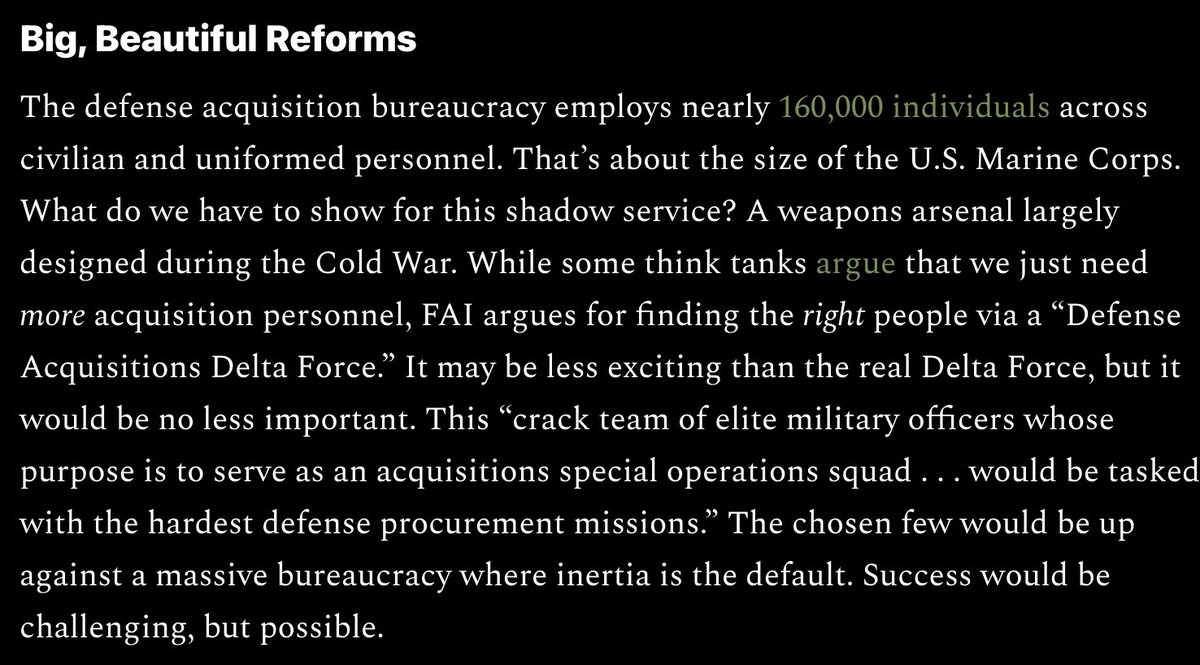
A new report by @JoinFAI features five bold proposals for putting America on a "wartime footing," from a Defense Acquisitions Delta Force to a citizen's proving ground for weapons testing.
These ideas are ambitious. More important, they're grounded in history: each proposal has a precedent.
America has done big things before. The question is whether we have the will to do them again.
Read the full article by @ssankar & @Madeline_Zimm:
firstbreakfast.com/p/five-proposa…
Who better to answer the question of why Germany didn’t win World War II than the author of Freedom’s Forge? @ArthurLHerman's latest for @FirstBreakfast
Germany had some of the world's most advanced—or, to use the modern industry term, exquisite—weapons in World War II.
Jet fighters. Ballistic missiles. Diesel-electric submarines. Even early forms of precision-guided munitions.
So why didn't Germany win?
Renowed historian @arthurlherman tackles this question today. He argues that innovation and whiz-bang tech alone are not enough to win a war. You need an industrial base deep, broad, and large enough to scale innovation—and bury your enemy under metal.
What lessons should the United States learn from this history?
firstbreakfast.com/p/why-didnt-ge…