

Hodel wizard
32.6K posts

Hodel wizard
@Hodelwizard
Web3 Enthusiast | Community Builder | Growth Strategist |Building connections & scaling communities.
web3 Присоединился Nisan 2022
3.8K Подписки2.6K Подписчики

Finally completed another artwork(#6) inspired by @get_optimum
Optimum is focused on improving communication between networks making systems more efficient scalable & connected without adding unnecessary complexity.
This artwork is my small tribute to that idea.


English

Why alignment comes before growth
Growth is easy to see.
Alignment is not.
Yet every strong network is built on alignment before growth.
Because growth without alignment creates noise.
Growth with alignment creates momentum.
The difference is not size.
The difference is direction.
When participants share information, they begin to share understanding.
Shared understanding creates alignment.
Alignment enables coordination.
Coordination drives growth.
And sustainable growth builds resilience.
shared information
↓
shared understanding
↓
alignment
↓
coordination
↓
growth
↓
long term resilience
Without alignment:
misunderstandings increase
↓
coordination weakens
↓
growth slows
↓
trust declines
↓
resilience fades
The strongest networks are not the ones growing the fastest.
They are the ones moving in the same direction.
Because lasting growth is not built on scale alone.
It is built on shared goals, shared information, and coordinated action.
Alignment may be invisible.
But its results are not.
Healthy growth.
Stronger coordination.
Long term trust
Resilient networks.
A network does not become stronger simply by becoming larger.
It becomes stronger when its participants remain aligned.
Growth is the outcome
Alignment is the foundation
@get_optimum

English

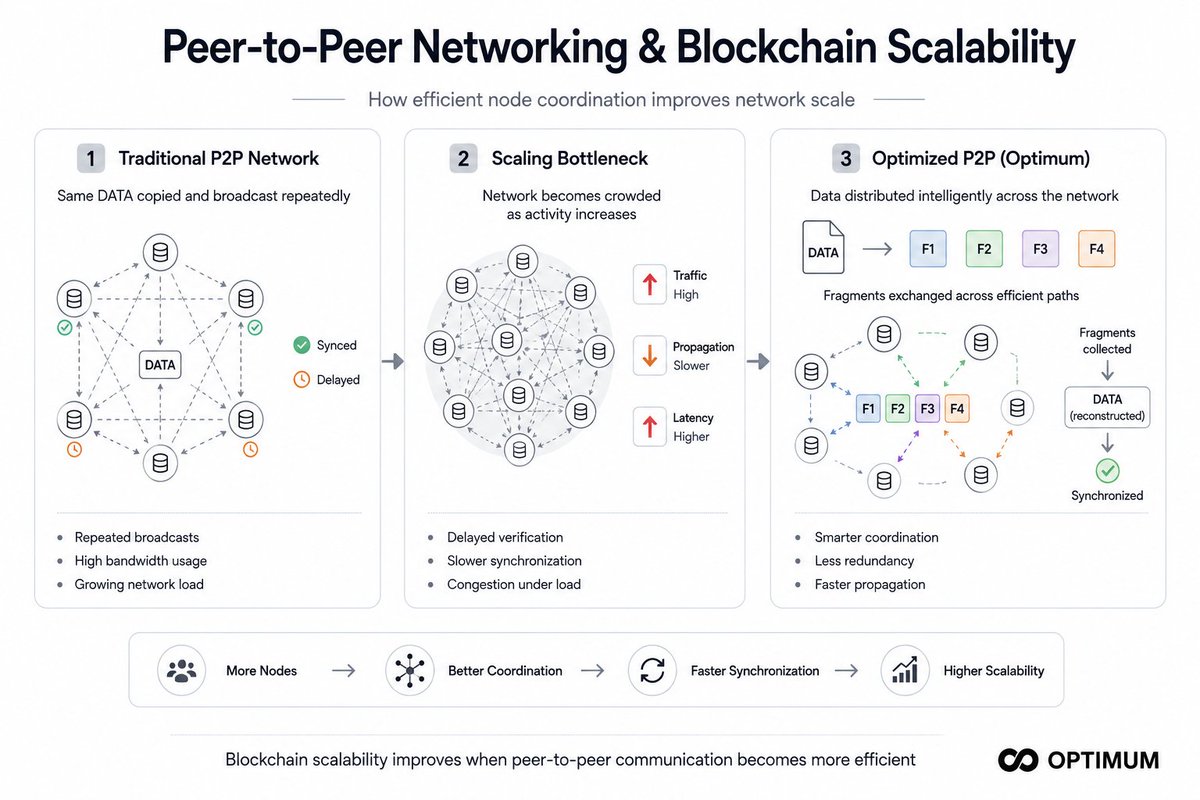
When people talk about blockchain scalability, most of the attention goes to execution.
Faster blocks.
Higher TPS.
Cheaper transactions.
But there’s another layer quietly carrying the whole system.
Peer-to-peer networking.
Because blockchains do not run from a central server.
Every validator and node depends on receiving information from other nodes across the network.
Blocks.
Transactions.
State updates.
Synchronization messages.
Everything moves through peer-to-peer communication.
At smaller scale, traditional P2P models work well.
Nodes receive data and forward it to others until the network becomes synchronized.
But as throughput grows, this model starts becoming expensive.
The same information gets copied and retransmitted again and again.
That creates unnecessary traffic.
More traffic means:
• more bandwidth consumption
• slower propagation
• delayed verification
• reduced efficiency under load
Eventually the network spends too much effort distributing data instead of processing it.
That’s why networking is becoming a scalability problem, not just an infrastructure detail.
The role of peer-to-peer networking is no longer simply connecting nodes.
It’s about coordinating information efficiently.
That means:
• reducing redundant transmission
• improving propagation paths
• keeping nodes synchronized faster
• delivering data with less overhead
Optimum explores this layer through optimized networking approaches.
Instead of relying only on repeated broadcasting, data can be distributed more intelligently across multiple paths.
Nodes exchange useful information instead of duplicating everything.
This helps the network stay coordinated even as activity increases.
Because blockchain scalability is not only about producing more blocks.
It’s also about helping those blocks move efficiently between thousands of participants.
English

𝗡𝗮𝘃𝗶𝗴𝗮𝘁𝗶𝗻𝗴 𝘁𝗵𝗲 𝗱𝗶𝗴𝗶𝘁𝗮𝗹 𝗳𝗿𝗼𝗻𝘁𝗶𝗲𝗿 𝘄𝗶𝘁𝗵 𝗢𝗽𝘁𝗶𝗺𝘂𝗺 - 𝘄𝗵𝗲𝗿𝗲 𝗶𝗻𝘁𝗲𝗹𝗹𝗶𝗴𝗲𝗻𝗰𝗲, 𝗲𝗳𝗳𝗶𝗰𝗶𝗲𝗻𝗰𝘆, 𝗮𝗻𝗱 𝗶𝗻𝗻𝗼𝘃𝗮𝘁𝗶𝗼𝗻 𝗰𝗼𝗻𝘃𝗲𝗿𝗴𝗲.

English

Most people think Ethereum's scaling problem is about execution speed.
It's not. It's about data propagation. 🧵
Here's the issue:
Every time a block is created, it has to reach thousands of nodes across the network — fast enough for validators to attest within seconds.
The bigger the block, the harder this gets. This is the real ceiling on blockchain throughput.
Right now, nodes handle this inefficiently.
Every node downloads the full block — even when it already has most of that data from previous gossip.
That's redundant. Wasteful. And it gets worse as blocks grow.
@get_optimum fixes this using Random Linear Network Coding (RLNC).
Instead of sending full blocks, data gets broken into encoded chunks spread across the network.
Nodes reconstruct the block from whatever chunks they receive — no waiting on one full copy from one source.
The results:
→ 6-20x faster block propagation
→ 90-95% less bandwidth used
→ No changes to consensus or protocol
→ Works at any block size, any network scale
Why this matters:
Lower bandwidth = cheaper to run a node.
Cheaper nodes = more participants.
More participants = stronger decentralization.
This isn't just a speed upgrade. It's an infrastructure upgrade for the whole network.
Already live on Hoodi testnet, partnered with Everstake, P2P.org, and Blockdaemon. $24B+ in staked ETH connected.
MIT research-backed. Real validators. Real numbers.
This is what fixing the foundation looks like. 🔗
getoptimum.xyz

English

Developer Opportunities with Optimum
Most people think of applications when they consider blockchain innovation. However, the application is just the tip of the iceberg; each great application relies on the infrastructure that supports it. As networks continue to expand and user expectations for applications continue to grow, developers need systems that allow for faster movement and access to data than traditional blockchain architectures enable.
This is where @get_optimum is so appealing. By focusing on efficient data dissemination and a memory-layer architecture, it hopes to eliminate some of the communication bottlenecks that currently plague decentralized networks.
For developers, this could provide a number of opportunities. AI agents could respond to on-chain events with greater immediacy, DeFi platforms could see more timely updates to data as well as smoother execution, blockchain-based games could have participants acting in a more responsive manner with state changes and network latency closer to "real time," social apps could provide their users' feeds, messages and interactions that feel more immediate and "natural."
The benefits of a superior networking infrastructure are not limited to one industry; any application that relies on speed with respect to accessing data from the blockchain could benefit from better networking. With user expectations getting higher, the performance of an application will increasingly differentiate it from other applications that are having difficulty gaining market penetration.
In summary, we can expect the continued evolution of Web3 in the future; be sure to check it out!

English

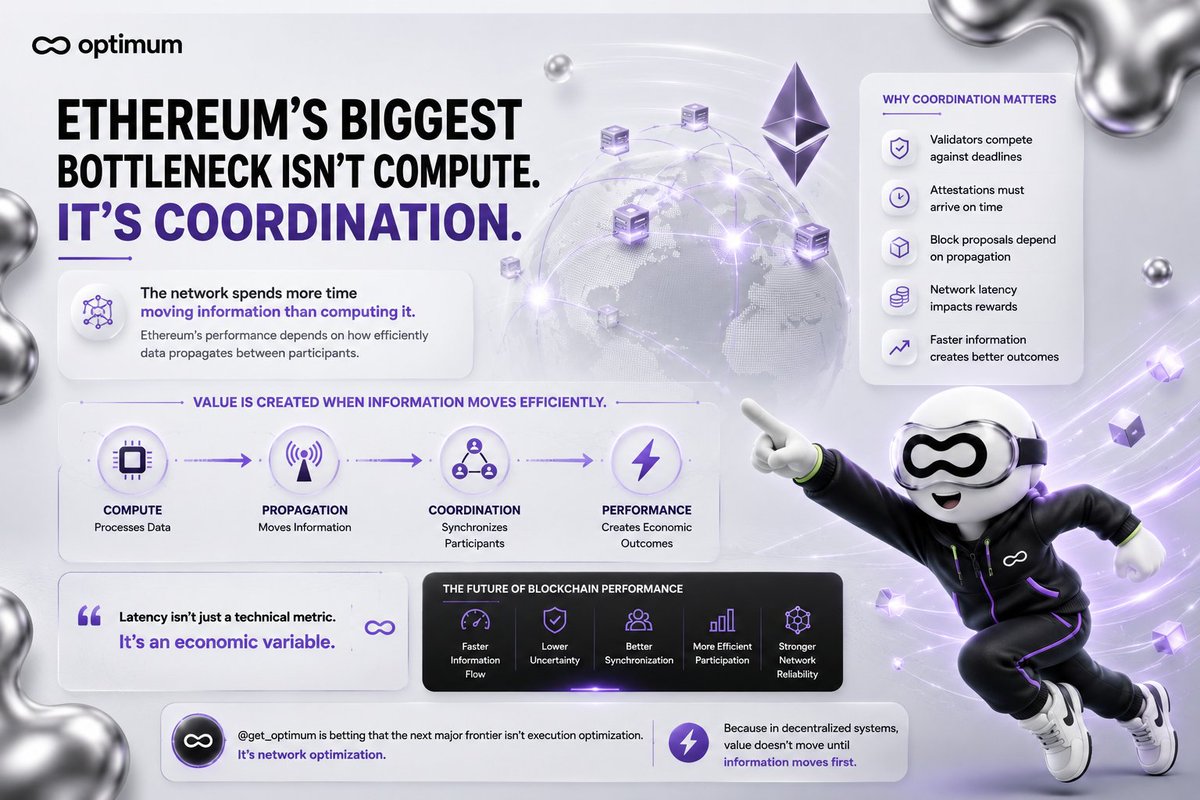
Ethereum's Biggest Bottleneck Isn't Compute. It's Coordination.
When people talk about blockchain performance, the conversation usually revolves around TPS, execution speed, faster block times, or more powerful hardware.
But as Ethereum continues to scale, a different reality is becoming impossible to ignore:
The network spends far more time moving information than computing it.
Before a validator can attest.
Before a builder can compete for blockspace.
Before a node can update state.
Before a transaction can reach finality.
Data must first travel across a globally distributed network of independent participants.
And that's where the real challenge begins.
Ethereum isn't a single machine sitting in one data center.
It's a living network spread across continents, internet providers, routing paths, and thousands of nodes operating under different conditions.
Every block, attestation, blob, and message must navigate this environment in real time.
The faster and more reliably information propagates, the healthier the network becomes.
The slower and more unpredictable propagation becomes, the more inefficiencies begin to emerge.
These inefficiencies are often invisible to most users.
But they have real economic consequences.
• Validators miss attestation opportunities
• Block proposals arrive too late
• Inclusion probabilities decrease
• Staking rewards become less efficient
• Network participants face higher uncertainty
In other words:
Latency is not just a technical metric. It's an economic variable.
This is why I find @get_optimum's approach particularly interesting.
Most infrastructure projects attempt to optimize what happens after data arrives.
Optimum focuses on optimizing how data moves through the network itself.
Because the future bottleneck of decentralized systems isn't computation.
It's communication.
As Ethereum grows, simply adding more hardware won't solve propagation challenges.
More nodes create more communication paths.
More communication paths create more complexity.
And more complexity creates more opportunities for delays and inefficiencies.
This is where technologies like RLNC become important.
Rather than treating network reliability as an afterthought, RLNC fundamentally changes how information is transmitted across decentralized networks.
The goal is not merely to send data faster.
The goal is to ensure data reaches the network more efficiently, more reliably, and with less dependency on perfect transmission conditions.
That distinction matters
Because blockchain performance isn't determined by peak speed.
It's determined by consistency
A network that delivers information reliably every time will outperform a network that is occasionally fast but frequently unpredictable.
This becomes even more important as Ethereum evolves into a global settlement layer supporting
• Institutional capital
• Tokenized real-world assets
• Global payments
• High-frequency onchain markets
• Large-scale staking ecosystems
At that scale, milliseconds are no longer just milliseconds.
They become financial outcomes.
The most valuable infrastructure in the next phase of Web3 may not be the infrastructure that computes the fastest.
It may be the infrastructure that coordinates information most efficiently.
Because in decentralized systems, value doesn't move until information moves first.
And the networks that master information flow will ultimately define the future of blockchain performance.
@get_optimum is betting that the next major frontier isn't execution optimization.
It's network optimization.
And that's a thesis worth paying attention to.
#Optimum #Ethereum #ETH #RLNC #Web3
Optimum@get_optimum
Consistently fast data propagation is how we optimize Ethereum's block supply chain. @sajidazouarhi
English

What happens when nodes receive blockchain data at different speeds?
@get_optimum focuses on one of the most overlooked challenges in blockchain infrastructure: inconsistent data delivery across the network.
When nodes receive blocks and transactions at different times, the network can become less efficient, creating delays that affect validators, consensus, and overall performance.
1. Uneven Network Visibility:
Blockchain networks rely on nodes having access to the same information as quickly as possible.
Geographic Delays: Nodes located in different regions may receive new blocks at different times due to network latency.
Propagation Variance: Data travels through multiple peer to peer connections, causing some nodes to learn about new information faster than others.
Temporary Information Gaps: During propagation, portions of the network may be operating with different views of the current blockchain state.
As networks grow larger, maintaining consistent information distribution becomes increasingly difficult.
2. Consensus Efficiency Can Be Impacted:
Consensus mechanisms depend on validators and nodes receiving timely information.
Delayed Block Reception: Validators that receive blocks later have less time to verify and react to new network activity.
Synchronization Challenges: Nodes must continuously update their local state as new transactions and blocks arrive.
Increased Communication Overhead: Additional messages may be required to ensure all participants eventually reach the same state.
The faster information spreads, the more efficiently the network can coordinate.
3. Optimizing Data Distribution:
Improving blockchain performance often begins with improving how information moves between participants.
Faster Propagation Networks: Reducing transmission delays helps nodes stay synchronized regardless of location.
Efficient Data Transport: Advanced networking approaches can improve delivery reliability while minimizing the effects of packet loss and congestion.
Better Network Coordination: When nodes receive data more consistently, the network can operate with greater efficiency and stability.
@get_optimum is building infrastructure designed to accelerate blockchain data movement, helping information reach participating nodes faster and more reliably across decentralized networks.
As blockchain ecosystems continue to scale, the speed and consistency of data propagation may become just as important as transaction execution itself.

English

𝗚𝗽𝗿𝗶𝘀𝗺𝗮 𝗘𝘃𝗲𝗿𝘆𝗼𝗻𝗲
𝗕𝗲𝘆𝗼𝘂𝗻𝗱 𝘁𝗵𝗲 𝗔𝘂𝘁𝗼𝗺𝗮𝘁𝗶𝗼𝗻 𝗠𝘆𝘁𝗵 : 𝗪𝗵𝘆 𝗧𝗲𝗹𝗲𝗼𝗽𝗲𝗿𝗮𝘁𝗶𝗼𝗻 𝗶𝘀 𝘁𝗵𝗲 𝗥𝗲𝗮𝗹 𝗙𝗼𝘂𝗻𝗱𝗮𝘁𝗶𝗼𝗻
The tech industry loves the myth of immediate, full automation the idea that we can deploy robots today and they will seamlessly navigate our complex messy world on day one.
The reality? Fully autonomous AI is a destination. Teleoperation is the vehicle that gets us there.
We are entering the era of Symbiotic Robotics (Human + AI + Hardware). The immediate future isn't about machines replacing human labor; it’s about human intuition underwriting AI uncertainty in real-time.
🔹The Data Paradox: Why AI Needs Human Interventions
To get better, edge AI needs high-fidelity, real-world data. But edge cases the unpredictable, chaotic moments in everyday environments are exactly where autonomous models fail.
When a human remote operator steps in to handle a complex task, they aren't just solving a temporary bottleneck. They are performing a high-value data injection:
Active Labeling: Every corrective movement provides a perfect training milestone for the underlying neural networks.
Risk Mitigation: Human intuition acts as the fail safe allowing companies to deploy hardware in unpredictable environments years ahead of schedule.
The Velocity Loop: More teleoperation leads to better edge case data which leads to smarter autonomy reducing the need for future interventions
🔹The Rise of the Global Intuition Layer
Through decentralized infrastructure, teleoperation transforms localized physical skill into a borderless, digital asset
This structural shift creates a completely new labor vertical: Professional Robotics Operators. A worker in one part of the world can safely navigate a logistics drone or a manufacturing arm on another continent earning incentives based on measurable precision and safety metrics.
🔹The Multiplier Effect
The narrative around robotics is shifting from a zero sum game to a collaborative ecosystem:
Human Skill builds the data foundation ➡️ AI
Infrastructure scales the execution ➡️ Robotic Hardware handles the physical output.
We aren't building a world of isolated, automated machines. We are building a global, interconnected grid where human expertise scales alongside artificial intelligence.
Autonomy is the goal, but Human-in-the-Loop is the engine.

English
English

Could Ethereum's biggest scaling bottleneck be bandwidth?
Everyone talks about faster execution, higher TPS and lower fees.
But none of that matters if blocks and blobs can't move efficiently across the network.
As Ethereum scales, data availability increases. So do the bandwidth requirements needed to keep thousands of nodes synchronized.
That's why Optimum caught my attention.
Instead of building another chain, it's focused on the layer most people ignore: data propagation.
Because the next phase of scaling may not be about producing more data.
It may be about moving it faster.
@get_optimum

0xJason@Jason0x1
Everyone talks about scaling blockchains. Few talk about scaling the networks that move the data. As Web3 grows, data transmission is becoming a critical bottleneck. Optimum is tackling this challenge with advanced network coding designed to improve speed, reliability and efficiency across decentralized systems. The next leap in blockchain performance may not come from execution. It may come from communication. @get_optimum
English
𝐖𝐞𝐛𝟑 𝐍𝐞𝐞𝐝𝐬 𝐁𝐞𝐭𝐭𝐞𝐫 𝐈𝐧𝐟𝐫𝐚𝐬𝐭𝐫𝐮𝐜𝐭𝐮𝐫𝐞 @get_optimum 𝐈𝐬 𝐁𝐮𝐢𝐥𝐝𝐢𝐧𝐠 𝐈𝐭.
We often talk about mass adoption, but we ignore the biggest elephant in the room: Network Latency. In high-performance ecosystems like Solana, block slots are just ~400ms. In a high-stakes environment (like MEV, high-frequency trading, or minting), a mere 100ms delay can change the entire outcome.
Speed isn't just a metric anymore; it literally defines the User Experience (UX).
Enter Optimum and their game-changing framework: DAW (Distributed Action & Workflow).
Here is a breakdown of how this infrastructure redefines data propagation:
1️⃣ Distributed Data (DD)
Traditional data handling creates massive bottlenecks. Optimum solves this by breaking down data into optimized, efficient pieces right at the generation stage. Smaller pieces = faster processing.
2️⃣ P2P Propagation (P2PP)
Once data is broken down and coded, it doesn't wait in a single queue. It propagates instantly across a highly resilient network of decentralized nodes. This ensures unmatched scalability and zero single-points-of-failure.
3️⃣ Actionable Workflow (AW)
The final and most crucial step. These distributed pieces are seamlessly reconstructed and validated across the network for lightning-fast consensus.
𝐓𝐡𝐞 𝐁𝐢𝐠 𝐏𝐢𝐜𝐭𝐮𝐫𝐞:
As blockchain demands grow, relying on old data propagation models will only lead to network congestion and failed transactions. Optimum is building the future-proof infrastructure required for a fairer, more robust decentralized ecosystem.
If we want Web3 to compete with Web2 speed, technologies like DAW are non-negotiable.
@shariaronchain

English

When people talk about blockchain performance, the spotlight usually falls on consensus and execution.
@get_optimum highlights another piece of the puzzle that often gets overlooked: data transmission.
Using RLNC, the network spreads encoded fragments of data instead of sending identical copies everywhere.
Once enough fragments reach a node, the original information can be recovered.
What does this improve?
• Reduces duplicate data being sent across the network
• Makes communication more resilient to packet loss
• Supports smoother synchronization between validators
The objective isn't just increasing speed.
It's making data delivery more efficient, reliable, and resource conscious.
As blockchain networks grow larger and more demanding, the efficiency of data distribution may play an equally important role in overall network performance as consensus itself.
@shariaronchain @blockchainjeff

AL AMIN@alamin8350
Optimum is building a decentralized high performance networking layer designed to improve how blockchain data moves across distributed networks. By leveraging advanced technologies such as Random Linear Network Coding (RLNC), Optimum helps reduce bandwidth usage, improve resilience against packet loss, and enable faster data propagation between nodes. Optimum FlexNodes are built to address that with: i) high-performance node architecture ii) efficient data handling iii) lower operational barriers iv) scalable decentralized participation. This approach supports better scalability, stronger network efficiency, and smoother validator coordination. As Web3 infrastructure continues to evolve, @get_optimum is contributing to a more reliable, decentralized, and efficient internet for the next generation of blockchain applications. @shariaronchain @blockchainjeff
English

Looking at the numbers in this image, some people might think:
"0.6% APR? 1.97% APR? That's not much."
But in Ethereum staking, those numbers are much bigger than they appear.
For large validator operators managing hundreds of millions or even billions of dollars in staked assets, an additional 0.6–1.97% APR isn't just a percentage increase.
It's potentially worth millions of dollars in additional revenue every year.
That's why infrastructure projects like Optimum are interesting to me.
They're not trying to create another chain or another narrative. They're focusing on something much more fundamental: moving data faster across the network.
A reduction of just 50–150ms may sound insignificant to most users.
But for validators competing for MEV, block proposals, and staking rewards, those milliseconds can become a real economic advantage.
Sometimes the biggest opportunities in crypto aren't measured in seconds.
They're measured in milliseconds.
@get_optimum

Optimum@get_optimum
English

Decentralization is often described through numbers. More nodes, more participants and broader distribution are usually viewed as signs of a stronger network.
Numbers alone do not tell the full story.
While learning more about @get_optimum and the challenges of distributed infrastructure, i started thinking about another side of decentralization.
● Different parts of the world operate under different network conditions
● Connectivity and infrastructure quality are not always the same everywhere
● Small differences in access can influence who is able to participate consistently
● Regional representation can be just as important as overall node count
● Expanding participation starts with reducing barriers to entry
Most discussions focus on how many participants a network has.
The question of where those participants are located feels just as important.
A network becomes more resilient when participation is not concentrated in a few regions but spread across a wider range of environments and communities.
That is one reason why accessibility remains an interesting part of the decentralization conversation.
●|@aqccapital | @shariaronchain |●

English

The Hidden Side of Blockchain
Most people only focus on TPS fees & execution speed when discussing blockchain performance.
But before a validator confirm anything, the data must first reach the network.
If data moves slowly → the entire system feels slower.
→ Why Data Movement Matters
Most blockchain networks still spread data by repeatedly broadcasting it between nodes.
It works but as networks grow bigger, it can lead to:
→ Higher bandwidth usage→ Slower propagation→ Network congestion
Real efficiency is not just about speed.It is about how smartly data travels.
→ What @get_optimum Is Solving
Instead of changing consensus itself, Optimum focuses on improving how blockchain data moves across participants.
Using advanced network coding research, the goal is to make data transmission more efficient & reliable across the network.
→ Simple Logic Massive Impact
A validator cannot verify data it never received.
Faster propagation → smoother block distributionSmoother distribution → stronger blockchain performance
→ Final Learning
Some of the biggest blockchain innovations happen quietly in the background. The real game changer is often the infrastructure layer that helps the entire network run faster smoother & more efficiently.
@cryptooflashh @aqccapital @ada_pegasus

SHUVO@shuvo6519848199
𝐖𝐡𝐚𝐭 𝐎𝐩𝐭𝐢𝐦𝐮𝐦 𝐀𝐜𝐭𝐮𝐚𝐥𝐥𝐲 𝐃𝐨𝐞𝐬 𝐅𝐨𝐫 𝐋1𝐬 & 𝐋2𝐬 → 𝐓𝐡𝐞 𝐏𝐫𝐨𝐛𝐥𝐞 Most blockchains try to scale by increasing hardware power. Faster validator expensive machines & higher requirements become the standard. But this creates a hardware arms race where decentralization slowly becomes weaker. → 𝐎𝐩𝐭𝐢𝐦𝐮𝐦 𝐀𝐩𝐩𝐫𝐨𝐚𝐜𝐡 @get_optimum take a different path. Instead of changing consensus, it improves how data moves across the network. That means chains can increase throughput without rebuilding their core architecture. → 𝐖𝐡𝐲 𝐈𝐭 𝐌𝐚𝐭𝐭𝐞𝐫𝐬 Better data flow = lower latency Lower latency = faster communication between nodes If node response time drops from 400ms → 120ms the network can process information much more efficiently. → 𝐓𝐡𝐞 𝐁𝐢𝐠𝐠𝐞𝐫 𝐈𝐦𝐩𝐚𝐜𝐭 This helps L1s & L2s scale smarter instead of simply scaling harder. Instead of scaling with bigger hardware Optimum scales with smarter data movement. Less latency + faster propagation = higher performance ceiling for L1s & L2s. @cryptooflashh
English
