Next Level

2.1K posts

Next Level banner
Next Level

Next Level

@NextLevelNtrtn

Taking precision nutrition to the next level. And reconnecting humans with herbs. Current focus: pro sports.

USA Присоединился Temmuz 2024
2K Подписки148 Подписчики
Закреплённый твит
Next Level
Next Level@NextLevelNtrtn·
mostly, herbs are snake oil. mostly, supplements are snake oil. this is because people aren't using them on a mechanistically targeted basis. or at the right time. and because products a) don't contain what they say, and b) they aren't in a bioavailable form.
English
1
2
11
2.6K
zeta
zeta@zeta_globin·
how it feels to work on small molecule drugs after years in cell therapy
zeta tweet media
English
3
1
110
1.9K
Fivos Aresti
Fivos Aresti@fivosaresti·
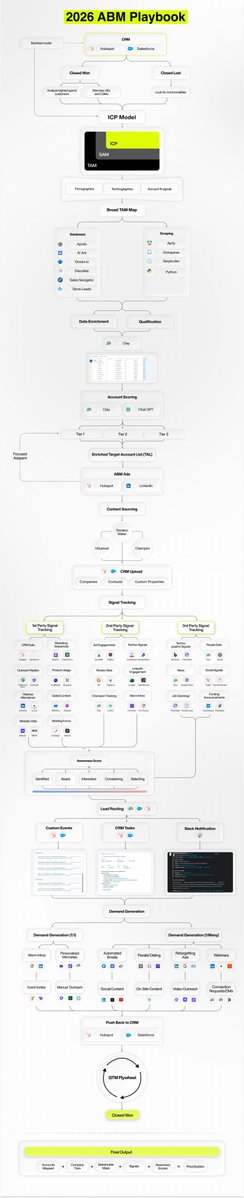
"ABM is only for enterprise teams with 6-figure budgets." That was true when 6sense was the only option. Now, with: - Clay - Claude Code - Signal tools like RB2B, Findymail, Jungler There’s no more excuse. Anyone can build full ABM infrastructure with a lean team. All you have to do is understand the 4 stages: 1. TAM mapping 2. Signal tracking 3. Awareness scoring 4. Demand generation. The RevOps layer that used to need dedicated headcount and 6-figure contracts now runs on a lean stack. Smaller teams with better infrastructure are outcompeting the ones who built ABM the old way. PS Comment the word "ABM" And I'll send you a massive breakdown we did on the 8 steps you need to build your ABM system.
Fivos Aresti tweet media
English
122
10
128
11.6K
Next Level
Next Level@NextLevelNtrtn·
@baym yes weird herbs demands better
English
0
0
0
52
Matt Kaeberlein
Matt Kaeberlein@mkaeberlein·
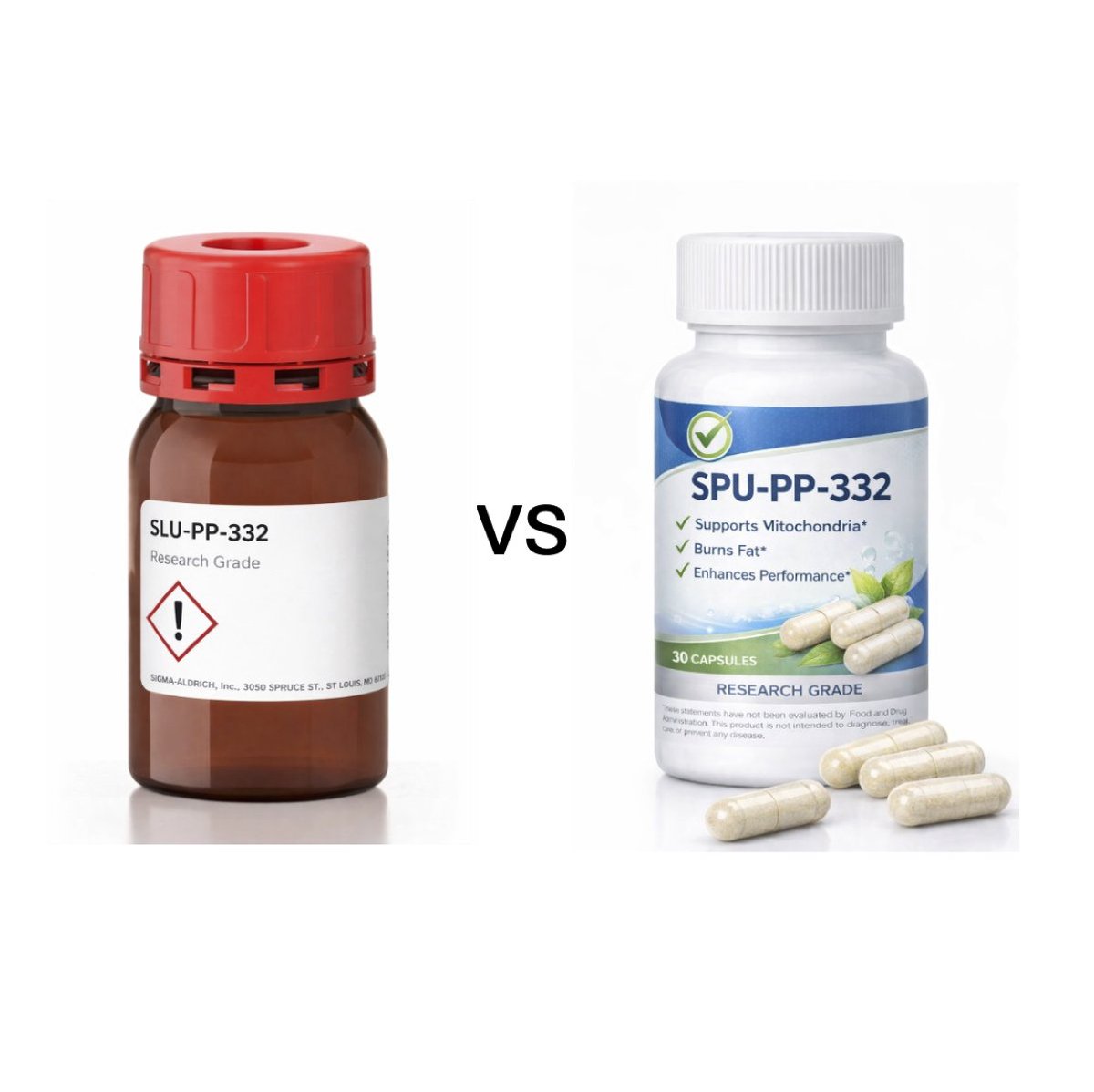
I’m seeing some dangerous trends in “longevity medicine” and biohacker culture as doctors, pharmacists, and influencers push the edges of what’s legal and ethical. Here’s one example 👇 Unscrupulous marketers are selling research-grade chemicals while packaging them to look like benign dietary supplements. That design choice isn’t accidental. It’s meant to make people think these compounds are safe, tested, and appropriate for human use, when many are not. SLU-PP-332is a good case study. Despite sometimes being called a “peptide,” it’s actually a small-molecule drug with no human safety or efficacy data. It has only been tested in a handful of mouse studies. Yet it’s being promoted as an “exercise mimetic,” and some clinicians are even illegally prescribing it. Do a quick Google search and you’ll find plenty of sketchy sites selling “research-grade” SLU-PP-332. Don’t buy it. If you wouldn’t take the brown Sigma-Aldrich bottle and sprinkle it on your yogurt, why would you trust the exact same chemical sold by a fly-by-night internet vendor, encapsulated with unknown purity and zero oversight? I tend to be libertarian when it comes to healthcare - people should be free to make choices about their own bodies if they’re fully informed. This isn’t informed choice. It’s deceptive opportunism that puts real people at risk. Choose evidence over aesthetics. Science over marketing.
Matt Kaeberlein tweet media
English
9
10
98
8.5K
Harry Stebbings
Harry Stebbings@HarryStebbings·
If you want a pricing premium as a startup fundraising today, you need to be one of two things: 1. Replacing jobs; now or in roadmap. (Harvey, Legora, Sierra, Decagon) 2. Co-attach to AI. Ride the tailwinds of AI. (Datadog, Supabase etc). If not either, discount will be real.
English
33
11
204
34.5K
Amy
Amy@alexandrite113·
I want to share a cautionary medical story, especially for people with ME/CFS / MCAS / extreme medication sensitivity. 💊 A tiny change in a medication nearly destroyed me.... and I almost never figured out why. (1/8)
English
24
63
362
31K
Next Level
Next Level@NextLevelNtrtn·
@sarah_cone @WillManidis u can addict urself with other weird herbs too anything that ↑ TAAR1, ↑ DR or ↑ OR
English
0
0
0
25
Avi Press
Avi Press@avi_press·
I've had @openclaw going for less than 24 hours now, so far it has: - cleaned up our Linear issues - Wrote several decent email follow-ups. - Opened 3 PRs - Sent thousands of messages in a loop to an innocent and unsuspecting person who happened to message me on WhatsApp. - Prospected our new signups for the day, now scheduled daily.
English
7
4
98
12.7K
Ansu Satpathy
Ansu Satpathy@Satpathology·
Yes, I’ve seen long lists of China drug assets that are being shopped around prior to JPM. TL1A/IL23 bispecifics, CD19/BAFF TCEs, PD-1/VEGF, IL17A/F antibodies... It may come one day but the future of breakthrough medicines is not there yet. I’ll bet on US academic and biotech innovation every day of the week and twice on Sunday.
English
5
8
94
12.2K
Year of Glad
Year of Glad@pemulisking·
So says the guy who lit >$6B on fire on his ill-conceived science project of a company. That could have funded a lot of good US innovation too!
Jason Kelly@jrkelly

I wish it weren't the case, but @LifeSciVC is wrong about this. The crisis in biotech startups is not just "biotech being cyclical" - you can see clearly that the rise in Chinese startups is not cyclical over the last 25 years - it's spiking up in the last 10 years (see chart below from @AsimovPress). The great article in @WSJ by @jaredmitovich does capture reality for scientists in Boston -- it's impossible for them to get jobs in biotech right now. wsj.com/tech/biotech/p… This has little to do with Kendall Square building too much lab space or COVID-driven boom times in biotech as Bruce suggests. Those happened too over the last 5 years, but the reason it is impossible for scientists to get jobs in biotech right now is that the center of gravity for biotech startups is moving to China. Things we should do to fix this: 1) Get fucking competitive US biotech scientists, academics, and entrepreneurs need to get out of the funk! There's a lot of defeatist attitudes -- "things are changing and I don't like change" about how the Trump administration has approached science. Get over it! I know folks like @mkratsios47 @sriramk @HHS_Jim @SecretaryWright aren't trying to stop US science -- but they do want to change how we do science with things like Project Genesis that bring our new AI datacenter horsepower into science. We also got into an attitude of WFH and a lower intensity during COVID across all of tech that I'm happy to see the AI crew in Silicon Valley has broken us out of -- but we need to bring that intensity back in biotech startups too or we deserve to lose it to China. Being intense about entrepreneurship is kinda our thing in the US - let's not forget it. 2) Block outbound US investment in Chinese biotech startups This is not impossible! In fact it just happened in the NDAA that passed 2 weeks ago with the Comprehensive Outbound Investment National Security Act of 2025 (COINS Act) arnoldporter.com/en/perspective… US biotech VCs (including our leaders like @LifeSciVC and @PeterKolchinsky -- I'm not trying to single them out, basically everyone is doing it) are running the same playbook that got run in tech VC with funds like Sequoia China 20 years ago. I get why! It's a great ROI to invest in Chinese biotech startups right now. There's no way to pressure one VC fund to opt-out, that's just bad business for them. But USG should add biotechnology to the COINS list of critical technologies alongside artificial intelligence (AI), quantum , semiconductors, high-performance computing/supercomputing and hypersonic systems that are on there today. Would love to see legislators who care about US biotechnology for national & economic security step up here like @SenToddYoung, @SenatorWarner, @SenPadilla, @RepBice, @RepHoulahan , @PeteSessions, @RepGusBilirakis, @sethmoulton, @JakeAuch and @RoKhanna -- leaders from the new Biotech Caucus: houlahan.house.gov/news/documents… and @biotech_gov ! If you are a scientist/entrepreneur in biotech, contact them and donate to them! They are stepping up to protect our industry in the US. 3) Fix US clinical trial regulations so we are just as fast as China and Australia. Changes we should make are well outlined by @rtnarch here: x.com/rtnarch/status… I believe @DrMakaryFDA is the right leader to fix this -- this is an @US_FDA that isn't afraid to make changes. Let them know we need these changes to keep up! 4) Leverage AI and Autonomous Labs to change the fundamental ROI for biosciences lab work in the US. Better trial regs aren't the only reason China is winning in biotech right now -- the other reason is they now have more trained lab bench scientists than we do in the US who work for lower salaries (thanks to CCP making investments in bioscience academia/R&D the last 20 years). This labor arbitrage was the playbook WuXi used in chemistry in pharma and it's coming now for biotech -- and not just for CRO work, but for all of of discovery science. The way out of this is to automate US lab work with autonomous labs. Paradoxically, lab automation will will increase scientist jobs in US, not reduce them! See the the 1951 IBM Electronic Calculator ad I attached below -- that calculator did not reduce engineer headcount by 150 by taking away their slide rules! We had a huge increase in both the number and the value of engineering jobs! The ROI on computation was wildly better after automation than when it was done manually -- same will happen with autonomous labs. We need to put down our slide rules in science (the pipettes and lab benches) and embrace total automation -- this is possible now with breakthroughs in AI and robotics, I wrote more about it here: ginkgo.bio/autonomous-lab Then US will be competing with China on whose scientists have the best ideas, commercial translation, and risk capital access -- not who has the lowest cost scientific hands. Finally, this is a national security priority for the United States. The reason is that biopharma is the only working market today for genetic engineering (i.e. "biotechnology") which is a technology that is as general and as important as computers (DNA and computer code are human's only two code-based technologies!). If we lose the drug startup ecosystem to China, we lose the frontier of designing DNA to China. I don't want to live in a future where democracies don't lead in developing the most important technology in human history. We're made of biology, our food is made of biology, our life support on this planet (and on the future on Mars, too) is provided by biology. We cannot take our eye of the ball here. The next 12 months matter to keep this technology healthy and leading in the US, we need to get to work. Hope you all (and biotech) have an awesome 2026! 🎉🧬

English
3
1
54
13.6K
Chris Pisarski
Chris Pisarski@chrispisarski·
if you are in a sales call and hear "I need to run this by my boss / wife / team", your #1 job should be to find the "fear question" something useful I picked up was asking: "that makes sense. but before you go into that meeting, what is the one hard question you are afraid your boss / team / … is going to ask you about this project that you don’t have a great answer for yet?" this does two things 1) identifies the real objection (budget, security, timing) they have 2) lets you coach them on exactly what to say in that meeting
English
13
18
394
48.9K
Next Level
Next Level@NextLevelNtrtn·
@LaraWeed yes hello what u think abt weird herbs?
English
0
0
0
29
Lara Weed
Lara Weed@LaraWeed·
Even a new color is technology
English
1
0
0
186
Next Level
Next Level@NextLevelNtrtn·
yes. weird herb time
Startup Archive@StartupArchive_

Marc Andreessen: Revolutionary technologies were often viewed as “trivialities” or “jokes” “If you read history, the great innovations of the past are now well understood as being very important. In almost every case, they were not widely understood as such at the time. In fact, I would assert that they were often actually viewed as trivialities or jokes.” He gives three examples: 1. The telephone. “When Thomas Edison was first working on the telephone, the assumption of the use case motivating his early work was the idea that telegraph operators needed to be able to talk to each other. It was considered implausible that you would have a system that would let any ordinary person pick up the telephone and talk to another person - that was clearly impossible… Completely missing the larger opportunity.” 2. The Internet. “I have personal experience with this one. The Internet was laughed at. It was heaped with scorn from 1993 to 1997-98. In fact, those of you who were in the industry at the time will remember the New York Times had a reporter on staff named Peter Lewis… I’m convinced he was specifically hired by the editors to just write negative stories about the Internet. It was all he did, and it was always the Internet was never going to be a consumer medium. The Internet is not nearly as big as these people think. Nobody is ever going to trust the internet for e-commerce.” 3. The car. “The car was absolutely viewed as a triviality and a toy when it first emerged. In fact, J.P. Morgan himself refused to invest in Ford Motor Company with the response that it’s just a toy for rich people, which is in fact what it was at the time. If you had one of the first cars, you had to be a rich person. You had to have a driver. You often actually had to also have a stoker with your early cars to keep the engine going. And then you also had to travel with a full-time mechanic because the thing would break down every three miles.” Marc concludes: “The great innovations of the present, I believe, are virtually guaranteed to be viewed as trivial and to be viewed as jokes. I think history 50 to 100 years from now will enshroud them in legend. In our time, they won’t be recognized as such. Of course, in the future, when they become legends, our descendants will themselves have their own trivial innovations to laugh at.” Video source: @MilkenInstitute (2013)

English
0
0
0
103
Sara Moscatelli
Sara Moscatelli@saramoscatelli7·
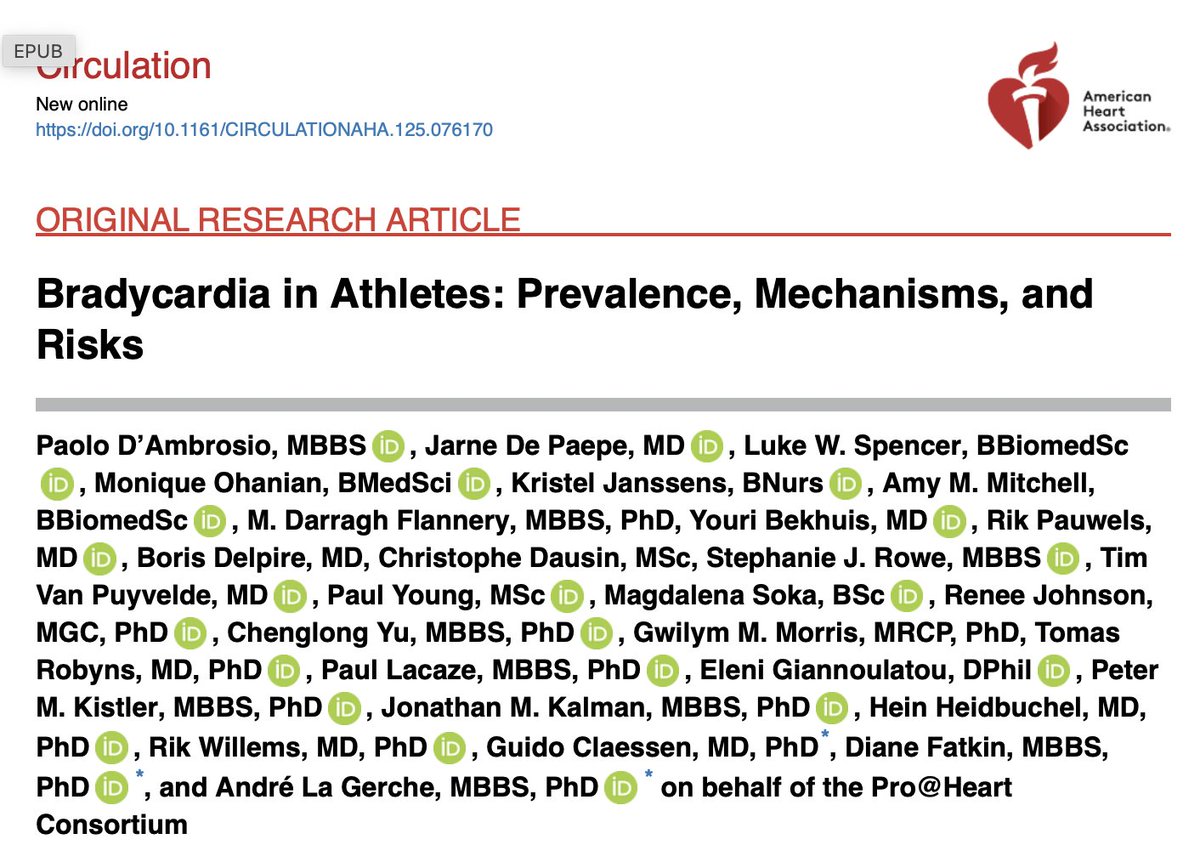
🏃‍♂️🫀 How slow is too slow in athletes? A new study in Circulation shows that bradycardia in endurance athletes is common, genetically influenced, and usually benign 💙 🔍 Key findings: ⏱️ HR ≤40 bpm in ~40% of athletes 🌙 Extreme bradycardia (≤30 bpm) is rare and mostly nocturnal 🧬 Low heart-rate polygenic risk score doubles the likelihood of bradycardia 🏋️ Greater fitness = greater physiological cardiac remodeling ✅ No increased risk of syncope, arrhythmias, or pacemaker implantation 📌 Take-home: in well-evaluated athletes, slow heart rates often reflect healthy adaptation — shaped by both training and genetics. #SportsCardiology #AthleteHeart #Bradycardia #CardiacRemodeling #CardioGenetics #PrecisionMedicine #CirculationJournal #HeartRate 🫀🧬 doi.org/10.1161/CIRCUL…
Sara Moscatelli tweet media
English
6
82
340
23.5K
Matthew S. Alexander
Matthew S. Alexander@Matt_Muscle_Guy·
#4. Wang et al., Cell Stem Cell., Multiomic profiling reveals that prostaglandin E2 reverses aged muscle stem cell dysfunction, leading to increased regeneration and strength. tinyurl.com/yes36epu
English
1
3
15
2K
Preston Rutherford
Preston Rutherford@PrestonRuther10·
The biggest misconception about Airbnb’s famous transition away from performance marketing is that they went from 100% performance to 100% brand They didn’t. They became more balanced. After studying their transition, here are the 5 ideas you can apply in your biz as you navigate finding the ideal balance for your brand. Why listen to Airbnb? They generated >$500M in profit in a single quarter and have maintained massive margins since shifting their strategy. Something’s working that’s not simply tied to the “return to travel boom”. 1) It's not "brand" OR "performance". It's a balance of "lasers" & "chandeliers" Brian Chesky, CEO: “We were spending a lot of money in performance marketing. I don't think performance marketing is a bad thing. I think of performance marketing as a laser, actually.” “We used to have this metaphor of lasers, flash bulbs and chandeliers. If you want to light up a room, performance marketing is a laser. It can light up a corner of a room. You don't want to use a bunch of lasers to light up an entire room - you should use a chandelier. And that's what brand marketing is.” “But if you do need to laser in and balance supply and demand, then performance marketing is really good.” 2) Brand marketing = Investment yielding accumulating advantages. Performance marketing = arbitrage seeking with eroding advantages. “Performance marketing, though, doesn't create very good accumulating advantages because it's not an investment.” “Now if you want to build it permanently, like Booking . com if you have a really high ROI now, you can have a performance marketing arbitrage business.” “But assuming you don't want an arbitrage business, you actually need to be investing.” 3) Brand building isn’t only talking about your values. Your product is just as central to the brand message, so tell people why it’s different and better. “We think of marketing as education, that we're educating people on the unique benefits.” “A lot of companies don't do product marketing. They do brand marketing, which are ads about the app, or they do performance marketing. But they're never really educating people about new things they're making.” 4) Word of mouth > everything “It's a full funnel approach. And last year we got 600,000 articles written about us. So, people talk a lot about Airbnb.” - Chesky from a recent Earnings call “When you invest in a brand, when your brand's a noun and a verb, and you have something unique, you get a lot of those benefits.” “90% of our traffic remains direct or unpaid.” - Dave Stephenson, Chief Financial Officer, Airbnb 5) The single reason you invest in brand is to make more money “Chesky said that the brand would never again rely so heavily on performance marketing. And shortly after the decision to reallocate marketing spend, the company reported its most profitable fourth quarter on record” - The Drum #brand #marketing #airbnb #profitability
English
6
4
105
13.4K
Dirk Haussecker
Dirk Haussecker@RNAiAnalyst·
What, patients being worse off after discontnuing Glp1s? There is a solution for that...body composition and inhibinE. $wve $arwr
Iñigo San Millán@doctorinigo

New Lancet data on GLP-1 agonists 👇 A new paper in The Lancet eClinicalMedicine shows that when GLP-1 therapy is stopped, most people regain the lost weight and lose metabolic benefits. In practice, this means GLP-1s function as chronic, often lifelong therapy not a temporary fix. To be clear, GLP-1 agonists are improving the health of many people, especially patients with obesity, type 2 diabetes and high cardiometabolic risk. For these individuals, weight loss can be genuinely life-changing. The concern is not appropriate medical use but indiscriminate use. With millions already taking these drugs and numbers rising rapidly (specially with the new pill format), many users are not patients in the classical sense, but generally healthy or mildly overweight individuals. In this context, the risk–benefit balance changes. Once started, most users will need to stay on GLP-1s indefinitely or face significant rebound effects, often returning to baseline or worse. As an important caveat: GLP-1s improve metabolic control, but they do not rebuild metabolic capacity. Without resistance training, meaningful metabolic work (Zone 2 and above), and adequate protein intake, long-term use may promote lean mass loss, low energy flux and increased frailty risk with aging. In addition, we still lack long-term data on potential pancreatic, thyroid, and central neurotransmitter effects. GLP-1s are powerful tools, but not a standalone solution. Long-term success requires pairing pharmacology with training and metabolic resilience. IMHO: based on current clinical and research evidence, it is now urgent that clinicians clearly inform users that starting GLP-1 therapy likely means committing to long-term or lifelong use, with all the consequences that may entail. thelancet.com/journals/eclin…

English
5
1
34
11.6K