and related github.com/monero-project….)
tevador: I wrote a simplified summary without any gory math details. The point is to agree on one of the 7 choices.
sgp_: Ty tevador for all your work on this and your work organizing this
rbrunner: Likewise
ofrnxmr: seconded
rucknium: Yes, thank you tevador :)
tevador: For comparison, Zcash is going with something similar to AN509, but worse, because they will have O(N) scanning time with N = number of addresses.
plowsof: +1
tevador: Does anyone have any comments? Any opposition to moving forward with BC1024?
rucknium: I am going to ask some noob questions. If a PQ adversary has one of the Carrot addresses of a wallet, they can de-anonymize the txs of the wallet that share a common private key seed, e.g. the Hierarical Deterministic (HD) wallet seed phrase. Is that correct? Then an impractical countermeasure is to eliminate HD wallets and go back use-once private keys for each tx packed into wallet.dat. Would that actually work?
tevador: They can deanonymize transactions that share a private view key. You can avoid that by having a different view key for each transaction, but that means O(N) scanning time.
tevador: Different view key for every address*
jeffro256: rucknium: For the new Carrot key hierarchy, the QA can deanonymize the transaction graph of the output receives externally. They cannot deanonymize the outputs which were self-sended
rucknium: Another hypothetical: Why would a party that is cooperating with a PQ adversary set up the infrastructure to send XMR to this special PQ address? Wouldn't they just say "Sorry, you must use the old addresses"? Isn't this a big part of the threat model that these PQ addresses are , um, addressing?
tevador: Yes, but self-sends are not very important in practice anyways.
jberman: A comment on potentially large (1kb+) address length: perhaps we could implement something like ASCII qr codes? So instead of copying and pasting massive clunky addresses, copy pasting ASCII qr codes. I see that the huge addresses aren't the only downside to the algos with huge addresses (pruned tx sizes seem lager too, which is significant and also affects scan time from downloading), but perhaps there is a solution that renders them not so terrible
tevador: If the Monero-RPC accepts the new address format, I don't see a reason for a merchant not to support it.
jeffro256: tevador: It is important because it hides where the wallet sent their funds. They would also gain importance once people realize the PQ implications and begin using self-sends as such
rucknium: Another question: Do these addresses get Monero closer, at all, to a countermeasure to PQ counterfeiting? I assume no, but I wanted to check.
tevador: No, this is purely for PQ privacy
jeffro256: A QA can, in many circumstances, calculate the spending location of externally received funds, not just where they were received. So a self-send in between would hide the spend locations of those outputs
jeffro256: rucknium: The mitigation of using ephemeral private keys for each tx would work. Note that your wallet scanning time would be O(N) for the number of pairs generated
tevador: Yes, but the QA learns the received amounts to the known address in any case, whatever you do afterwards, which is a biggest leak IMO.
rucknium: If the keys are designed to be single-use, then you could stop scanning after you found the first receive tx.
tevador: Addresses in Monero are not single-use.
jeffro256: tevador: Fair
rucknium: Going back to 2009
jeffro256: tevador: There could a specific address format which singles "hey don't use this twice please"
jeffro256: signals
tevador: Single use addresses would prevent the whole-wallet leak, but don't prevent the main problem of leaking the receiving transaction.
jeffro256: tevador: It's the biggest leak if trying to conceal income. Not the biggest leak if trying to conceal purchases
rucknium: I am developing the hypothetical with the sending adversary you don't trust fully, on privacy at least. So you would stop listening for txs after you got the one from the untrusted party.
tevador: I think you can already do this with a throwaway wallet seed.
rucknium: Yes. It would be a UX change.
jberman: tevador sorry if this is included somewhere, but why is the 2/16 tx size so much larger than the 2/2 tx size for NTRU-509 than it is for the other algos?
tevador: How would you do donation addresses with a single-use address format?
tevador: jberman: Good question. NTRU needs 16 ciphertexts in that case, but CSIDH needs just 1 shared public key for all 16 outputs in option A.
ixr3: It will take on tremendous importance! > It is important because it hides where the wallet sent their funds. They would also gain importance once people realize the PQ implications and begin using self-sends as such
rucknium: BTCPay Sever does single-use addresses for Monero, which are used by at least one nonprofit for XMR donations. Just show each user a different address.
rucknium: Server
rucknium: Just thinking outside the box here.
tevador: Do we want Monero to move to single-use addresses? Technically not publishing addresses ever (except to the sender) would solve the PQ privacy issue.
ofrnxmr: Tracking a lot of subaddresses begins to take its toll on scanning though, unless you stop scanning one once used?
rucknium: plowsof's Wishlist as a Service also shows each user a different address.
sgp_: Single, static donation addresses have their place
ofrnxmr: What happens if someone sends 2 txs to the same address? Would the 2nd tx be rejected?
ofrnxmr: something like silent payments maybe?
jeffro256: ofrnxmr: Not on CPU speed, just storage
tevador: I think these services would be vulnerable a denial of service by generating 1000s of addresses but never sending anything. Then the wallet has to keep scanning.
tevador: Also if interactive addresses are OK, we can just do this: monero-project/research-lab #106
rucknium: I didn't intend to distract so much from your question, tevador, about the best PQ encryption algorithm for the addresses. Can we have more comments on the options from meeting participants?
jberman: I think privacy-preserving static addresses are a critical Monero feature
gingeropolous: agree re: jberman
tevador: Btw, Jamtis brings other improvements to addresses apart from PQ privacy. PQ privacy was means as an extra feature.
rucknium: Reconsidering, if a service didn't offer the PQ addresses, then a competitor service could offer it. Market forces may squeeze out the non-adopter. Or at least there would be a good alternative for users who are aware of the quantum problem.
tevador: Technically we could still go with classical Jamtis, which has 260-char addresses.
jberman: I have a half debate in my head continuing about the acceptability of NTRU / a lattice based algo. Your arguments in favor of CSIDH are strong tevador , that's still where my head is at though
rucknium: But many services have a lot of market power, i.e. close to a monopoly.
rucknium: I will put this agenda item closer to the beginning next meeting.
tevador: Thanks
rucknium: More comments on this item?
tevador: I didn't mention this, but NTRU and other KEMs have an extra issue in that the address generator tier can collude with the quantum attacker to deaononymize transactions.
tevador: CSIDH doesn't have this issue.
jberman: tevador: ack
jpk68: Noob-ish question from me: is it really worth prioritizing smaller QR code sizes over shorter encoded address lengths? In my opinion, shorter addresses would be better from a UX perspective
jpk68: (I'm referring to the use of Base32 over Base62/etc.)
ixr3: rucknium: No, but I want to thank tevador for this very important work. It's hard to follow alongside all other developments going on
tevador: base62 would shorten addresses only aby about 16%
tevador: QR codes would become larger by 45%
jpk68: Would there be any real-world difference when scanning/using the QR codes though? For example, would scanning a payment terminal be reasonably more difficult with higher-resolution QR codes?
jpk68: I mean, of course it would (with insanely large codes) but with the 45% larger ones, I mean
tevador: I'm not sure what is the max reasonable QR code size to scan with a phone
jeffro256: Probably depends on camera quality and lighting
jbabb: Stack Wallet uses QR codes to exchange FROST information and we found that up to about 4000 chars is usable
jpk68: Just saying, from a UX perspective (in my opinion), a 16% decrease in address sizes is a 16% benefit for me. However a 45% larger QR code is about 0% less convenient, so long as the QR code is actually usable
tevador: What QR code size is that? in modules
rucknium: jbabb: Is that with zero error correction? IIRC, you can set different levels of error correction in a QR code.
tevador: I think Jamtis in base32 would be 69x69
jpk68: I know this is probably just bikeshedding, but I thought it would be worth bringing up
jbabb: tevador: 177x177, version 40 iirc, worked. but version 10-20 (57x57 to 97x97) is better and i think everything fits under these, ill have to check what the actual payloads are in practice
tevador: 177x177 is the largest possible size AFAIK
jbabb: was awhile since that work was done. versions 10-25 are practical imo
jbabb: rucknium: I will have to recheck these details sorry, twas awhile back we integrated kaya's frost
jpk68: I can't remember exactly, but when I looked into this a few days ago, the minimum QR code size that could be used for Base32 Jamtis addresses (13? 14?) had to be bumped up "only" two sizes from before
tevador: I think the encoding format can be resolved later anyways
tevador: I'm not opposed to base32 for the prefix + base62 for the data.
tevador: Yes, I think it would go from version 13 to 15
jpk68: xmr1a is valid Base62 though, no?
jpk68: Wrong prefix, oops
tevador: YEs, but the prefix also includes the 24-char checksum
jpk68: Oh, I see
tevador: This one should stay case insensitive for human readability
rucknium: We can end the meeting here. Feel free to continue discussing. Thanks everyone.
tevador: Thanks
ofrnxmr: I can generate a qr code right now for an example?
jpk68: Thanks
tevador: syntheticbird: In the prefix, that would be "li". In the data payload - nobody cares.
rucknium: How would the PQ address work in hardware wallets? Is the checksum prefix enough to prevent accidental or malicious substitution of the address?
tevador: Answer here: #523-visual-checksum" target="_blank" rel="nofollow noopener">gist.github.com/tevador/639d08…
rucknium: Thanks.
ofrnxmr: mrelay.p2pool.observer/m/monero.socia…
ofrnxmr: 621 chars, seems to scan fine
jpk68: In Base62?
ofrnxmr: most of it
vtnerd: Damn this may crush lwcli/monero-wallet-cli lol
sgp_: mrelay.p2pool.observer/m/monero.socia…
sgp_: 2953 test
jpk68: ofrnxmr: Works for me, up to around 6 feet away (average Android phone)
jbabb: scanned for me without even zooming it in. had to be 6in away from the screen tho
jbabb: strangely, zooming in didn't really help (scannable at about a foot from the screen)
tevador: Now make the version 40 qr code 5x5 cm and try to scan it
jpk68: sgp_: 2,953 characters of Bech32?
ofrnxmr: i zoomed the pic out so its only like 5cm across
ofrnxmr: "this" = sgp's 2953 qr code
jpk68: Are you using a telescope? Lmao
sgp_: mrelay.p2pool.observer/m/monero.socia…
sgp_: 4296 characters, alphanumeric (uppercase only)
jpk68: tevador: the payload is 368 bytes for BC1024
sgp_: mrelay.p2pool.observer/m/monero.socia…
sgp_: for 1379 characters alphanumeric, it fits in qr code version 34 with error correction level high
tevador: So probably more like 617 chars in base32
sgp_: version 22 with error correction low
UkoeHB: Why would QR codes be different sizes based on encoding? Can't encodings be translated? base-whatever -> QR code ideal -> QR code -> QR code ideal -> base-whatever
sgp_: mrelay.p2pool.observer/m/monero.socia…
jpk68: QR codes apparently have different modes, so if you restrict yourself to a smaller charset (i.e. Base32) you can encode more efficiently
jpk68: I suppose one could encode the payload as a QR itself (in bytes)
UkoeHB: Sure, my question is why QR encoding has to equal address encoding.
tevador: UkoeHB: presumably we only want one address format (string). But yes, a binary address encoding would be tiny bit more efficient in QR codes
UkoeHB: 45% doesn't seem tiny, unless you mean relative to b32
tevador: alphanumeric encoding encodes a 5-bit base32 character with 5.5 bits of encoding space, so the overhead is 10%.
#c669723" target="_blank" rel="nofollow noopener">libera.monerologs.net/monero-researc…
Two years ago today in a pre-dawn raid, began what has felt like a surreal nightmare which I have been trying to wake up from.
Two full years stolen.
And today, on this somber anniversary, when I remember who we were, and the hope we had for the future before everything changed, I find myself mourning alone.
I’m clinging to the hope for a pardon.
But even if it comes, it won’t give us back the 730 days we lost.
When Keonne finally walks through our door, we won’t be “picking up where we left off.”
If you’ve prayed for us, shared our story, signed the petition, or donated, sincerely thank you.
#pardonsamourai
Paul’s ecash hard fork is an excellent reason to:
1. Buy as much bitcoin as you can before August
2. Withdraw all coins from exchanges so you can claim your free ecash
Super bullish!
BREAKING: New Bitcoin Fork
I am helping create a **new Bitcoin Hardfork** -- dropping this August, called "eCash".
- Your coins will split. For example, if you have 4.19 BTC, then you will get 4.19 eCash.
- You may sell your eCash -- or keep it. Or ignore it!
Vegas:
- Yes, I will be in Vegas next week.
- No, I won't mention this, on stage -- (that would be rude).
Our L1 Node...
- is a near-copy of Bitcoin Core.
- is Sha256d mined.
- forks via a one-time difficulty-reset -- to its minimum value. (So, mining will be crazy at first.)
- Yes, we will change the seed nodes, the name, the network magic, etc.
Codewise, the L1 will remain compatible with Bitcoin Core:
- We will continue to merge their changes (even the bad ones).
- The L1 will activate Bip300/301 via CUSF -- the core untouched soft fork. So, no lines of code will be changed, on the L1.
- The activation client will be published periodically (link below).
- We will do several bug bounty contests this summer.
- The client will be frozen 30 days prior to the fork.
Yes, there will be Drivechains:
- We have 7 in developement right now.
- Users can also submit their own.
- Drivechain is a vision of "competing L2s" -- this avoids the "dev capture" problem.
- These L2s are all Merged Mined. Miners automatically get free $.
- Our L2s are already capable of planetary scale, and onboarding 8 billion users.
- We also have a zCash-like L2, with strong privacy.
- Other L2s: Truthcoin (Prediction Markets), CoinShift (Decentralized Exchange), BitAssets (NFT etc), BitNames (Identity), Photon (Quantum Resistant).
Unlike BCH (the 2017 fork):
- There is no "Bitcoin" in the name. New name, new brand.
- You are getting advanced warning (4 months).
- We are replaying all txns (at first). We will release a coin-splitter tool.
- This is a permanent & sustainable fix to Bitcoin's problems (instead of a 1 MB to 8 MB temporary fix).
- Back in 2017, the BTC tech stack was strong, and expectations for Lightning were strong. Today, it is the reverse.
Video to follow.
To access the scary dark web!!! That you can only access if you have Kali Linux as your bare metal OS and QEMU/KVM set up with Arch Linux on it, lastly you set up virtualbox + Whonix on that VM!
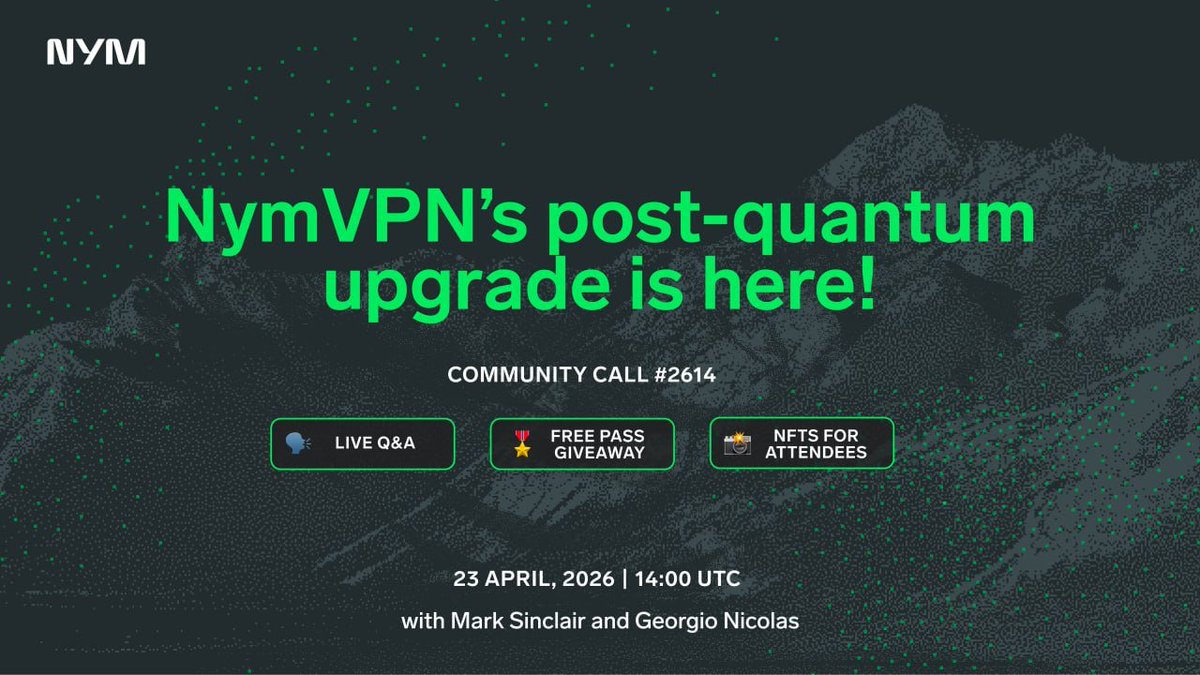
⚛️NymVPN's post-quantum upgrade is here
❓ Live AMA with the builders
🧪 What we shipped and what’s next
⚡️ How Lewes Protocol is designed to stay fast
x.com/i/broadcasts/1…
A phone number isn't an identity. It's a billing record with a SIM attached. Every time an app requires one to sign up, it's not verifying who you are. It's verifying who can be invoiced, traced, or cut off.
These are not the same thing.
A profile should belong to you, not to the platform. 👈
In Pubky, your identity is tied directly to your public key and resolved through open infrastructure like PKARR, PKDNS, and the DHT.
Simple to use.
Harder to take away.
Join Pubky today! pubky.app 🔑
Justin Berman recently put forward a proposal for the audits of the integration of Full-Chain Membership Proofs (FCMP++) into the Monero codebase!
'The goal is that by the end of the audit, the actual code merged into the Monero repository will have received highly qualified independent scrutiny and review by a singular or multiple 3rd parties.'
TC threw away its admin keys over a year ago.
67 anon nodes run the protocol.
They alone get to decide what happens now.
TC earned its decentralisation with blood sweat and tears.
Introducing internet privacy foundation.
We build the infrastructure that protects privacy online: open protocols and permissionless tools.
We're a 501(c)(3) nonprofit. Donations are tax-deductible for US donors.
ipf.dev
Citadel Dispatch 200: UTXO - WISP
We go deep on AI, his local rig, on device spam filtering, whether Claude is subsidizing us into oblivion, and what happens to big tech jobs when a unicorn only needs three employees.
serve.podhome.fm/episodepage/Ci…