Shay Boloor@StockSavvyShay
THE OPTICAL PHOTONICS BOTTLENECK
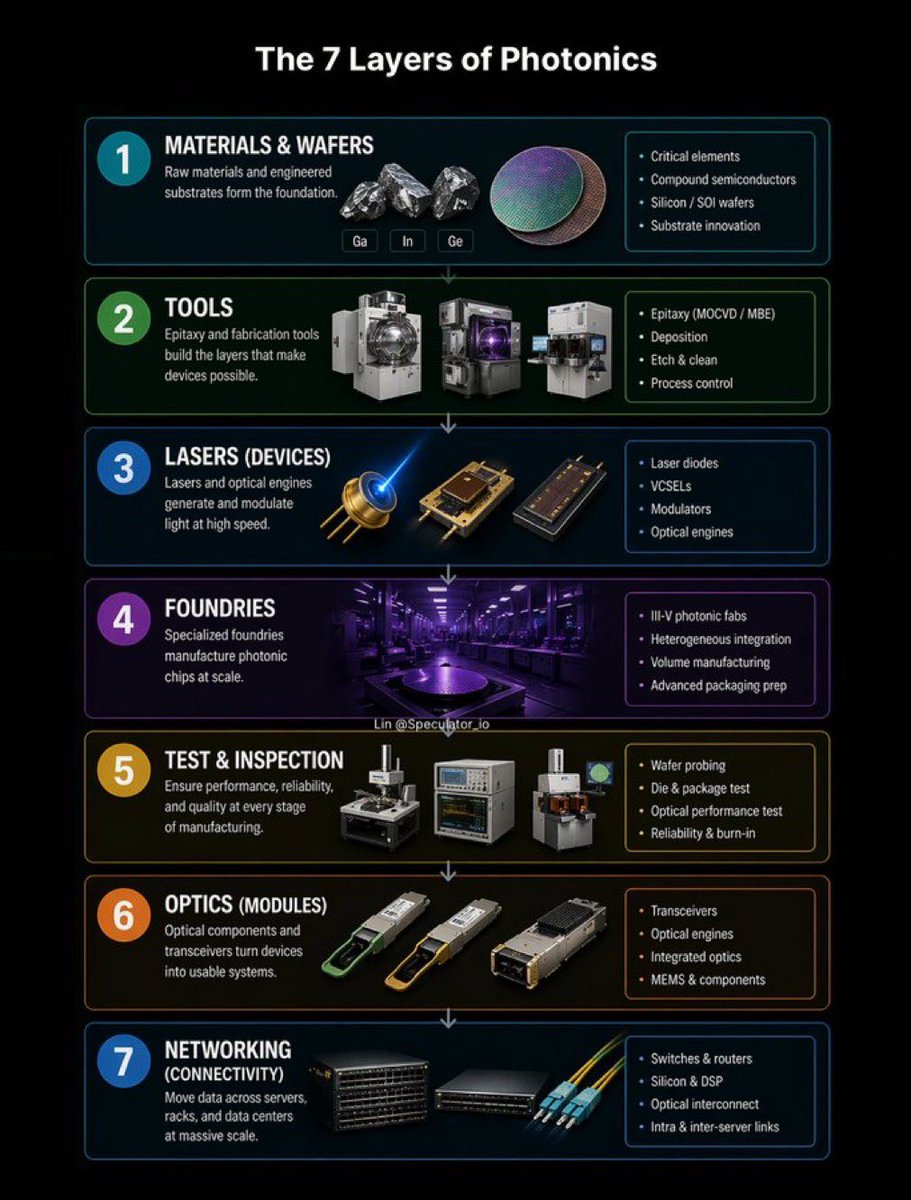
As AI clusters scale past copper’s physical limits, the bottleneck shifts to optical & these are the companies building that layer across the stack:
1. $AAOI building the transceiver layer of the AI network through vertically integrated U.S.-based InP laser manufacturing. It has already secured over $200M in its first volume 1.6T order from one hyperscale customer followed by another $124M in 800G orders from a second.
2. $AEHR building the reliability layer for the optical & AI hardware stack through burn-in & test systems. It just received a record $41M follow-on order from its lead hyperscale customer reinforcing the idea that Sonoma is becoming a key production burn-in platform for high-power AI ASICs.
3. $CRDO building the connectivity layer that helps AI clusters move data faster through active electrical cables, retimers & high-speed interconnect silicon. The DustPhotonics acquisition also extends that platform into silicon photonics before copper becomes a real constraint.
4. $LITE building the laser layer of the AI optical stack through EMLs, optical components & optical switching exposure. The setup is backed by a $2B $NVDA strategic investment & optical circuit switch backlog above $400M with orders reportedly extending through 2028.
5. $VIAV building the testing & validation layer of the optical stack through network instrumentation & photonics measurement tools. It is the picks-and-shovels layer of the transition because every high-speed optical buildout still needs to be tested regardless of which transceiver vendor wins.
6. $COHR building one of the core photonics bottlenecks through indium phosphide lasers, optical engines & communications components tied to next-gen AI networking. It also has a $2B $NVDA strategic investment behind it & is doubling InP device capacity into the 1.6T ramp.
7. $MRVL building the DSP & optical infrastructure layer through electro-optics, PAM DSPs, interconnect silicon & custom networking chips. The Celestial AI deal & NVLink Fusion exposure both strengthen its position as photonics becomes more central to AI cluster design.