Mo Akif ðŸĶ†

359 posts

Mo Akif ðŸĶ† banner
Mo Akif ðŸĶ†

Mo Akif ðŸĶ†

@ChiefMoAkif

hello

āđ€āļ‚āđ‰āļēāļĢāđˆāļ§āļĄ Åžubat 2019
411 āļāļģāļĨāļąāļ‡āļ•āļīāļ”āļ•āļēāļĄ147 āļœāļđāđ‰āļ•āļīāļ”āļ•āļēāļĄ
āļ—āļ§āļĩāļ•āļ—āļĩāđˆāļ›āļąāļāļŦāļĄāļļāļ”
Mo Akif ðŸĶ†
Mo Akif ðŸĶ†@ChiefMoAkif·
Building vs Betting — a 10-tweet summary of @NIApodcast ep 60 ft. @TrungTPhan, @jackbutcher, & @bzaidi. 1] Jack made his Permissionless Apprentice product free. Then raised it to $1; conversion rate 5X'd. Even an atomic commitment can get people invested. twitter.com/jackbutcher/stâ€Ķ
jack@jackbutcher

after seeing the open rate of permissionless apprentice material after making it free, I am making a slight change it is now $1 vv.run/permissionless

English
1
4
32
0
Mo Akif ðŸĶ† āļĢāļĩāļ—āļ§āļĩāļ•āđāļĨāđ‰āļ§
Cole Jaczko
Cole Jaczko@colejaczko·
@thedulab Lives remaining: 1
English
0
1
6
266
adel 🌟
adel 🌟@adelwu_·
i want to host an event for people confused about their career path. for the multi-hyphenates who don’t know what to pursue, bc there’s too many things. i left my last job not knowing what was next, only that i didn’t want to keep doing what i was doing. when i pivoted from eng to growth, the most eye opening conversations were those with people 2-3 years ahead of me who went through the same struggle. they could actually resonate with the existential stress i felt navigating the process. who would be interested? i’d love to put together a panel of people with amazing multi-faceted careers and took sabbaticals/breaks to figure things out!
Marc Randolph@marcrandolph

My path to entrepreneurial success was not linear, by any stretch of the imagination. I didn’t start working in tech until I was 32. I didn’t even move to California until I was 30. Before becoming an entrepreneur, I was: -The worst realtor in the state of New York -A gofer for the CEO of a sheet music company -An aspiring brand manager for flea shampoo Don’t be disillusioned if the path ahead isn’t clear. Relax. Find something that strikes your interest. And don’t be afraid to take a trail just because you can’t see the end.

English

46
5
236
46.4K
Vishal Singh
Vishal Singh@vishalvibes_·
If you want others to tell you what to build. Maybe take up a job. The whole point of entrepreneurship was freedom. Enjoy the freedom bro, build what your heart says. Keep doing it, one day a wave will hit you. Don't chase the wave. @steipete did not build OpenClaw chasing a wave.
English
3
0
25
3.4K
Rishab Kumar Jha
Rishab Kumar Jha@rishabkrjha·
I’m honestly pretty confused right now. One moment I see the Cal AI founder hitting $50M ARR at 19 and think maybe I should build consumer phone apps. Then I see all the hype around OpenClaw and feel the FOMO. Then I think I'm a developer, maybe I should build a devtool. Then YC says “build for agents, your new customers are agents.” Then others say “automate one full workflow with AI” and build a business like the ones on Starter Story. Finally built a Payment Gateway for AI Agents, Stripe launches the exact same thing next week. Back to square one ðŸĨē. There's just so much noise. What I do know: I don’t want to go the VC route. I want to be profitable from day one, build something meaningful, and reach $100M in the next 3–4 years while genuinely improving people’s lives.
Rishab Kumar Jha tweet media
English
216
18
1K
145.3K
Jogi
Jogi@jogicodes·
After thinking about it so much, I quit my job. I got a plane ticket to Vietnam to pursue my dream of becoming a successful entrepreneur. Currently I'm living off savings, coding 12 hours a day, and I know one day it will be worth it. Wish me luck.
Jogi tweet media
English
798
64
3.5K
105.3K
du
du@thedulab·
The best businesses are just the ones that monetize hyper personal experiences. Overcame a uniquely difficult time in your life and now you coach others through it. Developed a serendipitious obsession with some topic one year that ultimately morphed into a product Beauty is that there's an innocence to it and everything happens completely naturally. Didn't come from you painstakingly doing market research, trying to identify problems, etc with active intentions of finding something to sell. Rather you just embraced the flow of life and allowed things to develop without resistance Explanations like "yeah so a ton of people were interested in my story and then I started noticing a lot of the same questions and then I thought wait a second what if I just created a program for it" or "one day I randomly met a guy who got me into running and then I became obsessed with it and then I started creating my own stuff and then other people wanted to try it so I thought hey why don't I make more" Something something nobody can be a better you than you type beat. Perpetual possibility that some past or present combination of specific experiences could end up greatly surprising you in the future in ways you can't predict. Lean into curiosities, go with the flow. Makes everything you've done and happened to you thus far that much more meaningful
English
11
10
126
7K
Mo Akif ðŸĶ† āļĢāļĩāļ—āļ§āļĩāļ•āđāļĨāđ‰āļ§
Arnold Schwarzenegger
Arnold Schwarzenegger@Schwarzenegger·
Discipline is not a genetic trait. You build it one day at a time. So don’t be jealous. Get to work.
Gordana@Drfrecklemrhide

@Schwarzenegger You were gifted by God with high discipline. I’m jealous. Haha.

English
325
3.8K
32K
979.5K
Adele Bloch
Adele Bloch@adele_bloch·
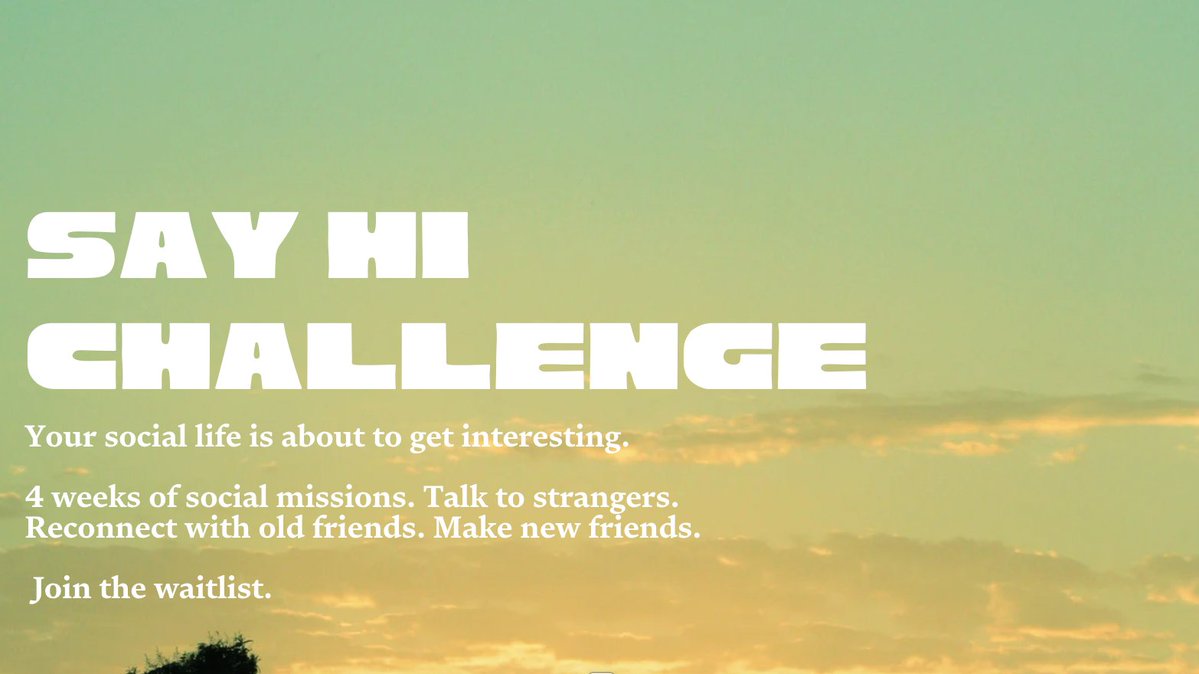
if you've been wanting to get better at talking to strangers... i'm launching the Say Hi Challenge!! 👋 a shared excuse to talk to strangers, make new friends & get out into the real world again comment if you want in :)
Adele Bloch tweet media
English
67
10
170
52.5K
suri
suri@suricidal·
eileen life coach era
Deutsch
35
1K
9.7K
237.9K
JJ Englert
JJ Englert@JJEnglert·
I've used Claude Code to build 20+ projects in the last 6 months. Thousands of new users across them. And I've never written a single line of code. I just dropped a 24-min video with my top 10 tips for non-developers — the exact playbook I use every day to run multiple AI agents that handle work that used to take me a full week. This is the best beginner guide to learning and building with Claude Code out right now. Every tutorial I found assumes you're a developer. This one doesn't. I cover everything from first install to running multi-agent workflows — with live demos and real examples for every single tip. How I set up new projects, how I got Claude to match my writing style, how I automate repeatable workflows with one command, and how I run multiple agents working on different tasks at the same time. I also built a full resource repo to go alongside the video — curated video tutorials, the best skill libraries, plugin directories, MCP server guides, written docs, community links, and a starter CLAUDE.md template you can copy-paste into your first project today. Comment "GUIDE" and I'll send you the full guide with everything you need to learn Claude Code! (make sure we're connected so I can DM you)
English
1.1K
202
1.9K
415.4K
Sierra
Sierra@Sierra_rak·
Alysa Liu when asked about competing and feeling pressure before the Olympics: “Singers perform all the time but they don’t get scored, you know? That’s how I view competitions. I can’t bring myself to see other skaters as competition. We’re just all independent artists.”
English
111
2.6K
53.5K
1.4M
Zara Zhang
Zara Zhang@zarazhangrui·
"It's hard to compete against someone who's just there to have fun." - @steipete Bring a playful spirit to your endeavors and you'll be surprised by the result
English
12
15
154
9K
Trung Phan
Trung Phan@TrungTPhan·
@claudeai “Claude. Pretend you’re a 22-year old Mckinsey analyst who got the job because your uncle is an alumni of the firm. Create a 23-slide Powerpoint that the Senior Partner won’t look at but will ask you to ‘pls fix’ anyways. Make no miskates.”
Bearly AI@bearlyai

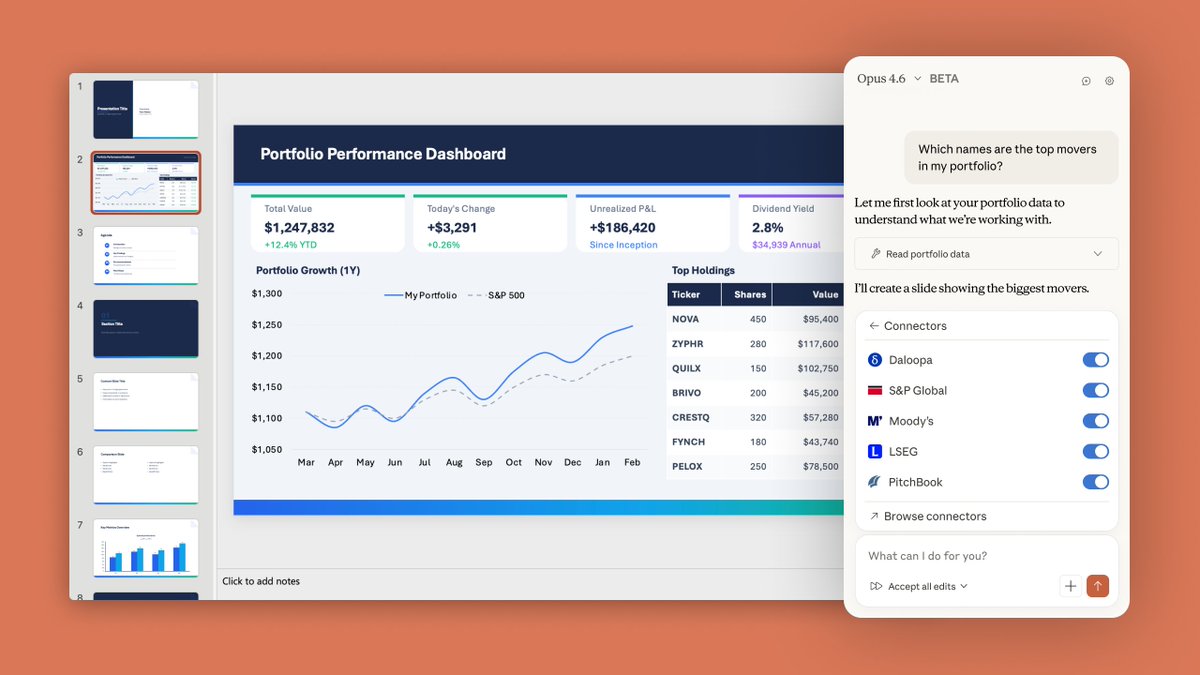
A good demo of Claude in Powerpoint: > upload an Excel investment watchlist > auto-generate a first draft slide deck > ask Claude to make it in “Mckinsey” style Still needs some work but cleary saves hours of work.

English
2
19
330
66.2K
Claude
Claude@claudeai·
Claude in PowerPoint is now available on the Pro plan. It also now supports connectors, bringing context from your daily tools directly into your slides. Try it here: claude.com/claude-in-poweâ€Ķ
Claude tweet media
English
279
829
9.6K
4.2M
Mo Akif ðŸĶ†
Mo Akif ðŸĶ†@ChiefMoAkif·
@joulee This is precisely what improving heart rate variability lets you do: switch from parasympathetic to sympathetic states and vice versa efficiently. The biggest factors to improve it are: sleep quality (esp low resting heartrate before bed), zone 2 cardio, & vo2max training (HIIT).
English
0
0
1
151
Julie Zhuo
Julie Zhuo@joulee·
One of the skills I am most in awe of: the ability to transition quickly between periods of intensity and relaxation. It’s great for me to be intense and in “get shit done” mode during most of the work day. But when I come home, I notice I sometime bring this “hard edge” back which is not how I want to be with my family. This mindset also makes me worse at the empathetic, people side of leading. Was talking with a friend lamenting how it often takes a few days to “get into” vacation mode for this reason. And then by the time you’re fully relaxed, now it’s hard to ramp back up into intensity. I really wanna learn how to get better at the fast transition. Working on breathing / nsdr / short meditations. Any other tips?
English
29
7
178
18.9K
Mo Akif ðŸĶ† āļĢāļĩāļ—āļ§āļĩāļ•āđāļĨāđ‰āļ§
Livid
Livid@lividvideo·
If you’re a Vimeo user, this video could save you thousands of $$$$$ livid.com #ditchvimeo #getlivid
English
1
6
13
517
Mo Akif ðŸĶ†
Mo Akif ðŸĶ†@ChiefMoAkif·
@PaulSolt @awilkinson @fak500 The running is an interesting one--Andrew mentioned that ADHD might have been advantageous for the hunter archetype pre-civilization. Maybe the regular persistence hunting they did naturally regulated their neurotype, helping them function optimally.
English
0
0
0
45
Paul Solt
Paul Solt@PaulSolt·
Thanks for sharing! I may be undiagnosed and I’m ok with that. Meditation, running, and cold showers help me reduce monkey mind. I really enjoyed your book and I’m going to listen to it again after I finish Poor Charlie’s Almanac again. I appreciate all the advice and thoughts behind your decision making.
English
1
0
1
198
Andrew Wilkinson
Andrew Wilkinson@awilkinson·
I recently got diagnosed with a brain disorder. On average, it shortens life expectancy by 7–9 years. If you're an entrepreneur, there's a high likelihood that you might have it too. Here's what I discoveredâ€Ķ ðŸ§ĩ "Your working memory is in the twentieth percentile," the neurologist told me, studying her charts from the battery of cognitive tests that my doctor had requested. I have APOE4, the Alzheimer's risk gene, and he felt it was important to track my memory over time. My palms started tingling. Was this how it started? Today, you're forgetting where you put your keys, tomorrow you're forgetting your own name and shuffling around in a hospital gown. "But your crystallized intelligence," she continued, "is solid." I felt my guts relax. "That's good, right?" She explained, "If your brain were a computer, working memory would be its RAM. It temporarily holds and processes information, like remembering a phone number long enough to dial it or doing mental math. Yours is way below average—imagine trying to juggle while holding only two balls when most people can handle four." "On the other hand," she went on, "your crystallized intelligence is like your mental library—everything you've learned, the skills, facts, and experiences you've accumulated. That part of your brain is above average." Her assessment rang true. I could barely remember a simple grocery list without spacing. "You might want to get tested for ADHD," she suggested. "Poor working memory is often indicative of some form of ADHD." I left the appointment feeling unsettled. Something about it didn't sit right—there was no way I had ADHD. I had always struggled with anxiety, but I'd never struggled with focus. I'd noticed the endless stream of TikTok videos and social media posts about adult ADHD diagnoses and rolled my eyes. It had become the explanation for everything—another mental health meme where everyone thought they had the disorder. I'd always been proud of my ability to power through work, tick off to-do lists, and juggle multiple projects. If anything, I saw myself as productive and organized—traits that seemed at odds with having ADHD. I had dismissed it as overhyped. A diagnosis given out too freely, especially in regards to the growing number of kids being prescribed amphetamine drugs. While I was skeptical, I spent the next afternoon deep-diving into ADHD. As I read, my skepticism began to evaporate and I started to feel like an asshole... The first thing that struck me was how quantifiable it was. I learned that scientists can literally see a difference in the brains of people with ADHD on MRI scans and that ADHD brains even grow more slowly. Reaching their peak thickness three years later than their peers in regions controlling attention and motor planning. Three years. That's the difference between starting high school and getting your driver's license. I couldn't deny it anymore—ADHD was as real as any other medical condition. I was reminded of how my parents' generation had scoffed at the idea of "anxiety" and "depression" and their fears that everyone was popping Prozac to avoid dealing with the reality of life. Was this just the modern equivalent? Was I, just like 90’s boomers, a mental health bigot? As I dug deeper, I discovered that ADHD isn't just visible in brain structure—it's fundamentally written into our genetics. According to a study in Nature Genetics, ADHD is up to 88% heritable (even more than height!), making it one of the most inherited psychiatric conditions out there. If you have it, there's a near certainty that one of your parents does too. Reading this, my thoughts turned to my father: his constant forgetfulness, his impulsive purchases, his encyclopedic knowledge of random topics paired with an uncanny ability to tune out or forget whatever everyone else deemed important. I wondered if he might have ADHD too. For years, I'd treated what I thought was just anxiety with an SSRI (vortioxetine), and while it helped a ton, that frantic, life-on-fire feeling of being overwhelmed had never really gone away. Studies show why: up to 50% of adults with ADHD also have anxiety disorders, suggesting what I thought was just anxiety might have been masking a deeper neurological difference. I was shocked to learn that ADHD's downsides extended far beyond distraction. Untreated, it has profound effects on those who have it, to the point where it can shorten their lives by almost a decade. A 2015 Lancet study found that people with untreated ADHD die, on average, 9.5 years earlier than their peers. Not from the condition itself, but from its cascade of negative effects: accidents, impulsive decisions, and self-medication. Research shows adults with ADHD are also five times more likely to develop substance use disorders, with up to 25% struggling with drug or alcohol addiction. Suddenly, my five nights per week of partying and binge drinking throughout my twenties made a lot more sense—the only way I could relax during the stressful ramp-up of my businesses. Self-medication. I also thought of the rampant drug and alcohol abuse in my extended family. Sure, this wasn’t a blanket explanation, but if what I was reading was true, there were likely a few family members who had untreated ADHD and had instead turned to drugs and alcohol, destroying their lives in the process. Yet there's hope: studies show that stimulant medication works in 70–80% of cases, making it one of the most effective psychiatric treatments across any illness. A Swedish study of over 38,000 individuals with ADHD found that stimulant medication reduced substance abuse rates by 31% compared to those not taking medication. The protective effect was even stronger in younger patients, with those 15 and under showing a 62% lower rate of substance abuse. Fortunately, many patients who start taking stimulants as children respond so well they eventually stop needing medication by adulthood—the medication potentially rewiring their brains. My concerns about treating children disappeared. This now seemed like a critical intervention. But here's where the story takes an unexpected turn. It’s not all bad news—in fact, in many ways, ADHD can be a gift. While ADHD can be challenging in traditional settings, these same traits can become surprising advantages in the right context. A recent study found that 27% of entrepreneurs have ADHD traits—three times the rate in the general population. This includes some of the most successful business leaders: Richard Branson has been open about his ADHD diagnosis, crediting it for his creative thinking and risk-taking ability. JetBlue founder David Neeleman has described how ADHD helped him see opportunities others missed, while IKEA founder Ingvar Kamprad used his ADHD traits to build one of the world's largest furniture companies. It makes a lot of sense. The very traits that make traditional jobs challenging become superpowers in entrepreneurship: a tendency to see the big picture while delegating details, the ability to hyperfocus intensely on whatever interests us, a knack for building systems to compensate for our weaknesses. Even our social tendencies—the constant need to connect, share, and build relationships—create powerful networks that drive business success. The entrepreneurial world, with its constant change and need for adaptability, seems almost perfectly designed for minds that thrive on novelty and creative problem-solving. ADHD may represent an evolutionary advantage that's mismatched with modern life. Some researchers propose these traits helped our ancestors excel at hunting—where heightened awareness of movement, quick reactions, and constant environmental scanning were crucial survival skills. As Thom Hartmann puts it: "The hunter is easily distracted by movement and sound—traits that make them exceptional at tracking prey but challenging in today's structured environments." This perspective helps explain why ADHD traits correlate with entrepreneurial success. Both hunting and building businesses reward adaptability, quick pattern recognition, and comfort with uncertainty. It's as if the business world had accidentally created the perfect environment for minds that don't fit the conventional mold. Suddenly, my own career path made a different kind of sense. As I read all this, it was like watching dominoes fall in slow motion—each symptom clicking into place, each pattern revealing itself with almost painful clarity. I realized the intricate web of systems I'd built wasn't just about being organized—it was a coping mechanism. I'd become obsessed with David Allen's Getting Things Done productivity system, spending hours maintaining its complex organization system. My phone was filled with thousands of Siri reminders shouted while driving, desperately trying to capture the stream of urgent thoughts racing through my brain before they vanished like smoke. I needed these systems because without them, important tasks would slip through the cracks of my unreliable working memory. Every notification, every color-coded calendar entry, every obsessively maintained checklist was compensation for what my brain couldn't do naturally. Reading about how ADHD plays out in romantic relationships and family life, I recognized myself. Someone who would drift off during intimate conversations with my partner, yet could spend hours intensely focused on unrelated projects. Forgetting commitments and neglecting agreed upon chores. I felt that I was a loving and supportive partner in many ways, but these seemingly basic aspects of home life felt inexplicably challenging. These challenges weren't limited to relationships. My work life prior to starting my company was equally difficult. I couldn't stick to the same routine tasks day in and day out and frequently jumped from job to job, impulsively quitting and moving on, sometimes without notice because I couldn't bear the idea of showing up to work another day. So in 2006, driven more by desperation than inspiration, I started my first business. Over the next five years, I impulsively launched ten separate companies, attempting to be the CEO of all of them at once. As you can imagine, this failed spectacularly. It wasn't until 2014 that I finally found my groove: buying great companies and hiring wonderful CEOs (who don't have ADHD) to run them. My inability to handle details didn't leave me any choice but to embrace delegation. While many entrepreneurs struggled to let go of tasks, I had the luxury of being absolutely terrible at them from the start. My habit of getting obsessed with random parts of the business meant I'd go super deep on M&A for a few weeks, suddenly get bored, then jump to product, then marketing—basically whatever shiny object caught my attention that week. This scattered approach somehow worked in my favor—being an inch deep and a mile wide on every part of the business turned out to be exactly what a CEO needed to be. Then there was my insatiable need to meet new people and socialize—often the most immediately rewarding part of my day, a reliable hit of dopamine. I'd strike up conversations with anyone, everywhere. Not so much networking as a complete failure to hold my cards close to my chest. This chronic oversharing somehow worked in my favor. When problems came up, I usually knew someone who could help. Within a matter of weeks, I had booked a formal diagnosis, and a month later, my neurologist's suspicions were confirmed: I had inattentive ADHD. They recommended a stimulant, and one day I buckled up and took Vyvanse. It was transformative in a way I never expected. The most surprising thing was the quiet. My brain previously felt like Times Square at New Year's, hundreds of thoughts competing for attention at once. On Vyvanse, it was more like a library. One thought at a time, each one getting its proper attention before moving to the next. Imagine living your whole life with a radio playing static in your head, and then someone finally shows you where the 'off' switch is. That feeling of being overwhelmed by midday, like hitting an invisible cognitive wall—vanished. Since I started treatment, for the first time in my life, I feel calm, focused, and present. I'm sharing all this because for years, I felt kind of broken. Like I was constantly letting everyone down. Sure, I'd found ways to cope—building a business where I could delegate all the things I was terrible at, engineering a scaffolding of to-do lists and reminders, and surrounding myself with amazing people who could handle what I couldn't. But that strategy falls apart in your personal life. You can't delegate being a dad, or a partner, or a friend. Those relationships require consistency, attention to detail, being present—exactly the things ADHD makes so challenging. The impact on family life has also been notable. Before, by dinner time, my mental energy would be completely depleted. I'd be there physically, but mentally checked out, running on empty after a day of trying to keep it all together. Now I can follow a bedtime story without my mind wandering off to work emails, or sit through a family dinner without yawning or zoning out. The day I first took medication, all I kept thinking was that I wish I'd been taking this my whole life, or at the very least, before my kids were born. All this is to say, getting diagnosed has been transformative for me. Like discovering the long-lost manual to my brain and realizing I've been using it wrong this whole time. I wanted to share in hopes that someone like me—who's struggling but has never thought about ADHD—might read this, see themselves in it, and seek treatment themselves. If you're reading this and any of it sounds familiar, I'd recommend checking out The ADHD Effect on Marriage by Melissa Orlov and Dr. Russell Barkley's excellent book, Taking Charge of Adult ADHD. Both were super helpful in figuring this out. And if you're listening to some of this and nodding along, thinking you might have it too, you could try prompting ChatGPT with this prompt to suss it out: Act as a clinician conducting a pre-assessment for ADHD. Ask me structured, clinically relevant questions to explore my symptoms, history, and their impact on my life. Cover: core symptoms (inattention, hyperactivity, impulsivity), their effect on daily life (work, relationships, self-care), medical and family history, lifestyle factors (sleep, diet, stress), coping strategies, and how long symptoms have persisted. Summarize my responses into a professional document I can share with a clinician. You should also watch the excellent YouTube video on diagnosis by Russel Barklay, which I link in the thread below. Of course, ChatGPT can't diagnose you, but it can give you a sense if maybe it's something to look into. There are tons of telehealth pill-mills that ask you ten questions then rubber stamp you a lifetime prescription of stimulants—you should avoid those. I think it's worth doing a full assessment, which is a multi-hour process that includes qualitative and quantitative testing. I got diagnosed at Resilient Health in Victoria and was impressed by how thorough they were. The assessment wasn't some quick DSM checklist. It was a comprehensive process involving interviews with me, as well as Zoe and my family, coupled with extensive attention and memory tests. It took about six hours altogether, and at the end I had a detailed document explaining both my ADHD diagnosis and my overall psychological profile. And if you're curious about brain health in general—something almost nobody seems to assess outside of my extreme health nerd friends—the neurologist who identified this for me was Dr. Kellyann Niotis. She's amazing, and I highly recommend checking her out, ADHD or not. Do you have ADHD too? I'm keen to hear your thoughts and experiences. I’m only a few months into navigating this, so I have much to learn :-) I've posted a list of links to the various studies, podcasts, YouTube videos, and books I've found helpful in the thread below 👇
English
181
51
939
214.1K
Cimmerian Pervert
Cimmerian Pervert@cimmerian_v·
HR immediately before firing 50% of engineering
Cimmerian Pervert tweet media
English
388
2.4K
71.7K
8M
Mo Akif ðŸĶ† āļĢāļĩāļ—āļ§āļĩāļ•āđāļĨāđ‰āļ§
Avichal - Electric ϟ Capital
Ironic that we got free AI from a hedge fund and $200/month AI from a nonprofit.
English
646
5.3K
46.3K
2M