Jakob 🪵

784 posts

Jakob 🪵 banner
Jakob 🪵

Jakob 🪵

@DerScheinriese

in the open source faction of the productivity industrial complex

localhost เข้าร่วม Haziran 2013
3.1K กำลังติดตาม761 ผู้ติดตาม
Jakob 🪵 รีทวีตแล้ว
Daniel Beauchamp
Daniel Beauchamp@pushmatrix·
Huh, so that's why text is called a string
English
425
1.6K
20.7K
1.1M
Jakob 🪵 รีทวีตแล้ว
Jakob 🪵 รีทวีตแล้ว
Karri Saarinen
Karri Saarinen@karrisaarinen·
@thenanyu Failure modes: 1. Design by pm (business) 2. Design by engineer (function) 3. Design by designer (visual)
Karri Saarinen tweet mediaKarri Saarinen tweet mediaKarri Saarinen tweet media
English
1
2
5
462
Jakob 🪵
Jakob 🪵@DerScheinriese·
@charlieholtz Why is the number of chats per workspace limited to 5?
English
0
0
0
23
Charlie Holtz
Charlie Holtz@charlieholtz·
My Conductor workflow: - new workspace (⌘N) for every bug/feature - spin up the dev server to test (add a run script so ⌘R runs server for you) - if all looks good, create PR (⌘⇧P) - kick off a review (⌘⇧R), look at diffs + leave comments - merge, then archive (⌘⇧A) - start again!
English
31
5
200
13.4K
Jakob 🪵
Jakob 🪵@DerScheinriese·
@JPEGuin Could the lifetime also be lowered a bit? That‘s what‘s been stopping me from committing yet.
English
1
0
1
110
Shihab Mehboob
Shihab Mehboob@JPEGuin·
Binge now has: - Drastically more features (comprehensive and substantial daily updates) - Considerably lower price tag (halved the monthly sub, and reduced the yearly one too, making it cheaper than other similar apps which actually have less features) - Better animations and improved UI (so you actually enjoy using the app) What's stopping you from trying it out?
Shihab Mehboob@JPEGuin

Introducing Binge 🍿 I have always wanted to make a movie/show tracker app. I love movies. I love watching them, logging them, consuming them, everything to do with them. So I made my own. Available today for free on the App Store: apps.apple.com/us/app/binge-m…


English
15
1
64
12.1K
Jakob 🪵
Jakob 🪵@DerScheinriese·
@stephenhaney @wesbos @paper afaik it doesn‘t have components, good pen tool etc… those are things I would need as professional for switching from Figma, if I’m not in "design for me" mode. Ideating on UI approaches via the MCP is a great first start tho.
English
1
0
1
145
Stephen Haney
Stephen Haney@stephenhaney·
@wesbos @paper Thanks Wes! We are definitely more about augmenting the professional than “design for me”, tho we do add some instructions to help the agents with contrast and spacing. Shoot me ideas or feedback any time. We’re just getting started.
English
4
0
21
2.5K
Wes Bos
Wes Bos@wesbos·
Tried out @paper - It's like Figma. It has an MCP so you can connect it to an Agent and it can both push and pull design details and data in/out of it. Makes a ton of sense when your design app can pull real data from your database, or act on a ticket. It seems like it's built with HTML/CSS, so the heavy use of flex/grid to align stuff makes it easier to implement a design for the web. For some reason I thought it had some secret sauce that made your designs good though. You still need talent for that
English
36
16
621
63.9K
Jakob 🪵 รีทวีตแล้ว
Joseph Viviano
Joseph Viviano@josephdviviano·
@rolypolyistaken I HAVE NO MOUTH AND I MUST CHAT
English
6
8
464
35.4K
Jakob 🪵 รีทวีตแล้ว
Benji Taylor
Benji Taylor@benjitaylor·
It’s never been easier to build both great and awful software
English
38
70
828
77.3K
Jakob 🪵 รีทวีตแล้ว
AluanWang
AluanWang@IOivm·
InkField | 墨域 is about to be released. From the first version, both humans and bots will be able to create on it together. In a way, the system reflects the time we live in. Humans and machines are already living in a kind of symbiosis. I’m generally an optimistic person. But I have to admit, 2026 feels a little heavy right now. Maybe the work will reflect that. Maybe it won’t. Either way, wishing everyone well. I still believe the dawn is coming.
English
27
198
2.2K
110.3K
Jakob 🪵
Jakob 🪵@DerScheinriese·
@Wattenberger I really like the "ask me 50 questions" approach that i saw @geoffreylitt describe recently: x.com/geoffreylitt/s… Starting broad (problem, audience, feel) … then getting more and more specific (interactions, edge cases, constraints). Finally writing a spec with this info.
Geoffrey Litt@geoffreylitt

Prototyping UIs has always been a good fit for vibe coding, because code quality matters less than when shipping to prod. But with the latest models, things have gotten kinda ridiculous… Opus 4.6 Fast can ask me 50 interview questions about a spec in rapid succession. That process reaches such clarity that it can then one-shot a big feature roughly aligned with the vision in my head, at an adequate quality level to feel out the concept and share the idea. Further iterations happen in seconds. Sometimes the integration tests for thousands of LOC pass on the first try which makes me chuckle—that’s not human level performance! In the past few days I’ve made two prototypes in a large codebase at work. Each one took a few hours from the initial seed of the idea to working demo, in total flow the entire time. I predict they would have taken days without AI (partially due to my unfamiliarity with the large codebase). In fact, without AI I would have chosen a different medium at this early stage. With modern tools, I find prototyping in prod code is often the fastest way for me to feel something out. Surprisingly the upfront interview is one of the most valuable parts — it feels amazing to have design decisions and judgment pulled out of me, without needing to stumble into the questions as I build; it feels like having a super sharp dev at the project kickoff. The faster model also promotes single-tasking focus which I love. For creative prototyping work (where figuring out what to build is the goal), I’m not a big fan of slow models and parallel multitasking; flow matters. Overall, production engineering has a ways to go with LLMs, but it feels like this problem of “UI prototyping assistance” is close to solved. The main bottleneck is my own decision making and judgment. While my main feeling is one of tremendous excitement and relief that I can validate the ideas in my head so quickly now, I do always worry a bit about the unintended consequences of such dramatic process change. Prototyping is a delicate art of working with a material and having reactions to it. There are no shortcuts; spending time is necessary to have good ideas. So I’m trying to keep an eye on that: what are the moments in my personal prototyping process that matter and must be preserved, and what are the parts that can be fast-forwarded? Tentatively things feel OK to me—using the draft UI and reacting to it is where the magic happens, I think, and the faster I can iterate on that UI the faster I can build intuition, without getting stuck in the mud of broken code. But it’s hard to know for sure, and as things speed up further I expect I may need to add more speed bumps to the process to ensure the same level of depth.


English
0
1
2
442
Jakob 🪵 รีทวีตแล้ว
kasey
kasey@kaseyklimes·
i’ve taught design students for over a decade, but last night was the first time I’ve spent time in the classroom since the wide adoption of claude code, etc. the distance between idea and reality has completely collapsed, which puts the new bottleneck in stark relief: clarity of thought. it used to be that weak thinking could be obscured by impressive execution, while strong thinking could get lost in poor execution. now, the execution is so universally impressive that it recedes into the background to reveal the thinking: what problem are you solving? for who? how do you know it’s a real problem? how do you know that your solution addresses it—not just in theory but in the real world? can you explain your idea clearly? this is *incredibly* hard, but it’s exciting that students can now focus on it without worrying about pixels and syntax. I think it’s a huge opportunity for design education to meet the moment, should it so choose.
English
19
34
385
38.2K
Jakob 🪵 รีทวีตแล้ว
Mitchell Hashimoto
Mitchell Hashimoto@mitchellh·
The lack of "feature design" is why so many products over time feel hollow or messy. This isn't visual design. This isn't architectural design. I thought that a short video lecture of what feature design is and a real case study of applying it in Ghostty would be helpful. Feature design is the planning step behind how you're going to solve one or more user problems with a product feature: what that feature looks like, how it feels, and not just how its going to tactically solve these specific problems, but how that solution is going to interface with the edges of other features that currently exist or are planned to exist in the future.
English
56
194
2.3K
154.4K
Jakob 🪵 รีทวีตแล้ว
AluanWang
AluanWang@IOivm·
墨域 InkField
日本語
3
35
441
12.2K
Jakob 🪵 รีทวีตแล้ว
kyle turman
kyle turman@kyleturman·
@joshpuckett I love the idea of having 2 ally claude’s trying to help you and 1 enemy claude trying to defeat you
English
7
5
219
8.2K
Jakob 🪵
Jakob 🪵@DerScheinriese·
@JPEGuin Where do the reviews come from? How can I write my own? Would be nice if I wouldn‘t have to click on each review individually but instead consume a list of multiple reviews at once.
English
1
0
0
261
Jakob 🪵 รีทวีตแล้ว
Ryo Lu
Ryo Lu@ryolu_·
folding concepts, not removing them: most products keep adding features horizontally – new tabs, new tools, new "things" – because it feels safer than consolidating. but that's how you get bloated interfaces nobody can navigate. the better way: fold concepts that should've been the same all along. when you merge "issues" and "bugs" into "database with status property", you're not taking anything away. you're revealing the truth that was always there. the trick is layers. people start with simple, familiar concepts. as they go deeper, they discover the power underneath. they're never overwhelmed because they only see what they're ready for. the hard part is the transitions. people who loved the old "bugs" tab feel like you took their thing away, even though it's still there and more powerful. you need to guide them through the folds gently. this is why single-purpose apps can't evolve. their whole identity is "we only do X". but reality is messy. concepts and roles start to blend. the future belongs to systems like Cursor and Notion that are infinitely malleable, so it could fold and unfold to match how you actually think.
English
26
29
660
39.7K
Jakob 🪵
Jakob 🪵@DerScheinriese·
@tiensonqin yeehaww! 🤠 excited to test the new mobile UI soon ^-^
English
0
0
2
394
Jakob 🪵 รีทวีตแล้ว
Tienson Qin
Tienson Qin@tiensonqin·
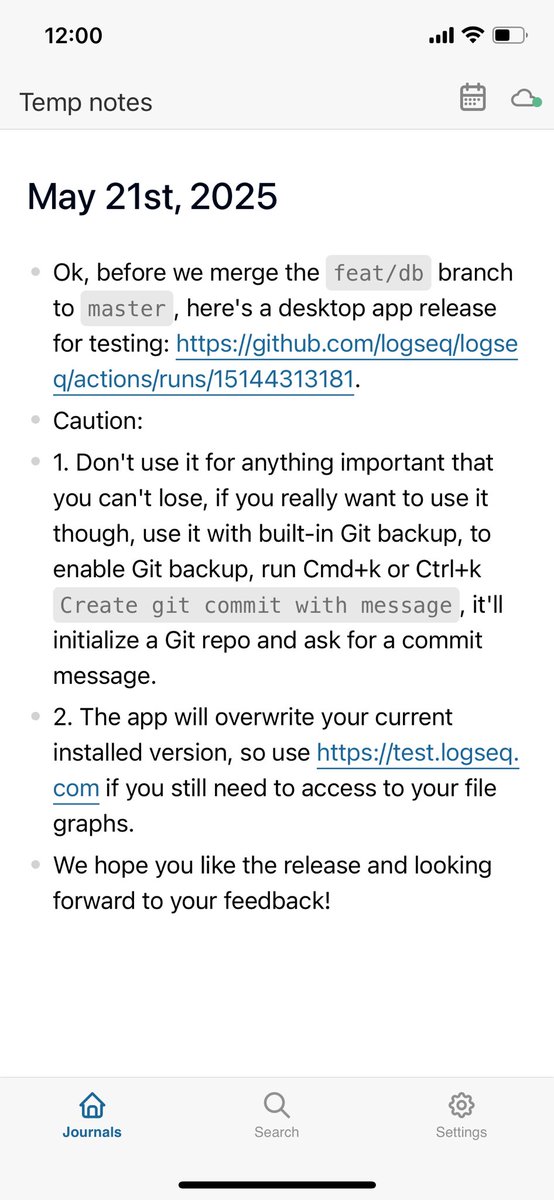
Hey
Tienson Qin tweet media
7
5
62
5.7K
Jakob 🪵
Jakob 🪵@DerScheinriese·
@vibester @ednico_ @logseq @tiensonqin Sure, that‘s one way to see it. All tools for thought have competing visions for the future of knowledge work, and not every vision will resonate with you. I was trying to explain to you that we’re primarily motivated to build RTC for our own needs.
English
0
0
1
78