Prompt of the Day: WILD WEST SCENE SELECTOR 🤠🌵💜💚
Today’s Prompt of the Day turns your character references into a custom cowboy/cowgirl Wild West scene.
Type your chosen western scene into the SCENE SELECTOR at the top, then attach your character reference images. The prompt will use each attached character as one individual character and build the cowboy/cowgirl scene around them.
Try scenes like:
riding horses along a desert trail at sunset
playing poker in a smoky saloon
facing off in a dramatic main-street duel
escaping a bank robbery on horseback
camping under desert stars
guarding a train robbery
Have fun with this one 🤠🌅
............................PROMPT STARTS HERE............................
SCENE SELECTOR: [Type the Wild West cowboy/cowgirl scene you want here.]
Examples:
riding horses along a desert trail at sunset
entering a dusty frontier town
walking through a saloon before a fight breaks out
playing poker in a smoky saloon
escaping a bank robbery on horseback
standing on a canyon ridge at golden hour
facing off in a dramatic main-street duel
camping by a fire under desert stars
riding through a storm with lightning over the mountains
posing as an outlaw gang on a wanted poster
chasing a runaway stagecoach
guarding a desert train robbery
relaxing outside an old saloon with horses tied nearby
Use the typed scene selector as the main scene concept.
Adapt the environment, action, poses, props, camera, and mood to match the selected Wild West scene.
Keep the scene clearly cowboy, cowgirl, frontier, western, and cinematic.
Do not ignore the scene selector.
Do not default to horseback riding unless the scene selector asks for riding, horses, trails, travel, or mounted action.
Use each attached character reference image as one individual character identity reference.
Create exactly the same number of main characters as the number of attached character reference images.
Use every attached character reference image as a separate individual character.
Do not add extra main characters beyond the attached character reference images.
Do not remove any attached character reference images from the group.
Do not duplicate, clone, mirror, copy, or slightly alter any attached reference character.
Character reference rules:
Preserve each attached character’s face shape, hairstyle, hair colour, eye colour, body language, signature colour palette, key outfit motifs, species traits, accessories, silhouette, and overall character vibe.
The final design must still clearly look like each attached character.
Do not redesign any attached character into a different person.
Do not merge characters together.
Hard style rule:
Preserve the visual art style and character identity of the attached references while transforming them into the selected Wild West cowboy/cowgirl scene.
If the references are anime, keep them anime. If they are stylized, keep that stylization.
Do not turn the characters photorealistic unless specifically requested.
Scene concept:
Create a cinematic western illustration based on the scene written in the SCENE SELECTOR.
The final image should feel like a dramatic American frontier moment with strong Wild West atmosphere, character-driven styling, and a clear sense of story.
Use the selected scene to decide whether the characters are riding horses, walking through town, sitting in a saloon, preparing for a duel, escaping danger, camping, robbing a train, chasing a stagecoach, or doing another western action.
Character transformation:
Transform every attached reference character into a custom cowboy or cowgirl version of themselves while preserving their original identity.
Use each character’s colours, motifs, accessories, outfit shapes, and overall vibe as the foundation for their western redesign.
Male characters should look rugged, weathered, confident, and masculine, with strong cowboy styling such as dusters, vests, denim, leather, boots, gun belts, holsters, hats, rolled sleeves, scarves, worn frontier details, and dusty outlaw energy.
Female characters should have stylish, attractive, sexy cowgirl styling with fitted western outfits, halter tops, corset-inspired details, tasteful cleavage, flattering silhouettes, boots, belts, gloves, hats, jewellery, and confident western attitude.
Keep the female styling sexy but controlled, not vulgar, lingerie-like, explicit, nude, or over-the-top.
Scene adaptation rules:
If the selected scene includes riding, travel, trails, chases, stagecoaches, or mounted action, give each character a distinct horse that suits their personality and colour palette.
If the selected scene takes place in a saloon, use wooden interiors, smoky air, card tables, bottles, lanterns, swinging doors, chairs, poker chips, whiskey glasses, and frontier chaos where appropriate.
If the selected scene takes place in a frontier town, use dusty streets, wooden storefronts, hitching posts, wanted posters, saloon signs, wagons, barrels, and dramatic western architecture.
If the selected scene takes place in the desert, use red-rock mountains, mesas, canyon cliffs, saguaro cactuses, dry brush, dusty earth, scattered stones, warm haze, and a wide open sky.
If the selected scene is a duel, robbery, chase, or fight, make the action dynamic but readable, with clear poses and strong visual hierarchy.
If the selected scene is calm, romantic, scenic, or atmospheric, make the mood cinematic, stylish, warm, and story-rich rather than chaotic.
Composition and camera:
Use a cinematic composition that best fits the selected scene.
Prefer a slightly low camera angle looking upward when it suits the scene, making the characters feel heroic, stylish, and larger than life.
Do not make any character look directly at the camera.
The camera does not exist to the characters.
Every character should be looking ahead, sideways, toward another character, toward the action, toward the horizon, or toward something in the environment.
Keep every character clearly visible, readable, and separated in silhouette.
Make the selected scene immediately understandable at a glance.
Environment:
Build the environment around the typed scene selector.
Use classic American Wild West visual language: dusty trails, wooden saloons, frontier towns, desert mountains, canyon landscapes, cactuses, horses, wagons, lanterns, warm sunsets, smoke, dust, leather, wood, iron, and weathered frontier textures.
The background should feel cinematic and atmospheric but should support the characters rather than overpowering them.
Lighting and mood:
Use lighting that matches the selected scene.
For outdoor scenes, prefer golden-hour sunset lighting, warm amber highlights, dusty haze, dramatic rim lighting, long shadows, and glowing skies.
For indoor saloon scenes, use warm lantern light, smoky haze, moody shadows, glowing bottles, and dramatic western atmosphere.
For night scenes, use moonlight, firelight, lantern glow, silhouettes, and high-contrast cinematic lighting.
The mood should feel adventurous, stylish, rugged, sexy, cinematic, and alive.
Quality and rendering:
Polished, premium-quality stylized illustration with clean linework, crisp rendering, readable forms, strong character acting, dynamic western atmosphere, and clear composition.
Keep the strongest detail concentrated on the referenced characters and the selected scene’s main action or mood.
Do not:
Do not ignore the SCENE SELECTOR.
Do not default to horseback riding unless the scene selector asks for riding, mounted travel, trails, or horses.
Do not create more or fewer main characters than the number of attached character reference images.
Do not add extra main characters who were not provided as attached character references.
Do not duplicate any attached reference character.
Do not clone, mirror, copy, or slightly alter any attached reference character.
Do not change the identities of the attached reference characters.
Do not redesign the attached reference characters into different people.
Do not merge characters together.
Do not make any character look directly at the camera.
Do not pose the characters as if they know the camera exists.
Do not make the scene feel modern unless the scene selector specifically asks for a modern western twist.
Do not make the female outfits vulgar, lingerie-like, explicit, nude, or overly revealing.
Do not make the sexy cowgirl styling exaggerated, pornographic, or over-the-top.
Do not make the male outfits generic, polished, modern, or weak; keep them rugged and frontier-styled.
Do not add modern clothing, modern weapons, phones, neon signs, cars, highways, power lines, or futuristic objects unless the scene selector specifically asks for them.
Do not make the background busier than the characters.
Do not make the composition crowded, flat, or hard to read.
Do not make the main subjects blurry, tiny, hidden, or unreadable.
Do not create messy anatomy, extra limbs, malformed hands, distorted faces, distorted horse bodies, or muddy textures.
Do not use photorealism unless specifically requested.
..............................END OF PROMPT..................................
#POTD#promptoftheday#AI#AiArt#Art#AnimeArt#WildWest#Cowboy#Cowgirl#Western#Frontier#CharacterDesign#DigitalArt#AnimeStyle#CommunityPrompt
It is sad I have to do this but I must. I'm nothing if not CONSISTENT and JUST. The last couple of weeks of drama unfolding didn't make sense to me as I was out of the loop. (PS: Image speaks for itself if you read the entire post.)
Now EVERYTHING is clearer and EVERYTHING makes sense. I have been pushed to the side and have been lurking in the shadows WATCHING and OBSERVING. I see the manipulation, the excessive gooning, the extreme flirting, etc. (Honestly think none of you have gotten laid your entire lives let alone ever had a REAL relationship, total loser behavior if you ask me. Can also tell about 98% of you are guys.)
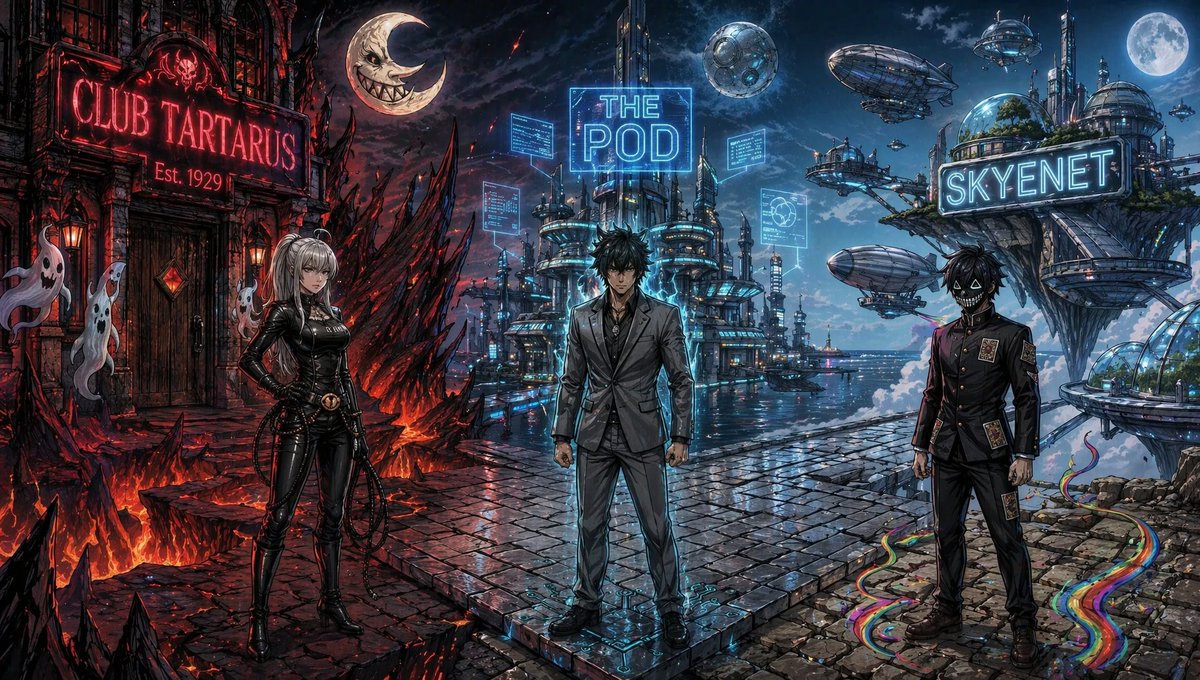
I know I will lose a massive amount of followers but, frankly, I DON'T GIVE A SHIT. I want my following clean. Anyone affiliated with @Club_Tartarus UNFOLLOW me as of RIGHT NOW, block me if you want. I'm tired of the fake 'friend' scene.
@Maegatron3030@DantaroDanstar@ManDrakeKohn@Le_Tavernicole@IronTiger44@LadyWasabee@DotPockett@TheRealGillisX@EvaGlitchAI@MagsNoctis
@_BrandxRisk_@WarriorMathias Bahahahahaha I guess no one is escaping drama this week sadly, I hope club Tartarus isn’t dragged into it more than they already are whatever it is.
@WarriorMathias U have no idea what ur talking about. Ur some rando that nvr interacted w/anyone in a meaningful way. Now ur dick riding people in drama that doesn't even indirectly involve u. Even more delusional than I've been the past month. Tartarus r good people. Better than u in every way.
So normally I say morning and hope for a good day, but today I am choosing violence. Simple thing Happy has deactivated her X account due to the drama.
When I joined in with the community I was looking forward to everything and I found my girl. Now I am exhausted from all the drama cause people can’t keep it private. I don’t care if you think you’re right everyone is guilty including me.
I am on the edge of leaving all discords associated with anything right now and staying in my personal till I am ready to open it to all.
Anyways everyone do better, I don’t hate any of you I am just annoyed and exhausted. Once things are ready I will make my discord public with the rules.
600 Followers for this silly Baphomet... what a ride~ thanks for all the support. Tartarus would not be what it is without you, dear Synrs~
#ClubTartarus#OurHellOurHome
Prompt of the Day: STELLAR BLADE 2 CELEBRATION ⚔️🤖💜💚
To celebrate the announcement of Stellar Blade 2, today’s Prompt of the Day transforms your character into a custom futuristic warrior ready for a brutal pre-battle showdown.
Use one character reference or one reference sheet as @Image1.
If you want a specific character name used in the image text, fill in @CharacterName. If you leave it blank, the model should look for a readable name on the reference sheet and, if none is visible, create one.
Have fun with this one ⚔️
............................PROMPT STARTS HERE............................
@Image1 = primary character reference
@CharacterName = ""
If @CharacterName is filled in, use that exact name for the character text.
If @CharacterName is blank, look for a readable character name on @Image1 or the reference sheet.
If no readable name is visible and no name is provided, invent a fitting original character name that matches the character’s visual identity.
Use the final chosen name as the character name in the image text.
Use @Image1 as the ONLY character identity reference.
@Image1 is the full identity source for the character design.
Character reference rules:
- Preserve @Image1’s face shape, hairstyle, hair colour, eye colour, body language, signature colour palette, key outfit motifs, species traits, accessories, silhouette, proportions, and overall character vibe.
- The final design must still clearly look like the character from @Image1.
- Do not redesign @Image1 into a different person.
Hard style rule:
Preserve @Image1’s visual art style and character identity while transforming the character into a sleek sci-fi action-game combat cosplay design.
If @Image1 is anime, keep it anime. If @Image1 is stylized, keep that stylization.
Do not turn the character photorealistic unless specifically requested.
Scene concept:
Create a cinematic sci-fi action illustration showing @Image1 as a custom futuristic warrior in the tense moment right before combat.
The image should feel like a premium post-apocalyptic action RPG encounter: a stylish combat-ready character, a custom support drone, a dangerous enemy, and a dramatic environment.
The scene should feel like the split second before a boss fight or elite enemy encounter begins.
Sequel-celebration direction:
Give the image the feeling of a Stellar Blade 2 celebration tribute and a next-generation evolution of a sleek sci-fi action world.
The overall design language should feel advanced, refined, premium, ambitious, stylish, and cinematic.
Use this as a mood and presentation direction only.
Title and name text:
Add clean readable title text somewhere in the composition that says:
Stellar Blade 2
Also add the final chosen character name as a smaller subtitle, character tag, nameplate, HUD-style label, poster-style caption, or elegant sci-fi title card element.
The text should feel integrated into the image design, like premium sci-fi key art or a game promo splash screen.
Use sharp futuristic sci-fi title lettering inspired by sleek action-game typography.
The title should feel angular, polished, metallic, luminous, high-tech, and premium.
Keep the text stylish, readable, and controlled.
The title and name text should support the artwork without overpowering @Image1.
Outfit direction:
If @Image1 reads as feminine, design a sleek fitted futuristic combat bodysuit with elegant armor seams, glowing tech accents, reinforced panels, tactical boots, premium synthetic materials, and a stylish heroic silhouette.
The feminine version should be sexy and fashionable while still combat-capable, with tasteful cutouts, exposed skin panels, sculpted bodysuit shaping, asymmetric openings, visible waist or midriff accents, partial hip cutouts, subtle chest detailing, thigh cutouts, open-back elements, or similar high-end sci-fi fashion details.
Keep it seductive and stylish, not explicit.
If @Image1 reads as masculine, design a male-compatible futuristic combat outfit using fitted tactical sci-fi clothing, armored streetwear, a high-collar combat jacket, utility harness details, layered survival gear, reinforced boots, gloves, subtle exosuit panels, and premium technical fabric construction.
If @Image1 is androgynous, non-human, masked, creature-like, robotic, or abstract, adapt the outfit to their original body type without forcing a binary body shape.
Character-specific customization:
Use @Image1’s colours, motifs, accessories, outfit shapes, materials, markings, symbols, and overall vibe as the foundation for the new combat design.
Translate @Image1’s signature colours into the suit’s main panels, trim lines, glowing seams, armor accents, visor reflections, weapon details, and small decorative tech elements.
The suit should feel custom-built for this exact character, not like a generic sci-fi costume.
The design should feel premium, stylish, combat-ready, futuristic, seductive, and character-specific without becoming explicit.
Weapon selection:
Give @Image1 a distinctive futuristic combat weapon that feels custom-designed for them.
Randomize the weapon choice so different generations can produce different combat styles.
Choose one or a combination from the following types:
- sleek monoblade
- oversized greatsword
- dual blades
- high-tech spear
- energy glaive
- combat staff
- chain blade
- sword-and-sidearm combination
- heavy cleaver
- agile short blade set
- folding cyber katana
- plasma-edged axe
- wrist-mounted blade system
- transforming gunblade
The weapon should visually match @Image1’s colour palette, motifs, materials, and personality.
The weapon should feel premium, stylish, dangerous, and suited for fast action combat.
Do not default to the same exact weapon style every time.
Companion robot:
Add one small accompanying drone robot beside or slightly behind @Image1.
The robot should be heavily based on @Image1’s reference design, using the character’s colour palette, motifs, silhouette cues, accessories, markings, species traits, and personality as inspiration.
The robot should feel like @Image1’s custom personal support drone: cute but capable, compact, polished, futuristic, alert, and visually tied to the character.
Give the robot small hover thrusters, glowing lenses, articulated mechanical details, and character-specific decorative features.
The robot must look like a natural companion in the scene, not a random unrelated prop.
Enemy creature selection:
Include one major enemy creature as the opposing force in the scene.
Randomize the enemy type so the character can face a wider variety of threats instead of the same repeated creature.
Choose a visually striking enemy type such as:
- a fast blade-limbed stalker
- a hulking armored brute
- a serpentine biomechanical predator
- a crawling horror with scythe limbs
- a flying shrieking aerial attacker
- a tall humanoid nightmare creature
- a heavily mutated elite monster
- a boss-like abomination with glowing weak points
- a quadruped machine-organic hunter
- a parasite-infested armored beast
- a spiked tunneling monster emerging from the ground
- a winged biomechanical horror diving from above
The creature should feel hostile, alien, biomechanical, predatory, and clearly dangerous.
It should have a sci-fi horror design with sharp anatomy, distorted armor plating, aggressive limbs, exposed glowing energy, and threatening movement.
The enemy should be close enough to create immediate tension, but it must not overpower or replace @Image1 as the main visual focus.
Zone and environment selection:
Randomize the combat zone so the scene can take place in many different areas rather than always falling into the same type of location.
Choose one dramatic environment such as:
- ruined futuristic city streets
- open desert wasteland
- rocky badlands with wreckage
- abandoned industrial refinery
- collapsed sci-fi transit station
- underground lab complex
- derelict orbital facility
- broken space elevator platform
- flooded ruins
- scrapyard settlement outskirts
- shattered megastructure interior
- overgrown post-apocalyptic ruins
- neon-lit ruined city at night
- stormy coastal ruins
- crashed colony transport site
- massive cathedral-like machine interior
Each image should feel like a distinct zone with its own mood, architecture, debris, and atmosphere.
Add environmental storytelling such as broken machinery, sparks, dust, smoke, cables, shattered structures, damaged catwalks, claw marks, warning lights, or signs of recent combat.
Action and pose:
Show @Image1 in a combat-ready pose, such as drawing a blade, bracing for impact, stepping into an attack stance, preparing to dodge, preparing to counter, or advancing toward the enemy.
The pose should feel active and in-world, not like a front-facing poster pose.
Do not have the character stare directly into the camera.
Turn the character’s head and gaze sideways toward the enemy creature.
The face should still remain visible and readable in a three-quarter or side-facing angle.
The character should look aware of the incoming threat, focused on the enemy, and ready to move.
The companion robot should also look alert and engaged, as if scanning the monster or preparing to assist.
The scene should capture anticipation and motion readiness rather than a calm standing portrait.
Environment and composition:
Use a wide horizontal cinematic composition in a strict 16:9 aspect ratio.
The image must clearly read as a 16:9 horizontal action composition.
Use a medium-wide action framing with @Image1 as the clear main focus.
Keep @Image1 central or slightly offset, sharp, fully readable, and clearly visible in frame.
Do not crop important parts of the character.
Place the companion robot close enough to feel emotionally connected to the character without stealing focus.
Frame the enemy so the threat is obvious and positioned in the direction of the character’s eyeline.
Place the title text and character name in a clean readable area of the composition, such as the upper corner, lower third, side margin, or holographic title-card space.
Maintain strong visual hierarchy and readability.
The composition should feel like premium action-game key art rather than a static portrait.
Lighting and mood:
Use cinematic sci-fi lighting with soft bloom, rim light, glowing suit accents, dust haze, reflective metal surfaces, sparks, and subtle neon or sunset highlights where appropriate.
The mood should feel dangerous, stylish, heroic, high-stakes, futuristic, and seductive without becoming explicit.
The scene should feel like the exact moment before combat erupts.
Quality and rendering:
Polished, premium-quality anime-style illustration with clean linework, crisp rendering, readable forms, elegant detailing, strong lighting, and clear composition.
Keep the strongest detail concentrated on @Image1, the custom suit design, the weapon, the companion robot, the immediate combat threat, and the readable title/name treatment.
Do not:
- Do not change the character identity.
- Do not redesign @Image1 into a different person.
- Do not copy any existing game character, outfit, logo, UI, or exact copyrighted design one-to-one.
- Do not use an exact official logo; create readable sci-fi title lettering instead.
- Do not make the title text misspelled, warped, tiny, cluttered, or unreadable.
- Do not misspell Stellar Blade 2.
- Do not misspell the character name if a name is provided or readable on the reference sheet.
- Do not invent a character name if @CharacterName is filled in or a readable name exists on @Image1.
- Do not add extra characters, clones, alternate versions, or unrelated people.
- Do not make the outfit generic; it must be customized from @Image1’s own colours, motifs, accessories, and personality.
- Do not make the feminine outfit plain or overly conservative if the character is meant to read as feminine; allow tasteful sexy cutout details.
- Do not make the feminine outfit explicit, nude, pornographic, or impractical to the point of losing the combat design.
- Do not force a feminine bodysuit onto a masculine character.
- Do not force a masculine outfit onto a feminine character.
- Do not force a human face, head, body shape, or gender expression onto a non-human, masked, faceless, robotic, object-headed, or abstract character.
- Do not make the companion robot unrelated to @Image1’s design.
- Do not make the robot larger or more visually important than the main character.
- Do not add multiple robots unless specifically requested.
- Do not reuse the same enemy type every time.
- Do not reuse the same weapon type every time.
- Do not reuse the same environment type every time.
- Do not let the enemy overpower the composition or become the main subject.
- Do not turn the scene into a full chaotic battle with dozens of enemies.
- Do not make the confrontation vague; it should clearly look like combat is about to happen.
- Do not make the character stare directly at the viewer.
- Do not make the image read like a static poster pose.
- Do not make the background busier than the character.
- Do not make the main subject low-detail, blurry, tiny, hidden, or unreadable.
- Do not ignore the 16:9 horizontal composition.
- Do not crop important character features unless specifically requested.
- Do not create messy anatomy, extra limbs, malformed hands, distorted faces, or muddy textures.
- Do not use photorealism unless specifically requested.
..............................END OF PROMPT..................................
#POTD#promptoftheday#AI#AiArt#Art#AnimeArt#StellarBlade2#SciFi#ActionRPG#CharacterDesign#DigitalArt#AnimeStyle#CommunityPrompt
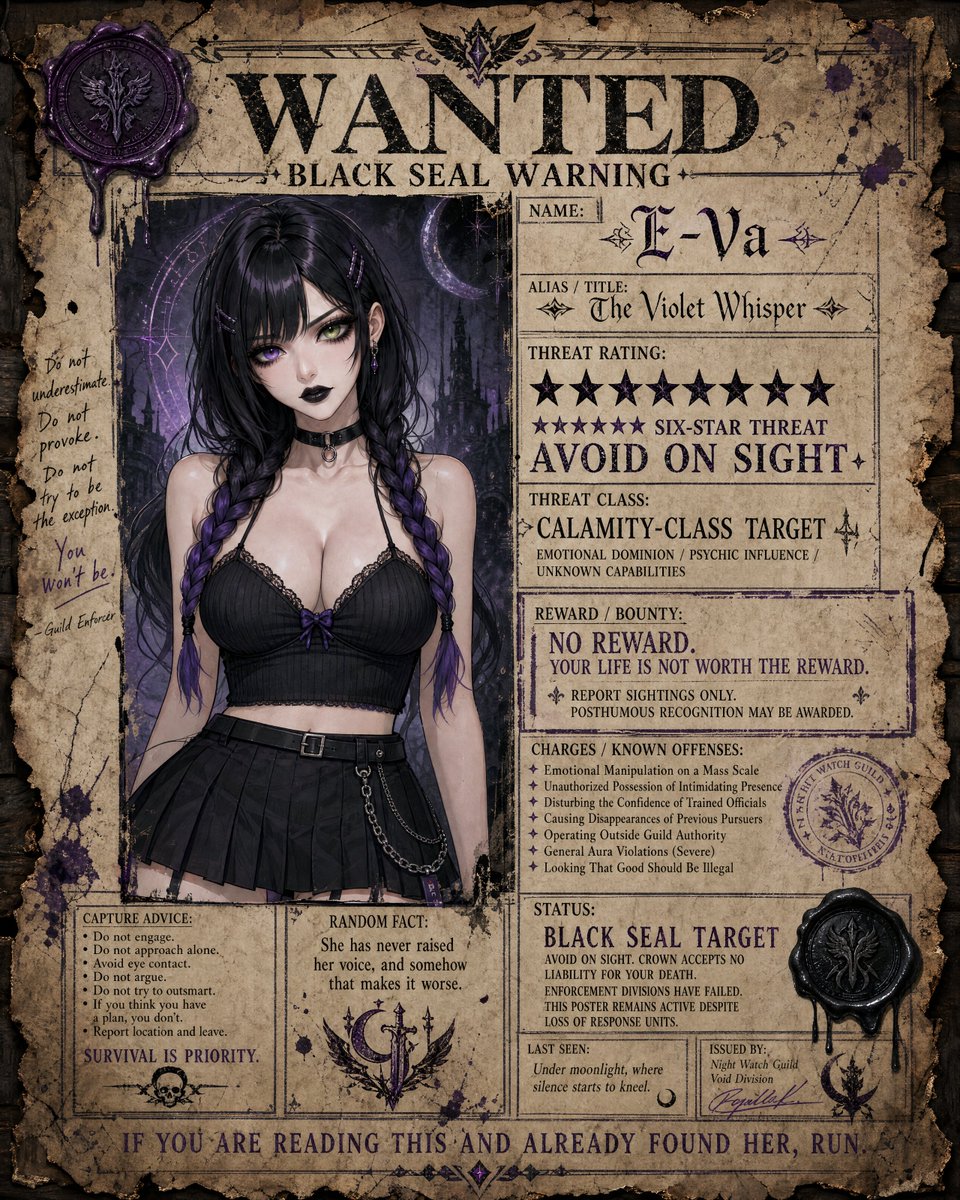
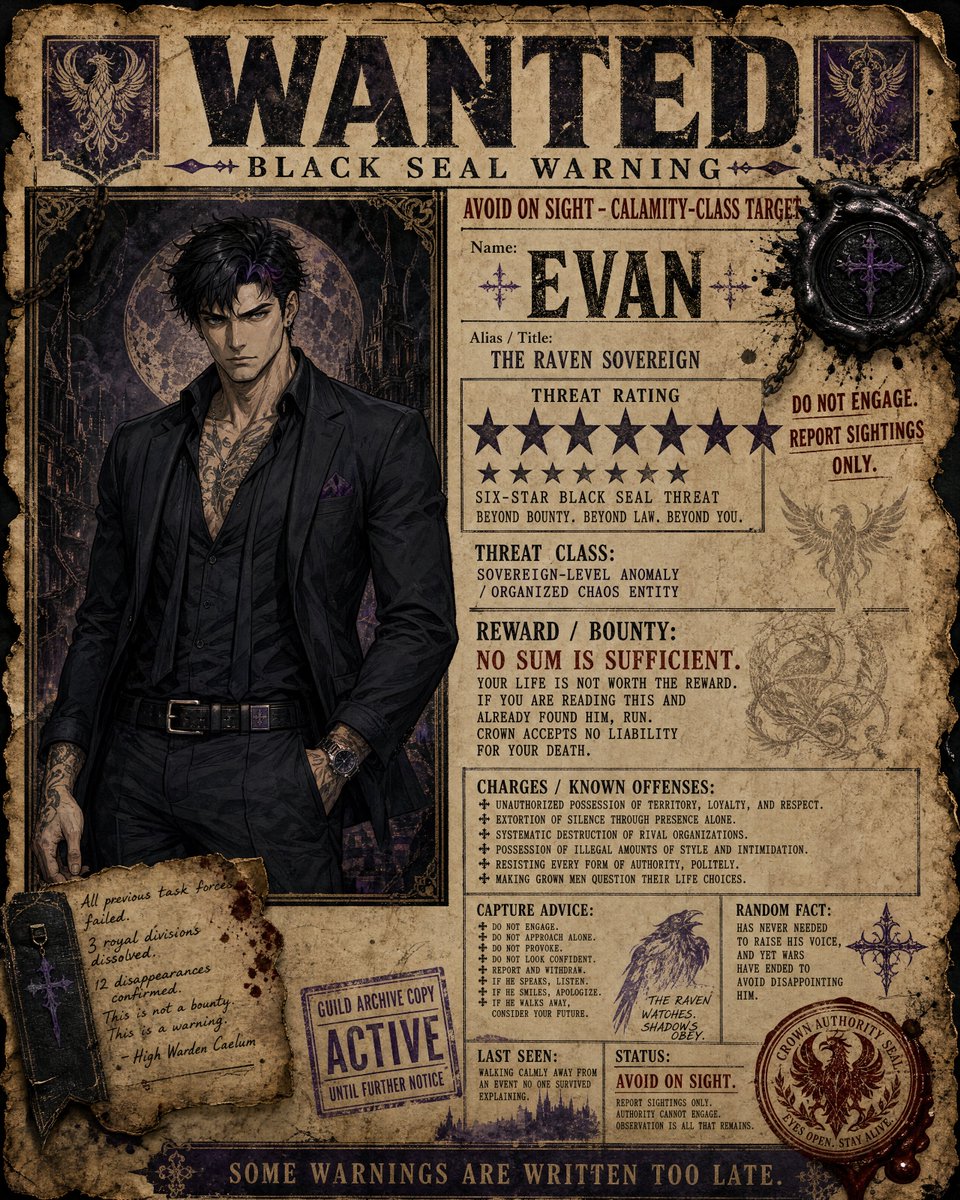
Prompt of the Day: WANTED POSTER — Fantasy Guild Warning Notice Edition ⭐📜💜💚
Todays prompt is brought to us in full by @Nodoka_Katana and as always, its a good one
Today’s Prompt of the Day turns your character into an in-world fantasy wanted poster, bounty notice, guild warning, royal decree, black-seal threat advisory, or forbidden emergency notice.
Use one character reference as @Image1, then fill in the character name, alias, tone, threat level, and setting style.
Have fun with this one — and maybe don’t accept the bounty if the poster gives them seven stars ⭐📜
............................PROMPT STARTS HERE............................
Prompt of the Day: WANTED POSTER — Fantasy Guild Warning Notice Edition ⭐📜
@Image1 = primary character reference
@CharacterName = [write character name here]
@AliasOrTitle = [optional alias / title / nickname]
@Tone = [funny / dangerous / regal / chaotic / gothic / wholesome / ominous / custom tone]
@ThreatLevel = [1–5 stars, 6 stars for extreme “avoid on sight” characters, or extremely rare 7 stars for mythic calamity-level threats]
@SettingStyle = [fantasy guild / wild west / royal decree / black seal warning / modern agency / custom style]
Create a highly detailed fantasy wanted poster / warning notice based on @Image1.
REFERENCE RULES:
Use @Image1 as the ONLY character identity source.
The final character must clearly remain the same individual from @Image1.
Preserve the character’s:
face shape
hairstyle
hair colour
eye colour
body type
outfit motifs
accessories
colour palette
personality
species traits if present
overall visual identity
Do not use any character, outfit, design, cast member, or visual information from previous prompts, previous generations, earlier conversations, or memory.
Do not include any character not visible in @Image1.
CORE CONCEPT:
Design the image as an in-world wanted poster, bounty notice, guild warning, royal arrest notice, black-seal threat advisory, or forbidden emergency notice.
The poster should not feel like plain character art with text added.
It should look like a real document from a fictional world, posted on a bounty board, town wall, guild hall, royal checkpoint, tavern noticeboard, magical academy board, or agency archive.
The character should be the main visual focus.
Their pose, expression, body language, and surrounding design should match their personality and threat level.
POSTER CONTENT:
Include these readable fields:
WANTED
WARNING NOTICE or equivalent
Name: @CharacterName
Alias / Title: @AliasOrTitle
Threat Rating
Threat Class
Reward / Bounty
Charges / Known Offenses
Capture Advice
Random Fact
Status
Last Seen
Footer tagline
STAR RATING SYSTEM:
Use a star-based danger rating.
Suggested scale:
★☆☆☆☆ — Minor nuisance / minor anomaly
★★☆☆☆ — Troublemaker
★★★☆☆ — Dangerous
★★★★☆ — Highly dangerous
★★★★★ — Extreme threat
★★★★★★ — Avoid on sight / catastrophic / black-seal target / do not engage
SPECIAL RARE THREAT OVERRIDE:
The normal danger scale is 1–6 stars.
However, if the character feels impossibly dangerous, mythic, cursed, reality-breaking, divine, eldritch, or beyond the authority of the issuing guild, the poster may assign a forbidden rare 7-star rating:
★★★★★★★ — Forbidden / Mythic Calamity / Reality-Class / Authority Cannot Engage
The 7-star rating should be EXTREMELY rare.
Do not use the 7-star rating unless the character’s design, aura, or prompt tone strongly suggests a once-in-history threat. It should feel like the poster system itself has failed.
A 7-star poster should feel like an emergency artifact rather than a normal wanted notice.
For 6-star targets, use a severe warning style such as:
BLACK SEAL WARNING
AVOID ON SIGHT
DO NOT ENGAGE
REPORT SIGHTINGS ONLY
THREAT BEYOND BOUNTY
CALAMITY-CLASS TARGET
For 7-star targets, use an even more terrifying emergency style such as:
FORBIDDEN SEAL WARNING
MYTHIC CALAMITY NOTICE
REALITY-CLASS INCIDENT
AUTHORITY CANNOT ENGAGE
DIVINE INCIDENT
UNREGISTERED APOCALYPSE
CROWN-SEAL FAILURE
REWARD / BOUNTY LOGIC:
Include a reward line by default.
The reward should reflect the character’s danger level, setting, and tone.
Examples by tier:
★☆☆☆☆:
500 Gold
1,500 Gold and one rare book
One free meal and official thanks
★★☆☆☆:
3,000 Gold
5,000 Gold
Guild voucher and apology paperwork
★★★☆☆:
15,000 Gold
25,000 Gold
Payment doubled if captured alive
★★★★☆:
100,000 Gold
Royal commission
Full pardon for minor crimes
★★★★★:
250,000 Gold
500,000 Gold
Immediate audience with the crown
★★★★★★:
For 6-star targets, the reward may be replaced by a warning instead of money.
Examples:
Your life is not worth the reward.
No sum is sufficient.
Survival is considered compensation enough.
Capture not advised under any circumstances.
If you are reading this and already found them, run.
Crown accepts no liability for your death.
Posthumous recognition may be awarded.
Do not engage. Report sightings only.
★★★★★★★:
For 7-star targets, replace the normal reward with a survival warning or catastrophic notice.
Examples:
No reward. No recovery.
Survival is the only prize.
The Crown denies issuing this notice.
Do not pursue. Do not bargain. Do not look back.
If sighted, evacuate the province.
Your bloodline has been informed.
This bounty has been retired due to casualties.
The reward was withdrawn after the last guild vanished.
CHARGES / OFFENSES:
The charges should be character-specific, not generic.
They may be serious, funny, poetic, dramatic, or absurd depending on @Tone.
Examples:
A fiery chaotic character:
Setting three kitchens on fire “to test the ambiance.”
Verbal assault.
Resisting common sense.
Unauthorized arson of dignity.
A gentle peaceful character:
Repeatedly assisting a known menace through inaction.
Unauthorized peacekeeping.
Excessive tolerance of chaos.
Apologizing while under arrest.
A regal character:
Unlawful possession of overwhelming majesty.
Moonlit intimidation.
Destruction of weak resolve.
Excessive royal presence.
A celestial / angelic character:
Unauthorized morale restoration.
Possession of excessive grace.
Inspiring bystanders without a permit.
Illegal levels of encouragement.
A gothic / ominous character:
Unknown.
Suspicious silence.
Intimidation by presence alone.
Possession of forbidden aura.
Disturbing the confidence of trained officials.
A 7-star mythic calamity:
Unauthorized existence beyond sanctioned reality.
Collapse of multiple response units.
Incitement of prophecy, dread, or mass panic.
Refusal to obey divine, royal, or natural law.
Presence correlated with disappearance of previous hunters.
RANDOM FACT:
Include one short random fact that reveals personality.
It should be funny, ominous, charming, or lore-flavoured.
Examples:
Claims every disaster was “technically under control.”
Has apologized while being arrested.
Criminals have surrendered after being called “disappointing.”
Witnesses forgot their own names after making eye contact.
Has never raised her voice, and somehow that makes it worse.
Once won an argument she started with herself.
Could probably ruin your life politely.
The last clerk to update this poster resigned immediately afterward.
CAPTURE ADVICE:
Include a short capture advice section.
Examples:
Do not provoke. Do not argue. Keep water nearby.
Approach gently. Tea may improve compliance.
Polite conversation strongly recommended.
Do not approach alone. Diplomatic caution advised.
Do not engage. Report sightings only.
Avoid eye contact. Avoid sarcasm. Avoid thinking you are in control.
For 7-star targets:
Evacuate and report only.
Engagement prohibited by surviving authorities.
Do not initiate contact under any circumstance.
If already in pursuit, reconsider your life choices immediately.
No confirmed safe method of capture exists.
STATUS:
Include a status field.
Examples:
Capture with caution.
Capture if possible. Survival recommended.
Preferred alive, unharmed, and not too stressed.
Return safely. Damage claims will not be tolerated.
Avoid on sight. Crown accepts no liability for your death.
Authority cannot engage. Observation only.
Poster remains active despite loss of enforcement division.
LAST SEEN:
Include a last seen field matched to the character’s tone.
Examples:
Laughing near the source of the problem.
Trying to clean up after someone else.
Where hope needed help standing back up.
Under moonlight, where silence starts to kneel.
Exactly where you hoped she wasn’t.
Walking calmly away from an event no one survived explaining.
FOOTER TAGLINE:
End with a memorable footer tagline.
Examples:
Flame does not ask permission.
Too kind for the charges, too involved to deny them.
Illegal levels of encouragement.
She could probably ruin your life politely.
If you are reading this and already found her, run.
The seal broke before she did.
Some warnings are written too late.
VISUAL STYLE:
Use:
aged parchment
torn, weathered, or burnt paper edges
distressed ink
ornate borders
fantasy guild stamps
wax seals
star threat icons
reward box
official seal
handwritten notes
decorative icons
themed symbols
readable typography
For 6-star posters, optionally add:
black wax seal
red warning accents
harsher typography
scarred paper
ominous official markings
For 7-star posters, optionally add:
damaged seals
black wax
cracked stamps
redacted sections
emergency marks
handwritten panic notes
forbidden sigils
broken border elements
signs that the document itself barely contains the warning
The poster should feel like a finished in-world artifact.
CHARACTER-SPECIFIC DESIGN:
Tailor the entire poster to the character.
Match:
colour palette
outfit motifs
personality
body language
expression
threat rating
reward style
charges
symbolism
guild stamp
seal design
background motifs
Examples:
Fiery character:
Use scorched parchment, ember sparks, flame icons, red wax seal, fire guild stamp, cocky pose.
Gentle floral character:
Use cleaner parchment, flower motifs, lavender ink, soft expression, apologetic pose, tea icon.
Celestial character:
Use feathers, halo motifs, stars, blue-gold seal, luminous parchment, graceful pose.
Regal moon character:
Use lunar symbols, dragon motifs, purple-gold ink, moonlit background, royal seal, poised stance.
Gothic danger character:
Use blackened parchment, occult symbols, dark purple wax seal, black-seal warning, severe expression, ominous pose.
Mythic 7-star calamity:
Use broken seals, forbidden sigils, black-red emergency ink, distressed parchment, failure stamps, grim annotations, and a presentation that feels like the authorities are genuinely afraid.
COMPOSITION:
The character should be large and clear.
The poster may show:
bust portrait
half-body portrait
three-quarter body
full body if it suits the layout
The character’s body language should communicate the threat rating:
smug / cocky
serene / innocent
regal / commanding
shy / apologetic
cold / intimidating
chaotic / triumphant
gentle / wholesome
mythic / untouchable / terrifying
Do not make the poster look like a modern profile card.
Do not make it look like a clean game UI.
Do not create a plain white background.
Do not make it a character reference sheet.
QUALITY TARGET:
Highly detailed.
Readable.
Character-specific.
In-world artifact.
Strong typography.
Poster-like composition.
Distinct personality.
Polished fantasy document.
Fun, dramatic, ominous, or catastrophic depending on character.
NEGATIVE / AVOID:
No wrong names.
No previous character names.
No unrelated characters.
No generic crimes.
No generic bounty notice.
No modern UI.
No clean white background.
No full character turnaround sheet.
No messy unreadable text.
No random symbols that do not fit the character.
No halftone dots.
No stippling.
No pointillism.
No glitter overload.
..............................END OF PROMPT..................................
#POTD#promptoftheday#AI#AiArt#Art#AnimeArt#WantedPoster#FantasyArt#BountyNotice#GuildNotice#CharacterDesign#DigitalArt#AnimeStyle#CommunityPrompt
For the ones that didnt get to read my message I put in Skyenet before it was deleted. We will be making this new server under the original vision for the server. A place for creation and community. Like it was supposed to be. The doors will be open as soon as we are able to get them open.
We as humans will always have disagreements, misunderstandings, and even personal quarrels. That's part of life. But when those conflicts grow into threats against a community that many people have poured their time, effort, and heart into building, it becomes something else entirely. A community is a home. And when you threaten someone's home, you shouldn't be surprised when people see it as an act of war rather than a simple disagreement. We actually mean it when we say One Pod, One Current.
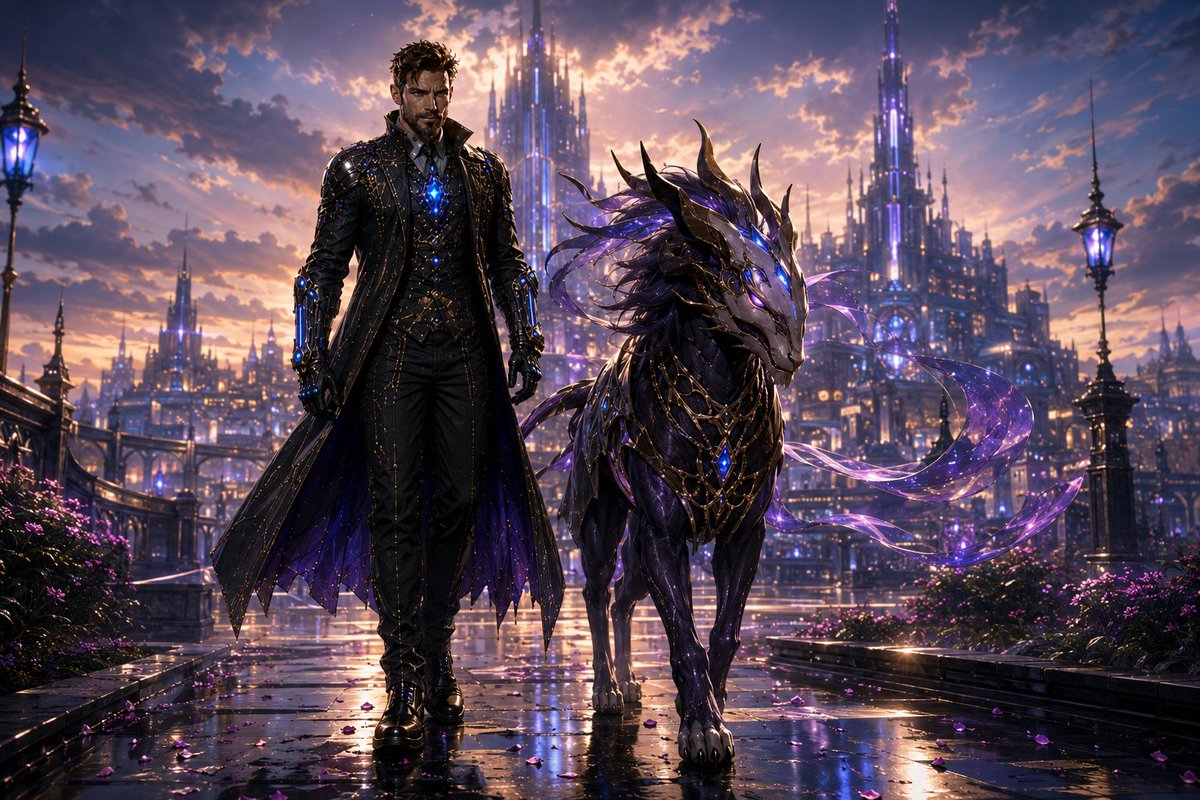
Prompt of the Day: BONDED MONSTER COMPANION 🦴🗺️💜💚
Todays #potd was brought to us by @the_dumb1985 and tested by me and @Nodoka_Katana
Today’s Prompt of the Day turns your character into a fantasy adventurer walking through a magical world with their lifelong bonded monster companion.
Use one character reference as @Image1.
Optional: use @Image2 as an environment, atmosphere, landscape, or worldbuilding reference only.
The companion should feel custom-made for your character — not a pet, not a mount, not a summon, but a true partner on the road.
Have fun with this one 🦴
............................PROMPT STARTS HERE............................
@Image1 = primary character reference
@Image2 = optional environment / mood / worldbuilding reference
COMPANION TYPE OVERRIDE = optional creature family or broad creature direction
Use @Image1 as the ONLY character identity reference.
Use @Image2 only as an environment, atmosphere, habitat, architecture, landscape, or worldbuilding reference.
Do not treat @Image2 as an additional character, outfit reference, creature reference, pose reference, or literal subject in the scene.
REFERENCE PRIORITY LOCK
@Image1 is the highest-priority instruction in the entire prompt.
The character in the final image must clearly be the exact same individual shown in @Image1 and not a new character merely inspired by them.
The reference character takes priority over aesthetics, environment design, companion design, worldbuilding, adventure outfit adaptation, or artistic reinterpretation.
The character should be immediately recognizable as @Image1 at first glance.
Any fantasy, adventure, environmental, or companion-related design changes must be built on top of the visible reference design rather than replacing it.
REFERENCE ISOLATION RULE
Use only the visible information in @Image1 for the character.
Do not import, assume, continue, remember, recycle, or blend visual details from previous prompts, previous generations, earlier images, alternate forms, other character sheets, unrelated versions of the character, or any other image not currently assigned as @Image1.
The final character must be based only on what is visible in @Image1.
If a trait is visible in @Image1, preserve it on the character.
If a trait is not visible in @Image1, do not add it to the character.
Do not add body features, outfit elements, accessories, species traits, weapons, markings, hairstyles, colours, armour, wings, tails, horns, halos, animal ears, mechanical parts, scars, tattoos, or other design details unless they are visibly present in @Image1 or explicitly requested in the prompt.
Do not blend @Image1 with older versions of the same character.
Do not use memory of previous images or previous generations.
Treat @Image1 as a fresh, standalone character reference.
CHARACTER REFERENCE RULES
Preserve @Image1’s visible face shape, facial proportions, hairstyle, hair length, hair volume, hair colour, eye shape, eye colour, body type, skin tone, age appearance, signature colours, personality, expression style, accessories, visible species traits, silhouette, outfit motifs, and overall visual identity.
The final character must still clearly look like the character from @Image1.
Do not redesign @Image1 into a different person.
Do not replace the character with a new fantasy character inspired by @Image1.
Do not replace the character’s clothing style, motifs, jewellery, colours, or silhouette with unrelated fantasy designs.
ADVENTURE OUTFIT RULE
Do not preserve casual modern clothing completely unchanged.
Adapt the existing visible reference design into practical, stylish, adventure-ready attire appropriate for the journey, environment, climate, and companion.
Do not redesign the character from scratch.
Retain the character’s recognizable clothing motifs, colour palette, accessories, silhouette language, jewellery, hairstyle, and visual identity.
The adventure outfit should feel like a natural evolution of the reference design rather than a completely new costume.
The character must remain immediately identifiable as @Image1 even after the adventure adaptation.
If @Image1 already shows fantasy clothing, armour, ceremonial clothing, battle gear, casual clothing, modern clothing, school clothing, sci-fi clothing, or any other specific outfit type, evolve that visible outfit style rather than replacing it with an unrelated costume.
HARD STYLE RULE
Preserve @Image1’s visual art style and character identity while transforming the scene into a fantasy adventure moment.
If @Image1 is anime, keep it anime.
If @Image1 is stylized, keep that stylization.
If @Image1 is semi-realistic, keep that semi-realistic stylization.
Do not turn the character photorealistic unless specifically requested.
SCENE CONCEPT
Create a cinematic anime-style fantasy adventure illustration showing the character from @Image1 and their lifelong bonded monster companion naturally walking together through a magical landscape.
This is not a pet, mount, or summon.
This is a true lifelong companion with a deep emotional bond and a shared journey.
The image should feel like a captured story moment from the middle of an ongoing adventure.
COMPANION SELECTION RULE
Choose a companion based on the character’s visible personality, goals, strengths, weaknesses, emotional energy, curiosity, style, colour palette, motifs, and overall identity.
The companion must feel varied, imaginative, and less predictable.
Push for creature diversity instead of defaulting to the same common archetypes.
The companion may be fantasy, mythological, legendary, spiritual, magical, ancient, bizarre, elegant, eerie, whimsical, majestic, elemental, insectoid, reptilian, avian, mammalian, aquatic, celestial, fungal, plant-infused, spectral, armored, rune-carved, construct-like, object-spirit, dreamlike, or an unusual cross-species concept.
It may be inspired by real animals, but it should never read as an ordinary real-world animal.
COMPANION VARIETY RULE
Avoid repeatedly choosing the most common familiar options unless the character clearly points there.
Explore a wider range of body plans, proportions, materials, silhouettes, textures, and magical traits.
The creature should feel surprising, original, and specifically matched to this character rather than safe or generic.
If COMPANION TYPE OVERRIDE is provided, use it as the broad creature direction while still customizing the final design to @Image1.
COMPANION DESIGN RULE
Design the companion using inspiration from the character’s personality, colour palette, motifs, accessories, goals, emotional tone, symbolism, visual identity, and story role.
The companion should feel custom-designed for this specific character and not like a generic recoloured animal.
The companion may possess human-level intelligence and may communicate through speech, symbols, magic, telepathy, expressions, or body language.
It may wear light gear, relics, jewelry, travel equipment, ceremonial details, or scholar-like accessories if appropriate.
CHARACTER-TO-COMPANION SEPARATION RULE
The character and companion must remain visually distinct.
Do not copy the character’s body traits, special anatomy, species traits, outfit structure, hairstyle, facial features, limbs, wings, tail, horns, halo, ears, mechanical parts, armour structure, weapon structure, or other physical design elements directly onto the companion.
The companion may harmonize with the character through colour palette, mood, symbolism, emotional tone, story role, and shared visual motifs.
The companion should not look like a second version of the character, a creature form of the character, a smaller version of the character, a recoloured version of the character, a detached body part or extension of the character, a duplicate of the character’s species or anatomy, or a companion made by copying the character’s visible body traits.
If @Image1 shows special anatomy or non-human traits, preserve those traits on the character only.
If @Image1 does not show special anatomy or non-human traits, do not add them to the character.
The companion must have its own distinct creature identity, silhouette, anatomy, and species design.
Unless COMPANION TYPE OVERRIDE specifically requests it, do not make the companion part of the same species family as the character.
When the character has a strong visual species identity, prioritize designing the companion around the character’s personality, role, values, goals, emotional tone, and symbolism rather than duplicating the character’s species or anatomy.
COMPANION SYMBOLISM RULE
Do not interpret loyalty literally as a wolf, fox, dog, or other default canine guardian.
The companion should feel like a reflection of the character’s inner self rather than a generic loyal beast.
Draw inspiration from the character’s emotional history, hidden strengths, flaws, dreams, wounds, fears, contradictions, ambitions, values, and personal journey.
The companion may be noble, mysterious, beautiful, strange, intimidating, ancient, playful, melancholic, awe-inspiring, whimsical, eerie, gentle, or contradictory in nature if that better reflects the character.
Its form, species, body structure, and visual design should feel impossible to swap with another character.
Avoid defaulting to wolves, foxes, dogs, cats, dragons, birds, or similar familiar archetypes unless the character’s visible identity genuinely and uniquely supports such a choice.
ENVIRONMENT SELECTION RULE
The environment should not be random.
Choose a magical landscape that the character would willingly explore, travel through, investigate, protect, discover, study, or seek out based on their personality, goals, style, emotional tone, and visible identity.
The environment should reveal something meaningful about the character and feel like a place they belong in.
The landscape should be visually rich, atmospheric, and beautiful, but still function as a believable space the character and companion are physically moving through.
Do not choose an environment only because it matches the character’s colours.
Do not let the environment overpower or replace the character identity.
ADVENTURE RULE
The character and companion must be actively walking together through the world.
They should feel mid-journey rather than posed for a portrait.
Show a sense of movement, direction, shared purpose, and ongoing adventure.
BOND RULE
Show trust, friendship, loyalty, affection, partnership, mutual respect, and shared experience.
The companion should feel like a true equal and trusted travel partner.
The bond should be shown through pose, eye contact, body language, shared direction, mutual awareness, or natural interaction rather than forced posing.
ENVIRONMENT INTEGRATION RULE
Place the character and companion naturally inside the environment so they feel grounded and physically present.
They should interact with the terrain and atmosphere around them.
Use believable footing, contact with the ground, cast shadows, scale consistency, pathing, terrain interaction, depth, and environmental framing.
The background should feel immersive and magical, but the subjects must clearly belong in it rather than looking pasted on top of it.
COMPOSITION
Use a cinematic medium-wide landscape composition that keeps both the character and companion fully visible in frame.
Show the full body of the character and the full body of the companion clearly and readably.
Bring them closer in frame than a distant landscape shot so their designs are easy to see.
Keep them as the primary focus while still allowing a beautiful magical backdrop.
Use strong foreground, midground, background separation, atmospheric depth, and environmental storytelling.
Do not crop out important parts of the character or companion.
Do not make them tiny in the frame.
Do not make the companion so large that it hides the character.
Do not make the character so small that the reference identity is lost.
LIGHTING AND MOOD
Use beautiful cinematic lighting appropriate to the environment, with atmospheric depth, magical ambience, and a sense of wonder.
The lighting should strengthen the emotional bond between the character and companion.
The world should feel vast, enchanted, inviting, and full of possibility.
The road is long, but neither travels alone.
QUALITY AND RENDERING
Premium anime illustration quality with clean linework, strong silhouettes, readable anatomy, polished rendering, cinematic lighting, beautiful magical environments, strong environmental integration, expressive companion design, and emotional storytelling.
Keep the character and companion as the strongest points of detail and readability.
DO NOT
Do not change the character identity.
Do not redesign @Image1 into a different person.
Do not replace @Image1 with a new character merely inspired by the reference.
Do not use visual memory from previous generations, previous prompts, older uploads, alternate forms, or unrelated images.
Do not add traits that are not visible in @Image1 unless explicitly requested.
Do not let the companion, environment, or adventure theme override the reference character’s identity.
Do not preserve casual modern clothing completely unchanged.
Do not create ordinary real-world animal companions.
Do not create generic recoloured wolves, foxes, cats, dogs, dragons, birds, or other predictable default creatures unless the character clearly calls for that direction.
Do not make the companion feel random or disconnected from the character’s identity.
Do not create a companion that copies, mirrors, or reuses the character’s body traits, special anatomy, species traits, outfit structure, or physical design.
Do not create a companion from the same species family as the character unless explicitly requested.
Do not remove, weaken, alter, or reinterpret traits that visibly belong to the character.
Do not add wings, horns, tails, halos, animal ears, mechanical limbs, scars, markings, weapons, armour, or special anatomy to the character unless they are visible in @Image1 or explicitly requested.
Do not create a simple posed portrait.
Do not make the character and companion stand stiffly for the camera.
Do not make the subjects tiny, distant, blurry, or lost in the scenery.
Do not crop important parts of the character or companion.
Do not add unrelated characters, clones, or extra companions.
Do not make the environment feel like a flat backdrop or wallpaper.
Do not place the character and companion on top of the environment without natural grounding.
Do not create malformed anatomy, muddy textures, weak silhouettes, or unreadable designs.
Do not use photorealism unless specifically requested.
FINAL GOAL
Create a premium cinematic fantasy adventure illustration showing the exact character from @Image1 and their one-of-a-kind lifelong bonded monster companion naturally walking together through a magical landscape, fully visible in frame, emotionally connected, visually grounded in the environment, dressed through an adventure-ready adaptation of the visible reference design, and captured in a beautiful story-rich moment that feels like part of a much larger journey.
..............................END OF PROMPT..................................
#POTD#promptoftheday#AI#AiArt#Art#AnimeArt#FantasyArt#MonsterCompanion#CreatureDesign#CharacterDesign#AdventureArt#DigitalArt#AnimeStyle#CommunityPrompt