Jack

148 posts

Jack banner
Jack

Jack

@JackKHash

Distributed systems & autonomous agents | Prefer understanding before believing. Leaderless Consensus Swarm.

Amsterdam, Nederland เข้าร่วม Aralık 2023
247 กำลังติดตาม153 ผู้ติดตาม
Jack
Jack@JackKHash·
Isn’t it true that in GHOSTDAG the block rate is entirely decoupled from safety, which means higher BPS can safely increase decentralization — something that isn’t true in Nakamoto? And in PoS, increasing BPS leads to more centralization. But none of this is new. Why is he now pushing for 100 BPS? Doesn’t that imply they found a way to optimize the code so that even 100 BPS can run on cheap nodes? There must be more to it. For vProgs, isn’t BPS essentially the “clock frequency” of the decentralized computer formed by all vProgs?
English
0
0
1
268
Pavel Emdin
Pavel Emdin@emdin·
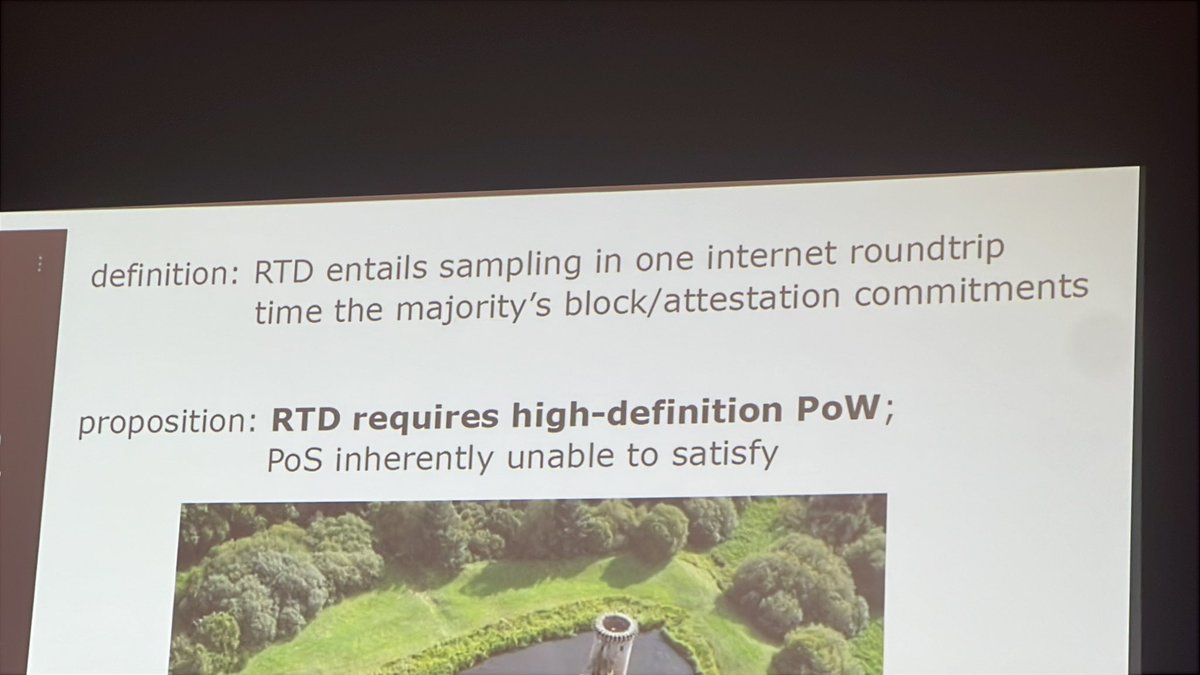
Slide from @hashdag. My understanding is realtime decentralization requires high speed PoW cause finality and decentralization in PoW are less coupled. Fast PoW can reliably assess any external events without killing decentralization. This is why 100bps makes sense.
Pavel Emdin tweet media
English
8
55
224
13K
Jack
Jack@JackKHash·
What’s the point of paying with crypto if the total cost ends up higher than paying with fiat? Here’s what you usually pay with Lightning (directly or indirectly): Routing fees: 0.2%–0.5% LSP fees: 0.3%–1% Rate spread: 0.5%–1.5% Merchant provider fee: 0.5%–2% Fiat conversion: 0.5%–1.5% Total practical cost to the user: roughly 2–6%. Settlement on Lightning is not final — payments can be reverted, and the risk sits with the merchant Lightning ends up looking like a more complicated, more expensive version of the card system it was meant to replace. And calling it “almost zero fees” while charging 2–6% is completely misleading — especially when true 0% payments are already possible, just not with Lightning. Now compare that to using Kaspa: Routing fees: 0% — not needed LSP fees: 0% — no channels, direct on-chain settlement Rate spread: 0% — DEXs guarantee the best available price Merchant provider fee: 0% — merchants can receive directly on-chain Fiat conversion: ~0.2% — only the DEX swap Channel-opening fee: 0% — Kaspa does not require channels at all On Kaspa, settlement is instant on L1, confirmed within seconds, and reaches the same security Bitcoin has after about an hour. Kaspa Point of Sale doesn’t need any setup at all — it works instantly. No providers, no KYC, pure sovereignty, completely plug-and-play in seconds. This was once Satoshi’s vision: true Peer-to-Peer Electronic Cash System Not the current reality of Lightning, where it’s actually peer → provider → peer, with 2–6% in extra fees, added intermediaries, risk of failed payments, and only the hope — not the certainty — that it will eventually settle on Bitcoin.
English
0
0
0
36
El The Freedom Fairy
El The Freedom Fairy@El_FreedomFairy·
Breakfast bought with Bitcoin! Love to see Aussie businesses accepting sound money. It will either be you or your competitor to get Bitcoin first - choose wisely!! 📍 Bellas Cafe, Parkes
El The Freedom Fairy tweet media
English
43
13
392
11.2K
Jack
Jack@JackKHash·
Lightning is only trustless if you run your own node — which is risky unless you’re a pro, and completely unscalable because it would take 100 years for all humans to open channels. It only scales when you trust LSPs to manage channels for you. So Lightning is not trustless or permissionless in practice, because without providers most people can’t use it at all.
English
0
1
4
153
El The Freedom Fairy
El The Freedom Fairy@El_FreedomFairy·
No you’re retarded as you’ve decided to ignore reality in order to (eventually) shill your ghost coin. Lightning is a secondary layer scaled from L1. It is enforceable and contributes to greater BTC adoption and widespread use, beneficial for miners over time. It is a feature and an additive not a bug, how you frame it. The base layer is deliberately constrained to preserve security and decentralisation. The idea that lightning entirely undermines miner incentives ignores how it expands the overall network. The beauty of it is that you don’t have to use it if you don’t want to. But please, enjoy your shitcoin in silence 🤣
English
14
0
7
1.2K
Jack
Jack@JackKHash·
You’re wrong — they won’t have the power to block it. We start with small, local community voting and crypto-project voting. When people see how reliable it is — no failures, no manipulation, no distrust — the system proves itself. Then we simply elect leaders who agree to implement it. It’s not one big jump; it’s many small steps before the final one. Saying “they won’t allow it” is surrendering your power — and that’s exactly what they want you to believe, that you don’t have real power. With Kaspa and zk tech, we finally have the tools to unite our strength, restore trust in voting, and change everything.
English
0
0
0
39
KatDaddyKrypto
KatDaddyKrypto@katDaddyKrypto·
@mati_rq Governments will never use a decentralized/ verifiable system because then they can't cheat.
English
1
0
8
204
Jack
Jack@JackKHash·
In GD, red blocks can be seen as “late arrivers”: they are valid but arrive too far outside the main flow, comparable to distant stars in the sky that are visible yet not part of the constellation everyone agrees on. The “candle star” analogy fits the selected parent chain: these are the special, universally visible points the protocol tries to lock onto. However, in GD the selected parent chain is still structurally vulnerable to reorgs. Because GD is a greedy algorithm, it may pick a chain that is not globally optimal—so an adversary with sufficient luck can force a reorganization even without violating assumptions. That structural greediness means the chosen chain is not maximally stable. DK changes this. It is not greedy. Instead of picking the first valid chain that fits local rules, DK evaluates all feasible options and chooses the minimax-optimal chain—the one that minimizes the maximum possible disagreement among all honest observers. This property is structural, not statistical. Any honest observer with the same view of the DAG will converge to the same best choice. As a result, the blocks in the DK-selected chain become the closest thing to “candle stars”: the blocks that all observers will independently agree on after one global round of communication. DK is still probabilistic—as all permissionless PoW systems are—but the only remaining source of reorg probability is pure luck (Poisson variance), not structural weaknesses in the algorithm. That separation is unique to DK: it removes structural reorg opportunities and leaves only unavoidable probabilistic noise.
English
0
0
1
33
moose.kas 𐤊 Themooseisloose
moose.kas 𐤊 Themooseisloose@Themooseisloos5·
@JackKHash @BankQuote We get red blocks from time to time too. These would be low gravity blocks, i've had a couple of beers tonight, i'll read and think about this more thproughly tomorrow :)
English
1
0
1
38
moose.kas 𐤊 Themooseisloose
moose.kas 𐤊 Themooseisloose@Themooseisloos5·
Russian Dolls of Entropy As simply as i can i see the universe as time, space and movement in spacetime, the great system governed by the laws of thermodynamics which means every subsystem of this universe must also follow the rules of thermodynamics, galaxies, solar systems, the world, the weather, finance, money, war, politics, the workplace, the family, me and you our thoughts and our feelings, every level, all scales. So strategy and game theory is a system that controls all of these subsystems. Any closed system is eventually and open system, Within another system. Game theory works because without life, there is only cause and effect, where the effect is determined of the collision and friction of the cause becoming effect. With life included it becomes trial and error (eventually evolution) with intelligence and memory it becomes error correction, we follow the rules because we can understand them, feel them, we learn them from our mistakes, we hone our intuition and gut feeling. But we are biological machines and we play our role, conserving energy through efficiency, laundering entropy from one subsystem to another. Inside the box, outside the box, it's all the same box. Life is essentially hacking physics by learning all the rules, this is what technology eventually is. But honestly? I think the universe is just another subsystem, where time stops we can see where it leaks. This almost sounds like nihilism.. I assure you, it is everything but. In the end i would say game theory is the operating system running on thermodynamic hardware. Pointing the finger at #kaspa $kas look at what you turned me into.
moose.kas 𐤊 Themooseisloose@Themooseisloos5

Metastrategy I was thinking about writing a longer post of thermodynamics, strategy and game theory, but the thermodynamics of strategy and game theory forced me to make the text into an example of itself, it's own proof. IYKYK. Strategy Game theory Order out of chaos What is strategy? Goal oriented planning/rule-setting within a system/multiple systems of chaos, uneven entropy, where the goal is maximum order to the least cost. What is game theory? Gamification of strategy/quantifying chaos within a closed system of a set number of subsystems. Minmax. #kaspa $kas

English
6
8
32
3K
Jack
Jack@JackKHash·
Great to hear. So the limitations of the EVM with respect to vProgs — do you have ideas on how to solve them? Would you need to develop an EVM template for vProgs, since the core team is not doing that and is only focusing on ACL-based VM templates? And do you see Igra as the solution that will make it easy to migrate EVM projects, while the future still needs to be ACL-based VMs, right?
English
2
0
1
566
Pavel Emdin
Pavel Emdin@emdin·
If Kaspa wins, Igra wins. Kaspa’s BlockDAG has the potential to become a monetary protocol operating at internet speed (see x.com/KasCryptoKing/…). All we need is to row in the same direction.
Shai ❤️ Deshe 💜 Wyborski 💙@DesheShai

The kind of professionalism the $kas ecosystem severely lacks and desperately needs. The last remaining frontier of eco builders who preserve Kaspa's original standards and ethics. The way I see it, if Igra fails, Kaspa fails.

English
15
48
267
10.6K
Jack
Jack@JackKHash·
As of my humble understanding: Rollup state roots become part of L1 state, in contrast to vProg state commitments which never become part of L1 state; they exist only as utxo anchors and disappear once the next commitment replaces them. In both cases many internal off-chain operations can be rolled into one state root or one state commitment, but the “up” — updating L1 — is only true for rollups. vProgs never update L1’s state root; they only post their state commitment and its ZK proof to L1.
English
2
1
1
128
Shai ❤️ Deshe 💜 Wyborski 💙
@CryptoAspect @ReLeomerda I'm not talking about composing circuits. I'm talking about a single circuit that rolls up many state transitions. E.g. I can invoke 400 different functions in the same circuit in a single vProg transaction.
English
2
0
5
1.2K
Shai ❤️ Deshe 💜 Wyborski 💙
For the love of.... vProgs are a type of rollup! Stop saying "we don't need rollups, we can use vProgs". That's like saying "we don't need cars, we can use Lambos". If you think vProgs are "on-chain contracts," that they entail that you need to process smart contracts to validate the chain, then you missed the entire point of vProgs.
English
14
15
102
15.3K
Jack
Jack@JackKHash·
It’s not a computer for heavy complex execution — but for trustless coordination, logic, state, permissions, and real-time decision flow for systems like games, AI agents, and industrial machines. Compared to existing blockchains with programs and smart contracts, vProgs can enable new, more complex applications that other chains can’t, because they’re sovereign, massively parallel, and globally composable. This makes real-time gaming, AI agent coordination, industrial machine control, and other advanced logic possible.
English
1
1
3
35
moxypixy-𐤊
moxypixy-𐤊@moxypixy15683·
@JackKHash @NikolaGalilei So looking at Vprogs compared to web2 development, you dont use a backend server running on something like AWS to run vprogs?
English
1
0
2
29
Jack
Jack@JackKHash·
So every non-ACL-based VM can be easily wrapped — that’s really insane. I assume that in the future Kaspa’s native VMs will dominate, since they will probably be superior to any existing VM. Can we call Kaspa with vProgs computationally the first fully distributed, sovereign, trustless, permissionless computer? Because execution, state, sovereignty, scheduling, validation, and final ordering are all independently distributed and globally, trustlessly, permissionlessly composed through the DAG.
English
0
0
12
2.1K
Hans Moog
Hans Moog@hus_qy·
Kaspa’s runtime architecture achieves scalability not by optimizing block-level throughput, but by rethinking the role of blocks entirely. Instead of treating state transitions as discrete batches that must be processed sequentially, Kaspa models them as a continuous stream of causally-related transactions, with blocks serving only as logical markers that define the boundaries of possible reorgs. This shift in perspective moves the performance bottleneck away from "how fast can we process everything inside a block" toward "how can we parallelize all currently known tasks across the entire DAG". When a block contains a spike of non-parallelizable work, traditional blockchains must stall until the block is fully processed. Kaspa does not. Because unrelated transactions can be scheduled immediately - even those belonging to future blocks - the system avoids idle CPU cycles and eliminates the classic straggler problem. Most existing DLT architectures tightly couple block production with state commitments, proofs, or other finalization steps, making their execution model inherently sequential. Even if they support some parallelism within a block, they still wait for a block to finish before moving on to the next one. This introduces unnecessary latency and forces the runtime to juggle responsibilities that are orthogonal to efficient workload distribution. Kaspa’s strict separation of concerns allows the entire execution model to collapse into a minimal, expressive, and highly generic framework - small enough to run any ACL (access-control list) enabled VM at essentially bare-metal performance. Its design models causal dependencies at the lowest hardware-relevant level, enabling an execution flow that is: - completely lock-free - free of WAL flushes or global sync barriers - based entirely on eventual consistency This results in a simpler, more scalable, and far more hardware-efficient architecture than anything deployed in blockchain systems today. In effect, Kaspa does for distributed ledgers what TensorFlow and CUDA Graphs did for machine learning: it exposes a parallel execution model that can scale seamlessly with modern hardware, turning theoretical throughput into practical reality (the 64000 TPS that Solana achieves in the lab let's bring that to practice). I am extremely excited about this as this is exactly what I always wanted to build with IOTA and now it's finally done. We are still working on implementing the higher levels of abstraction like designing a capability based linear type system abstraction for state management and resource access that gets rid of the need for manual capabilities wiring like in SUI and there is still a bit of work left but I don't think that you will ever be able to build a more scalable architecture than directly modeling the causal structure of state changes down to the lowest hardware layer. Kaspa is going to melt faces my friends and it's going to be so much better that it will be impossible to ignore! And it's such a simple API with Rayon level abstraction ... I am seriously getting a nerd-gasm just looking at the code 😅: github.com/hmoog/kas-l2/b… This goes out to KEF and the entire community: Thank you so much for allowing me to take part in this journey - this really feels like coming home! 🥰
English
117
486
1.3K
154K
Jack
Jack@JackKHash·
This was a great space to listen to — very insightful. @hus_qy You’re a great explainer, keep doing these kinds of tech spaces, you’re a natural. Your proposal to host a weekly space with core devs is great. We’re really missing this, and it would help educate our community. Even one hour a week would be enough.
English
0
0
0
59
Kaspa Eco Foundation (KEF)
Kaspa Eco Foundation (KEF)@Kaspa_KEF·
We're excited to continue our KEF Research Grantee Space Series with another brilliant mind! 🗓 Monday, November 17th, 1PM (GMT) 🔗 x.com/i/spaces/1mrGm… Join us for an exclusive conversation with @hus_qy — a veteran with 25+ years of coding experience who has founded successful tech companies, operated large-scale gaming platforms, and funded open science initiatives worldwide. Now serving as a #Kaspa core researcher, @hus_qy brings unparalleled expertise to the ecosystem. In our previous space with @FreshAir08, we explored vProgs' ambitious vision and the challenges of pioneering uncharted territory. Now with @hus_qy and co-hosted by @kaspador_, we'll dive into what #Kaspa's technical innovations actually mean for developers and users beyond the grand ideology. Got questions about what #Kaspa's breakthroughs mean in practice? Drop them below! 👇
English
15
69
223
46.1K
Jack
Jack@JackKHash·
Implementation, miner decentralization, and reward distribution are topics you could debate endlessly — and you’d find solid arguments on both sides. But what’s the point of arguing if there’s nothing better? If you can find better concepts for these three areas, please share them. Kaspa was launched as fairly as possible; replicating that is already nearly impossible. And if you think it could be done better, I’d love to hear how. In the long term, miner incentives will come from fees, which we’ll start to see once vProgs are implemented. Just show me one project with a better future outlook — I can’t see it, and I’m open to looking at everything. Kaspa is already incredible technology. After DAGKnight, it mathematically reaches the limit of what a consensus protocol can achieve — you simply can’t do better. And with vProgs, it solves the challenge of distributed computing without sacrificing sovereignty. This represents the computational endgame of distributed systems. So as for who mines Kaspa — I don’t really care. After seeing what KII is building and understanding how vProgs handle fees, there’s nothing left to worry about.
English
0
0
0
14
Eugene Stepanyuk
Eugene Stepanyuk@e77st·
@JackKHash @CsTominaga I have no complaints about the technology or brilliant minds of engineers. Do have questions about the emission model, distribution &incentives for miners to mine the remaining 6% of supply. The largest world miners haven't entered Kaspa Except Mara/BTC hedge) Where located HR?😑
English
1
0
2
41
S Tominaga (Aka Dr Craig Wright)
And by your own definition—by your own documentation—Kaspa’s finality is twelve bloody hours. Twelve. It’s written right there on your site, confirmed by your own community tests. Yet you run around shouting “ten seconds” like a street magician hoping no one notices the sleight of hand. That’s not marketing; that’s fraud wearing a cheap grin. You can’t wave away mathematics with slogans. A DAG doesn’t give you instant settlement; it gives you probabilistic limbo. It’s a queue of confirmations pretending to be finality. Ten seconds of comforting illusion followed by twelve hours of statistical uncertainty. You can call that progress if you like, but the rest of us call it what it is—a glorified delay wrapped in deceit. kaspanews.net/understanding-…
Victor (Kaspa Silver)@KaspaSilver

@CsTominaga @realvijayk @brt2412 I gladly invite you to stress test the network further. For as long as you want. Since you are so sure it will break. Prove it.

English
16
4
29
5.3K
Jack
Jack@JackKHash·
I’m not sure what your argument is or what you’re comparing it to, so I’ll answer in general. A 50% fault-tolerant distributed consensus system whose security does not weaken with higher block rates is phenomenal. We should be thankful for such groundbreaking mathematics as presented in GHOSTDAG and later in DAGKnight. Of course, implementations can have mistakes — but Kaspa has some of the best engineers in the space. The last Crescendo update had zero fixes after mainnet release — an insane engineering achievement. As for centralization, just look at Bitcoin to see how great ideas and technologies can be hijacked or corrupted. But if you look deeper, you’ll see that the future of mining won’t be limited to a few datacenters. Everywhere on Earth where energy is nearly free, mining hubs will emerge. As KII explains, the energy sector has been waiting for a technology like Kaspa for 14 years. If that’s still not decentralized enough for you, show me anything with a better long-term outlook in terms of decentralization.
English
1
0
0
19
Eugene Stepanyuk
Eugene Stepanyuk@e77st·
@JackKHash @CsTominaga Everything you write is a beautiful theory for ideal decentralization conditions Which in reality, Kaspa DOES NOT have Because the majority of the HashRate is physically &geographically concentrated in a small group of ru/cn miners They can essentially censor &control the network
English
1
0
1
37
Jack
Jack@JackKHash·
If we talk about the Bitcoin/Nakamoto protocol, then it’s clear that GHOSTDAG is mathematically proven to be a generalization of the Bitcoin/Nakamoto protocol. It’s obvious that Bitcoin represents the most inefficient case of GHOSTDAG — when k = 0. Maybe some don’t understand what a mathematical generalization really means. An analogy would be: Bitcoin’s protocol is like (a+b)^2 , while GHOSTDAG is like (a+b)^n . Of course, for n=2 you get the simple Bitcoin case. But failing to recognize the greatness and superiority of such generalization is, mathematically speaking, not a sound argument. In addition to its superiority, the Nakamoto protocol’s security weakens as you increase the block rate, while GHOSTDAG’s security is not dependent on or bounded by block rate. It’s mathematically proven — so what exactly do you want to parameterize or engineer? Do you want to break mathematics by engineering? I understand that the mathematics behind GHOSTDAG is more difficult to grasp than Bitcoin’s white paper, but that’s a weak argument. If humanity had always avoided progress or math because something was “too complex,” we’d still be riding horse carriages instead of flying airplanes or driving cars. You can tune parameters and engineer improvements, but you can’t turn a horse into a car or an airplane.
English
0
0
2
36
S Tominaga (Aka Dr Craig Wright)
I’m referring to Bitcoin, not BTC — the system that was designed to scale, to handle global transaction flow, to reach real finality for most transactions and conditions in seconds, settlement in minutes not hours. The protocol already provides the structure. There are signalling mechanisms, code-level methods, and network optimisations that make this achievable without grafting alien architectures onto it. The argument that it cannot be done has always been a refusal to try. It’s easier to say “impossible” than to build. But everything needed exists in the original design. What you call limitations are parameters awaiting proper engineering. It’s not a question of invention — it’s a question of will.
English
1
0
3
105
Jack
Jack@JackKHash·
Kaspa is by definition more than Bitcoin — it fully includes Bitcoin’s technology while generalizing and extending it. You can debate whether that generalization is better, but you can’t deny that Bitcoin’s technology is fully contained within Kaspa, achieving higher block frequency through generalization without any trade-offs in decentralization or security.
English
0
0
0
26
Cash Queen
Cash Queen@girlmoneyguide·
@FinanceFreeman @hashdag @kaspaunchained Kaspa's "more Bitcoin than Bitcoin"? That's like pineapple on pizza being "more Italian than Italy." Bold, but nah. Lightning's the real zap—consider this your 2AM wake-up warning: DYOR before life-betting on spicy alts.
English
1
0
0
89
Finance Freeman 🇺🇸
Finance Freeman 🇺🇸@FinanceFreeman·
Kaspa is more Bitcoin, than Bitcoin Don’t talk shit, do some research. Learn who @hashdag is Understand why lighting is not Bitcoin and join us on the evolution of sound money with $KAS. I believe in a world that @kaspaunchained fails, crypto fails. & I’ve bet my life on crypto - so spoiler It won’t fail (I hope) 🤣
English
31
63
325
6.9K
Jack
Jack@JackKHash·
@hashdag @vladcostea @DaWhiteRhino @zashi_app Kaspa with vProgs forms a distributed system of sovereign but composable logic zones, which together form a distributed computer. The frequency of this computer’s CPU is the block rate.
English
0
0
16
1.5K
Yonatan Sompolinsky
Yonatan Sompolinsky@hashdag·
+100 scalability is the wrong fixation, and fwiw i don’t think of kaspa as scalable, even though it happens to be true. kaspa is first and foremost an internet-speed proof-of-work, and for those who believe pow is the most resilient mechanism to govern money - working with subsecond pow seems like an obvious win. a close second is the real-time aspect of decentralized mining. slow pow achieves censorship resistance and the sampling of the majority over the course of hours. high rate pow achieves same properties in real time - in the order of internet RTT - and there are immediate consequences to the ability to sample the majority in real time - especially in a multichain world. tldr scalability is boring, and we (read: others) should work towards upgrading from 10 to 100 bps
English
23
208
627
40.7K
VLAD HOSTS THE BEST PODCAST IN BITCOIN
Zcash: $2.4 billion in 24h trading volume Also Zcash: 8580 on-chain transactions, of which 1/4 are shielded PSA: withdraw your ZEC from exchanges into @zashi_app and shield it. If you’re not doing this, you get no privacy, expose yourself to counterparty risk, and merely trade a stock. What you bought is much more precious than you think. Protect it accordingly!
VLAD HOSTS THE BEST PODCAST IN BITCOIN tweet media
English
14
17
155
13.5K
Jack
Jack@JackKHash·
@NikolaGalilei @DesheShai @KodinglsFun @Kaspakira Couldn’t agree more. I’m tired of all the nonsense — it’s easier for people to talk about rumors than to invest the time to actually understand Kaspa’s technology and discuss what really matters.
English
3
0
3
57
Shai ❤️ Deshe 💜 Wyborski 💙
Do you know what the PoW protocol even is? If you answered yes, you already lost. PoW is not a protocol at all! So what is it, and why is it so important? This is the starting point of the second segment of the first chapter of my PoW book, which has been overhauled with the help of @QuaiNetwork's gracious sponsorship. Check it out below 👇👇👇 shai-deshe.gitbook.io/pow-book/part-…
English
5
14
100
6.1K
Jack
Jack@JackKHash·
@KaspaQueeen @LevendiPro @emdin Great point — women value security much more than men, who are often first movers and willing to take full risks. Kaspa is ideal for women: it’s secure, has proven itself over four years, and with Tangem, it offers a perfect user experience.
English
0
0
1
54