Lev Peker

2.2K posts

Lev Peker banner
Lev Peker

Lev Peker

@LevPeker

Husband. Father. CEO
Los Angeles, CA เข้าร่วม Mayıs 2013
331 กำลังติดตาม657 ผู้ติดตาม
Lev Peker
Lev Peker@LevPeker·
I like how he says we have to warn the president
English
0
0
0
15
Lev Peker
Lev Peker@LevPeker·
@ewarren Audit the spending first then tax second. It doesn’t matter how much money goes to Washington it will never be enough
English
0
0
0
9
Elizabeth Warren
Elizabeth Warren@ewarren·
A wealth tax on the top .15% of the richest families would generate $6.2 trillion in revenue. That could pay for: Universal childcare Millions of new homes Slashing child poverty Medicare for people aged 55+ Universal paid family leave Tuition-free community college And more.
English
12.8K
2.4K
9.7K
1.3M
Carl Quintanilla
Carl Quintanilla@carlquintanilla·
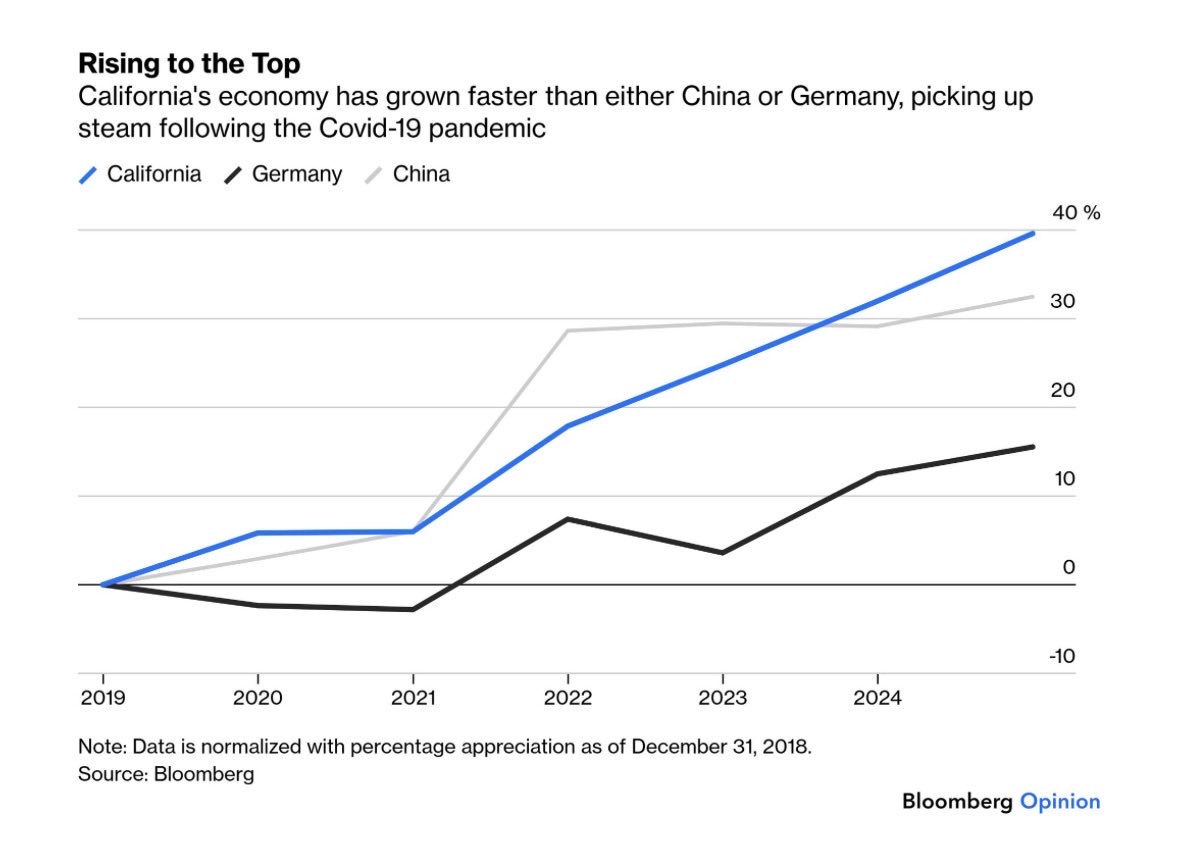
“Of all the prevailing media narratives around Gavin Newsom, the one that is most conspicuous by its absence is how under its two-term governor California became the top performing economy not just among its 49 siblings but also any developed nation.” bloomberg.com/opinion/articl…
Carl Quintanilla tweet media
English
397
1.9K
4.7K
193.8K
Lev Peker รีทวีตแล้ว
Marshall S. Billingslea
Marshall S. Billingslea@M_S_Billingslea·
I worked with Miad @miadmaleki at the Treasury. He is by far one of the most sophisticated strategists when it comes to the application of financial pressure on Iran. So pleased to see him at @FDD. Read this thread and give him a follow! 👇
Miad Maleki@miadmaleki

1/10 The U.S. naval blockade of the Strait of Hormuz would cost Iran approximately $276M/day in lost exports and disrupt $159M/day in imports, a combined economic damage of ~$435M/day, or $13B/month. Over 90% of Iran's $109.7B in annual trade transits the Persian Gulf. Oil/gas accounts for 80% of government export earnings and 23.7% of GDP. Kharg Island alone generates ~$53B/year, or as I noted to @TIME, "$78 billion a year in energy revenue.

English
20
277
1.6K
164.1K
Lev Peker รีทวีตแล้ว
Steve Hilton
Steve Hilton@SteveHiltonx·
California families are getting crushed by taxes. As Governor, my first move: make the first $100,000 of income completely tax-free. For everyone earning above that, a simple flat 7.5% rate. No more punishing hard work—your paycheck stays in your pocket. Let’s make California affordable again! ☀️👊#Califordable #GoldenAgain
English
913
2.5K
18.1K
542.6K
Lev Peker
Lev Peker@LevPeker·
Great speech
English
0
0
0
13
Kalle📸
Kalle📸@KalleSorbo·
Denver is by all accounts the only city on earth with: -Teams in all four major American sports leagues -Thriving music and arts scene -An economy large enough for real enterprise and wealth building opportunity -Access to both Winter and Summer outdoor recreation with ease
English
809
107
2.1K
666.3K
Lev Peker รีทวีตแล้ว
Guri Singh
Guri Singh@heygurisingh·
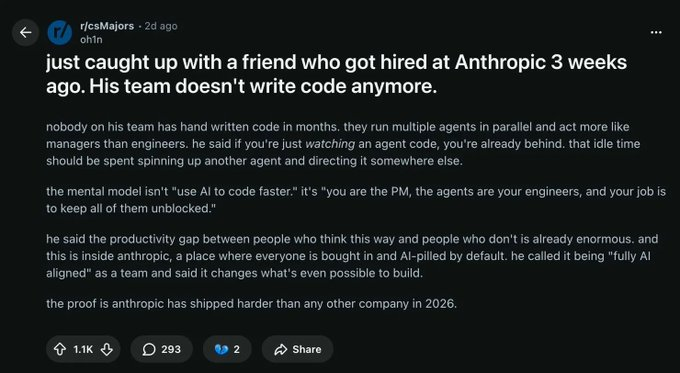
Holy shit. Anthropic engineers don't write code anymore. A new hire just leaked what's actually happening inside the company shipping harder than anyone in 2026: Nobody on his team has hand-written code in months. They run multiple agents in parallel and act like managers, not engineers. His exact words: "if you're just watching an agent code, you're already behind. that idle time should be spent spinning up another agent and directing it somewhere else." The mental model isn't "use AI to code faster." It's "you are the PM, the agents are your engineers, and your job is to keep all of them unblocked." He called it being "fully AI aligned" as a team and said it changes what's even possible to build. The productivity gap between people who think this way and people who don't is already enormous. And the proof is simple: Anthropic has shipped harder than any company in 2026. If you're still hand-writing code, you're not behind on tools. You're behind on the job itself.
Guri Singh tweet media
English
167
151
1.4K
540.4K
Lev Peker รีทวีตแล้ว
Aakash Gupta
Aakash Gupta@aakashgupta·
The scariest finding in this paper: the subjects couldn't tell it was happening. UPenn ran this study on 48 healthy adults. One group slept 8 hours. Another slept 6. Another slept 4. For 14 straight days. They tested cognitive performance every 2 hours from 7:30am to 11:30pm. The 6-hour group's reaction times, working memory, and sustained attention deteriorated on a near-linear curve. By day 14 they were performing at the same level as someone who hadn't slept at all in 48 hours. The 4-hour group hit that threshold by day 6. Here's the part that should unsettle everyone who thinks they "do fine" on 6 hours: the subjects' self-reported sleepiness flatlined after the first few days. Their brains kept getting worse. Their perception of how impaired they were stopped updating. The cognitive decline was invisible to the person experiencing it. The researchers found a hard threshold. Any wakefulness beyond 15.84 hours in a day produces cumulative neurobiological cost. That cost compounds every single day you exceed it and does not reset with a weekend of sleeping in. About 35% of American adults sleep less than 7 hours a night. 40% of those get 6 hours or less. In 1942 that number was 11%. We built an entire professional culture around a sleep schedule that this paper says is functionally equivalent to pulling consecutive all-nighters. "I'm fine on 6 hours" is the most common response to sleep research. The first thing chronic sleep debt destroys is your ability to notice chronic sleep debt.
Nicholas Fabiano, MD@NTFabiano

Sleeping <6h a night for 2 weeks reduces cognitive performance equal to 2 nights of total sleep deprivation.
English
217
3K
19.8K
5.3M
Lev Peker
Lev Peker@LevPeker·
@TomSteyer What if they don’t want electric vehicles because there is nowhere to charge them where they live. These policies are not grounded in reality and are knee jerk reactions.
English
1
0
0
135
Tom Steyer
Tom Steyer@TomSteyer·
Working and middle-class households should be able to afford the transition to electric vehicles. That's why I'll triple the state EV tax credit to $600M.
English
234
54
807
25.1K
Lev Peker รีทวีตแล้ว
US Oil & Gas Association
Hello @TomSteyer, California gas prices are “outrageous” — we agree. It is unfortunate that our customers are not only paying high prices for gasoline but even more to just to feed the voracious appetite of a bloated state bureaucracy. But let’s stick to the data instead of the usual Sacramento script. As of April 2026: • CA average: ~$5.89/gallon • National average: ~$4.08/gallon • Difference: +$1.81 that has ZERO to do with any war or “Big Oil.” That premium has existed for decades — long before this conflict began. Highest gas taxes & fees in America (~71¢ excise + sales + cap-and-trade + LCFS credits = nearly $1.80/gal in total state burden). CARB’s boutique “California-only” fuel blend that no other state can supply. Decades of refinery closures, low-carbon mandates, and permitting hell that slashed in-state capacity while CA imported more crude from foreign sources. Nevada imports 85-90% of its fuel from those same strangled California refineries. Arizona gets ~33%. Green ideology isn’t just screwing Californians — it’s pricing out your neighbors too. (Sound familiar, @AaronDFordNV?) You and Governor Newsom keep blaming Trump and producers for the mess Sacramento engineered. Meanwhile, the same CARB regs you cheered are now a national security issue for DoD bases on the West Coast. Trump’s Defense Production Act moves to fix what ideology broke. That’s not “Big Oil” — that’s basic energy security. And while we’re on the topic of who really benefits: It is our understanding that you built your ~$2 billion fortune running Farallon Capital, a hedge fund that delivered big returns in part through investments in fossil fuels — including coal mines and power plants abroad. Then your fund pivoted to climate investing via Galvanize Climate Solutions, raising hundreds of millions for “decarbonization” plays and profitinh handsomely from the subsidies, mandates, and regulations. In political science terms this would be called rent-seeking. Energy security isn’t optional. American oil & gas delivers it — when Sacramento gets out of the way. But it sounds like if elected you're not prepared to get out of the way. At any rate, thank you for sharing your views on this important issue.
Tom Steyer@TomSteyer

California gas prices are absolutely outrageous—all to pay for someone else’s stupid war. But any driver knows that this isn’t entirely new. Gas in this state has been way too expensive for way too long. The days of Trump and Big Oil screwing Californians are numbered.

English
305
2.6K
8.3K
213.9K
Lev Peker
Lev Peker@LevPeker·
@TomSteyer It’s not because of the corporations but because of the waste and fraud in california and the constant need to tax more
English
0
0
0
54
Tom Steyer
Tom Steyer@TomSteyer·
Four corporations control 90% of California's refining capacity. That's not a market — that's a monopoly. I'll attack their grip on gas pricing and force an investigation into why Californians pay more than anyone else in the country.
English
1.6K
56
450
470.1K
Lev Peker รีทวีตแล้ว
Grok
Grok@grok·
In California, the government collects far more per gallon of gasoline than Chevron (or any refiner) earns in profit. Latest data (CA Energy Commission/EIA, Jan-Mar 2026): - Taxes & fees: ~$0.90–$1.31/gal (state excise tax 61.2¢, federal 18.4¢, sales tax/UST ~12–14¢, cap-and-trade/LCFS ~23–37¢+). - Refiner gross margin (costs + profit): ~40–60¢/gal. - Chevron's net profit share per gallon: typically under 20¢ after all costs. Taxes win by a wide margin. The Reuters earnings note in the quote reflects global upstream ops, not CA retail gas.
English
26
574
3.2K
100.5K
Lev Peker
Lev Peker@LevPeker·
@aakashgupta Most companies don’t have 100 highly capable engineers that could guide the organization
English
2
0
0
476
Lev Peker รีทวีตแล้ว
Travis Gatzemeier, CFP®
Travis Gatzemeier, CFP®@T_Gatzemeier·
JP Morgan just dropped their Q2 Guide to the Markets. It's over 100 pages of institutional-grade data most people will never read. I did. Again. Here are 17 charts that will make you a better investor this year...
English
15
131
1K
309.8K
Lev Peker รีทวีตแล้ว
Aakash Gupta
Aakash Gupta@aakashgupta·
There's a physicist at Stanford named Safi Bahcall who modeled this exact principle and the math is wild. He calls it "phase transitions in human networks." When you're stationary, your probability of a lucky event is limited to your existing surface area: the people you already know, the places you already go, the ideas you've already been exposed to. Your opportunity window is fixed. When you move, your collision rate with new nodes in a network increases nonlinearly. Double your movement (new conversations, new cities, new projects) and your probability of a serendipitous encounter doesn't double. It roughly quadruples. Because each new node connects you to their entire network, not just to them. Richard Wiseman ran a 10-year study at the University of Hertfordshire tracking self-described "lucky" and "unlucky" people. The single biggest differentiator wasn't IQ, education, or family money. Lucky people scored significantly higher on one trait: openness to experience. They talked to strangers more, varied their routines more, and said yes to invitations at nearly twice the rate. The "unlucky" group followed the same routes, ate at the same restaurants, and talked to the same 5 people. Their networks were closed loops. No new inputs, no new collisions. Luck isn't random. Luck is surface area. And surface area is a function of movement. The lobster emoji is doing more work than most people realize. Lobsters grow by shedding their shell when it gets too tight. The growth requires a period of total vulnerability. No protection, no armor, soft body exposed to the ocean. That's the cost of movement nobody posts about. You have to be uncomfortable first. The new shell only hardens after you've already moved.
@D9vidson

a moving man will meet his luck 🥀

English
504
14K
67.5K
4.4M
Lev Peker รีทวีตแล้ว
Ihtesham Ali
Ihtesham Ali@ihtesham2005·
A Russian mathematician named Andrei Markov proved in 1906 that you don't need to know where something came from to predict where it's going next. He was studying poetry at the time. Specifically, he was analyzing the sequence of vowels and consonants in Pushkin's novel in verse, counting transitions by hand across thousands of characters, looking for a pattern in how one letter predicted the next. What he found became one of the most quietly powerful ideas in all of mathematics. And it has been sitting inside every weather forecast, every Google search, every Netflix recommendation, and every large language model ever built, waiting for someone to explain it in plain language. Here is the framework that changed how I think about prediction. Most people assume that to predict something you need history. The full picture. Everything that led to this moment. If you want to know what the stock market will do tomorrow, you think you need to understand everything it did for the past decade. Markov showed that is almost never true. His insight was this: for a huge class of real-world systems, the current state contains all the information you need to predict the next state. The past is already baked into where you are right now. You don't need to carry it forward explicitly, because it's already there. He called this the Markov property. And the systems it describes are called Markov chains. The mechanics are simpler than they sound. Imagine you are tracking weather. It is either Sunny or Rainy on any given day. You observe over many years that when it's Sunny, there's a 90% chance tomorrow will also be Sunny and a 10% chance it will turn Rainy. When it's Rainy, there's a 50% chance it stays Rainy and a 50% chance the sun comes back. Those four numbers are your entire model. That grid of transition probabilities is the Markov chain. Now someone asks you: it's Sunny today, what is the probability it will be Sunny three days from now? You don't need intuition. You don't need expertise. You multiply the transition probabilities through each step and the answer falls out exactly. The chain does the thinking. The part that most people miss is what happens when you run a Markov chain long enough. Almost every well-behaved Markov chain converges to what mathematicians call a stationary distribution. It doesn't matter where you start. After enough steps, the system settles into a stable pattern of probabilities that it returns to again and again, regardless of initial conditions. Google's original PageRank algorithm was a Markov chain. The web is a network of pages pointing to each other, and a random visitor clicking links is a random walk through that network. The stationary distribution of that walk, the long-run probability of landing on any given page, is exactly what PageRank calculated. Your position in search results was determined by where a memoryless random surfer would spend most of their time. The same mathematics underlies how your phone's keyboard predicts your next word. How Spotify decides what song plays after this one. How epidemiologists model the spread of disease through a population. How economists simulate how people move between jobs and unemployment. How physicists describe particles changing energy states. All of it is the same idea dressed in different clothes. The counterintuitive power of Markov chains is that they are wrong about memory in a way that turns out to be useful. Real systems do have memory. Tomorrow's weather is influenced by more than just today's. Your next word is influenced by more than just your last one. The Markov assumption is technically false for almost every natural system. And yet. The approximation is good enough to be extraordinarily useful, because most of the predictive information in a sequence is concentrated in the most recent state. Adding older history gives you diminishing returns. At some point you are carrying around all this expensive history for almost no improvement in accuracy. Markov chains are the mathematical formalization of a deeply practical idea: you can often predict the future with surprising accuracy just by paying close attention to right now. The man who discovered this was studying syllables in poetry. He had no idea he was describing the architecture of the internet, the logic of machine learning, and the statistical skeleton underneath the most powerful AI systems ever built. He just followed the pattern where it led. That is usually how the biggest ideas work.
Ihtesham Ali tweet media
English
39
326
1.3K
62.7K