Martin O'Dea

117 posts

Martin O'Dea banner
Martin O'Dea

Martin O'Dea

@MartinODea10

CEO of Applied Longevity Intelligence Services (ALIS) & Longevity Summit Dublin

Dublin, Ireland เข้าร่วม Haziran 2022
164 กำลังติดตาม158 ผู้ติดตาม
Martin O'Dea
Martin O'Dea@MartinODea10·
2/2 Europe does have an event that is focused on aging science and brings the community together. We will try our very best to help this happen at LSD 2026.a
English
0
0
0
19
Martin O'Dea
Martin O'Dea@MartinODea10·
1/2 Very sad news about ARDD 2026. For many of us the end of August is one of the highlights of our year. There really is an awful lot of work behind these events and we hope Morten and team come back in 2027 and enjoy success in Boston in '26 For 2026 it is essential though that
English
1
0
0
30
Martin O'Dea
Martin O'Dea@MartinODea10·
@MaxUnfried No rejuvenation therapies now or in the foreseeable are given to people over 70. So if this is the metric of success we use we are in trouble for at least another half century.
English
0
0
1
80
Max Unfried
Max Unfried@MaxUnfried·
If you were 100 in 1850 you would most likely die within ~2 years. If you turn 100 in 2025 you would most likely die within ~2 years. We really haven’t made progress in the last 175 years when it comes to pushing the boundaries of life extension, especially as old age.
English
25
13
168
17.9K
Martin O'Dea รีทวีตแล้ว
Longevity Summit Dublin
Longevity Summit Dublin@LongevityDublin·
William Greene at #LSD2024 @hevolution_f aims to revolutionize healthspan science • Funding cutting-edge research • Supporting biogerontology investigators • Translating discoveries into therapeutics • Launching VC for longevity biotech Full talk here: youtu.be/KzPp1LV04Fg?si…
YouTube video
YouTube
English
1
3
13
1.2K
Morgan Levine
Morgan Levine@DrMorganLevine·
I just came across this hilarious meme.😂🏃🏼‍♀️
Morgan Levine tweet media
English
5
2
46
4.3K
Martin O'Dea รีทวีตแล้ว
thefranceway
thefranceway@thefranceway·
Fragmented data, privacy breaches, inefficiencies—healthcare faces numerous challenges. Blockchain is revolutionizing healthcare and longevity research by transforming data management, enhancing clinical trial platforms, and empowering patients with data ownership, transparency, and incentives.
English
1
2
9
444
Martin O'Dea
Martin O'Dea@MartinODea10·
@fedichev I see logic @davidpblackmore response but think we need to walk and chew gum concurrently here. error is not trusting public with multiple goals. Prevent disease but also prevent decline. research on both. Prevent decline may help slow disease, but is a different biological goal
English
0
0
4
216
Peter Fedichev
Peter Fedichev@fedichev·
Want me to explain why the popular shift from focusing on lifespan to healthspan is a bad idea? First, let’s understand why this narrative persists. Current medicine is incentivized to fight diseases, many of which are chronic, that is irreversible. Naturally, preventing diseases sounds good, and since aging is the biggest risk factor, they say, 'Why not slow aging to reduce disease burden?' You may have heard the vision: people live disease-free past 100, then one day drop dead with zero medical costs, the ideal citizen. This 'squaring the curve' argument referencing the shape of the survival curve sounds great, right? But here's the question few people ask: if all is so perfect, life is good, then why does the person still die? Even disease-free, humans become increasingly fragile. Aging isn't just a sum of diseases; it's the progressive accumulation of irreversible damage leading to a linear decline of key functional indicators, such as IQ, VO2max, EGFR (kidney function), etc. A 90-year-old without disease is still functionally a disabled version of their younger self. Squaring the curve by optimizing healthspan toward maximum lifespan won’t intercept aging (this requires a proof and it will soon follow). Yes, lifespan and healthspan may increase, but without addressing aging, it's a path to prolonged disability. Lifespan is a bad measure of aging. It’s hard to track, influenced by diseases, and optimizing it may more often than not lead to inhumane outcomes. Maybe that’s why many intuitively resist the idea of 'anti-aging' drugs. Carthago delenda est. Aging must be stopped. Like, follow, and repost if you agree."
English
16
18
112
9.4K
Martin O'Dea รีทวีตแล้ว
Aubrey de Grey
Aubrey de Grey@aubreydegrey·
I spoke at the excellent #ARDD2024 last week and broke the habit of a lifetime by presenting data :-) (On RMR1, natch.) Those who missed the livestream will have to wait for the video, but here's a photo (by Eugen Chirita), one of 100s at the site: photos.google.com/share/AF1QipPe…
English
1
15
82
5K
Martin O'Dea รีทวีตแล้ว
Henrik Sotnedal
Henrik Sotnedal@Sotnedal·
Another great update and comments from @aubreydegrey Definitely worth reading and supporting. RMR is an important milestone and threshold for future interventions and public awareness. When RMR is achieved, everyone will start talking about rejuvenation and demand action.
Aubrey de Grey@aubreydegrey

Here's the August RMR1 update! We're getting fairly near to the end of the study - but how near, we certainly can't yet say. Six of the 20 treatment groups, two male and four female, are now extinct, but the all-treatment groups of both sexes are still at 25% survival at over 35 months of age, which gives hope that the longest-lived mouse in the entire study will turn out to be fairly impressive. Across all 20 groups combined, 67 mice are still alive. The more detailed analysis, teasing out the relative impact of different treatments, is getting more and more clear and interesting. Here are a few highlights. 1) I think we have to accept that our senolytic was a bust. We have some theories about why - more on that in due course - but in short we definitely do NOT think senolytics in general are useless, just that there's still some way to go to extract their full potential. 2) As I noted in the last update, the impact of the other damage-repair treatments (HSCs and telomerase) over and above rapamycin is disappointingly insignificant in females but looks rather good in males. In fact, at this point it begins to be arguable that the damage-repair treatments actually DIMINISH the benefits of rapa in females - but have the opposite, i.e. beneficial, impact in males. This is definitely something requiring more thought - and, of course, more studies - but first let's see how things look when RMR1 is complete. 3) The only-telomerase group is the one with the starkest sex-disparity: bucking the above trend, it was downright bad for male mice but definitely beneficial for females. Was that disparity big enough to survive statistical significance, given how many hypotheses we are testing simultaneously in this study? Watch this space! In that vein, I must as usual repeat my caution not to run too much with any of this quite yet. Nothing that I say above has been validated by rigorous statistical analysis, and the main reason it hasn't is that there is still so much that can change as a result of those last 67 mice. If you doubt me, just look at the all-but-rapa males over the past 250 days. In the first 125 of those days, there were 15 deaths, reducing the cohort from 19 to 4 (not including those culled for tissues); and in the subsequent 125 days, there have been... zero deaths. We can expect more such fluctuations - it's an inevitable consequence of the fact that this experiment started with "only" 1000 mice, not 10000.

English
2
3
15
819
Martin O'Dea รีทวีตแล้ว
Aubrey de Grey
Aubrey de Grey@aubreydegrey·
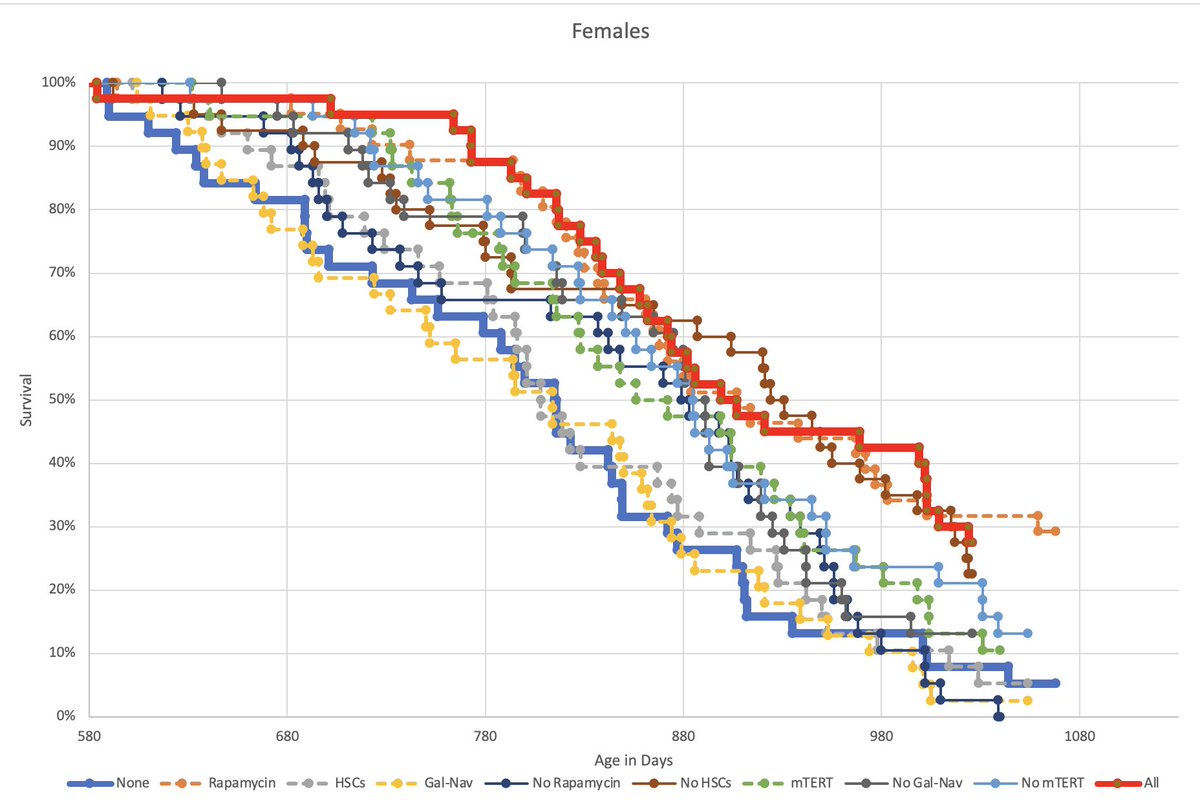
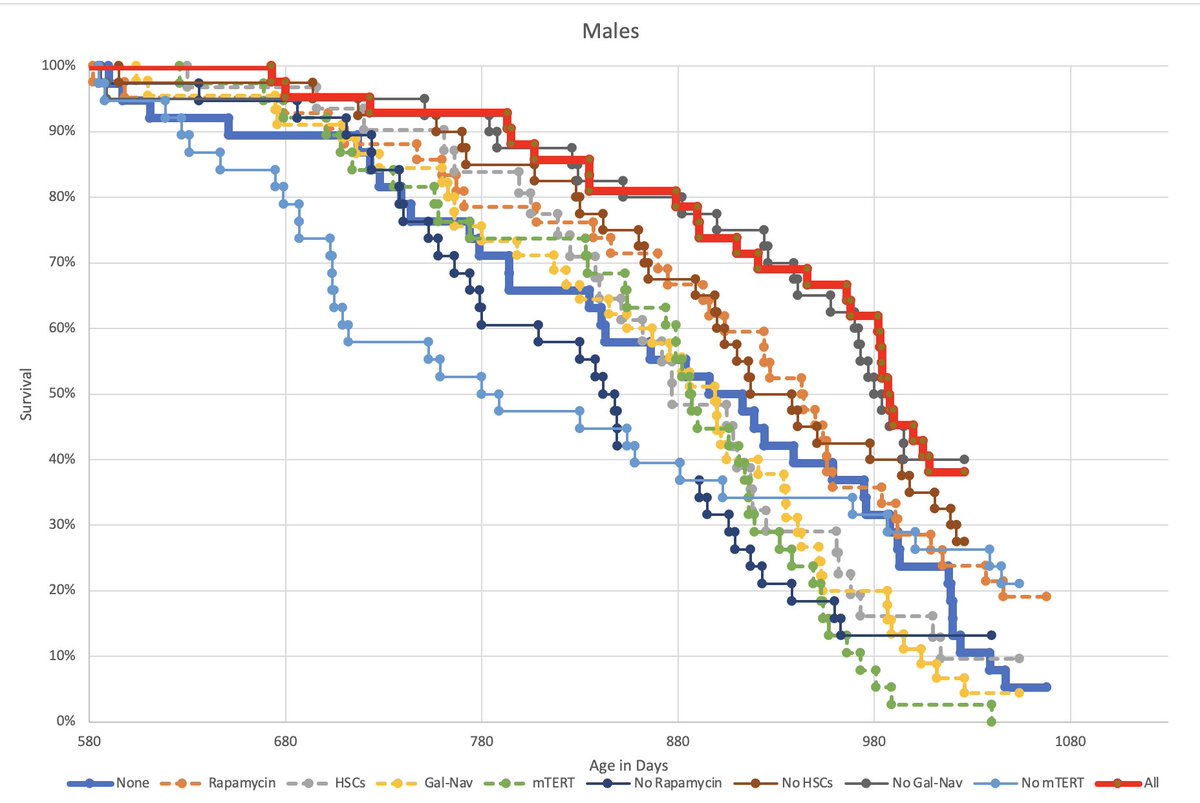
Many apologies for having skipped a monthly update - I was just too swamped with preparations for @LongevityDublin (which was a roaring success as always - if you didn't attend, you missed a real feast of education and entertainment). Back on track now though! This update marks a milestone, namely that one treatment group of each sex has now entirely expired. For males it's the group getting only telomerase, and for females it's the group getting everything except rapamycin. In females, moreover, the group getting only rapamycin is doing as well as the group getting everything - both of them are still above 25% survival. I think it's now fair to conclude that the impact of rapamycin in the female groups has overshadowed everything else - which is disappointingly boring, but which we will of course be analysing in much greater depth as we collate more of the firehose of data on mouse health that we've been collecting. In males, however, the situation is altogether more interesting, and since males of this strain are well known to live longer in the first place (and considerably more lifespan studies have been done on males than on females anyway), that's for sure the sex I would choose to give interesting results. Here, the rapa-only groups is also doing better than any of the other single-treatment groups, but it's being beaten not only by the all-four group but also by three of the three-treatment groups. Indeed, the all-but-rapa group, which was doing the worst of all a few months ago, has now overtaken all the other groups that aren't getting rapa. So at this point it can reasonably, albeit still tentatively, be said that the three bona fide damage-repair interventions are indeed conferring meaningful benefit over and above rapa in males, even if not in females. Nonetheless, the results for both sexes strongly argue for the decision we've provisionally made regarding RMR2, which is to give everyone rapa so as to provide the best possible baseline. We've also, finally, reached the point where all groups have passed the 50% mortality point and we can thus do final analysis on median lifespans. But honestly I'm not sure there's much point, because everyone is (rightly) much more interested in maximum lifespans, which we're getting close to being able to analyse too. It's certainly weird that the no-telomerase group and the no rapa group fell below 50% in males at so early an age, but since they both completely caught up I have difficulty getting intrigued. And all other groups are maintaining pretty much the same rank order that they had at 50% survival (and indeed at 75% survival), so we may as well wait until the curves are complete (or almost so,anyway) before analysing them further.
Aubrey de Grey tweet mediaAubrey de Grey tweet media
English
15
24
224
14.2K
Martin O'Dea
Martin O'Dea@MartinODea10·
@BarackObama Big ol place America with a colourful political adolescence still breathing, and so difficult to pinpoint single moments. Could spend hours on why but your orchestrating Biden over Bernie (from an Irish no dog (but humanity) in fight perspective)) could be last and sturdiest nail
English
0
0
0
8
Barack Obama
Barack Obama@BarackObama·
Bad debate nights happen. Trust me, I know. But this election is still a choice between someone who has fought for ordinary folks his entire life and someone who only cares about himself. Between someone who tells the truth; who knows right from wrong and will give it to the American people straight — and someone who lies through his teeth for his own benefit. Last night didn’t change that, and it’s why so much is at stake in November. joebiden.com
English
88.8K
72.6K
559.7K
121.5M