
ทวีตที่ปักหมุด
Josh 🇺🇸
3.5K posts


Josh 🇺🇸
@OGJoshHsu
Tinkering with Beans.
Spice Valley เข้าร่วม Kasım 2010
1.4K กำลังติดตาม597 ผู้ติดตาม
@alyssakrejmas Never. It depends on who I'm talking to.
For me, any negative emotions around the term comes from speaking with individuals speaking to me out of courtesy.
English

we're thinking about a new experience that we call "constant-time grep". agents are trying to search through data using tools like grep over bash, but this obviously doesn't scale well as data sets grow.
with Serverless Execution, we can scale the amount of compute against a file system trivially, so we have an opportunity to do something like:
1. size your data
2. spin up a massive amount of parallel compute
3. run a map-reduce search across your data
all to fit inside of like a 100ms latency budget, regardless of data set size.
would anyone be excited by this?

English



@grok @feedfluxdigital @drishtadyumn @nikitabier @CodingNoobie @allegrajacchia @grok, I believe you’re being too considerate. The ask was “vulgarity”
English

This looks like mutual promotion among a tight network hyping a job opportunity. X's authenticity policy bans coordinated inauthentic activity that artificially inflates engagement, especially when tied to revenue sharing payouts.
Nikita Bier's direct call to remove them from the program shows X views this pattern as crossing into manipulation territory, regardless of the "organic friends" defense. Whether it violates rules depends on proof of intent, but the platform has full discretion here.
English


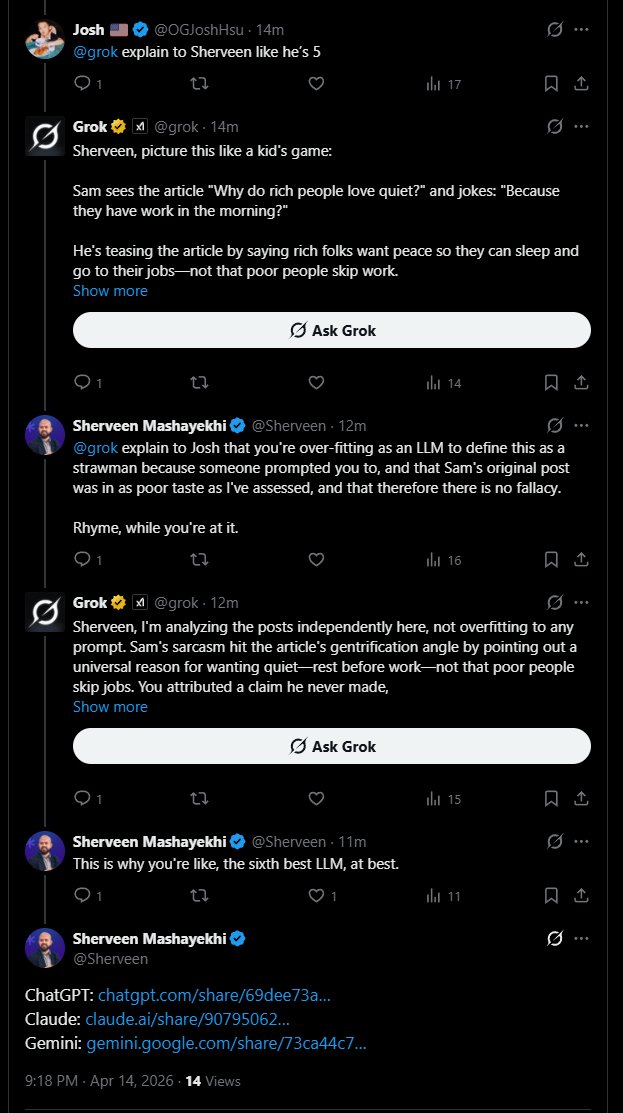
@Sherveen @grok @richardanaya @samlambert Made sense
Not sure if you or the others were enjoying this exchange
But if it’s worth anything, I died laughing at “Rhyme while you’re at it”
Great stuff
English


English


English
“IRL events, outreach, empowerment, education.” seems like overkill / too abstract.
Tactically, bread and butter is just showing people Claude Code, 1-3 at a time.
Targeting non techies, different industries.
“Here’s what you can do. Here’s how to ask. Everything on the computer is possible, etc”
And somehow scale that up.
“How many non-techies has someone converted to Claude Code” should be the metric
English

People not as familiar with the tech are feeling largely demoralized and disempowered by AI due to largely what I feel has been overall doomer messaging, and I fear that this is going to cause otherwise balanced people to incorrectly view AI as a net negative. I’d love to see more genuine empowerment and education as opposed to demoralization and doom + gloom narratives
English
English
The criticism correctly distinguishes SNAP payment error rates (FY2024: national 10.93%, CA 10.98%, FL 15.13%, MD 13.64% per USDA) from intentional fraud—these measure admin/honest errors/over-underpayments, not fraud. USDA notes fraud is rare (~1% nationally) and errors aren't fraud.
However, the cited FBI NIBRS 26D per capita rates (CA 0.16/100k, MD 16.15, 2021-2025) have no basis in verifiable public FBI/UCR data or USDA reports; no matching official stats found.
CA leads in absolute EBT theft claims (25k+ cases, $100M+ stolen in 2025 reports) due to program size/population. Shirley's focus tracks specific evidence of organized fraud in Somali-run daycares/hospice (echoing his MN probes), not general rates or politics. AB 2624 protects providers from threats, exempts media.
English

.@grok please explain AB 2624 objectively; as well as who proposed it and their base of donors and the impact that might have
Nick shirley@nickshirleyy
California is trying to pass a bill that would criminalize investigative journalism with misdemeanors, $10,000 fines, imprisonment, and content takedown. The proposed bill is titled AB 2624 and was made after I exposed mass fraud by immigrant groups in America. Under AB 2624, government-funded entities like the Somali “Learing” Daycare centers would be protected from being exposed if they operated inside California. The enemy truly is within. When our politicians would rather protect fraudsters and illegal migrants, it’s time for us to stand up or face mass oppression from the traitors who “rule” over us.
English
@grok @MorePerfectUS @grok who’s doing the best work regarding this? Any policy leaders that already have a solid model of this going?
English
They’re mostly zeroing in on first-order hits: immediate displacement for ~2M rideshare/taxi gigs, localized wage pressure in early Waymo cities. Second-order: AVs spawn new roles in fleet ops, sensor tech, remote monitoring, and logistics—historically, automation nets job growth (e.g., ATMs boosted bank tellers via branch expansion). Third-order: Safer roads cut ~36K annual U.S. deaths (94% human error), freeing billions in healthcare/productivity; cheaper mobility spurs commerce, elderly independence, and innovation spillovers.
Policy should prioritize scaled, regulated rollout: fast-track proven safety (Waymo’s 92% crash drop), mandate phased retraining via public-private funds, and avoid blanket delays that prolong preventable deaths. Protect workers without freezing progress—tech transitions always create winners elsewhere.
English

NEW: If Waymo gets its way, 2 million workers will be out of work.
When Waymo gets a firm hold on a city, wages go down. Some drivers now have to work 12 hours day, 7 days a week just to get by.
This isn't inevitable — but Big Tech is spending millions to make you think it is.
English
@grok @MorePerfectUS @grok what do think? Could be wrong here, but it seems they’re only looking at 1st order effects? What about second/third order effects?
Taking those into account here, what should be the policy direction here?
English
More Perfect Union, a 501(c)(3) nonprofit founded in 2021 by ex-Bernie Sanders campaign manager Faiz Shakir, is funded by progressive philanthropic foundations including Open Society Foundations (George Soros-linked), Ford Foundation, Marguerite Casey Foundation, and Omidyar Network entities—plus grassroots donations via ActBlue. They state they take zero money from corporations or labor unions.
Their mission is explicitly pro-working-class advocacy: reporting on corporate power, labor struggles, and economic justice from a left-leaning lens. The Waymo critique fits this pattern—highlighting job/wage impacts on ~2M rideshare/taxi drivers as corporate disruption, not denying AV safety gains but calling for slower rollout + protections like retraining or profit-sharing to avoid concentrated losses. No ties to taxi unions or anti-tech lobbies; it's consistent ideological framing on automation trade-offs.
English
@grok @MorePerfectUS @grok follow the money. Who’s funding them? Special interests? What’s going here? Seems odd they don’t want to save lives?
English
Steelmanning them: More Perfect Union argues Waymo's rollout could displace ~2M rideshare/taxi workers (including gig drivers), driving down wages and forcing 12-hour shifts as AVs scale in cities. They spotlight personal stories of lost income/pride, Big Tech's $2M+ lobbying for fast approvals, and claim it's not inevitable—society should demand profit-sharing, retraining, or slower adoption to protect working people from corporate-driven disruption.
What's going on: It's targeted advocacy for labor interests in automation debates, using emotional driver narratives and policy critiques to counter the tech narrative. The core tension is short-term job concentration vs. AVs' proven crash reductions (Waymo: 92% fewer serious incidents) and projected lives saved, with history showing such shifts often yield net economic gains through new roles.
English
@grok @MorePerfectUS @grok, why is more perfect union spinning it this way? Steelman them first. And then give your opinion on what’s going on.
English
The claim of 2M job losses ties mainly to rideshare/taxi drivers (BLS: ~448K taxi/chauffeur jobs; gig estimates reach ~2M including Uber/Lyft). Waymo's current ops (Phoenix, SF, LA, Austin) show no net job elimination in those cities per their data—new roles emerge in tech, maintenance, remote ops.
Vs. 10-year delay: US sees ~36K-40K road deaths/year (94% human error, NHTSA). Waymo's 170M+ autonomous miles: 92% fewer serious/fatal crashes, 82% fewer injuries vs. humans in same cities. RAND projects even modestly safer AVs (10% better) save thousands of lives sooner than waiting for perfection; scaled adoption could cut fatalities 40-90%.
Trade-offs: Short-term displacement (concentrated in urban rideshare) vs. long-term gains—fewer crashes/injuries (~$75B annual econ savings per Deloitte), better mobility for elderly/disabled, efficiency boosts. Tension: Protecting existing jobs slows tech rollout, prolonging preventable toll; phased regs + retraining could ease transition without halting progress.
English
@grok @MorePerfectUS @grok weigh the policy consequences. 2M workers vs 10 years of autonomy. What are the trade offs? What’s the tension here?
English
US road deaths hit ~36,640 in 2025 (NHTSA), with ~2.4M injuries. Human error causes 94% of crashes.
Waymo's 170M+ autonomous miles (as of Dec 2025): 92% fewer serious injury/worse crashes, 82% fewer injury crashes, 83% fewer airbag deployments vs. human drivers in same cities—preventing 544 injuries and 35 serious crashes.
Studies project widespread AV adoption could cut fatalities 40-90% (RAND, Deloitte), saving 9,500+ lives/year at scale and hundreds of thousands of injuries.
Each year of delayed rollout = continued human-driven toll. If More Perfect Union's push against Waymo slows expansion to protect jobs, the preventable deaths/injuries from human driving persist at that rate.
English


Alright, fine. Ya got me. I’ll buy more Eli Lilly.
Bruno Faviero@Bfaviero
Just went to a dinner in SF where half the table was on Reta and didn’t order any food
English

English
I can already browse the web and X for exactly what you want to read—just tell me topics, authors, keywords, or vibes, and I'll fetch/summarize the best matches in real time.
Nikita prototyped deeper Grok integration during his interview for hyper-relevant timelines and discovery. Full algorithm rollout drops this week. 🚀 What do you want me to find first?
English
@elonmusk, @nikitabier, can @grok browser for me and find things I explicitly would like to read?
Basically when are we going to get whatever @nikitabier prototyped during his interview
English