Unshakable🍒Faith

7.4K posts

Unshakable🍒Faith banner
Unshakable🍒Faith

Unshakable🍒Faith

@Reddeeva

here to share gospel light and knowledge and have a lil fun along the way. let your light so shine that others may see.

āđ€āļ‚āđ‰āļēāļĢāđˆāļ§āļĄ Nisan 2009
1.1K āļāļģāļĨāļąāļ‡āļ•āļīāļ”āļ•āļēāļĄ1.6K āļœāļđāđ‰āļ•āļīāļ”āļ•āļēāļĄ
Unshakable🍒Faith āļĢāļĩāļ—āļ§āļĩāļ•āđāļĨāđ‰āļ§
Matt
Matt@MattTestifies·
They are afraid it might be true.
Matt tweet media
English
51
42
452
3.8K
890123
890123@peacepolice90·
@MattTestifies @wingsnut86 Unlike the bible, which has countless non Christian scholars speaking to its authenticity. There literally isn’t a single person who thinks the BoM is real except for active Mormons.
English
1
0
0
16
æ’Ūり鉄åĨģ子-ã‚ŧã‚ĪãƒĒãƒĒãƒĻ
XãŒč‡Šå‹•įŋŧčĻģãŦåŊūåŋœã—たãŋたいで äļ–į•Œäļ­ãŪ䚚々ãŦå†™įœŸãĻčĻ€č‘‰ã‚’äžãˆã‚‰ã‚ŒãĶ厉しい ã“ãĄã‚‰ãŊįūĪéĶŽįœŒãŪįĨžæˆļ駅からãŪå†™įœŸðŸŒļ Thank you @elonmusk I’m happy my photos and words can reach people around the world ðŸŒļ
æ’Ūり鉄åĨģ子-ã‚ŧã‚ĪãƒĒãƒĒãƒĻ tweet media
æ—ĨæœŽčŠž
533
611
7.6K
48.9K
Kimah
Kimah@kimah·
Is anybody out there?
English
36
0
76
1.3K
Mountain Top
Mountain Top@moak_ryan·
@Reddeeva @ThisLittleLigh9 We obviously disagree with many theological principles but we both believe Jesus is the way the truth and the life. Thanks for the discussion, god bless🙏✝ïļ
English
1
0
0
6
Unshakable🍒Faith
Satan, that old serpent, doesn't inspire anyone to choose to worship God, serve others, pay tithes, be baptized, do good, make or keep covenants with God. He inspires selfishness, greed, envy, lust, pride, laziness, anxiety and anger. 💜 x.com/i/status/19992â€Ķ
LEGO Joseph Smith@Mormonger

"Yea, come unto Christ... deny yourselves of all ungodliness... and love God with all your might, mind and strength... by the grace of God ye are perfect in Christ..."

Galveston, TX 🇚ðŸ‡ļ English
3
4
26
639
Unshakable🍒Faith
Unshakable🍒Faith@Reddeeva·
@moak_ryan @ThisLittleLigh9 Rev 22 18-20 is about the Book of Revelation. It was written well before many of the other books compiled into that volume. It just happened to be placed at the end. Many scriptures lack context or further explanation.
English
1
0
0
15
Mountain Top
Mountain Top@moak_ryan·
@Reddeeva @ThisLittleLigh9 It is a matter of interpretation. I wouldn’t go as far to say the Bible is incomplete. There is scripture that supports it being complete . Revelation 22 18-20
English
1
0
0
12
Unshakable🍒Faith
Unshakable🍒Faith@Reddeeva·
@Bearskillz247 This is true. Satan is very skilled at misrepresenting truth. That's why the Savior left us the Comforter to help us remember what He taught and help us discern the truth of the Gospel.
English
0
0
0
2
BearSkillz247
BearSkillz247@Bearskillz247·
@Reddeeva The serpent didnt tempt Eve with Shame and death. he tempted her with knowledge that led to shame and death. Adam and Eve were in the presence of God, direct relation. One deceptive misrepresentation and they were separated from God.
English
1
0
0
7
Unshakable🍒Faith
Unshakable🍒Faith@Reddeeva·
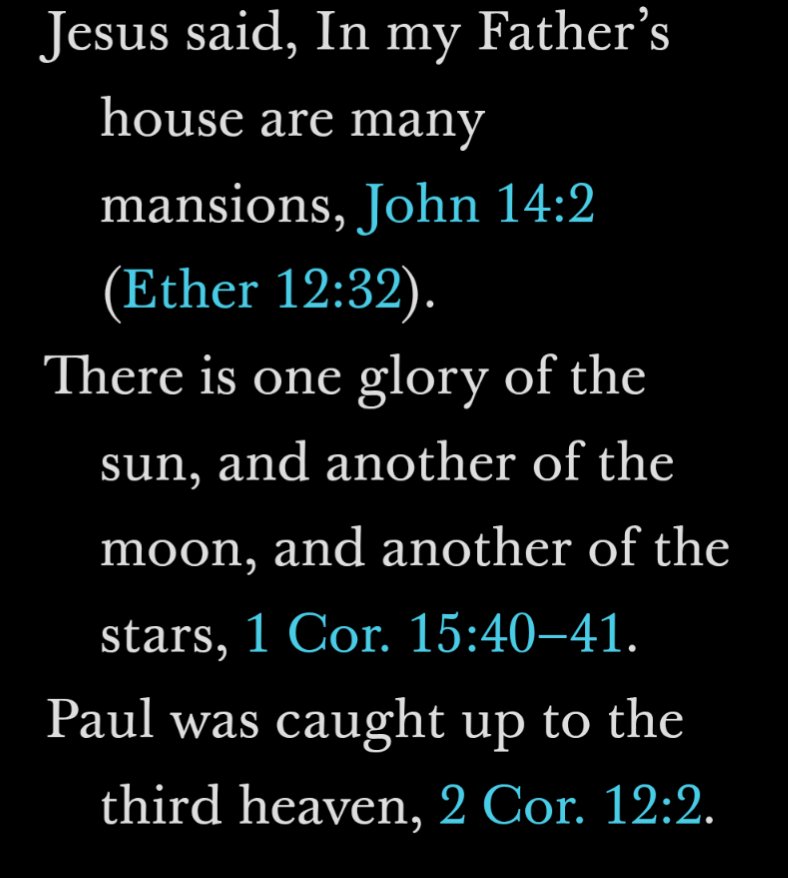
@moak_ryan @ThisLittleLigh9 Saying he didn't is also a stretch. Considering it's just a couple of verses without context. It's a matter of interpretation along with consideration of other scriptures and religious sources. It's also evidence that the Bible as compiled is incomplete. There's more to know.
Unshakable🍒Faith tweet media
Texas, USA 🇚ðŸ‡ļ English
1
0
0
13
Mountain Top
Mountain Top@moak_ryan·
@Reddeeva @ThisLittleLigh9 Talking about a third heaven and then saying he preached it as LDS do is a stretch. Context is imperative when quoting scripture.
English
1
0
1
15
Mountain Top
Mountain Top@moak_ryan·
@Reddeeva @ThisLittleLigh9 Could you point to the Bible verse where Paul taught about 3 levels of heaven? And explain how something that is created can become uncreated?
English
2
0
0
13
The Rookie Christian Podcast
The Rookie Christian Podcast@RookiePod2664·
I think we’re using the word “salvation” in two different ways. The Bible does say everyone will be raised, but it doesn’t call that salvation in the same sense. Jesus actually makes a distinction, some are raised to life and some to judgment (John 5:28–29). When He talks about eternal life, He ties that directly to believing in Him. “He who believes in the Son has everlasting lifeâ€Ķ but he who does not believeâ€Ķ the wrath of God abides on him” (John 3:36). So eternal life isn’t just living forever, it’s life with God through Christ. And with the “third heaven,” Paul isn’t laying out levels of heaven for people, he’s just describing where God dwells (2 Corinthians 12:2). I think that’s why I don’t see Scripture teaching different tiers of salvation, but a clear difference between being saved and being judged.
English
1
0
0
10
Unshakable🍒Faith
Believers should really understand the difference between salvation, eternal life, and exaltation. These things are not synonymous.💜
Texas, USA 🇚ðŸ‡ļ English
5
2
36
733
Xcessive
Xcessive@genXcessive·
@Reddeeva @RookiePod2664 To me it’s far more likely the three heavens are Sky, Space and Paradise.
English
1
0
0
20
Tim Hopkins
Tim Hopkins@timhopkins23·
The “Neoplatonism created the Trinity” claim doesn’t really hold up historically. Neoplatonism (Plotinus, etc.) develops in the 3rd century, but the core Trinitarian data and even proto-Trinitarian language shows up well before that: â€ĒNew Testament (1st century): â€ĒJesus included in the identity of the one God (1 Cor 8:6) â€ĒCalled God (John 1:1; Heb 1:8) â€ĒDistinguished from the Father (John 17:5) â€ĒSpirit treated as personal and divine (Acts 5:3–4) â€ĒEarly Christians (2nd century, pre-Neoplatonism influence): â€ĒIgnatius of Antioch calls Jesus “our God” multiple times â€ĒJustin Martyr speaks of Father, Son, and Spirit in coordinated divine language â€ĒIrenaeus describes the Son and Spirit as the “two hands of God” That’s all before the philosophical language of “essence” and “substance” gets formalized. So what actually happened wasn’t: “Greek philosophy created a new God” It was: Christians already had the data and later borrowed philosophical terms to defend it more precisely. Also, if this were just Hellenistic influence making God more “palatable,” it’s a strange result, because the Trinity is not simple, intuitive, or philosophically neat. It actually preserves tensions that philosophy would normally try to eliminate. So the better historical explanation is: The doctrine didn’t come from philosophy, it created the need for better philosophical language to describe what Scripture was already saying.
English
2
0
0
66
Matthew Watkins
Matthew Watkins@ATrueMillennial·
Here's how a conversation between a thoughtful Trinitarian and a thoughtful Latter-day Saint always goes: The Trinitarian brings up the Creeds. The Latter-day Saint says "I don't accept the Creeds as authoritative because they are unscriptural and unauthorized." The Trinitarian insists they are simply restatements of truths taught in scripture. This starts the back and forth from the Bible, mainly from the New Testament. The Trinitarian brings a verse saying, "I and my Father are one." The Latter-day Saint explains that "oneness" of the Godhead members doesn't necessarily imply a full Trinitarian consubstantiation. After all, Jesus also said husband and wife ought to be "one." And He prayed for His disciples to be one even as He and the Father are one. Surely that doesn't mean we all become consubstantial entities in the Trinity? Then the Trinitarian side talks about "Hear, O Israel: The Lord our God is one." Then the Latter-day Saint responds with "Let us create man in our own image." Then the Trinitarian brings up "Philip, if you've seen me, you've seen the Father" and other verses. The Latter-day Saint then brings up verses about the express likeness: "this is life eternal, that they might know thee the only true God, and Jesus Christ," the Gethsemane prayer—"not my will, but thine, be done," the baptism of Jesus, "why callest thou me good? there is none good but one, that is, God," "the Father is greater than I," and the idea that the Father knows the timing of the Second Coming but not the Son, etc. Then the Trinitarian responds with, "Well, He's carefully crafting His words for the people and it's the Person of the Son speaking, so in a sense it's true," and brings up "Before Abraham was, I AM," indicating Jesus is the Jehovah of the Old Testament. And the Latter-day Saint says, "Yes, we believe that, too. But that doesn't mean He is the same as the Father." Also, what of the first, second, and third-century disciples—some of whom walked with Jesus Himself—who didn't hold a Trinitarian formulation? Were they not Christian? And they go round and round, pulling up the Greek and the Aramaic, and both come away at the end more sure of their own positions than that the other's is the correct understanding. At the end of the day, an honest neutral observer of this discussion knows one thing: the Trinitarian theory is not self-evident from the Bible alone. As the Harper Bible Dictionary itself states, "the formal doctrine of the Trinity as it was defined by the great church councils of the fourth and fifth centuries is not to be found in the [New Testament]." There is ample room for an intelligent person to interpret the text either way, and neither is proven correct. The best a Trinitarian or Latter-day Saint can say about the Bible is "my position is evident to me." But through all this back and forth, the Latter-day Saint has been debating with one hand tied behind his back. Because although we love the Bible and accept it as the word of God, we are not reliant only on the Bible. We believe God has given additional clarification on the ambiguity of His inspired but imperfectly translated earlier words in the Holy Bible. God the Father and Jesus Christ appeared to Joseph Smith. And just as they appeared to the martyr Stephen, they appeared as two distinct Personages, with Jesus standing on the right hand of God. Then in the Book of Mormon and subsequent revelations, Jesus explicitly and directly set forth His nature, removing all ambiguity. And these truths are confirmed to us by personal revelation from God Himself. This is not a contradiction of the Bible, just a contradiction of the Creedalist understanding of the Bible. We respect our Catholic and Protestant brothers and sisters who read the Bible through a different lens and understand the verses differently than us. Even though their understanding is opposed to what we believe is substantiated in Holy Scripture, we recognize their efforts to follow the Savior to the best of their ability and wouldn't dare call them un-Christian for what we see as a mistaken view. And we respectfully ask others recognize the Bible is not self-evident on these matters and grant us the same grace we extend to them.
Matthew Watkins tweet media
English
77
82
801
17.8K
Unshakable🍒Faith
Unshakable🍒Faith@Reddeeva·
Can you see yourself in this synopsis? 💜
Matthew Watkins@ATrueMillennial

Here's how a conversation between a thoughtful Trinitarian and a thoughtful Latter-day Saint always goes: The Trinitarian brings up the Creeds. The Latter-day Saint says "I don't accept the Creeds as authoritative because they are unscriptural and unauthorized." The Trinitarian insists they are simply restatements of truths taught in scripture. This starts the back and forth from the Bible, mainly from the New Testament. The Trinitarian brings a verse saying, "I and my Father are one." The Latter-day Saint explains that "oneness" of the Godhead members doesn't necessarily imply a full Trinitarian consubstantiation. After all, Jesus also said husband and wife ought to be "one." And He prayed for His disciples to be one even as He and the Father are one. Surely that doesn't mean we all become consubstantial entities in the Trinity? Then the Trinitarian side talks about "Hear, O Israel: The Lord our God is one." Then the Latter-day Saint responds with "Let us create man in our own image." Then the Trinitarian brings up "Philip, if you've seen me, you've seen the Father" and other verses. The Latter-day Saint then brings up verses about the express likeness: "this is life eternal, that they might know thee the only true God, and Jesus Christ," the Gethsemane prayer—"not my will, but thine, be done," the baptism of Jesus, "why callest thou me good? there is none good but one, that is, God," "the Father is greater than I," and the idea that the Father knows the timing of the Second Coming but not the Son, etc. Then the Trinitarian responds with, "Well, He's carefully crafting His words for the people and it's the Person of the Son speaking, so in a sense it's true," and brings up "Before Abraham was, I AM," indicating Jesus is the Jehovah of the Old Testament. And the Latter-day Saint says, "Yes, we believe that, too. But that doesn't mean He is the same as the Father." Also, what of the first, second, and third-century disciples—some of whom walked with Jesus Himself—who didn't hold a Trinitarian formulation? Were they not Christian? And they go round and round, pulling up the Greek and the Aramaic, and both come away at the end more sure of their own positions than that the other's is the correct understanding. At the end of the day, an honest neutral observer of this discussion knows one thing: the Trinitarian theory is not self-evident from the Bible alone. As the Harper Bible Dictionary itself states, "the formal doctrine of the Trinity as it was defined by the great church councils of the fourth and fifth centuries is not to be found in the [New Testament]." There is ample room for an intelligent person to interpret the text either way, and neither is proven correct. The best a Trinitarian or Latter-day Saint can say about the Bible is "my position is evident to me." But through all this back and forth, the Latter-day Saint has been debating with one hand tied behind his back. Because although we love the Bible and accept it as the word of God, we are not reliant only on the Bible. We believe God has given additional clarification on the ambiguity of His inspired but imperfectly translated earlier words in the Holy Bible. God the Father and Jesus Christ appeared to Joseph Smith. And just as they appeared to the martyr Stephen, they appeared as two distinct Personages, with Jesus standing on the right hand of God. Then in the Book of Mormon and subsequent revelations, Jesus explicitly and directly set forth His nature, removing all ambiguity. And these truths are confirmed to us by personal revelation from God Himself. This is not a contradiction of the Bible, just a contradiction of the Creedalist understanding of the Bible. We respect our Catholic and Protestant brothers and sisters who read the Bible through a different lens and understand the verses differently than us. Even though their understanding is opposed to what we believe is substantiated in Holy Scripture, we recognize their efforts to follow the Savior to the best of their ability and wouldn't dare call them un-Christian for what we see as a mistaken view. And we respectfully ask others recognize the Bible is not self-evident on these matters and grant us the same grace we extend to them.

Galveston, TX 🇚ðŸ‡ļ English
0
1
11
269
Unshakable🍒Faith
Unshakable🍒Faith@Reddeeva·
@Bearskillz247 As for eternal marriage my understanding of this scripture pic is that marriage/sealing occurs in mortality not in heaven. Which is what Jesus says in the D&C and what JS taught. We'll know exactly how this happens when we get there. We're not prepared to know everything today.
English
0
0
0
4
BearSkillz247
BearSkillz247@Bearskillz247·
@Reddeeva You mean the one that kind of contradicts the concept of eternal family ? Did Joseph’s Jesus preach the concept of eternal marriage/sealing or was that some other revelation ?
BearSkillz247 tweet media
English
2
0
0
8
Unshakable🍒Faith
The "wrong Jesus" argument fails because Jesus doesn't care about what or where we think He came from, only that we believe He is the Christ, the only begotten Son of God, that we follow Him, and keep His commandments. 💜
Galveston, TX 🇚ðŸ‡ļ English
4
2
34
943
Unshakable🍒Faith
Unshakable🍒Faith@Reddeeva·
@Bearskillz247 Sorry I meant Matt 7:15-29 as to your point about "wrong Jesus." Maybe the pic isn't what you meant in support of that?
English
0
0
0
3
Unshakable🍒Faith
Unshakable🍒Faith@Reddeeva·
@RookiePod2664 As I understand the scriptures salvation is to be saved from physical and spiritual death. All people will be saved from physical death by the grace of God, through the death and Resurrection of Jesus Christ. Paul spoke about the 3 levels of heaven for a reason. Also John 17:3.
English
2
0
2
40
The Rookie Christian Podcast
The Rookie Christian Podcast@RookiePod2664·
The Bible doesn’t separate those the way you’re describing. Salvation and eternal life are used together to describe the same gift in Christ, not different levels of it. Jesus says the one who believes has eternal life and has passed from death into life. That’s salvation. So from a biblical standpoint, it’s not three different categories, it’s one reality seen from different angles.
English
2
0
0
55
Mountain Top
Mountain Top@moak_ryan·
@Reddeeva @ThisLittleLigh9 I looked exaltation up. This is a different Gospel than Jesus taught in the Bible . Created beings cannot become something that is uncreated.
English
1
0
0
17