The Overcomer Magazine

2.6K posts

The Overcomer Magazine banner
The Overcomer Magazine

The Overcomer Magazine

@TheOvercomerMag

Proclaiming Christ, not culture. Daily truth from The Overcomer Magazine. No fluff. No politics. Just the Word. For those with ears to hear. Follow along.
เข้าร่วม Mayıs 2025
90 กำลังติดตาม367 ผู้ติดตาม
The Overcomer Magazine
The Overcomer Magazine@TheOvercomerMag·
That verse doesn’t help your case, it actually proves the point. “The meek shall inherit the earth.” (Matt. 5:5) Where does Jesus get that from? Psalm 37, and what is Psalm 37 about? The wicked being cut off, the righteous inheriting what remains and a complete overturning of the present order. Now watch how the New Testament expands it: “Abraham… should be the heir of the world” (Rom. 4:13) Not a strip of land....the world, and Hebrews goes even further: “They desire a better country, that is, an heavenly.” (Heb. 11:16) So the trajectory is not: Land → same land later It is: Land → earth → new creation Jesus is not shrinking the promise to Middle East geography, He is expanding it beyond it. The inheritance is not less real it is greater. You’re reducing the promise back to land. The apostles expand it to the world and ultimately to a heavenly inheritance.
English
0
0
0
5
His Word Never Fails
His Word Never Fails@HisWordForever·
@TheOvercomerMag You have no idea what you’re talking about You don’t know your Bible at all So many verses destroy Yoyr fallacy Here’s just one: The meek shall INHERIT the EARTH
English
1
0
0
19
The Overcomer Magazine
The Overcomer Magazine@TheOvercomerMag·
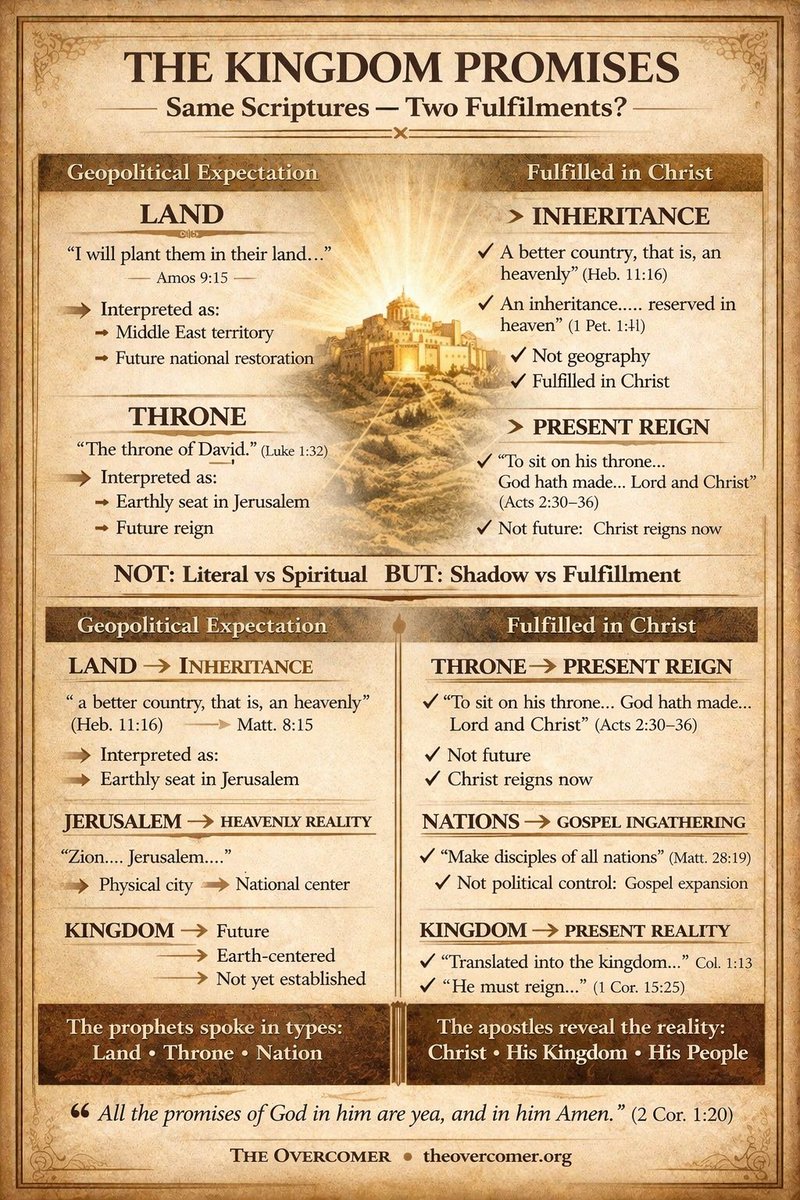
You’re assuming something the apostles never assume: that “land, throne, and nations” must remain geopolitical in fulfillment. But the New Testament shows those promises are fulfilled in Christ, not postponed into an earthly system. Throne? “God… raised up Christ… to sit on his throne” (Acts 2:30–36) Peter doesn’t say “will sit.” He says He is seated now. Kingdom? “Who hath delivered us into the kingdom…” (Col. 1:13) Not future —> present. Jerusalem? “Jerusalem which is above is free…” (Gal. 4:26) “Ye are come unto mount Sion…” (Heb. 12:22) Not earthly geography —> heavenly reality. Land? The apostles never preach land as real estate in the Middle East. Never! They preach: inheritance in Christ a heavenly country (Heb. 11:16) an incorruptible inheritance (1 Pet. 1:4) So the issue isn’t “spiritual vs real,” it’s shadow vs fulfillment The prophets spoke in land, throne, and nation language. The apostles show those realities fulfilled in: Christ His kingdom His people Moving fulfillment back to geography isn’t faithfulness to Scripture, it’s stepping behind the apostles and undoing the way they revealed everything fulfilled in Christ.
The Overcomer Magazine tweet media
English
13
7
26
966
The Overcomer Magazine
The Overcomer Magazine@TheOvercomerMag·
I do indeed want to see yours. I’m not AI. For instance, the Apostles never spoke about a regathering on land in this world, so yes, show me where the apostles spoke of a physical temple, regathering on a strip of land, a geopolitical nation on earth, physical throne on earth and physical nation on earth.
English
0
0
0
2
The Overcomer Magazine
The Overcomer Magazine@TheOvercomerMag·
To my understanding you are still anchoring authority in the “plain sense” of the prophets instead of the apostolic interpretation of those prophets. Do you see what I’m saying? You’re starting with what seems like the “plain sense” of the prophets, and then asking the New Testament to fit that. The apostles do the opposite. They start with Christ and then interpret the prophets through Him. For example: Peter takes the promise of David’s throne and says it is fulfilled in Christ’s resurrection and exaltation (Acts 2:30–36). Hebrews takes Jeremiah 31 and says the New Covenant is already established—not future (Heb. 8:6–13). Paul takes the promises to Abraham and says they are fulfilled in Christ and those in Him (Gal. 3:16, 29). So the issue isn’t preserving the integrity of Scripture, we both want that. The issue is, who defines what those promises mean, the prophets in isolation, or the apostles interpreting them in Christ? You mentioned not wanting to “reinterpret” the prophets. But the apostles do reinterpret them, not by changing them, but by revealing their fulfillment. That’s why what looked earthly becomes: Land → inheritance Nation → one new man Throne → present reign Kingdom → already established So this isn’t me reinterpreting anything, I’m following the plain reading of the apostles themselves and how they handle these prophetic promises. I appreciate the discussion, truly. Feel free to follow along as I continue working through these issues.
English
0
0
0
10
The Overcomer Magazine
The Overcomer Magazine@TheOvercomerMag·
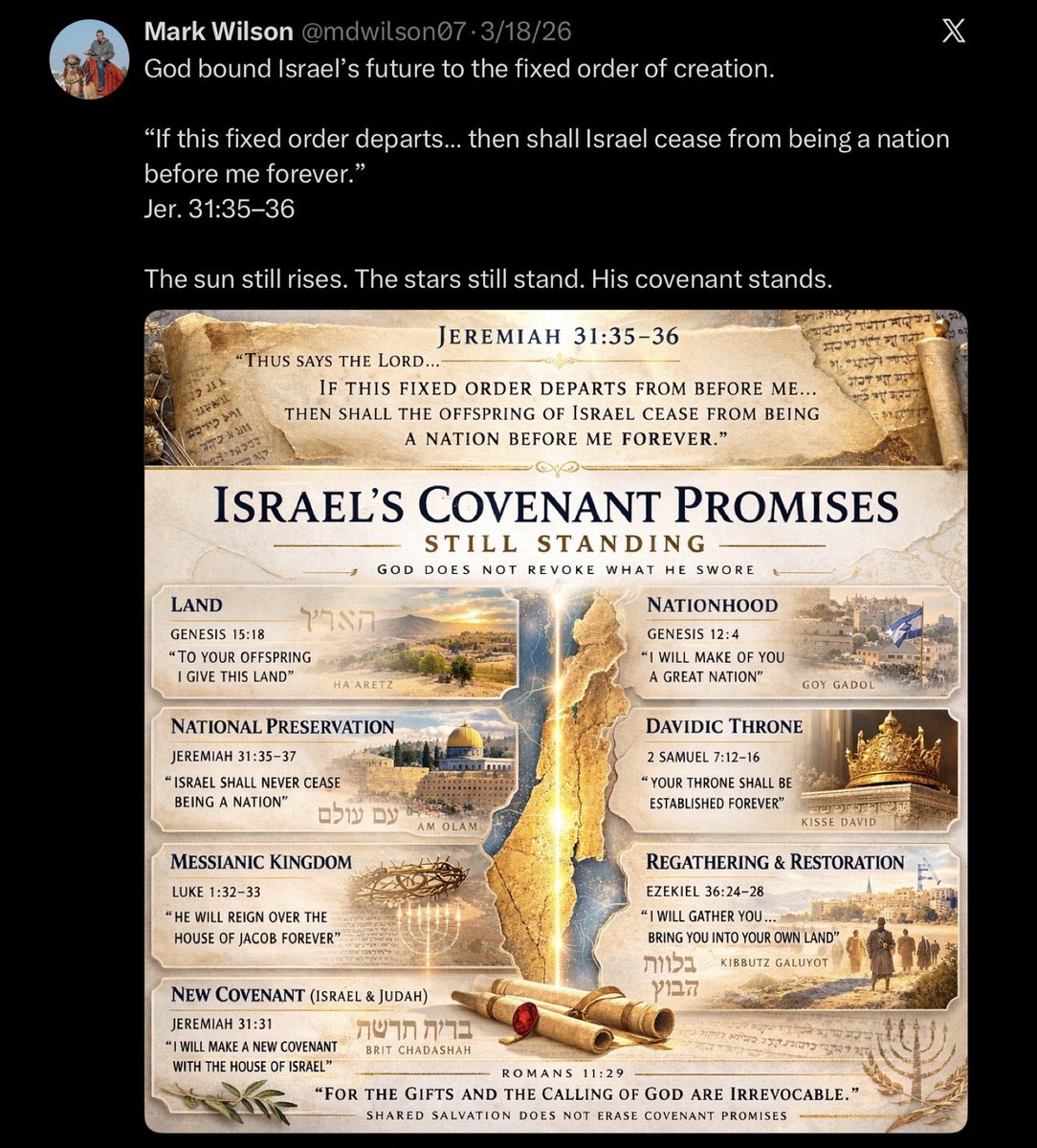
This graphic assumes something that is never proven. That God’s promises must be fulfilled in the same outward form in which they were spoken. But the apostles don’t read Scripture that way. They don’t deny the promises, they reveal what those promises were actually pointing to. Jeremiah 31:35–36 is not about preserving a geopolitical nation forever. It’s about the certainty of God’s covenant people and the New Testament tells us exactly who that is. Because the same chapter says: “I will make a new covenant…” (Jer. 31:31) And Hebrews 8 quotes that and says it is fulfilled in Christ, now, not in a future political system. The graphic takes real verses: Land (Gen. 15:18) Nation (Gen. 12:2) Throne (2 Sam. 7) New Covenant (Jer. 31) …and locks them into a geopolitical framework: Land = Middle East territory Nation = ethnic Israel Throne = earthly Jerusalem Kingdom = future system But the apostles do something very different: Land → Inheritance “A better country… an heavenly” (Heb. 11:16) Nation → One New Man “All one in Christ… Abraham’s seed” (Gal. 3:28–29) Throne → Present Reign “God hath made… Jesus… Lord and Christ” (Acts 2:30–36) New Covenant → Already Established “This is my blood…” (Matt. 26:28; Heb. 9:15) Regathering → Gospel Ingathering “Call them my people…” (Rom. 9:25) So when it says, “Israel will not cease,” Paul explains what that means: “They are not all Israel…” (Rom. 9:6) “The Israel of God” (Gal. 6:16) “If ye be Christ’s… Abraham’s seed” (Gal. 3:29) God did not promise to preserve a strip of land, a political state or a modern nation. He promised to preserve His covenant people, and He has, perfectly, in Christ. The irony is this, he points to the sun, moon, and stars as proof of a physical nation…but the New Testament points to something greater: “One new man” (Eph. 2:15) “Made nigh by the blood of Christ” (Eph. 2:13) So, the real issue is not literal vs spiritual but shadow vs fulfillment. Yes, “God does not revoke what He swore.” Amen. He fulfills what He swore, in Christ. “All the promises of God in him are yea, and in him Amen.” (2 Cor. 1:20) The certainty of Israel is not preserved in geography but in Christ. #ChristianZionism #Dispensationalism
The Overcomer Magazine tweet media
English
4
2
6
202
The Overcomer Magazine
The Overcomer Magazine@TheOvercomerMag·
I understand what you’re saying, but I think the issue runs the other way. It’s not that the New Testament reinterprets a clear earthly system, it’s that the apostles show us what those promises were always pointing to. The question is not, “What does this look like on the surface?” The question is, “How do the apostles interpret it?” Because once they do, that becomes the standard. For example: Peter takes the promise of David’s throne and says it is fulfilled in Christ’s resurrection and exaltation (Acts 2:30–36). Hebrews takes the land promise and says Abraham was ultimately looking for “a better country, that is, an heavenly” (Heb. 11:16). Paul says all the promises are fulfilled in Christ, not postponed (2 Cor. 1:20). So this isn’t about setting aside promises, it’s about recognizing their fulfillment in a way greater than the shadow. And that’s the key difference: You’re starting with the prophets and holding to the surface form, then fitting the New Testament into that. The apostles start with Christ and interpret the prophets through Him. That’s not less literal, it’s more faithful to how Scripture itself teaches us to read Scripture. The issue isn’t whether prophecy is fulfilled, it’s whether we let the apostles define what fulfillment means.
English
0
0
0
10
The Overcomer Magazine
The Overcomer Magazine@TheOvercomerMag·
Sin, self, death—to name a few. Gentiles were never under the Law of Moses, but they were not free. Scripture says they were: “dead in trespasses and sins” (Eph. 2:1) “serving divers lusts and pleasures” (Titus 3:3) “having no hope, and without God in the world” (Eph. 2:12) The Law didn’t create bondage, it exposed it and Christ didn’t come merely to free people from the Law, but from the power of sin itself: “Whosoever committeth sin is the servant of sin” (John 8:34) And: “the law of the Spirit of life in Christ Jesus hath made me free from the law of sin and death” (Rom. 8:2) So even a Gentile “God-fearer” still needed the same deliverance, not from Moses but from Adam.
English
0
0
0
3
Wrestle With God
Wrestle With God@god_wrestle·
@TheOvercomerMag @n647097 @lbeers37 I’m reading the text as if I was a 1st Century Gentile “god fearer” in the synagogues of Corinth. I’d have asked Paul, if I was never under the Law what did Jesus set me free from?
English
1
0
0
16
The Overcomer Magazine
The Overcomer Magazine@TheOvercomerMag·
Zechariah 12 actually proves the opposite of what he is saying because the New Testament tells us exactly how to read it. “They shall look upon me whom they have pierced” (Zech. 12:10) John says this is fulfilled in Christ at the cross: “They shall look on him whom they pierced” (John 19:37) That anchors the chapter in Christ, not in a future geopolitical scenario. And the New Testament consistently redefines Jerusalem: “Ye are come unto… the heavenly Jerusalem” (Heb. 12:22) “Jerusalem which is above… is the mother of us all” (Gal. 4:26) So the focus is no longer an earthly city, but the people of God in Christ. The issue isn’t whether these promises are real, it’s whether we read them the way the apostles did. And they consistently bring them to Christ, not to a future national system.
The Overcomer Magazine tweet media
English
7
5
11
374
Wrestle With God
Wrestle With God@god_wrestle·
@TheOvercomerMag @n647097 @lbeers37 Yes. I’m reading Deuteronomy 4 into the text of 1 Corinthians 15 & vice versa. That’s how Midrash works. The New Testament is full of Midrash. Jesus was a master at Midrash & eisegesis. Paul was too.
English
1
0
0
16
The Overcomer Magazine
The Overcomer Magazine@TheOvercomerMag·
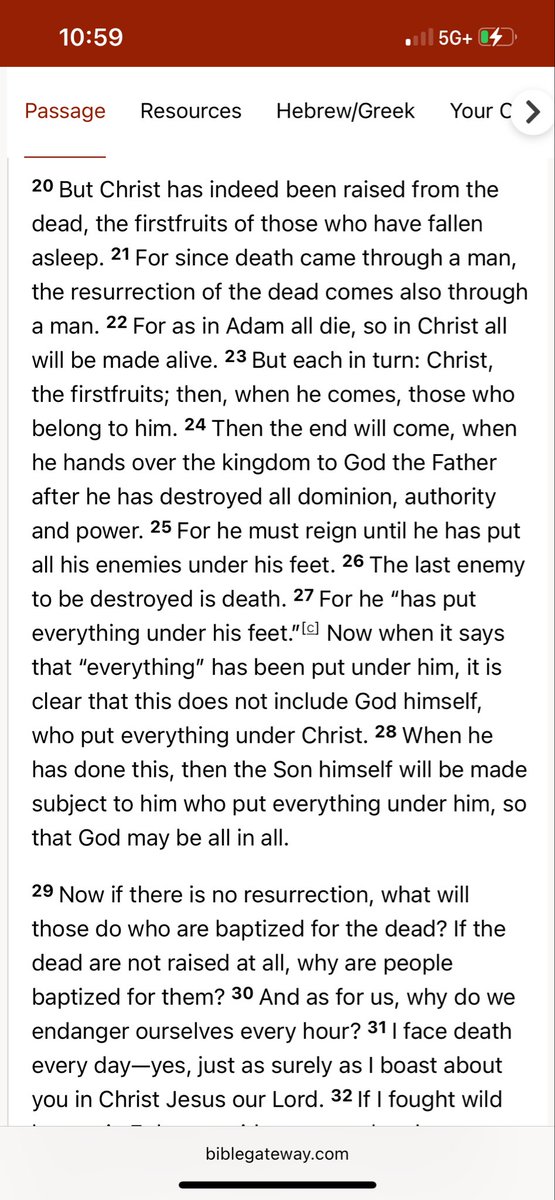
You’re connecting passages that Scripture never connects. Deuteronomy 4 is a warning against idolatry, the sun, moon, and stars being worshiped. 1 Corinthians 15 is about resurrection, the difference between corruptible and incorruptible bodies. Paul is not building a system about “gods ruling nations.” He’s explaining how the body is raised. “There are celestial bodies, and bodies terrestrial…” (1 Cor. 15:40) That’s not about spiritual rulers, it’s about types of bodies, and the whole chapter centers on Christ raised, believers raised, death defeated and death finally destroyed at the resurrection Nothing in the chapter says Christ “became celestial to defeat other gods.” You're reading that into the text.
English
4
0
0
10
Wrestle With God
Wrestle With God@god_wrestle·
@TheOvercomerMag @n647097 @lbeers37 I Corinthians 15 uses the same words in the same order as Deuteronomy 4. Deuteronomy 4 is the “bad news” for all nations except Israel. YHWH has apportioned other “gods” to rule them. 1 Corinthians 15 is the “good news” for Gentiles. Christ became a celestial to defeat the “gods”
English
1
0
0
14
The Overcomer Magazine
The Overcomer Magazine@TheOvercomerMag·
Thank you for your reply and I appreciate the way you’re thinking this through. I think the key difference between us is that you’re trying to hold together physical and spiritual as parallel fulfillments, while the apostles consistently show OT shadow → NT fulfillment in Christ. Acts 1:6 is important but it shows their expectation before the Spirit (which changes after the Spirit). They never mention it again, because now they understand. So, what we see immediately after is not a delay of that expectation, but a transformation of it. Peter doesn’t say, “The throne is still future” He says: “God… raised up Christ to sit on his throne.” (Acts 2:30) Not “will sit”, but "has." And from that point on, the apostles never return to a future earthly throne in Jerusalem or a geopolitical restoration system. Instead, everything is anchored in Christ exalted, Christ reigning now and the kingdom present and advancing. I agree with you that fulfillment doesn’t mean denial but the question is: Does fulfillment preserve the old form or reveal the reality it pointed to? Because the apostles consistently do this: Temple → Christ Sacrifice → Christ Priesthood → Christ Israel → one new man in Christ Inheritance → not land, but a better country (Heb. 11:16) So when it comes to throne and kingdom, they do the same, not postponed, not merely partial but fulfilled in Christ and now revealed. The “tension” you’re describing only exists if we try to hold onto the OT shadow alongside the NT substance. But the New Testament never does that.
English
0
0
0
19
The Overcomer Magazine
The Overcomer Magazine@TheOvercomerMag·
I think you’re mixing categories that Scripture keeps separate. 1 Corinthians 15 isn’t about stars ruling nations, it’s about resurrection bodies: “There are also celestial bodies, and bodies terrestrial…” (v.40) Paul is explaining the difference between our current body and our resurrected one, not building a system about cosmic beings governing nations. And Deuteronomy 4 is warning Israel not to worship the host of heaven not teaching that stars are living rulers over the world. So the issue isn’t “death stars” or celestial rulers the issue is what Paul actually says: Christ is reigning now, putting enemies under His feet and the last enemy...death, will be destroyed at the resurrection. That’s the order of 1 Corinthians 15.
English
5
0
0
11
Wrestle With God
Wrestle With God@god_wrestle·
@TheOvercomerMag @n647097 @lbeers37 Evil continues and Christ still reigns because “The Death Star” has not yet been defeated….IF you think celestial bodies are living beings that controlled the Gentile nations…. Deut 4 / 1 Cor 15 But you don’t believe stars are alive, right?
English
1
0
0
18
The Overcomer Magazine
The Overcomer Magazine@TheOvercomerMag·
You’re mixing two things Paul keeps distinct. Death has been defeated, but it is not yet abolished. “Who hath abolished death, and hath brought life and immortality to light through the gospel.” (2 Tim. 1:10) For those in Christ, death no longer reigns. It has lost its power. “O death, where is thy sting? O grave, where is thy victory?” (1 Cor. 15:55) But 1 Corinthians 15 also tells you the timing: “The last enemy that shall be destroyed is death.” (v.26) So yes, Christ reigns now putting enemies under His feet (present tense), and death will be fully removed at the resurrection (future consummation). That’s the order Paul gives: “Christ the firstfruits… afterward they that are Christ’s at his coming.” (v.23)
English
1
0
0
19
The Overcomer Magazine
The Overcomer Magazine@TheOvercomerMag·
If Peter (and the apostles) didn’t understand the church until later, then your whole system is built on pre-resurrection expectation instead of post-resurrection revelation. Acts 1:6 shows the disciples still thinking in pre-cross, pre-Pentecost categories: “Lord, wilt thou at this time restore again the kingdom to Israel?” That’s their expectation not the final interpretation. Jesus doesn’t affirm it. He redirects them. “It is not for you to know the times or the seasons…” And then immediately points them to what is about to happen: “But ye shall receive power… and ye shall be witnesses…” (Acts 1:8) In other words, the focus shifts from geopolitical restoration → gospel expansion. And once the Spirit comes, everything becomes clear: Peter declares Christ is already on David’s throne (Acts 2:30–36) The kingdom is not postponed, it is established The promises are fulfilled in Christ, not waiting on a future system So yes, Peter didn’t fully understand yet in Acts 1. But that’s exactly why we don’t interpret prophecy from Acts 1. We interpret it from Acts 2 and onward, after the Spirit, after revelation, after the apostles begin preaching. You don’t build doctrine from their questions, you build it from their Spirit-inspired answers. Acts 1 shows their expectation. Acts 2 shows God’s fulfillment.
English
0
0
0
12
Well-Marbled Musings
Well-Marbled Musings@MarbledWell7·
Funny how you parse the passages to make it sound like they reinforce your point. They don’t. The apostles’ understanding? “So when they had come together, they were asking Him, saying, “Lord, is it at this time You are restoring the kingdom to Israel?” Acts 1:6 They don’t ask “if” Jesus will restore the kingdom to Israel, only “when” because God promised and He does not lie. You quoted a piece of Peter’s sermon in Acts 2. It ends like this: “For it was not David who ascended into heaven, but he himself says: ‘The Lord said to my Lord, “Sit at My right hand, Until I make Your enemies a footstool for Your feet.”  Acts 2:34-35 Jesus will sit at his Father’s right hand…until he returns to rule over the nations from Zion, according to Scripture. Peter goes on to say this in response to mockers who question whether Jesus will actually return: “But the day of the Lord will come like a thief, in which the heavens will pass away with a roar and the elements will be destroyed with intense heat, and the earth and its works will be burned up. Since all these things are to be destroyed in this way, what sort of people ought you to be in holy conduct and godliness, looking for and hastening the coming of the day of God, because of which the heavens will be destroyed by burning, and the elements will melt with intense heat! But according to His promise we are looking for new heavens and a new earth, in which righteousness dwells.” 2 Peter 3:10-13 Jesus will return and will make all things new, as he reigns on the throne of David in Jerusalem forever. “Thus says the Lord of hosts, ‘I am exceedingly jealous for Zion, yes, with great wrath I am jealous for her.’ Thus says the Lord, ‘I will return to Zion and will dwell in the midst of Jerusalem. Then Jerusalem will be called the City of Truth, and the mountain of the Lord of hosts will be called the Holy Mountain.’” Zechariah 8:2-3
English
1
0
0
43
The Overcomer Magazine
The Overcomer Magazine@TheOvercomerMag·
That’s exactly the point but it cuts the other way. Scripture never equates “spiritual” with “unreal.” It equates the spiritual with what is more real, more permanent, and from God. “The things which are seen are temporal; but the things which are not seen are eternal.” (2 Cor. 4:18) The issue isn’t that something is spiritual. The issue is when we insist it must remain earthly to be real. That’s where sight takes over. The apostles don’t move us from real → unreal. They move us from shadow → substance. From land → inheritance From temple → Christ From throne → present reign “By faith we understand…” (Heb. 11:3) And Hebrews 11 goes on to say they were looking for: “A better country, that is, an heavenly.” (Heb. 11:16) So this isn’t faithlessness. It’s actually the difference between holding onto visible patterns vs recognizing what those patterns were pointing to in Christ
English
1
0
1
16
The new man
The new man@imagine_vn·
@TheOvercomerMag Unfortunately many people assume that something being spiritual means it doesnot exist, this is faithlessness. But by faith we understand..
The new man tweet media
English
1
0
1
34
The Overcomer Magazine
The Overcomer Magazine@TheOvercomerMag·
They assume the Old Testament must be fulfilled in the same outward form it was spoken: land as geography, throne as a chair in Jerusalem, kingdom as a political system. And you're right, that’s exactly what many in Jesus’ day expected too. They had the Scriptures. They had the promises. But they missed the fulfillment because they didn’t recognize how God would bring it to pass in Christ. How Christians miss this is indeed baffling. The Pharisees didn't have the NT scriptures but Christians do (and supposedly the Holy Spirit) which makes it all the more baffling. The apostles don’t send us back to geography, they bring everything into Christ: The irony is not on this side, it’s on the side that insists on the shadow after the substance has come.
English
0
1
3
27
Traveler Church
Traveler Church@TravelerChurch·
@TheOvercomerMag It baffles me people interpreting scripture like Mark don’t see the irony that they are interpreting the exact same way the Pharisees were in Jesus’ day!
English
1
0
1
33
Dominus Broviscum
Dominus Broviscum@DominusAD78·
You’re setting up a false choice. No one says the Kingdom is “just spiritual.” The NT shows how those promises are applied. They don’t get canceled, they get fulfilled and expanded in Christ. Land? Paul says Abraham inherits the world (Rom 4:13), not a narrow territory. Throne? Christ is already seated and reigning now (Acts 2:30–36). That’s David’s throne fulfilled, not delayed. Nations? They’re coming in through the Gospel right now. And Amos 9 isn’t up for grabs. James interprets it in Acts 15 as the Gentiles being brought into the people of God. That’s the apostolic reading. So you’re taking OT images the NT already explains and pushing them back into geography like nothing changed. Where does the NT ever say Christ’s reign is waiting on a future land-based kingdom instead of being established now in His Church?
English
2
0
1
118
Mark Wilson
Mark Wilson@mdwilson07·
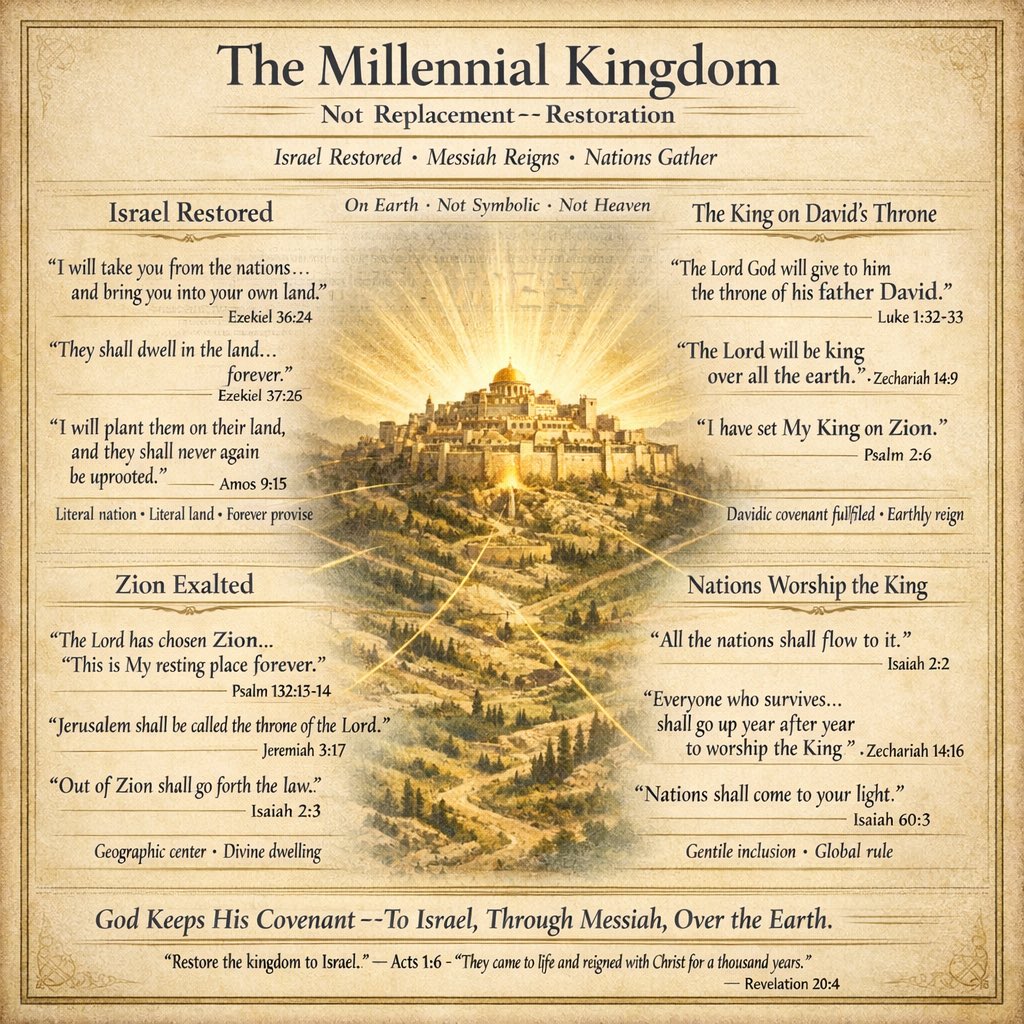
If the Kingdom is just “spiritual,” why does Scripture anchor it to land, throne, and nations? “I will plant them on their land… never again be uprooted” (Amos 9:15) “The Lord God will give him the throne of his father David” (Luke 1:32) This is restoration—on earth
Mark Wilson tweet media
English
78
77
260
13.4K