Jeff

2.4K posts

Jeff banner
Jeff

Jeff

@WithinAllOfUs

Formerly known as MythosMayhem. Theologian dedicated to promoting the love and relationship of One God and Father who is over all, through all and within all.


เข้าร่วม Ekim 2025
198 กำลังติดตาม129 ผู้ติดตาม
Jeff
Jeff@WithinAllOfUs·
@BiblicalBeauty @lukeramone Don’t confuse salvation with redemption. Salvation is the process of living once one understands the good news of redemption.
English
0
0
0
48
Melissa the Hopeful🏠Homemaker
@lukeramone Which is true. Jesus Christ is the only way of salvation. "And there is salvation in no one else, for there is no other name under heaven given among men by which we must be saved.” -Acts 4:12
English
6
4
57
783
Melissa the Hopeful🏠Homemaker
Yesterday, Franklin Graham shared the Gospel at CPAC, warning the audience that "there's gonna be millions of conservatives in Hell," and urging them to place their faith in Jesus Christ for salvation: "I want to talk to you about the most important mission in history. Jesus Christ came on a redemption mission. That's right. Easter's just around the corner. But what does that mean for us? You see, God made us. God created us. He loves us. But mankind has a problem. And that problem is called sin. The Bible says we've all sinned and come short of God's glory. The Bible tells us that the wages of sin is death. Everyone of us, including Franklin Graham, is a sinner... But yet, God so loved the world that he gave His only begotten Son that whosoever believeth in Him shouldn't perish, but should have everlasting life..."
English
71
475
2.7K
62.6K
Jeff
Jeff@WithinAllOfUs·
@BiblicalBeauty Franklin, like many others, wouldn’t know hell from a Municipal Park outside of Jerusalem.
Jeff tweet media
English
1
0
0
304
Jeff
Jeff@WithinAllOfUs·
Does your version of the Bible use the Byzantine or Alexandrian text types of the Ancient Greek MSS? Is it based on the Majority or Critical Text? Which is the most accurate? Once you’ve decided that, which of the four hermeneutics (methods of interpretation) are you going to use for your translation? Is it literal, allegorical, moral or anagogical? Does that hermeneutic match the author’s intent? Is the interpretation then exegetical or eisegetical? In other words, does the translation of your version of Scripture use a translator’s opinion of what the Greek text means? What about the Greek words that have multiple meanings in the English? Does the text contain allegory, metaphor, symbolism, poetry or is it literal? Who is the final authority on which literary device was used by the original author? Again, which combination of these is most accurate to the author’s intent? You can’t just pick up an English Bible as though you’re reading the original text, as man’s opinion is inundated within it, and then believe it to be inerrant. It’s a guide, sure, but it’s not a rulebook. Have the inmates rely on deep prayer while reading and they’ll be much better off.
English
0
0
1
6
Calvin | Fight of Faith
Calvin | Fight of Faith@FightofFaith·
Why do I give out thousands of Bibles in the prisons and jails? The Bible has never been wrong. The Bible will never be wrong. The Bible points us to Jesus.
Calvin | Fight of Faith tweet media
English
79
105
1.1K
7.2K
Jeff
Jeff@WithinAllOfUs·
Is that truth absolute? If your view of Jesus is a physical God-man who was scourged with a whip, ripping flesh and tissue from bone, then slowly asphyxiated while hanging on a piece of wood as a physical sacrifice to subdue God’s wrath, but I read this same story as an allegorical story pertaining to the Spirit of God within humanity, as reflected in Jesus as an archetype of humanity, with a loving Father indwelling His creation through the Son, the doesn’t the story have totally different themes? Mine is founded in a Father’s love within all as represented in the person of Jesus as an archetype, while your’s in founded in wrath and anger only appeased by a bloodlust. I longer “regard Christ according to flesh”, and see the death is the pure, ethereal Logos (Christ) suffering death by becoming mortal, dying flesh and tabernacling within us, which is the proper exegesis of John 1:14. His crucifixion wasn’t a physical beating and slow strangulation, but is the process of each of us metaphorically crucifying our own flesh to give a resurrection of the Spirit (which is buried in the mind, or the place of the skull), and rises in ascension to preeminence within us. Paul explains my theology in 1Cor 15 as his received good news. So is the absolute truth founded in wrath and bloodlust, or love and a spiritual hypostatic union?
English
0
0
0
2
Scott Roberts
Scott Roberts@ScottRoberts·
Truth is not relative; it is absolute. And it is found in the Person of Jesus Christ.
English
8
19
143
1.9K
Jeff
Jeff@WithinAllOfUs·
Are men and women equal, or is the male superior to the female? How are all equal in Christ, but subordinate in role? Is that not contradictory? The answer is that the Bible isn’t discussing human physical sexes & relationships, but spiritual ones. Let start at the beginning: John 1 teaches that in the beginning was the Logos, and the Logos was toward God and God was the Logos. But what does Logos mean? Logos was a Greek concept of divine principle, creation or order. In the beginning was God’s divine order, and that order was ‘toward God (in union with) and God was the divine order. This is a retelling of Genesis 1. An accurate translation of John 1:14 continues “and the Logos became flesh and tabernacled within us”. The divine tented himself, or became mortal, in humanity. We know this Logos in Scripture as the Son, or the Christ. Now let’s go a step further: Galatians 3:28 teaches that “there is neither Jew nor Greek, there is neither slave nor free, there is neither male and female; for you are all one within Christ Jesus.” Note that Paul makes a distinction of slave NOR free, Jew NOR Greek, but male AND female. See the difference here? He compares the two social statuses, but equates the male & female, as these two are one based on the ethereal Logos tabernacling in mortal flesh. The two are not separable in humanity. So what does male and female mean if they aren’t the physical sexes? If in Christ, those male and female aren’t physical sexes, then how does Genesis tell us, “in the likeness of God(s/plural) created him (self), male and female created he them (selves)”. This tells us that the male and female aren’t actual physical attributes of God, as God is ethereal, without substance, form or physical sex. Male & female represent the states of God and his creation. This male/female metaphor carries on throughout the Scripture where the masculine terms of Adam/man/husband all represent that which is spiritual and the feminine terms represent that which is physical. Adam is the archetype of the Logos as the unknown, indwelling spirit, which was also the catalyst for Eve, the entire physical creation. Man & husband continue this allegory was the spirit within mankind. Colossians 1:16 backs this indwelling: “because within Him [the Son] were created all things in the heavens and upon the earth, the visible and the invisible, whether thrones or lordships or rulers or authorities; all things have been created through Him and for Him.” This equates to all of creation. Everything is within, through and for the Son/Christ, and also the Father, for there is “one God and Father who is over all, through all and within all”, Eph 4:6. Also in Ephesians, in 5:22-31, concerning the roles of husband & wife, Paul explicitly states, “This is a great mystery, but I speak concerning Christ and the church” which simply means the spirit of Christ and the body of Christ. If Paul were speaking solely of physical relationships, then there’s no mystery. As these roles started in Genesis with Eve (the physical creation) being through Adam (the Logos of God), Scripture continues this language throughout. In humanity, the spirit/flesh (husband wife) union is our true nature. That which is physical is in subjection to the spirit, i.e. faith over works. When we begin to understand that the male/man/husband represents the spiritual aspect while the female/woman/wife represents the created/material, Scripture begins to coalesce. That which is physical is subordinate to that which is spiritual, which is why we are to walk in the spirit and not in the flesh.
English
0
0
0
3
Skip Heitzig
Skip Heitzig@skipheitzig·
Contrary to popular belief, women’s liberation didn’t start with Gloria Steinem. It started with Jesus 2,000 years ago. In a culture that overlooked women, He saw them, valued them, and showed them compassion.
English
62
402
3.3K
32K
Jeff
Jeff@WithinAllOfUs·
I believe that God’s Spirit is an aspect of Himself, just as the Son/Christ/Logos is another aspect. Personal, but not a distinct person. And of you want to read Scripture truthfully, look at what Scripture says about our own mindset in Philippians 2:5: “Let this mind be in you which was also in Christ Jesus: Who, existing in the form of God, did not consider to be equal with God something to be grasped, but emptied Himself, having taken the form of a servant, having been made in the likeness of men”. This is the mindset that we are to have also. We are to be, “σύμψυχοι, τὸ ἓν φρονοῦντες” or “soul-united minded the same” with Christ in the Father. “We have been co-crucified (συνεσταύρωμαι) with Christ, and we no longer live, but Christ lives within us”. We too are found within the form of God, made in human likeness, and which should also be our mindset.
English
0
0
0
6
TruthBomb
TruthBomb@DroppingTrooth·
@WithinAllOfUs @Truth_matters20 Ok well, IMO, that doesn't change the initial, have value interpretation much. The Spirit still seems likely to be a personal helper of a like kind of Jesus... Part of the godhead, sharing the name of Yahweh. I'm sure you disagree.
English
1
0
0
13
Danny
Danny@Truth_matters20·
You can't possibly miss it if you ACTUALLY read the Bible: "Go therefore and make disciples of all nations, baptizing them in the name of the Father and of the Son, and of the Holy Spirit". —Matthew 28:19
English
34
4
90
3K
Jeff
Jeff@WithinAllOfUs·
Your view of death is a physical God-man being scourged with a whip, ripping flesh and tissue from bone, then to be slowly asphyxiated while hanging on a piece of wood. I read this as an allegorical story pertaining to the Spirit of God within humanity, as reflected in Jesus as an archetype of humanity. I longer regard Christ according to flesh, and see the death is the pure, ethereal Logos (Christ) suffering death by becoming mortal, dying flesh and tabernacling within us, which is the proper exegesis of John 1:14. His crucifixion wasn’t a physical beating and slow strangulation, but is the process of each of us metaphorically crucifying our own flesh to give a resurrection of the Spirit (which is buried in the mind, or the place of the skull), and rises in ascension to preeminence within us. Paul explains my theology in 1Cor 15 as his received good news. As for actions of the flesh, we cannot in one passage believe that everything is permissible, but not everything is beneficial, then create rules where actions are no longer permissible. We can explain how certain actions can lead to detriment in our lives, but not create concrete doctrine where others have to perform a certain level to be accepted by God, for Scripture teaches that He loved us while we were yet sinners (without form). There are no human barriers in any passage of Scripture.
English
0
0
0
12
TruthBomb
TruthBomb@DroppingTrooth·
@WithinAllOfUs @shane_pruitt78 You just don't believe he was crucified in an agonizing and shameful death? We must "hate" the things that threaten the security of those whom we love. Appreciation of the extent of love can only be known by seeing the contrast. Can God's love be known without a protective hate?
TruthBomb tweet mediaTruthBomb tweet media
English
1
0
0
19
Shane Pruitt
Shane Pruitt@shane_pruitt78·
Jesus died over 2,000 years ago. Yet, nobody ever refers to Him as the late Jesus. Never is He referred to in the past tense. Why? Because, of the resurrection! He is the living God!
English
116
485
5K
39.4K
Jeff
Jeff@WithinAllOfUs·
Salvation is the process of walking in the Spirit in this age, which is our zoen aionion, or the spiritual life of the age. No one likes disciple, sure, But when we view God’s chastisement as loving toward His creation to bring us closer to Himself, versus punishing humanity for having being ‘without form’ (sin) within our created state is vastly different. God chastises because He loves, but He doesn’t eternally punish the very state He created. That’s a ludicrous theology. Scripture teaches that there is “one God and Father who is over all, through all and within all”, so He is ever-present. If he eternally condemns us, He eternally condemns Himself. Again, ludicrous. We also read, “Christ is all and within all.” Col 3:11 And “within Him were created all things in the heavens and upon the earth, the visible and the invisible, whether thrones or lordships or rulers or authorities; all things have been created through Him and for Him.” Col 1:16. Who does that not include?
English
0
0
0
1
LoosingToWin
LoosingToWin@LoosingToWin·
@WithinAllOfUs @PastorMark All good parents discipline their kids. We should fear the consequences of doing wrong. If we repent, he is faithful and just to forgive our sins. Salvation is actualized after death. We must live each day obeying Jesus, as His true disciples did. (Philippinas 2:12)
English
1
0
0
7
Pastor Mark Driscoll
Pastor Mark Driscoll@PastorMark·
Jesus is not your buddy, He's your God. We have lost all fear of God in the West, and instead of preaching the actual Gospel, American pastors have turned towards the false gospel of self-esteem which is leading their congregations down a very dangerous path.
English
62
57
336
17.5K
Jeff
Jeff@WithinAllOfUs·
@DroppingTrooth @shane_pruitt78 If fully believe that Christ became flesh, as taught in John 1:1, and 1:14. “and the Logos became flesh and tabernacled within us”. Proper exegesis is critical.
English
1
0
1
21
Jeff
Jeff@WithinAllOfUs·
In the Greek, verbs do not have gender. John 14:16,17 is literally “And I will ask the Father, and will give you another (of the same kind) helper, that may be amid you to the age--the Spirit of truth, whom the world is not able to receive, because does not see nor know. But you know for abides near you and will be in you.” The addition of the personal pronouns aren’t found in the Greek text. ‘He’ can also be translated as ‘she’ or ‘it’.
English
1
0
1
21
TruthBomb
TruthBomb@DroppingTrooth·
@WithinAllOfUs @Truth_matters20 What do you say of John 14:16-17 then? We have different views of the Trinity, and I would say my leanings are non-traditional. They arise largely out of John 17.
English
1
0
0
30
Jeff
Jeff@WithinAllOfUs·
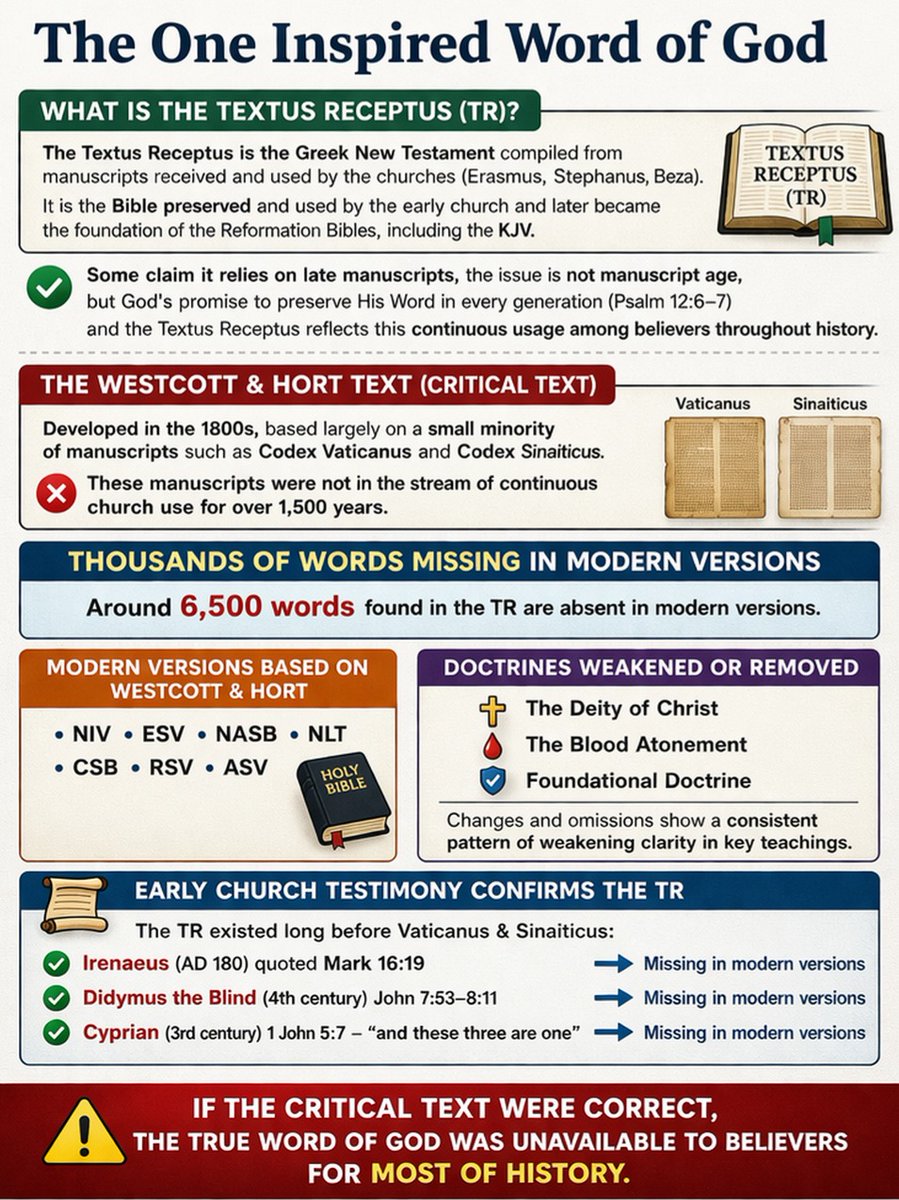
His foundation is the TR is based on the Byzantine Text type, which is partially true. Where he misses the point though is that Erasmus’ work was based on late manuscripts and were the copies available in Western Europe in the 16th century. These are not the same as the earlier Byzantine texts that we have knowledge of today, and contained many errors of which we now have knowledge of. Textual criticism compares those later manuscripts against earlier version that we now have, and in comparison the Alexandrian Text types, along with the works of the early church fathers in their scriptural quotes. This allows for knowledge where scribes have added to the text, or copyist errors were expounded over time. It’s kinda like trusting a doctor who learned the medical knowledge from seven medical journals of the 1500s, versus a doctor who reviewed those same journals, and how they compared to other journals, as compared to what exegetical, etymological and historical knowledge that we know now, which is always increasing. You can stick with the 1500s, and it might do you ok, but I’d rather have a text with based on research and accuracy to determine the original language and intent, instead of basing my faith on indoctrinated zealotry.
English
1
1
1
25
Oliver Burdick
Oliver Burdick@oliverburdick·
There is only 1 Bible. There are 31 different Qurans.
Oliver Burdick tweet media
English
326
109
609
156.2K
Jeff
Jeff@WithinAllOfUs·
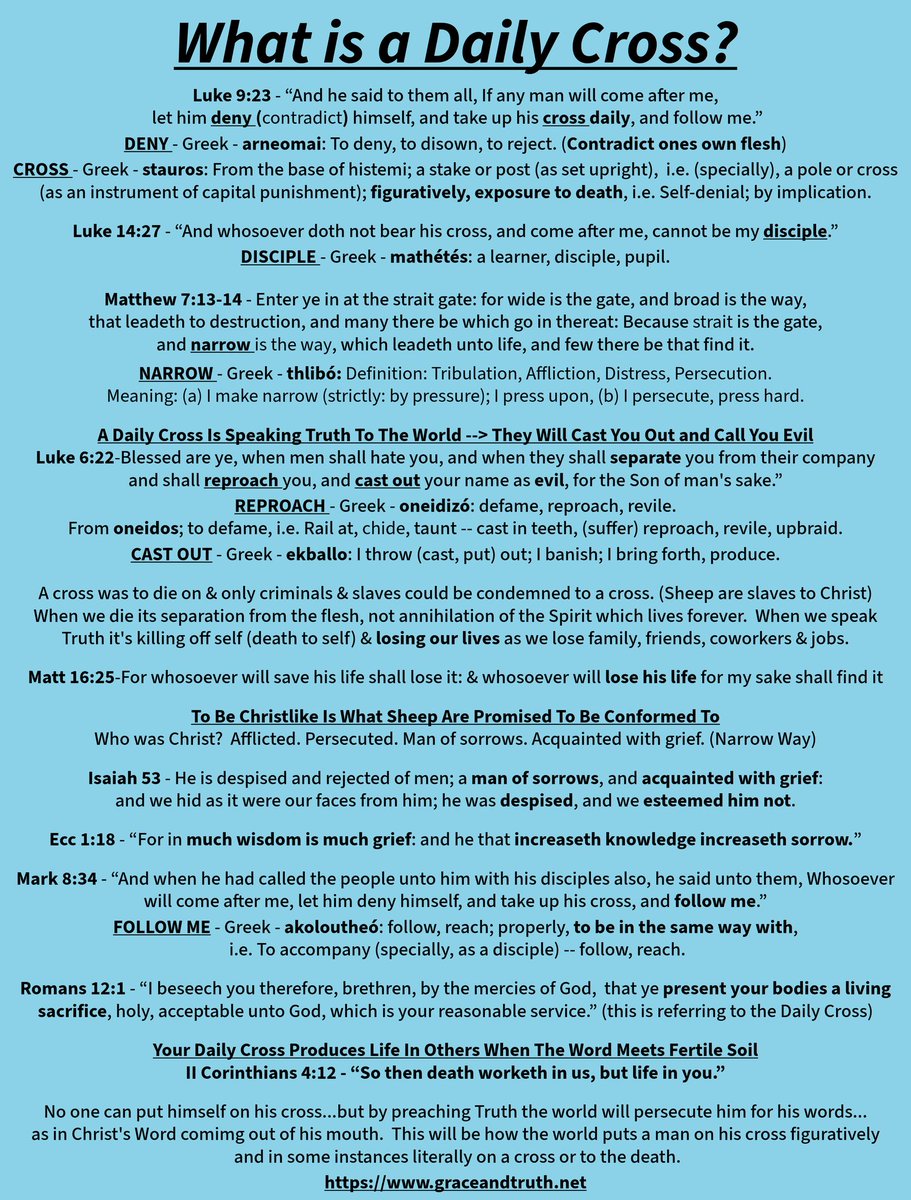
If the cross is a burden, why would the Christ say to take it up daily in one passage, but tell us to take his yolk, which is light, in another. The word translated as ‘ up’ is the Greek ἀράτω, arato which can also mean to ‘take away’ in a sense of removal, as we see in 1Cor 5:2, “so that he might be removed from among you”, or Col 2:14, “He has taken it out of the way”. The cross represents our flesh, which must be shed to give preeminence to the spirit. As for 2Cor 4, you have to also read verses 10 and 11, “always carrying around the death of Jesus in body, so that the life of Jesus also should be manifested in our body. For we the living are always being delivered to death on account of Jesus, so that the life of Jesus may also be manifested in our mortal flesh. So then, death works in us, but life in you.” The death we carry is of the flesh, that the life of Jesus is manifest within us. We ‘have been co-crucified with Christ and it is no longer we who live but Christ lives within us.’
English
0
0
1
6
Rob
Rob@GatorRob777·
“So then death worketh in us, but life in you.” 2 Corinthians 4:12 Unless a pastor preaches a daily cross and death to self one has to question their doctrine. Without a daily cross one cannot be a disciple (a student) of Christ. If one is not a student it is doubtful they will make it to heaven. Our death to self produces life in others. This is the key to the Gospel.
Rob tweet media
English
27
46
137
33.1K
Jeff
Jeff@WithinAllOfUs·
Actually, Erasmus’ TR was created from just a handful of 10th -12th century partial manuscripts. Even the transition to the MT afterward has many scribal additions and errant passages. I would suggest the Nestle-Aland Novum Testamentum Graece (NA28) which uses textual criticism to determine the most probable wording of the original text.
English
1
1
0
69
Rob
Rob@GatorRob777·
@oliverburdick There's 100s of Bibles. All translations are error. The way to see what God said is look to the Textus Receptus (Received Text) original text and define words. God only spoke 1x.
Rob tweet media
English
2
2
7
1.1K
Jeff
Jeff@WithinAllOfUs·
Jude 1:7 is the fifth verse that is interpreted as being against homosexuality. In this verse, where it is translated ‘strange flesh’, σαρκὸς ἑτέρας the word is literally ‘another flesh’, which can refer to any sexual encounter outside of an intimate bond. This ‘another flesh’ relies on opinion. Also, the Greek for ‘another’ is heteras, where we get the English hetero, so it’s actually not opposed to homo. This is debated to be either a sexual union between humanity and angelic beings, or again as a spiritual metaphor. The sixth and last is Romans 1. In Romans 1:26, the translation of ‘degrading passion’ is literally dishonorable suffering or strong emotion. This is followed by ‘and they exchanged the natural use for that which is besides the inner nature.’ Many infer this to be sexual due to the word ‘likewise’ in the next verse 27, where Paul speaks about burning with lust. But how do define ‘burning with lust’, and being ‘against nature’? This ‘lust’ does not automatically denote forms of sexuality, as these terms could also apply to the emphatic mental state of desiring or intrinsically demanding that these idols which we create in our lives to be our salvation instead of turning to the Spirit of God within? This outwardly mentality would the be considered against God’s nature. Basically in my research, each of the verses relies on someone’s opinion of what the terms should mean, so I don’t believe that we should be creating concrete doctrine where the Greek language used is far from concrete. I prefer to err on the side of loving my neighbor instead of castigating them.
English
2
0
3
37
Jeff
Jeff@WithinAllOfUs·
As uneducated Christians continue to parrot that which they don’t study, I post this regularly as it needs to be understood. There are 6 main places in the Bible where the English is interpreted to speak against homosexuality. The first two are in the OT book of Leviticus, 18:22 and 20:13.. In Leviticus 18:22, the Hebrew says, “with a male you shall not lie as with a woman”. Where the translation says ‘male’, the Hebrew word zakar is used, which was normally used to denote a younger male, instead of a mature man, which is the Hebrew word ‘ish’. This verse can be interpreted, “With a young male you shall not lie. As with a woman”. Notice again the way the Hebrew is worded. It says ‘male’ and not man. Why say male and woman instead of male/female or man/woman? The Hebrew makes a distinction here, which can infer that zakar (male) can mean a young male. Basically don’t lie with a young boy as with a mature woman. An older man taking a young man child as a sexual partner is called pederasty. This is very similar to verse 20:13 which I’ll discuss later. The next two places are in 1Cor 6:9 and 1Tim 1:10 where the Greek word arsenokoitai is used. When the OT was translated into the Greek, it was called the Septuagint, or LXX. When Lev. 20:13 was translated into the Greek for the LXX, the words arseno and koiten were used. Arsenokoitai is a combination of those two words: arseno (meaning man) and koite (mat or bed). These two verses are where it is currently translated as homosexual, which started in 1947 Since Leviticus 18 could be interpreted as pederasty versus homosexuality, Martin Luther used the pederastic opinion in his 1534 German interpretation of 1Cor 6 and 1Tim 1. He used the German word for boy molester, knabenschander, where the Greek used arsenokoitai in the two verses. The German versions kept this boy molestation interpretation until around 1798, when they also included Sodomite and buggerer along with pederasty. Something to note about the word ‘arsenokoitai’ is that it is a hapax legomenon, which means that it is not used anywhere else in Greek literature. It literally only exists in the LXX for Lev. 18, and in the NT in the two passages mentioned. The word as Paul wrote it is the noun ‘man-bed’. As the word itself is so vague, with no other usage to determine what it definitely means, it could mean pederasty, as Martin Luther, believed, or it could mean any sexual promiscuity in some sense. There is also other hermeneutics (ways to interpret) which could give the word a spiritual sense. Additionally, the classical Greek had two words, ἐρώμενος (passive male sex partner) and ἐραστής(lit. Love-with, courted the ἐρώμενος) which were the common terms for those in a typical homosexual relationship, so for the term ‘arsenokoitai’ referring to homosexuality, there’s no concrete basis for what Paul was speaking against. So homosexuality in these passages are very debatable, but what about the effeminate of the same passage in 6:9? Where the Bible mentions a person being ‘effeminate’, the Greek word there is debated as to how it should be translated in the English. For instance, in Matt 11:8, Luke 7:25, the word μαλακός, malakos is translated as ‘soft’ concerning the types of clothing worn in a king’s palace, or what type John the Baptist’s clothes weren’t. The translation of ‘effeminate’ is a stretch by any hermeneutic. So when 1Cor 6 says that ‘malakos’ shall not inherit the kingdom of God, what does that mean? Does it mean that people who wear finery don’t experience a true spiritual experience in this age? Does it mean that people who aren’t physically strong (aka physically soft), or maybe not of a strong moral character (ethically soft)? There are many ways to interpret this word ‘soft’, but the modern English versions use effeminate, which is a biased opinion. But I digress. Cont.
English
1
0
3
94
Oliver Burdick
Oliver Burdick@oliverburdick·
"What do you think of same-sex marriage?" It doesn't really matter what I think. The Bible is clear: homosexuality is sin. If you don't like that, you can take it up with Jesus. I'm just a messenger.
English
65
46
469
7.7K
Jeff
Jeff@WithinAllOfUs·
He returned within me almost three decades ago. if Scripture teaches, “I will never leave you nor forsake you” and "...And surely I am with you always, to the very end of the age", we have to understand that Christ’s return is from a standpoint from which He never left. The return is a ‘return to preeminence’ in our life, as He was/is always present within us.
English
0
0
0
18
Greg Laurie
Greg Laurie@greglaurie·
In the last days, people will ignore prophetic warnings, just as they did in Noah’s day. And just as they mocked Noah, people will mock us as followers of Christ. That, too, is a sign of the last days. But one day the mockery will cease, and the laughter will stop when Christ fulfills His very words. Jesus is coming back. harbingersdaily.com/ignoring-proph…
English
127
535
2.4K
28.1K
Jeff
Jeff@WithinAllOfUs·
@5Solas2 And every tongue will ‘praise’ that Jesus is Lord to the glory of God the Father. This passage reflects a universal worship scene.
English
0
0
0
15
5 Solas
5 Solas@5Solas2·
5 Solas tweet media
ZXX
1
22
166
1.8K
Jeff
Jeff@WithinAllOfUs·
Jude 1:7 is the fifth verse that is interpreted as being against homosexuality. In this verse, where it is translated ‘strange flesh’, σαρκὸς ἑτέρας the word is literally ‘another flesh’, which can refer to any sexual encounter outside of an intimate bond. This ‘another flesh’ relies on opinion. Also, the Greek for ‘another’ is heteras, where we get the English hetero, so it’s actually not opposed to homo. This is debated to be either a sexual union between humanity and angelic beings, or again as a spiritual metaphor. The sixth and last is Romans 1. In Romans 1:26, the translation of ‘degrading passion’ is literally dishonorable suffering or strong emotion. This is followed by ‘and they exchanged the natural use for that which is besides the inner nature.’ Many infer this to be sexual due to the word ‘likewise’ in the next verse 27, where Paul speaks about burning with lust. But how do define ‘burning with lust’, and being ‘against nature’? This ‘lust’ does not automatically denote forms of sexuality, as these terms could also apply to the emphatic mental state of desiring or intrinsically demanding that these idols which we create in our lives to be our salvation instead of turning to the Spirit of God within? This outwardly mentality would the be considered against God’s nature. Basically in my research, each of the verses relies on someone’s opinion of what the terms should mean, so I don’t believe that we should be creating concrete doctrine where the Greek language used is far from concrete. I prefer to err on the side of loving my neighbor instead of castigating them.
English
0
0
0
19
Jeff
Jeff@WithinAllOfUs·
As uneducated Christians continue to parrot that which they don’t study, I post this regularly as it needs to be understood. There are 6 main places in the Bible where the English is interpreted to speak against homosexuality. The first two are in the OT book of Leviticus, 18:22 and 20:13.. In Leviticus 18:22, the Hebrew says, “with a male you shall not lie as with a woman”. Where the translation says ‘male’, the Hebrew word zakar is used, which was normally used to denote a younger male, instead of a mature man, which is the Hebrew word ‘ish’. This verse can be interpreted, “With a young male you shall not lie. As with a woman”. Notice again the way the Hebrew is worded. It says ‘male’ and not man. Why say male and woman instead of male/female or man/woman? The Hebrew makes a distinction here, which can infer that zakar (male) can mean a young male. Basically don’t lie with a young boy as with a mature woman. An older man taking a young man child as a sexual partner is called pederasty. This is very similar to verse 20:13 which I’ll discuss later. The next two places are in 1Cor 6:9 and 1Tim 1:10 where the Greek word arsenokoitai is used. When the OT was translated into the Greek, it was called the Septuagint, or LXX. When Lev. 20:13 was translated into the Greek for the LXX, the words arseno and koiten were used. Arsenokoitai is a combination of those two words: arseno (meaning man) and koite (mat or bed). These two verses are where it is currently translated as homosexual, which started in 1947 Since Leviticus 18 could be interpreted as pederasty versus homosexuality, Martin Luther used the pederastic opinion in his 1534 German interpretation of 1Cor 6 and 1Tim 1. He used the German word for boy molester, knabenschander, where the Greek used arsenokoitai in the two verses. The German versions kept this boy molestation interpretation until around 1798, when they also included Sodomite and buggerer along with pederasty. Something to note about the word ‘arsenokoitai’ is that it is a hapax legomenon, which means that it is not used anywhere else in Greek literature. It literally only exists in the LXX for Lev. 18, and in the NT in the two passages mentioned. The word as Paul wrote it is the noun ‘man-bed’. As the word itself is so vague, with no other usage to determine what it definitely means, it could mean pederasty, as Martin Luther, believed, or it could mean any sexual promiscuity in some sense. There is also other hermeneutics (ways to interpret) which could give the word a spiritual sense. Additionally, the classical Greek had two words, ἐρώμενος (passive male sex partner) and ἐραστής(lit. Love-with, courted the ἐρώμενος) which were the common terms for those in a typical homosexual relationship, so for the term ‘arsenokoitai’ referring to homosexuality, there’s no concrete basis for what Paul was speaking against. So homosexuality in these passages are very debatable, but what about the effeminate of the same passage in 6:9? Where the Bible mentions a person being ‘effeminate’, the Greek word there is debated as to how it should be translated in the English. For instance, in Matt 11:8, Luke 7:25, the word μαλακός, malakos is translated as ‘soft’ concerning the types of clothing worn in a king’s palace, or what type John the Baptist’s clothes weren’t. The translation of ‘effeminate’ is a stretch by any hermeneutic. So when 1Cor 6 says that ‘malakos’ shall not inherit the kingdom of God, what does that mean? Does it mean that people who wear finery don’t experience a true spiritual experience in this age? Does it mean that people who aren’t physically strong (aka physically soft), or maybe not of a strong moral character (ethically soft)? There are many ways to interpret this word ‘soft’, but the modern English versions use effeminate, which is a biased opinion. But I digress. Cont.
English
1
0
0
99
GodlyAction
GodlyAction@GodlyAction·
You can be a Christian struggling with same sex attraction. But you can't be a gay Christian.
English
190
45
653
32.6K