
Blake รีทวีตแล้ว
Blake
1.5K posts


Blake รีทวีตแล้ว

rsETH hole filling tracker:
Hole: 112204 rsETH = 118.4k ETH
Lido: -2.5k ETH
Etherfi: -5k ETH
Arbitrum freeze: -30.7k ETH
Ethena: Didn't say how much, assume -1k ETH
Excess rsETH in aave / coumpound: ~-15k ETH
Stani personal donation: -5k ETH
Layerzero: Didn't say how much, assume -5k ETH
Mantle: -30k (!!!!)
Kraken / Ink: Didn’t say how much, assume -5k eth
Golem: -1k eth
Ernesto: -0.1k eth
BGD labs: -0.25k ETH
Emilio: -0.5k ETH
Aave dao: -25k ETH
THE HOLE IS FILLED.
likely goal is now reducing the amount they need to borrow from Mantle.
Far better outcome if Aave themselves have to take on no laons
English
Blake รีทวีตแล้ว

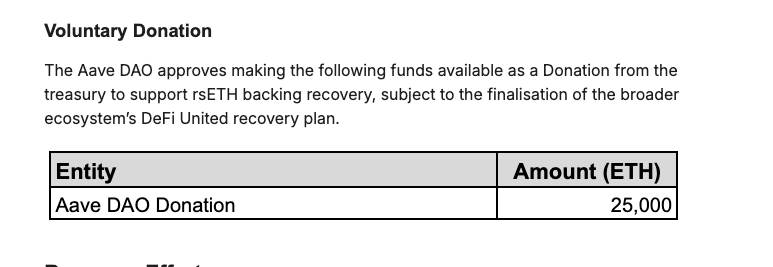
Aave service providers have published an Aave DAO governance proposal to contribute 25,000 ETH to the ongoing DeFi United effort.
Aave DAO's ETH contribution would go towards the plan to restore rsETH's backing to try and normalize market conditions as quickly as possible.
DeFi United.
governance.aave.com/t/arfc-rseth-i…
English
Blake รีทวีตแล้ว
Blake รีทวีตแล้ว

Grateful for this contribution. Emilio has been side by side working on Aave for almost a decade when DeFi wasn't a thing and we were called ETHLend (if anyone remembers). Now its time to put all efforts to unite under one team and solve this.
Emilio^@The3D_
I am committing 500 ETH to the Defi united recovery fund. This represents a large part of my crypto holdings, but there are things that are more important than money - Like Stani, I have been working on Aave since the beginning and the only thing I care about is to see it succeed. There are no defeats in life, only lessons. We will be coming back stronger. Aave will win.
English

I am committing 500 ETH to the Defi united recovery fund. This represents a large part of my crypto holdings, but there are things that are more important than money - Like Stani, I have been working on Aave since the beginning and the only thing I care about is to see it succeed. There are no defeats in life, only lessons. We will be coming back stronger.
Aave will win.
English
Blake รีทวีตแล้ว
Another one. @golemproject and @golemfoundation have made a 1,000 ETH contribution to the ongoing rsETH relief effort.
We appreciate their willingness to participate and help users.
DeFi United.
Golem Foundation@GolemFoundation
Golem Foundation and Golem Factory are contributing a combined 1000 ETH from our treasuries to @aave's coordinated DeFi relief effort following the rsETH incident. We've been working closely with the Aave team this week in a supporting capacity. Our contribution will go toward restoring rsETH backing and enabling an orderly resolution for affected stakeholders. Glad to stand with @aave and the rest of the ecosystem responding here. DeFi United.
English
Blake รีทวีตแล้ว
Blake รีทวีตแล้ว
rsETH hole filling tracker:
Hole: 112204 rsETH = 118.4k ETH
Lido: -2.5k ETH
Etherfi: -5k ETH
Arbitrum freeze: -30.7k ETH
Ethena: Didn't say how much, assume -1k ETH
Excess rsETH in aave / coumpound: ~-15k ETH
Stani personal donation: -5k ETH
Layerzero: Didn't say how much, assume -5k ETH
54.2k ETH left to find
English

"This is really unpopular, but I don't see a very long-term use case for a lot of enterprises using, say, ETH."
@canaryfunds's CEO argues that we are witnessing a fundamental miscalculation in how the market views institutional adoption.
While retail assumes big banks will flood into the public Ethereum ecosystem, the reality is more predatory.
These corporations love the technology, but they are simply forking the code and owning their own private versions of the chain.
This creates a "Utility Leak" where the public asset is bypassed entirely.
@stevenmcclurg’s focus is shifting to protocols designed to be broad-based foundations where institutions are forced to build directly on top rather than just taking the code.
English
Blake รีทวีตแล้ว

“But don't be fooled - if you are a mainnet rsETH holder, you should not be exposed to rsETH-OFT wrapper risks.”
💯💯💯💯
bartek.eth@bkiepuszewski
Lot's of discussion re: should reETH mainnet holders be affected by kelpDAO LZ bridge hack or not. Some argue that every reETH (on L1 and L2s) is "equal", part of the same "social contract" that should be known to all reETH holders. Also, for all intents and purposes, they are fungible, so how can they not be the same ? Others point out that, from the technical PoV, we actually have two different tokens on mainnet - rsETH and rsETH-OFT wrapper. Is this really a technicality, an unimportant implementation detail, and they are part of the same, common "social contract" or they cannot be ? In my opinion implementation which anyone can (and should) verify should follow a social contract. KelpDAO implemented reETH w/out OFT functionality first. Later, they could have upgraded it to include OFT functionality. The ability to upgrade is part of a social contract (as it can be seen in the code and anyone that buys reETH agrees to the upgradability functionality). Ideally there should be a time delay, so if you are reETH holder and you see an upgrade that you don't like, you can rage-quit. Monitoring of upgrades and time delays should be the norm as is the case in any social contract in the real world - your supplier changes Terms - you should be able to quit the contract But KelpDAO did not do the upgrade. Instead they created a seperate reETH-OFT wrapper. This action cannot be detected by reETH holder just by observing reETH contract onchain. I fail to see how reETH holders could automatically enter the new "social contract" of an OFT version of reETH. The confusion clearly comes from the fact that every single UI, ranging from wallets to exchanges and DeFi apps fooled everybody that reETH and reETH-OFT are the same tokens. No, they are not. They carry very different operational risks. Hiding this fact is something I am strongly opposed to. You want the convenience (and risks) of an OFT token? Fine, issue your token as a pure burn-mint OFT or upgrade the existing token to it. But if you create an OFT wrapper, you create a new token with a new social contract. The main problem with this interpretation is that - ironically - it creates much bigger losses for Aave (see governance.aave.com/t/rseth-incide…), so it is perhaps not surprising that the "all rsETH is the same" theory is being promoted. But don't be fooled - if you are a mainnet rsETH holder, you should not be exposed to rsETH-OFT wrapper risks.
English
Blake รีทวีตแล้ว
The past few days have been intense, but I wanted to give some updates as we continue to work on this. Our priority is our users, and every decision we are making is aimed at an orderly return to normal market conditions and the best possible outcome for everyone involved.
Working around the clock, the team has made progress on multiple paths forward with several partners. The Arbitrum Security Council also recovered $70 million in ETH, which could meaningfully reduce the potential exposure, and multiple discussions and solutions are being considered. I am confident we will move towards a strong resolution.
Reviewing what happened and learning from it matters. But pointing fingers is not something that gets us to the other side of this.
Every bit of my energy right now is focused on the outcome for Aave users and the protocol. Aave has been my life's work, and this is an important moment for DeFi as much as it is for Aave. I am deeply grateful for the support and collaboration we have received from builders and partners across the industry.
We’ll get through this together and we’ll continue to publish updates on @aave as they happen.
English
Blake รีทวีตแล้ว

Alex Jones predicted 9 years ago that the Charlottesville Unite the Right rally was a staged false flag run by Southern Poverty Law Center assets using paid actors dressed as Nazis. He nailed it. Credit where credit is due. A number of his predictions are uncannily accurate.
English
Living in a nursing home shouldn’t mean giving up everyday freedoms.
I just signed a bill allowing seniors living in nursing homes to consume alcohol - so that everyone can enjoy happy hour!
English
Blake รีทวีตแล้ว

Blake รีทวีตแล้ว

I'm a member of the Security Council & I can tell you we did not make this decision lightly, there were countless hours of debates, technical, practical, ethical and political.
But all it takes for evil to triumph is for good men to do nothing, so today, we decided to do something.
Arbitrum@arbitrum
The Arbitrum Security Council has taken emergency action to freeze the 30,766 ETH being held in the address on Arbitrum One that is connected to the KelpDAO exploit. The Security Council acted with input from law enforcement as to the exploiter’s identity, and, at all times, weighed its commitment to the security and integrity of the Arbitrum community without impacting any Arbitrum users or applications. After significant technical diligence and deliberation, the Security Council identified and executed a technical approach to move funds to safety without affecting any other chain state or Arbitrum users. As of April 20 11:26pm ET the funds have been successfully transferred to an intermediary frozen wallet. They are no longer accessible to the address that originally held the funds, and can only be moved by further action by Arbitrum governance, which will be coordinated with relevant parties.
English
Blake รีทวีตแล้ว

If I’m understanding the 2 scenarios here where either all rsETH positions (L1 and L2) are marked down and you risk some bad debt / haircut across Aave ETH lenders on all networks or you recognize all the unbacked rsETH on just L2s where they bare a bigger loss (which seems insane to me)…
Why can’t there be a third scenario where a hero steps in to plug the hole through some debt repayment program?
DeFi is not just profit-driven. There is enormous ego in this space.
Huge moment for a white knight to step up. This would be the best outcome for all affected users.
Kinda surprised if a CEX doesn’t see opportunity in this, ie @Bybit_Official, @coinbase, @binance
Aave@aave
Update on rsETH incident: @LlamaRisk has published a report outlining the rsETH incident, the immediate actions taken, its impact on Aave, and potential paths forward. All service providers have been working to assess the two potential bad debt scenarios on the Aave protocol. Aave DAO service providers are also leading an effort with ecosystem participants to address any bad debt. This effort already has several indicative commitments from various parties and we are grateful for the strong support we have received so far. We will share further updates as we have them. In the meantime, the full report can be read here: governance.aave.com/t/rseth-incide…
English
Blake รีทวีตแล้ว