dotglum

14.9K posts

dotglum banner
dotglum

dotglum

@dotglum

(learn) complexity, economy, moneyness, history, capital, platforms (apply) global - fintech, ecommerce. RT ≠ agreement

เข้าร่วม Nisan 2008
458 กำลังติดตาม537 ผู้ติดตาม
dotglum รีทวีตแล้ว
Taylor Pearson
Taylor Pearson@TaylorPearsonMe·
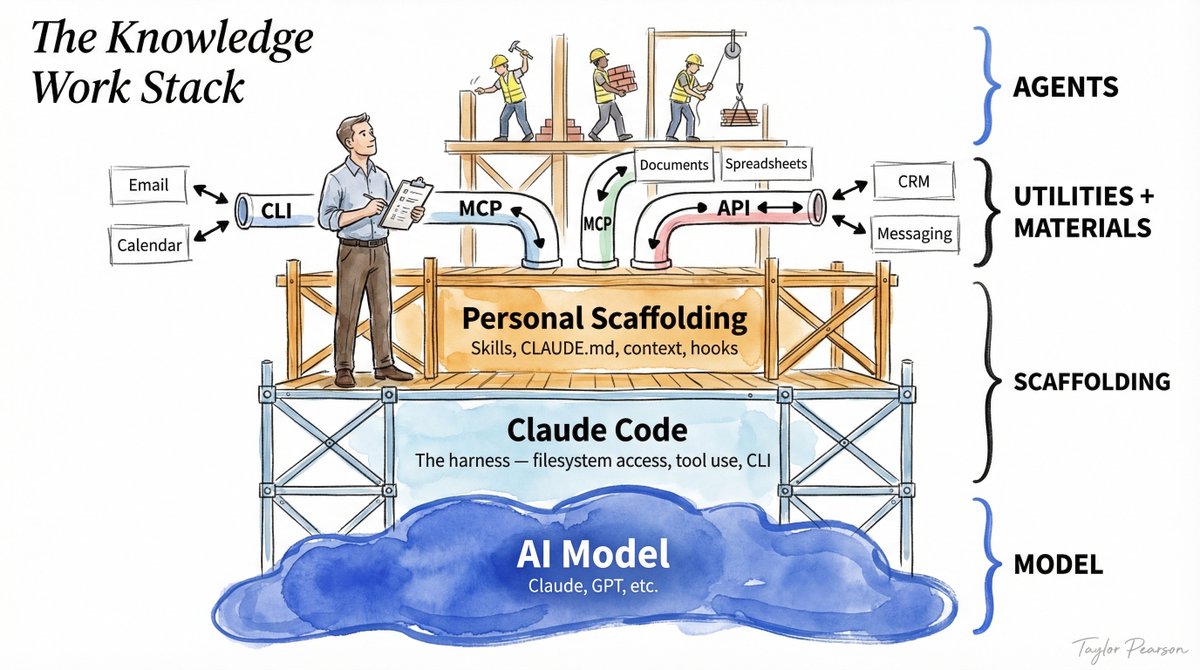
I've been working on a longer piece about how Claude Code is changing knowledge work — an "As We May Work" riff on Vannevar Bush's 1945 essay. In the process I've been trying to visualize how all the pieces fit together. This is my favorite attempt so far — the Knowledge Work Stack: Five layers, bottom to top: The Model. The big blob of compute. Claude, GPT, whatever. Powerful but shapeless — it doesn't know your files, your preferences, or your Tuesday meeting schedule. The Harness. Claude Code, Codex, etc. This gives the model hands — filesystem access, terminal commands, the ability to read and write files. Without it, the model is a chatbot. With it, the model can actually do things on your computer. Personal Scaffolding. Your CLAUDE dot md files, skills, hooks, memory logs, folder conventions. Everything that makes the model work like your assistant, not a generic one. Everyone has access to the same models. The scaffolding is where differentiation happens — (h/t @DanielMiessler) Utilities + Materials. APIs, MCPs, and CLIs that connect to external services — email, calendar, CRM, documents. When an email comes in requesting a meeting, the model checks my calendar, drafts a reply, creates the event. I never open a browser. Markdown files plus Unix plus an LLM is a surprisingly general-purpose system — once you have ways of connecting to external applications, the model can basically do anything on a computer. Agents. Once the infrastructure is in place, you deploy agents that use it autonomously. An agent is just a Claude Code session running on its own — you define the goal, it executes using the same tools and context it would if you were sitting there. You stand on the scaffolding layer like a general contractor — directing the agents, inspecting work, occasionally grabbing a hammer yourself. The job is the same one the freestyle chess amateurs had: understanding what the machine is good at, designing process around its strengths, and applying your own judgment where it falls short.
Taylor Pearson tweet media
English
6
20
195
11.3K
dotglum รีทวีตแล้ว
Eric Stromberg
Eric Stromberg@ericstromberg·
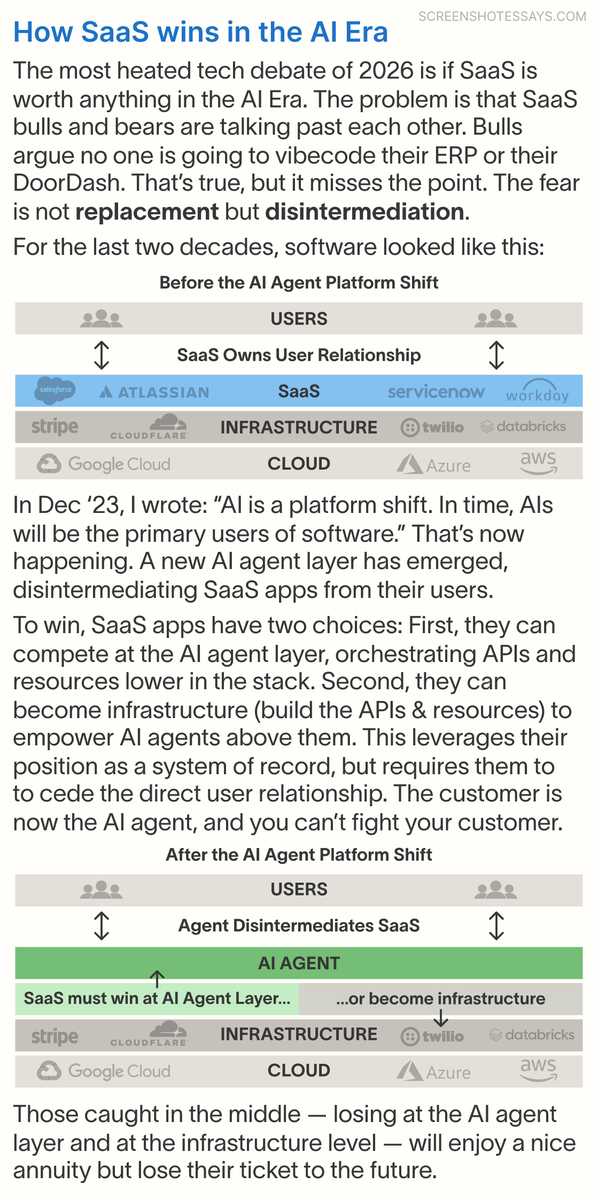
How SaaS wins in the AI Era
Eric Stromberg tweet media
English
7
21
214
15.2K
dotglum รีทวีตแล้ว
Sean McClure
Sean McClure@sean_a_mcclure·
Don't summarize books. A summary is a course-graining, taking on the form of averages. Averages are devoid of synthesis. You have understood a book when you have identified its macro invariants. It's stable projections that contain meaning (e.g. I keep reading different passages and x, y, z keep reappearing, despite shifting context). Synthesize, don't summarize.
English
1
5
41
1.3K
Ole Peters
Ole Peters@ole_b_peters·
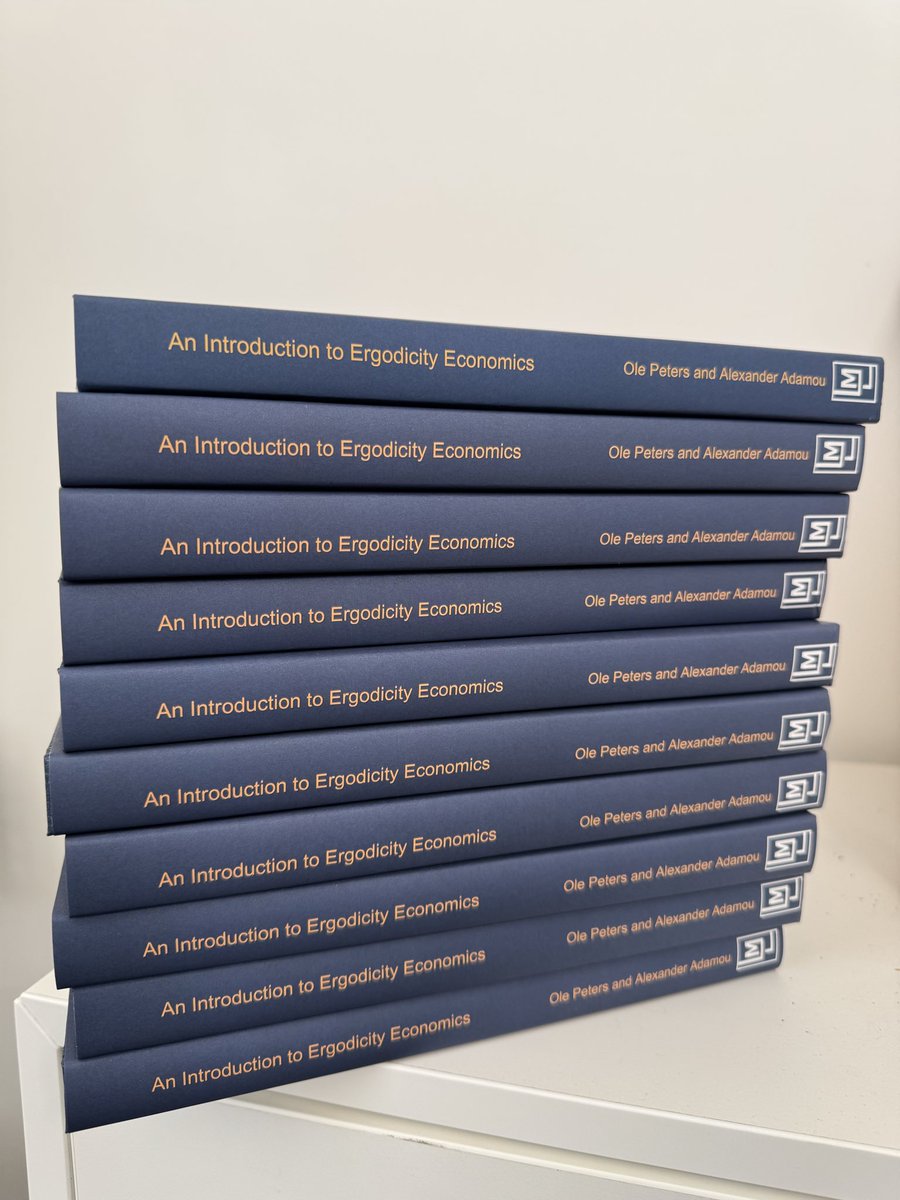
Ten essential books to read in 2026 for happiness, wisdom, world peace, untold riches, and kindness.
Ole Peters tweet media
English
14
15
300
18.4K
dotglum รีทวีตแล้ว
Sean McClure
Sean McClure@sean_a_mcclure·
Yes, you can play entire seasons of a sport, or an entire card or chess game, all in your mind, should you wish to do so. Many would struggle to understand where the required randomness of gameplay comes from. The unpredictability of the ball ⚾️, the happenstance of the dice roll 🎲, the next card in the deck🃏. Yet imagination is full of fleeting, stray thoughts and aberrant creativity. Letting the rules of the game evolve into genuine gameplay is merely the natural state of a free mind. Creativity is not about intense focus on what you already know, it’s about knowing how to embrace the mind’s distractions. To bounce around the possibility space, and converge on something new. Exercise your mind’s power by letting go and observing what nature grants you. Creativity is not something you force, it’s something you give into.
English
0
2
36
1.6K
dotglum รีทวีตแล้ว
Lenny Rachitsky
Lenny Rachitsky@lennysan·
My biggest takeaways from @stewart: 1. Product design is about creating understanding, not removing friction. Teams obsess over reducing friction and removing steps, but 70% to 80% of product design challenges are actually about helping people *understand* what your product does and what to do next. Users arrive barely interested and confused about what you offer. If they can’t quickly grasp what they’re looking at, they’ll leave. Making confusing things faster just gets users to the exit quicker. The mantra should be “Don’t make me think,” not “reduce friction.” 2. You’re not selling features—you’re selling outcomes. Nobody wants a saddle; they want to go horseback riding. Nobody wants a hammer; they want something built. People understand cars and beer without explanation, but new software needs an explanation of both what it is and why people should want it. Slack wasn’t selling messaging features—it was selling better team coordination and reduced email chaos. If you can’t articulate the transformation your product creates in people’s lives, you’re just listing features. 3. Organizations naturally fill with fake work that looks exactly like real work, what Stewart calls “hyper-realistic work-like activities.” Meetings to preview deck slides, analysis of tiny feature differences, elaborate processes around insignificant decisions. People aren’t stupid or lazy; they’re responding to having more workers than valuable work to do. Leaders must continuously ensure there’s enough clearly valuable work and explicitly say no to projects that can’t possibly generate meaningful impact. 4. The value of a feature exists on a "utility curve." There’s the initial flat zone where a feature is too weak to matter, then a steep rise where it brings users to the "aha" moment, then the value levels off where improvements don’t matter much anymore. Teams often give up in the first flat zone or waste resources in the third. The key question isn’t whether you have a feature, but whether you’ve invested enough to reach the steep part of the curve where it becomes genuinely valuable. 5. Small conveniences create emotional connections that drive word-of-mouth growth. No one switches products because of a good time-zone picker or smooth password recovery, but these details make users love or hate your product. Slack grew largely because people who used it at one company would join a new company and advocate strongly for adopting it. That advocacy came from accumulated small delights, not major features. 6. The “owner’s delusion” explains why bad experiences persist everywhere. Restaurant owners create terrible websites even though they’ve experienced the frustration of visiting other terrible restaurant websites. Business owners assume visitors care deeply about their product, when in reality people arrive distracted, in a hurry, just above the threshold of caring at all. The solution is to regularly step back, pretend you’re a normal person with limited time and patience, and honestly evaluate if your product makes sense. 7. Only pivot after exhausting all reasonable ideas. The right time to pivot isn’t when things get hard—it’s when you’ve genuinely tried every non-ridiculous approach and can coldly, rationally assess that the expected value has dropped below alternatives. Pivoting is humiliating because you’ve convinced investors, employees, and users of a vision you’re now abandoning. That emotional cost means most people either pivot too quickly or wait until they run out of money. 8. Treating customers and employees with extraordinary generosity creates a competitive advantage. Slack pioneered fair billing (not charging for unused seats), gave free credits during Covid, and automatically refunded customers for downtime without their asking. This wasn’t just ethics—it helped attract better employees, created positive stories, and built long-term customer loyalty. The mantra was “In the long run, the measure of our success will be the amount of value we create for customers.”
Lenny Rachitsky@lennysan

Stewart Butterfield (@stewart) rarely does interviews. After 2 years of trying, I finally convinced him to come on. In this special conversation, Stewart shares the frameworks and mental models that most helped him build two of the most important products in tech history (@Flickr, and @SlackHQ—which he sold for $28B, and which powers how basically every company collaborates these days). We discuss: 🔸 "Utility curves" — his framework for prioritizing ideas 🔸 "The owner's delusion" — why restaurant websites suck 🔸 "Tilting your umbrella" — a hilarious Slack core value 🔸 "Hyper-realistic work-like activities" — my new favorite concept 🔸 "Don't make me think" — Stewart's foundational design philosophy 🔸 The story behind "We don't sell saddles here" Listen now 👇 • YouTube: youtu.be/kLe-zy5r0Mk • Spotify: open.spotify.com/episode/42JBWU… • Apple: podcasts.apple.com/us/podcast/sla… Thank you to our wonderful sponsors for supporting the podcast: 🏆 @WorkOS — Modern identity platform for B2B SaaS, free up to 1 million MAUs: workos.com/lenny 🏆 @getmetronome — Monetization infrastructure for modern software companies: metronome.com 🏆 @Lovable — Build apps by simply chatting with AI: lovable.com

English
25
69
636
129.8K
Sean McClure
Sean McClure@sean_a_mcclure·
The moment you place your life into a schedule is the moment you have frozen your life into a bad design. Life is far too dynamic to benefit from predefined allotments of time and effort. You never know the ultimate form of your day, nor the opportunities and realizations that will fashion the better versions of your endeavors. Embrace the wisdom of haphazard dynamics. Bounce around the space of possibilities. Never consign your mind or body to the saddle points of life’s error and correction.
English
1
5
62
2.3K
dotglum
dotglum@dotglum·
@sean_a_mcclure Thanks a lot for the input. I have been in the complexity theory and evolution rabbit holes for a couple of years now which makes your book very useful for me. Also been navigating away from cause-effect syndrome in understanding problems
English
1
0
1
45
Sean McClure
Sean McClure@sean_a_mcclure·
@dotglum I have not read it, but it obviously promotes causal methods in science which I am against. But by all means, compare and contrast.
English
1
0
1
88
dotglum
dotglum@dotglum·
@GerardoMunck The same author has a book on ‘emergence and convergence’ … are these 2 books related? ideally they should be related
English
0
0
1
532
Gerardo L. Munck
Gerardo L. Munck@GerardoMunck·
Mario Bunge on Causality This is a fascinating, profound book on causality as used in the sciences. I reread parts of it every now and then because it discusses ideas many philosophers and methodologists ignore. For information on the book: routledge.com/Causality-and-…

Gerardo L. Munck tweet media
English
13
173
1.1K
55.1K
dotglum
dotglum@dotglum·
@CankayKoryak does not require consciousness, only the mindless process of producing invariance due to survival
English
0
0
0
8
Cankay Koryak
Cankay Koryak@CankayKoryak·
Theories of consciousness seem to be stuck in conformation bias. The parties repeat the same things like a parrot. There is neither a new study nor a new article. ​Confirmation Bias is a cognitive bias—a systematic error in thinking—that involves: ​Seeking: Actively searching for, or paying more attention to, information that confirms a pre-existing belief or hypothesis. ​Interpreting: Interpreting ambiguous evidence in a way that supports a pre-existing belief. ​Recalling: Remembering information selectively to validate what is already believed.
English
38
6
62
3.8K
Physics In History
Physics In History@PhysInHistory·
Did we invent or discover time? ✍️
English
371
50
406
63.7K
Urbaneblob 🇵🇸🌹
Urbaneblob 🇵🇸🌹@urbaneblob·
@noetic_emetic I read this book a few years ago and after I finished it I looked up more about Hegel and found out that most of what’s in this book is incorrect :/ Kinda frustrating because I wanted a short intro to Hegel by a secondary source, and then when I got one it was inaccurate
English
1
0
2
477
Sawyer Merritt
Sawyer Merritt@SawyerMerritt·
Elon Musk: “I am not working on a phone. I can tell you where I think things will go, which is that we’re not going to have a phone in the traditional sense. What we’ll call a phone will really be an edge node for AI inference with some radios to connect. Essentially, you’ll have AI on the server side communicating with AI on your device—formerly known as a phone—and generating real-time video of anything you could possibly want. There won’t be operating systems or apps in the future; it’ll just be a device that’s there for the screen and audio, and to put as much AI on the device as possible.” (via Joe Rogan Experience Podcast)
English
1.3K
1.9K
17.2K
4.4M
dotglum
dotglum@dotglum·
@ShaanVP upon observations; highly doubt if their goal is to be the first. its rather giving life to even otherwise dead technologies with a biz model innovation. so it is more of when they “later” want to arrive
English
0
0
0
15
Shaan Puri
Shaan Puri@ShaanVP·
What the hell is Apple doing? *Failed to make a car *No AI investments *Siri still sucks *just releasing the same phone over and over again How can you miss AI? how is that even possible?
English
1.6K
319
9.8K
2.6M