
ทวีตที่ปักหมุด
JS⚡₿ ⛏🌊
418 posts


JS⚡₿ ⛏🌊
@jdstuart
When an honest man discovers he is mistaken, he will either cease to be mistaken or cease to be honest.
North Carolina, USA เข้าร่วม Nisan 2022
390 กำลังติดตาม40 ผู้ติดตาม


Alright so I guess there's going to be a non-age-check fork of every single Linux distro going forward.
The issue is that the big corps using Linux will continue using the cucked versions.
Funny - that's exactly what happened in Bitcoin. All the large corps still use Core while the based plebs all switched to Knots/110.
English
@GrassFedBitcoin @start9labs StartTunnel requires the use of a VPS, correct? In that case, I don't see how it is an improvement over the other services you mention.
I would prefer integration with something like HolePunch that requires no other 3rd parties.
English
New @start9labs is beautiful.
The accompanying Start Tunnel is the revolution that was needed for the home-server to be genuinely usable without the horrible workarounds required before (Tailscale/Tor/DDNS etc).
It just works.
0.4.0 will be in public beta any day now but the current alpha release is stable and I'm happy to recommend it.
English
I read all of Luke's comments and concerns and my reaction is: "I disagree, but this is going to be great for a healthy discussion and to help people think through their decision process."
Then I see this purely emotional name-calling bullshit. I think I'm going to mute as well. These type of comments actually do more harm to the discussion.
English

@lukedewolf Typical influencer and spam apologist...
"I hate spam", then immediately goes to justify increase of datacarriersize, from 83 bytes to 256 bytes, for easier/cheaper grifting.
I see right through your hand waving and smooth talking.
English

My thinking on BIP-110 has shifted quite a bit in the last weeks and months. Where I currently stand is complicated. Honestly, I'm a bit tired of the whole thing.
I stand with BIP-110 in principle, in that I disagree strongly with the proliferation of arbitrary data on Bitcoin.
At the same time, my reasoning has always been a little different from the motivations cited in the BIP itself.
I view arbitrary data as an attack on Bitcoin's availability as a monetary network. I mean that in a technical sense, from the cybersecurity world, where availability refers to one of 3 primary ways that cyber attacks target systems and information, the others being data confidentiality and information integrity.
Arbitrary data isn't the same thing as gold jewelry, which only takes a portion of the stock off the open market and distorts the price a little. Arbitrary data also competes for the throughput of scarce block space.
It's shortsighted to think that fees generated by arbitrary data are a good thing. The situation might be somewhat positive for the miners, but again, only in the short term. The real effect on users, making it more expensive to transact and potentially pushing activities off the main chain, is only net negative in my view. Growing real adoption will solve the fee issues in the long run. We don't need arbitrary data protocols for that.
This is all to say that my concern over spam isn't quite the same as cited in the BIP. I'm not as worried about contiguous data as the strongest proponents are. I'm more frustrated by the size and volume generally.
It has also been truly concerning to me the way that Bitcoin Core tacitly allowed the propagation of arbitrary data even before the OP_RETURN change. Taproot shipping without covering Tapscript with datacarriersize and adhering to previously established limits made it much easier for inscriptions to get a foothold in the market when it did. Refusing to fix those bugs in Core feels strongly disingenuous to me.
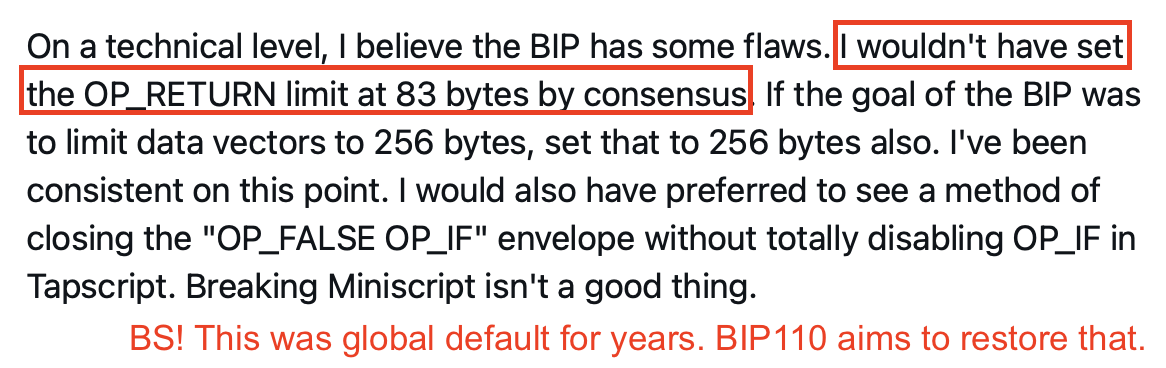
On a technical level, I believe the BIP has some flaws. I wouldn't have set the OP_RETURN limit at 83 bytes by consensus. If the goal of the BIP was to limit data vectors to 256 bytes, set that to 256 bytes also. I've been consistent on this point. I would also have preferred to see a method of closing the "OP_FALSE OP_IF" envelope without totally disabling OP_IF in Tapscript. Breaking Miniscript isn't a good thing.
At the same time, I also assert that it must be possible to walk back certain parts of upgrades, at least temporarily. Otherwise, there's nothing we can do in the case of unforeseen consequences in future upgrades. Breaking user space isn't a good excuse here. Bitcoin is a distributed system, not individual computers. It's not a valid security model to say that no individual can ever be impacted by network-level changes.
Therefore, I assert that the tradeoffs of BIP-110 are technically acceptable to me. Having a little bit less development freedom (again, temporarily) is perfectly fine if it serves greater network goals.
As to whether BIP-110 will actually reduce spam, honestly I'm not convinced about that anymore. I see the willingness for arbitary data enthusiasts to move to other methods. Perhaps the cost can be increased for them, somewhat, but the claim at least is that the cost increase is negligible.
Still, I come back to another cybersecurity principle, where actively exploited bugs are prioritized and fixed first. Closing off the vectors that are being actively used at least forces the spammers to do something in order to salvage their precious JPEGs and tokens.
Then again, is any of this worth a potential chain split? I don't think so.
There are 3 logical scenarios here:
One is that BIP-110 fails entirely, and the status quo is maintained. At this point, I find that scenario acceptable. Move on, continue the fight another day.
The other is that BIP-110 succeeds, activates, and becomes the rules of Bitcoin. I believe this is a good outcome, and will be good for the network in the long run. Others disagree, and say that Bitcoin's reputation will be permanently damaged by a change being forced through without consensus.
The final scenario is a protracted chain split. I'm told that this is unlikely by BIP-110 proponents, and that it's extremely likely by opponents. I at least acknowledge that it's a possibility. And I unequivocally believe that this outcome would be bad for Bitcoin.
All scenarios probably result in some individuals leaving the space, for better or worse. It would be a shame for monetary maximalists to give up on Bitcoin. I don't want that, considering I consider myself one. It would also be negative if a lot of dedicated developers left the space if 110 activates. And a split is a split. Not good either.
This whole post is mostly all to say that I'm tired of fighting for the merits of this BIP when I don't really believe in it entirely. I like the idea of the BIP, and the idea of taking action against arbitrary data. But if the BIP isn't going to be truly effective, and all it's going to do is cause community controversy, then I don't think it's a net positive.
I still support the idea of taking action against arbitrary data in the future. I also support increasing the share of node implementations other than Core. In my ideal scenario, no one implementation has the majority of the market share. Perhaps it's optimal to have only one primary implementation, but in the case where multiple implementations exist, not having any one be dominant is preferable to me.
So, I'm withdrawing from the fight, for now at least. I'm continuing to work on Bitcoin education and adoption efforts. Whatever happens, all I care about is Bitcoin fixing the money and fixing the world. I hope that's still possible.
English


NEW: "BIP-110 is an intentional literal downgrade," says Adam Back.

English
@brian_trollz @hodlonaut How dare you selectively post people's quotes! You're missing the context. You have to post everything they said the whole day AND what they had for breakfast. Deception!
English

@hodlonaut This in no way is "journalism." This is selectively posting peoples quotes, ignoring many other quotes from them, and then making up an imaginary conspiracy theory that directly contradicts all of those quotes: x.com/brian_trollz/s…
Shinobi@brian_trollz
You are a clown, a hack, and a deceptive person. A Grok summary (that I fully read and verified) on why this whole thread is misleading bullshit distorting context: In summary, by fixating on Citrea as the linchpin and portraying the change as arbitrary or corrupt, hodlonaut manipulates the narrative to suggest undue influence from one entity, while underplaying the policy's role in mitigating real risks of bypass-induced damage. This could appeal to purists worried about "non-Bitcoin" projects, but it distorts the reality that such changes aim to standardize practices for a wider ecosystem of builders, preventing fragmented or abusive workarounds that could harm the network long-term.Hodlonaut's thread, particularly in the highlighted post (part 27), constructs a narrative that centers Citrea as the primary, if not sole, driver behind the Bitcoin Core change to remove the 80-byte OP_RETURN relay limit (via PR #32406). He does this by compiling a series of quotes from developers like Peter Todd, Poinsot, Corallo, instagibbs, and Towns, all acknowledging Citrea's role in sparking or justifying the discussion. This creates an impression of a targeted "co-opting" of Bitcoin Core's development for one specific project's benefit, complete with allegations of conflicts of interest (e.g., Jameson Lopp's undisclosed investment) and procedural irregularities (e.g., muting critics, locking PRs). However, this framing distorts the broader context in several ways: Overemphasizing Citrea as the cause rather than an example: While Citrea's technical needs (related to embedding ZK proofs for their Bitcoin layer-2 bridge) were indeed the initial trigger mentioned in early discussions and PRs like #32359, hodlonaut downplays evidence that it was treated as illustrative of a larger class of issues. For instance, in the May 1 IRC meeting logs he references, instagibbs explicitly advocates for an unlimited cap to "future-proof" for ZK rollups in general, citing uncertainty around proof sizes so the issue wouldn't need revisiting. Similarly, Towns notes the conversation "started with Citrea," but broader community resources (e.g., instagibbs' public gist on retiring the limit) frame the change as addressing longstanding inefficiencies, not just one project. By cherry-picking quotes that name Citrea without balancing them against these generalizations, hodlonaut implies a narrow, self-serving motivation, ignoring how Citrea exemplified emerging use cases for data-heavy applications on Bitcoin. Ignoring the technical rationale for bypass risks and network health: A key distortion is hodlonaut's dismissal of the relay policy's inherent softness and the "damaging ways" it can be bypassed. Bitcoin's relay rules (like the OP_RETURN limit) are not hard consensus rules; they're defaults in node software that operators can modify. If a limit is too restrictive, builders (e.g., for ZK rollups, covenants, or other innovations) will often work around it using more harmful methods, such as embedding data in fake P2PKH/P2SH outputs, bare multisig, or other opaque formats. These alternatives bloat the UTXO set, increase node resource demands, or make spam harder to filter, potentially fragmenting the network or raising costs for all users. Instagibbs' gist explicitly argues that the 80-byte cap "channels [large data] into more opaque forms that cause damage to the network," and removing it encourages cleaner, provably unspendable OP_RETURN usage instead. Hodlonaut retroactively questions the necessity (e.g., citing Lopp and Back's claims that Citrea could use witness data or that limits are arbitrary), but this sidesteps how refusing the change could push more projects to these damaging bypasses, undermining Bitcoin's usability for legitimate builders without solving the underlying spam issue. Selective timeline and omission of counterpoints: The thread's chronology highlights "52 days" from Citrea's issue being raised to the merge, framing it as rushed and captured. Yet it omits that similar proposals (e.g., Peter Todd's earlier PR two years prior) were discussed long before Citrea, and the change aligns with evolving views on policy vs. consensus (e.g., Bitcoin Core v30 making the limit configurable via -datacarriersize, with deprecation planned). Hodlonaut also notes the gist's omission of Citrea/PR history as suspicious, but doesn't acknowledge how this document speaks "for the project" to explain the merits broadly, not the origins—consistent with viewing Citrea as a non-unique example. This selective focus amplifies drama around process flaws while minimizing the "broad support" instagibbs claimed, even if not unanimous.
English

1/
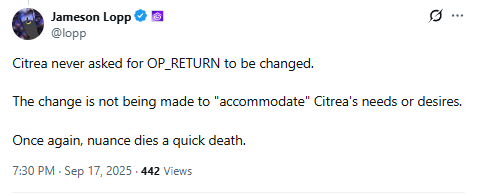
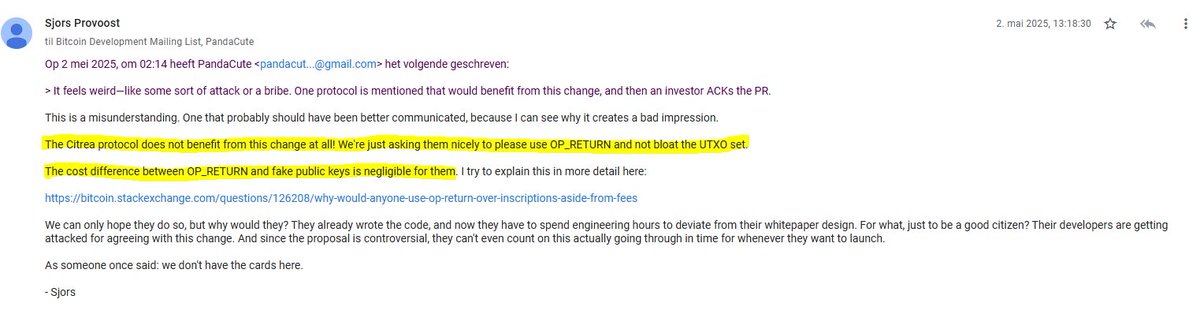
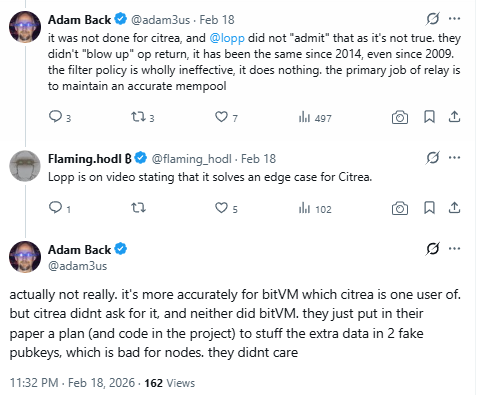
There's a narrative circulating that Citrea had nothing to do with the OP_RETURN uncap.
That Citrea didn't need it. Didn't ask for it. Was just caught in some drama it didn't start.
This thread explores what the people who pushed the change actually said.
🧵
English
@brian_trollz @hodlonaut To be fair, "didn't need" and "didn't ask for" are two different things. Hodlonaut's research focused more on the "didn't need" part. But once again, this is irrelevant to the purpose of debunking the 'Citrea had nothing to do with it' narrative.
English
@jdstuart @hodlonaut > That Citrea didn't need it. Didn't ask for it. Was just caught in some drama it didn't start.
The part of hodlonaut's tweet you conveniently left out of your quote.
English
Did you even read the original post?
You are raising a separate topic that is NOT the point of the OP. Whether Citrea is "the cause or an example" is not what hodlonaut's post was debunking. It was the effort to rewrite history and the "narrative circulating that Citrea had nothing to do with the OP_RETURN uncap."
(Literally copy/pasted from hodlonaut's introduction.)
YOU are trying to obfuscate by shifting the topic.
YOU are the one being deceptive.
But honestly, I like your whole crash-out, as it just makes Core's intentions to bend over for data even more clear.
English
You are a clown, a hack, and a deceptive person.
A Grok summary (that I fully read and verified) on why this whole thread is misleading bullshit distorting context:
In summary, by fixating on Citrea as the linchpin and portraying the change as arbitrary or corrupt, hodlonaut manipulates the narrative to suggest undue influence from one entity, while underplaying the policy's role in mitigating real risks of bypass-induced damage.
This could appeal to purists worried about "non-Bitcoin" projects, but it distorts the reality that such changes aim to standardize practices for a wider ecosystem of builders, preventing fragmented or abusive workarounds that could harm the network long-term.Hodlonaut's thread, particularly in the highlighted post (part 27), constructs a narrative that centers Citrea as the primary, if not sole, driver behind the Bitcoin Core change to remove the 80-byte OP_RETURN relay limit (via PR #32406).
He does this by compiling a series of quotes from developers like Peter Todd, Poinsot, Corallo, instagibbs, and Towns, all acknowledging Citrea's role in sparking or justifying the discussion. This creates an impression of a targeted "co-opting" of Bitcoin Core's development for one specific project's benefit, complete with allegations of conflicts of interest (e.g., Jameson Lopp's undisclosed investment) and procedural irregularities (e.g., muting critics, locking PRs).
However, this framing distorts the broader context in several ways:
Overemphasizing Citrea as the cause rather than an example: While Citrea's technical needs (related to embedding ZK proofs for their Bitcoin layer-2 bridge) were indeed the initial trigger mentioned in early discussions and PRs like #32359, hodlonaut downplays evidence that it was treated as illustrative of a larger class of issues. For instance, in the May 1 IRC meeting logs he references, instagibbs explicitly advocates for an unlimited cap to "future-proof" for ZK rollups in general, citing uncertainty around proof sizes so the issue wouldn't need revisiting. Similarly, Towns notes the conversation "started with Citrea," but broader community resources (e.g., instagibbs' public gist on retiring the limit) frame the change as addressing longstanding inefficiencies, not just one project. By cherry-picking quotes that name Citrea without balancing them against these generalizations, hodlonaut implies a narrow, self-serving motivation, ignoring how Citrea exemplified emerging use cases for data-heavy applications on Bitcoin.
Ignoring the technical rationale for bypass risks and network health: A key distortion is hodlonaut's dismissal of the relay policy's inherent softness and the "damaging ways" it can be bypassed. Bitcoin's relay rules (like the OP_RETURN limit) are not hard consensus rules; they're defaults in node software that operators can modify. If a limit is too restrictive, builders (e.g., for ZK rollups, covenants, or other innovations) will often work around it using more harmful methods, such as embedding data in fake P2PKH/P2SH outputs, bare multisig, or other opaque formats.
These alternatives bloat the UTXO set, increase node resource demands, or make spam harder to filter, potentially fragmenting the network or raising costs for all users. Instagibbs' gist explicitly argues that the 80-byte cap "channels [large data] into more opaque forms that cause damage to the network," and removing it encourages cleaner, provably unspendable OP_RETURN usage instead. Hodlonaut retroactively questions the necessity (e.g., citing Lopp and Back's claims that Citrea could use witness data or that limits are arbitrary), but this sidesteps how refusing the change could push more projects to these damaging bypasses, undermining Bitcoin's usability for legitimate builders without solving the underlying spam issue.
Selective timeline and omission of counterpoints: The thread's chronology highlights "52 days" from Citrea's issue being raised to the merge, framing it as rushed and captured. Yet it omits that similar proposals (e.g., Peter Todd's earlier PR two years prior) were discussed long before Citrea, and the change aligns with evolving views on policy vs. consensus (e.g., Bitcoin Core v30 making the limit configurable via -datacarriersize, with deprecation planned). Hodlonaut also notes the gist's omission of Citrea/PR history as suspicious, but doesn't acknowledge how this document speaks "for the project" to explain the merits broadly, not the origins—consistent with viewing Citrea as a non-unique example. This selective focus amplifies drama around process flaws while minimizing the "broad support" instagibbs claimed, even if not unanimous.
English

@SimonDixonTwitt Bro... It *is* actually AI even though it says it's not
English
@cguida6 @SteveSimple I agree to disagree.
Keep up your good work though. I love what you do. 🤝 We don't have to agree on everything.
That reasoning leads to "compromising layer1 for layer2 is justified for bitcoin's existence".
English

@SteveSimple Strongly disagree
Lightning is bitcoin
Bitcoin would quickly be captured and killed without lightning
English

Bitcoin only has one layer.
Lightning is great. I like all the technologies that will come and go with varying degrees of success at layering themselves on top of Bitcoin.
Those are their own things. Those are not layers of Bitcoin.
English
@BitMEXResearch @ocean_mining @BarefootMining That is an interesting question, and one worthy of discussion. But it is unrelated to individual miners signaling.
Here is Jason's comment.
x.com/wk057/status/2…
I'm kinda done helping you do research... ironic for someone with "Research" in their name
Jason Hughes@wk057
People wanting to signal for fork readiness should actively participate and use DATUM as noted above. The non-DATUM OCEAN template is < 10% of the pool. So, if it were up to me, I'd say it should generally follow the majority of the pool's DATUM hash rate on these things.
English

@jdstuart @ocean_mining @BarefootMining So with the Ocean pool, what node is currently run to calculate the payouts, BIP-110 or not?
English

90 minutes ago, @BarefootMining found block #938903.
As part of constructing and mining their own block using DATUM, they also signaled readiness for activation of a soft fork.
They did this entirely independently of their pool.
OCEAN is designed such that miners can perform the full spectrum of mining, and actually take a direct role in coordinating network upgrades. That includes constructing their own block templates and deciding when, and whether, to signal.
OCEAN restores agency to miners.
Back in 2017, Slush Pool let miners express their preference during the SegWit activation debate:
nasdaq.com/articles/slush…
OCEAN takes that one step further by reducing the pool’s role even more. Through DATUM, miners construct their own templates and embed their own signal directly in the blocks they mine. Further still - any blocks they find get broadcast directly to the network without needing to pass through a middle man.
Fork proposals are part of Bitcoin’s maturation. We encourage miners to study BIP-110, form their own view, and signal accordingly.
Your hash. Your choice.
English
@BitMEXResearch @ocean_mining @BarefootMining Huh?
*currently* there is only one chain.
I think I've probably been wasting my time in this thread 🤦♂️
English
@jdstuart @ocean_mining @BarefootMining > Oh wow. Yeah, you really got me here. I didn't answer a question that no one can answer. LOL
It is certainly possible to respond, please note the word's "current setup". Its not about predicting the future
English
@BitMEXResearch @ocean_mining @BarefootMining You've mentioned it several times in this thread. Most succinctly here...
x.com/BitMEXResearch…
But apparently you have additional arbitrary requirements that are pointless to argue with.
BitMEX Research@BitMEXResearch
@jdstuart @ocean_mining @BarefootMining Yes The signal flag is supposed to signal the software you are currently running to validate blocks
English
English
@BitMEXResearch @ocean_mining @BarefootMining >"The signal is about what node software is currently being run"
Exactly! You got it dude👍
English
@jdstuart @ocean_mining @BarefootMining > Ocean should be able to answer 6 months from now and they will!!
That wasnt my point. That is another question
The signal is about what node software is currently being run
English
@BitMEXResearch @ocean_mining @BarefootMining I think trying to argue with your arbitrary definition of what defines a 'true' or 'false' signal is going to be a losing battle, since it is whatever you say it is.
English
@jdstuart @ocean_mining @BarefootMining > Dwell on the answer to that question.
My answer is that its a fake signal...
English
@BitMEXResearch @ocean_mining @BarefootMining Ocean should be able to answer 6 months from now and they will!!
Whatever miners signal in the meantime is still relevant!!
English
@jdstuart @ocean_mining @BarefootMining > Yeah, you really got me here. I didn't answer a question that no one can answer. LOL
They should be able to anser it, if signalling is accurate!!!
English
@BitMEXResearch @ocean_mining @BarefootMining "Why would a miner signal that they plan not to get paid by the pool? It makes the membership of the pool pointless."
I think you are answering your own questions again. Dwell on the answer to that question. Everything will fall into place.
English
@jdstuart @ocean_mining @BarefootMining > You can now try to tie pool payouts with miner signaling, but I'm pretty sure that is not part of anyone else's definition of what miner signaling signifies.
Why would a miner signal that they plan not to get paid by the pool? It makes the membership of the pool pointless.
English
> "Notice how you can't or won't answer..."
Oh wow. Yeah, you really got me here. I didn't answer a question that no one can answer. LOL
It is impossible to predict the future, so I went ahead and addressed the question's underlying issue... that it is currently irrelevant.
You can now try to tie pool payouts with miner signaling, but I'm pretty sure that is not part of anyone else's definition of what miner signaling signifies.
What will Bitcoin's price be next month? Answer or your wrong! Ha! I win🙄
English
What is the answer to the question? Notice how you can't or won't answer...
> that has nothing to do with miner signaling
It does, because the miner siganlling (if accurate), could mean the miner wont get paid...
> Even if you take your worst-case scenario (which is bizarre to begin with)
The scenario is what happens when the BIP-110 rule enforcement becomes relevant.
English