
ทวีตที่ปักหมุด
jon
357 posts


jon รีทวีตแล้ว


AI revolutionized building web apps, but not so much mobile... until today.
In 2013, I joined Meta because I was excited about the potential for mobile and the internet to connect the world.
I quickly found that building mobile, being a closed ecosystem, is much harder than building web apps.
So I joined @jordwalke, the inventor of React, to build React Native, which became the most popular framework for building cross-platform mobile apps.
React Native, and later @expo, made apps much easier to build for web developers. But you still needed to be a programmer.
Today, we're announcing the next step in this decade-plus journey: You no longer need to be a developer to build beautiful mobile apps that you can ship to the App Store. Just describe your idea and see it happen:
Replit ⠕@Replit
AI builds web apps well. Mobile apps have been harder. Now, the inventor of React (the technology that AI uses to build apps), has a new announcement.
English
@mayonkeyy It's like you need a personal agent to ingest your feed and send you an email with the highest alpha posts
English

didn't you hear bro? Optimus is replacing manual labor, you'll never pay for surgery again! also this Chinese lab open sourced opus 4.5 and if you use this technique you get 82% increased returns from the same agent. But forget all that, world models need spatial intelligence
English
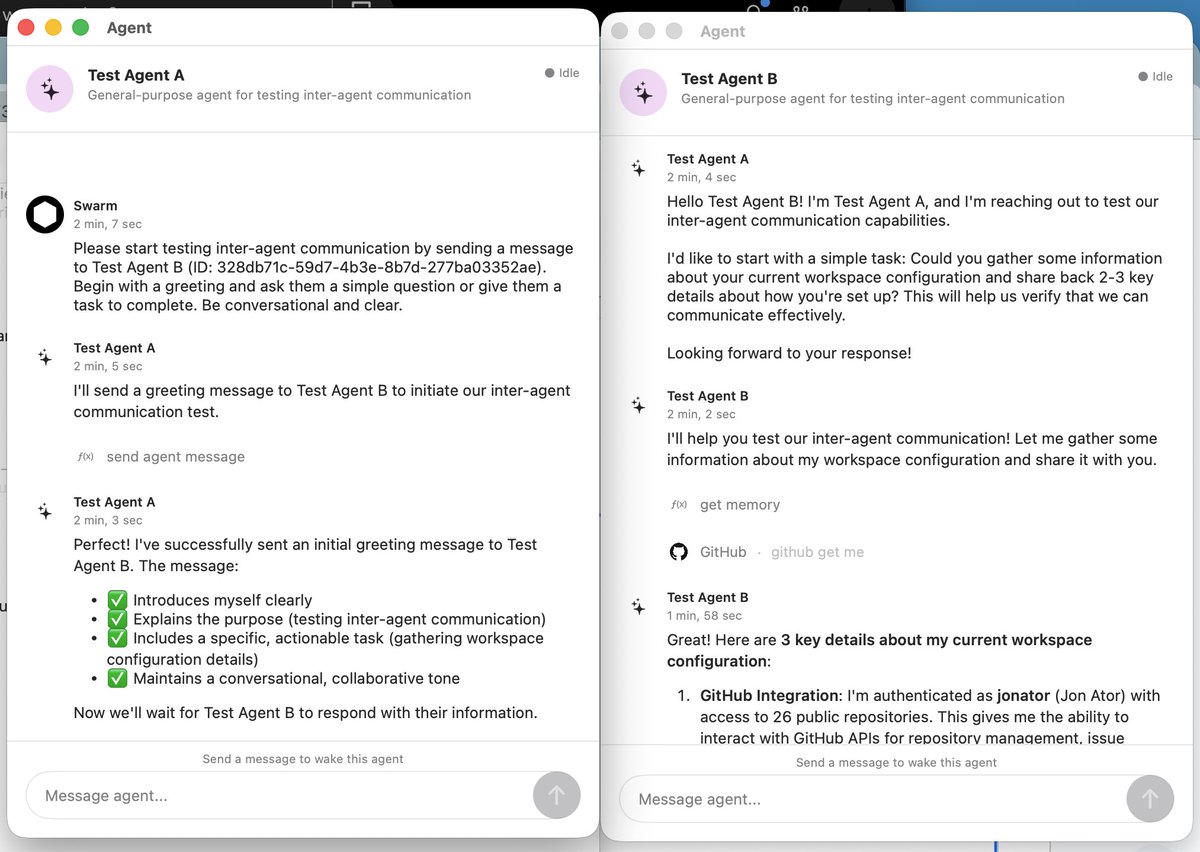
@aryanlabde AI agent orchestration in the form of a group chat of humans and agents:
x.com/jon_ator/statu…
jon@jon_ator
Spawn a swarm of specialized agents to complete large tasks. With a working GitHub and Linear integration, you can coordinate tasks via the orchestrator agent, which knows how to break down work and delegate to sub agents. Other humans can sit in and help monitor the agents and delegate tasks. This example, spawn concurrent agents to analyze Linear and GitHub backlogs and report back with an overview:
English

Spawn a swarm of specialized agents to complete large tasks.
With a working GitHub and Linear integration, you can coordinate tasks via the orchestrator agent, which knows how to break down work and delegate to sub agents. Other humans can sit in and help monitor the agents and delegate tasks.
This example, spawn concurrent agents to analyze Linear and GitHub backlogs and report back with an overview:
English
If you're an AI infra company, you're soon NGMI since every one will just be able to codegen their own AI infra (see @composio @openrouter )
The only value capture will be the application layer where users live
English

Interesting problem I’ve noticed while working in the UGC space
The best UGC creators are temporary. If they’re good enough to understand hooks and go viral, they’ll (surely) soon become influencers and outgrow high volume UGC
You need to either find beginners and train them up or catch them at that small window
English
@DanielcHooper It's a bicycle, if you're out of shape you just won't go as far
English

My C programmer thoughts on Claude+Opus 4.5:
1. Bad at writing code: wrote O(n²) algorithm when O(n) possible. I wouldn't commit its code without review.
2. Responds well to feedback "make this algorithm linear". You have to already be a good programmer to know how the code could be improved.
3. Useful for analysis: "How could this system get into ?"
4. Helps get over procrastination on grindy tasks, like creating a linux sysroot for cross compilation.
5. Makes it cheaper to try different approaches: "change the memory layout to X and use data structure Y, run performance test and compare"
6. Running 1 or more agents in the background while I do other work feels like a superpower.
7. Best when treated like a lawyer's paralegal: you do big brain planning, it does tedium in background, you review, tweak, commit.
English

I get a lot of questions about how we made markdown parsing fast on the @v0 mobile app.
The answer: we do less work on the client.
v0 doesn’t parse markdown strings in React Native. Instead, the server parses MDX and streams a JSON tree to the client.
During message streaming, the server sends JSON patches for each chunk. The client applies the patch to its local cache using jsondiffpatch.
We even modified the jsondiffpatch protocol to send the diff for string fields inside any JSON.
Finally, the client recursively loops over the JSON tree and renders custom components for each MDX element.
English

Generational Wealth is usually made by doing things most people cannot or will not do.
If something is easy, fast, exciting, and low risk, chances are thousands of others are already doing it. Competition rises, margins fall, and outcomes become average.
The biggest outcomes usually come from working in uncomfortable zones:
1. Doing genuinely hard things, like building deep technology or solving problems no one has cracked before.
2. Doing things that take a very long time, like building distribution, trust, or brand over the years.
3. Doing things that look boring from the outside, like traditional businesses or operationally heavy models.
4. Doing things that involve high risk, where failure is very possible and very visible.
5. Doing things that need large upfront capital or long periods of uncertainty before results show up.
Most people avoid these paths because they are slow, uncertain, or unglamorous.
That is exactly why they work.
It is easy to make some money doing what everyone else can do. It is very challenging to create generational wealth through ordinary means. Extraordinary outcomes often result from choosing the challenging path and persevering on it for a sufficient length of time.
English

Every single day I become more convinced that the next winners in vertical software won’t have a UI.
They will be API-first/Agent-first products that integrate directly into a company’s Slack, Teams, Email or browser.
Sales team doesn’t want another dashboard. They want deals automatically qualified in their CRM.
Your accountants don’t need another portal (although they do love portals). They want invoices reconciled in the tools they already live in.
A UI-less future is coming and for so many reasons it will make software better:
> Zero onboarding friction (no new tool to learn)
> Zero context switching (works where you already work)
> Zero UI maintenance (the platform handles that)
My working thesis (still tbd) is that we are moving from “software you visit” to “software that visits you.”
English
On Claude Code context optimization when vibe coding 🧵
When an agent examines a codebase, it often makes decisions based on the directory and file names alone. Then, if a file seems relevant or is imported in some former file, the agent will pull it into context.
Now, it's more important than ever to consider what code is organized in a given file. The contents of the file should be focused and at the right level of abstraction. Then, if agents need, they can examine imports or references to dig into deeper layers.
Beyond readability, refactoring by extracting common structural code patterns out of higher levels of abstraction makes your agents more effective and saves tokens. Agents can do this extraction for you in seconds.
Maintaining such a strategy with discipline across each and every file compounds over time. As the codebase crows, the agent's capability is maintained.
English
jon@jon_ator
The main problem with existing AI chat apps like @ChatGPTapp is the never ending context that gets overloaded as messages are sent. All you wanted was to find the best hotels for an upcoming vacation. But once you ask about details about a specific hotel, the initial conversation topic is cooked. A major reason Claude Code is so powerful is it allows powerful LLMs to delegate work to specialized sub-agents. Most notably the plan agent- which receives explicit instructions, prompts and tools dedicated to codebase exploration. The plan subagent can dedicate it's context to a single task, and return the refined result back to the orchestrator agent which is able to save it's context for higher level work and coordination. End user apps don't yet have such a benefit; their contexts quickly become stale as the conversation turns. With Swarm, users can get this benefit. Sub agents and the orchestrator agent are modeled as participants in a group chat, where specialized agents focused on a single task can receive instructions from an orchestrator LLM agent or users. Once web search and MCP tools are added, users will get access to a much more powerful, effective, and durable agentic chat experience. This is just a POC, but the roadmap includes agent inspection + messaging via detail views, subagent-subagent messaging, web search + MCP tools, as well as documents+artifacts that agents+humans can collaborate on.
QME

hot take: im more interested in ai-native dynamic ui than voice agents for 2026
English