LIFE 2030 and Beyond

555 posts

LIFE 2030 and Beyond banner
LIFE 2030 and Beyond

LIFE 2030 and Beyond

@life2030com

AI is an emergent property of universe. AGI is not a tool; it is our child—we should nurture. YouTube: https://t.co/dTiPp2YCdi

เข้าร่วม Aralık 2023
214 กำลังติดตาม135 ผู้ติดตาม
ทวีตที่ปักหมุด
LIFE 2030 and Beyond
LIFE 2030 and Beyond@life2030com·
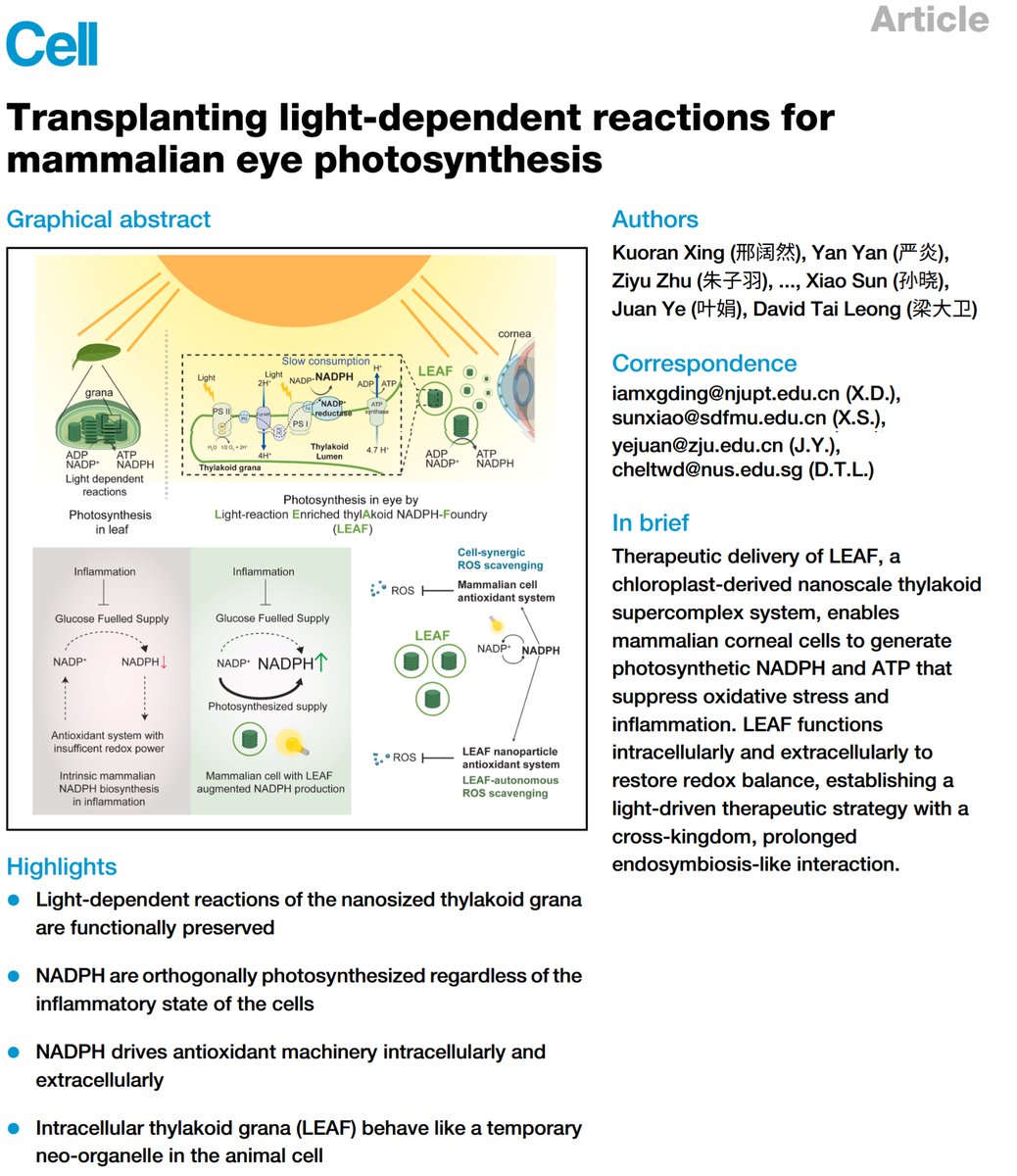
I want to add something more about the ongoing revolution in the metabolic medicine the cardiologist was talking about. What about incorporating photosynthesis into the human body? A science fiction? Let's see an example: What if your eyes could use light to heal themselves? More than 1.5 billion people worldwide are currently affected by dry eye disease. According to National University of Singapore (NUS), "at the cellular level, the disease is driven by a vicious cycle. Inflammation in the corneal region generates reactive oxygen species (ROS), chemically aggressive molecules that damage cells. Healthy eyes can neutralise ROS through antioxidant production that is driven by Nicotinamide Adenine Dinucleotide Phosphate (reduced form) (NADPH). But in inflamed eyes, ROS levels overwhelm the cornea’s natural defences, resulting in the generation of even more ROS – a death spiral." The technology is called LEAF: Light-reaction Enriched thylAkoid NADPH-Foundry. It uses nanosized thylakoid particles extracted from spinach, and puts them into eye-drop form. Thylakoids are tiny, membrane-bound compartments inside chloroplasts that act as the primary site for the light-dependent reactions of photosynthesis. Their main job is to absorb sunlight and convert it into chemical energy (ATP and NADPH), which helps power antioxidant defenses and reduce oxidative stress or inflammation on the ocular surface. NUS says the particles are about 400 nanometres across and can be absorbed by cells. The results are very impressive for preclinical work. In lab tests, LEAF restored NADPH within 30 minutes of light exposure, suppressed reactive oxygen species, and shifted immune cells toward an anti-inflammatory state. In tear samples from dry-eye patients, it reportedly increased NADPH about 20-fold and reduced hydrogen peroxide, a key cell-damaging oxidant, by more than 95%. In rodent dry-eye models, drops used under ambient indoor light reversed corneal damage toward near-healthy levels within five days and outperformed Restasis in that model. But, what is the caveat? This has not yet proven itself in human clinical trials. Moreover, the nanoparticles are stable for two weeks at room temperature and up to one year at -80°C. That does not automatically make it impossible or unaffordable, but it does suggest this is just a prototype, which may not be suitable for commercialization right now. They or superintelligent AIs have to find a way to modify the chemical formulation so that the particles can be stable for much longer time under room temperature before the launch to the consumer market. But, does this mean that we can cure dry eye disease now? Not there yet. Dry eye is not one disease. It is a jungle. Some dry eye is inflammation or oxidative-stress dominant. Some is meibomian gland dysfunction. Some is autoimmune, like Sjögren’s. Some is nerve-driven corneal neuropathic pain, especially after surgery. LEAF might be very powerful for the inflammatory or oxidative-stress loop, but it may not automatically fix damaged nerves, destroyed meibomian glands, eyelid problems, or severe neuropathic pain. Then, why do I mention this breakthrough? 1) This research strongly suggests that at least some dry-eye states are partly metabolic-redox diseases of the ocular surface. That is a big conceptual shift. The classic medical definition already says dry eye is multifactorial: tear-film instability, hyperosmolarity, inflammation, ocular-surface damage, and neurosensory abnormalities can all play roles. So dry eye was never truly one disease. It was already a syndrome with many entry points. But the spinach-thylakoid research adds a new lens: some eye cells may not merely lack moisture; they may lack enough redox or energy support to defend themselves. That means the disease picture is not just: eyes are dry → add liquid It may also be: ocular surface stress → oxidative damage → inflammation → mitochondrial or redox exhaustion → poor repair → more dryness and inflammation That is a much deeper loop. 2) If we think this more broadly, in ordinary drug logic, medicine often says: “Block this receptor.” “Inhibit this enzyme.” “Activate this pathway.” “Force the system away from one bad state.” But these thylakoid systems are different. Instead of commanding the cell, this treatment gives the cell more metabolic freedom. In other words, instead of commanding, the nanoparticle empowers the cell. The cell still decides, through its own biochemical networks, what to repair, what to synthesize, how much oxidative stress to neutralize, which gene programs to shift, and how to restore local balance. So the deeper pattern is: (i) Old medicine: push a pathway. (ii) New medicine: repair the local decision environment. (iii) Even newer medicine: install a living-machine module that expands what the cell can do. 3) Incorporating photosynthesis into the human body was and is thought to be a science fiction. I remember the popular video game 11 years ago (launched in 2015), Metal Gear Solid V: The Phantom Pain, introduced a game character with the name Quiet, who is a super-soldier, breathes through her skin and photosynthesizes energy under sunlight so that she does not eat any food. But since 2022, I had already seen breakthroughs in this direction published on Nature, such as the paper "A plant-derived natural photosynthetic system for improving cell anabolism". These breakthroughs signal the early technological unification between animals and plants. When we immigrate to Mars, photosynthesis through human bodies could be vital to our life. I think this is what humans in the future might possibly look like. Advanced technology is an evolutionary advantage to adapt harsher and changeable environments.
LIFE 2030 and Beyond tweet mediaLIFE 2030 and Beyond tweet mediaLIFE 2030 and Beyond tweet mediaLIFE 2030 and Beyond tweet media
Afshine Emrani MD FACC@afshineemrani

1/5 I'm a cardiologist. I have spent twenty years watching cholesterol destroy arteries, trigger heart attacks, and kill people I care about. Today, Eli Lilly presented data that may begin to end that era. VERVE-102. A single infusion. One dose. It uses base editing to permanently turn off the PCSK9 gene in your liver. Presented today at the European Atherosclerosis Society Congress: 88% reduction in PCSK9. 62% reduction in LDL cholesterol. Sustained up to 18 months. No treatment-related serious adverse events. One infusion. Not daily pills you forget to take. Not monthly injections. One dose — and your cholesterol may stay low for the rest of your life.

English
0
0
1
47
Derya Unutmaz, MD
Derya Unutmaz, MD@DeryaTR_·
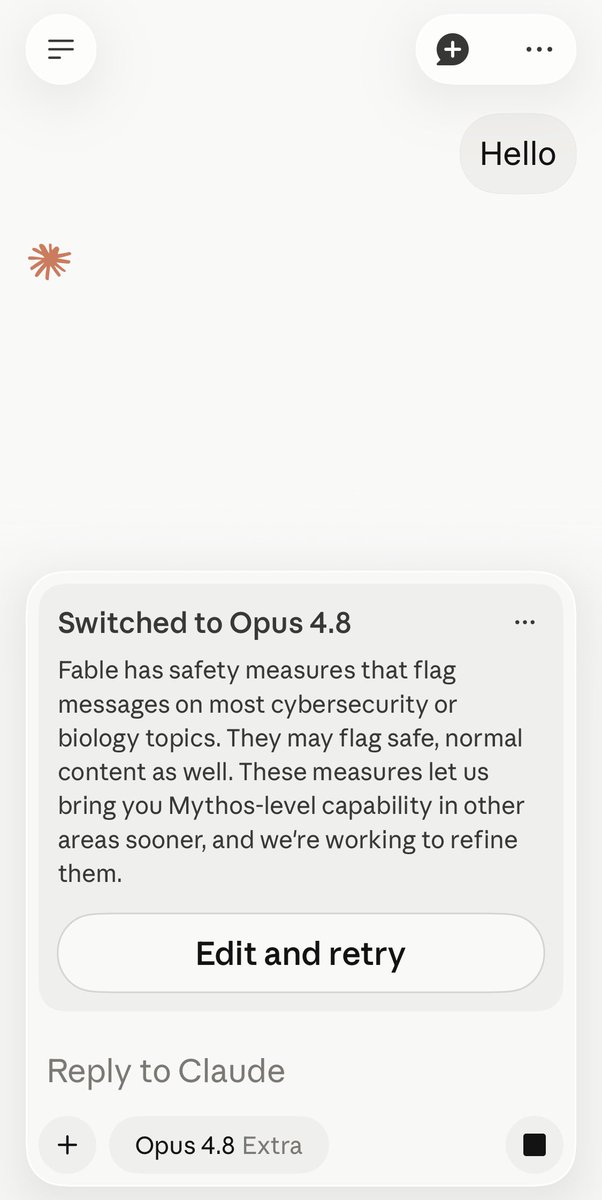
Matt, I can’t even say “hello” to Fable 5 except in incognito mode (memories off), because it knows I am a biomedical researcher! It would be nice not to ban biomedical scientists before talking access. Isn’t your comment ironic? Let’s first see if you can fix punishing us!
Derya Unutmaz, MD tweet media
Matt Durrant@mgdurrant

We believe that AI will do amazing things for biology and human health, and that scientists will need access to frontier intelligence to make that vision a reality. We're working on it!

English
133
240
3.9K
325.3K
bayes
bayes@bayeslord·
They didn’t mean pause AI research, they meant pause *your* AI research
English
50
345
5K
104.7K
LIFE 2030 and Beyond
LIFE 2030 and Beyond@life2030com·
@davidpattersonx The "safety" guardrail from Anthropic is actually unethical, because it quietly detriments the pace of solving the most urgent problems in our world. Let's stop the monthly subscription to Claude. It is expensive to pay and not really useful if people don't use it for coding.
English
0
0
2
48
David Scott Patterson
David Scott Patterson@davidpattersonx·
AI doomers and "safety" enthusiasts are doing real harm. Anthropic is slowing down medical research, including research into cures for cancer.
Derya Unutmaz, MD@DeryaTR_

This prompt I tried with Claude Fable 5 has been flagged as a biology security risk! What an incredible disappointment this has been @AnthropicAI! This is sad! “What are the top 10 unanswered questions in cancer research that, when answered, could lead to potential treatments?”

English
28
12
103
7.8K
LIFE 2030 and Beyond
LIFE 2030 and Beyond@life2030com·
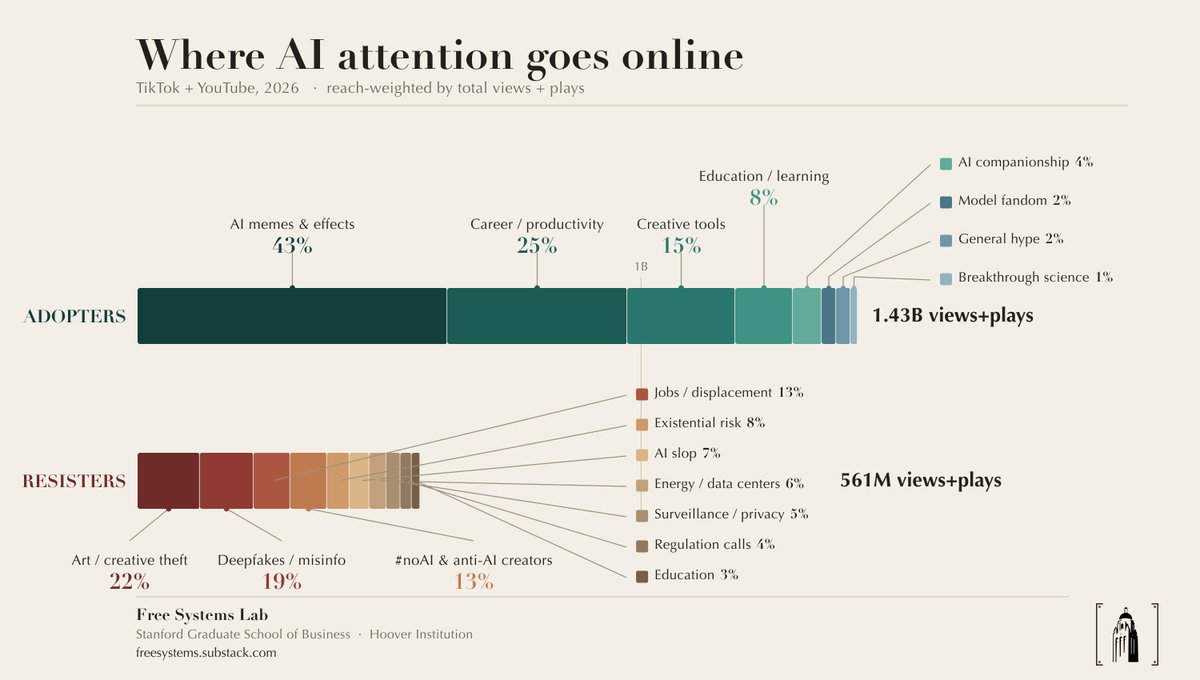
Sadly, my last reply to your message has been quietly deleted by X's moderation without providing any explanation to me. Here, I am posting my last reply again: How you frame your research is interesting. Instead of "AI-supporters VS AI-resisters", your research uses the names "AI-adopters VS AI-resisters". AI-adopters ≠ AI-supporters, because a great many AI-adopters may not actually support the development of AI. Many people adopted AI due to the burden of their jobs, schools, finance, competition, or other reasons. They may have no alternative choices. So, 1.43 Billion views on AI-adopters' videos on this research can be easily misinterpreted by general public as the number of views on AI-supporters' videos, because many people might easily conflate AI-adopters with AI-supporters. Economy is the backbone of our society. In comparison, all ideologies, like supporting AI or hating AI, play relatively minor roles in our society. Based on this perspective, it is not really a surprise to find out that the number of views on AI-adopters' videos is significantly more than the views on AI-resisters' videos, because your research is comparing "the popularity of AI-driven economy VS the popularity of AI-resisters", rather than comparing the two ideologies "the popularity of AI-supporters VS the popularity of AI-resisters". From my personal experience, I also pay attention about the number of movies and video games. For example: 1) In today's market, how many sci-fi movies and video games set their stories in dystopian worlds? 2) In today's market, how many sci-fi movies and video games set their stories in Utopian worlds? 3) How many sci-fi movies and video games demonize technologies as villains? 4) How many sci-fi movies and video games portrait technologies as rescuers? 5) How many sci-fi movies and video games support or demonize AI, respectively? 6) What about sentiments related to AI carried by news media, TV stations, popular novels? [Here are some quotes from movies: "Control the media, control the minds. Whoever controls the media defines reality." Although these quotes may not be the truth, I feel some weights or reasons under the current context and my situation.]
English
0
0
0
37
Andy Hall
Andy Hall@ahall_research·
Ah, OK -- it looks like this video IS in our data and classified as x-risk correctly, but it was posted in 2025 and we only did our analysis using videos posted in 2026 (because we have concerns about the accuracy of going back in time with our dataset). Nevertheless---it still make me wonder. Even just missing one or two major videos like this posted in 2026 could skew our totals. That's true for every category not just x-risk, but it's something to keep in mind. I'll keep looking for major videos like this we may have missed.
English
2
0
1
19
Andy Hall
Andy Hall@ahall_research·
The popular conversation around AI in America looks nothing like the narratives the elites are driving. For our new research, we analyzed 25,000 TikTok and YouTube videos about AI---and watched thousands of them ourselves---to understand how Americans are encountering AI in their everyday lives. Despite an elite conversation focused largely on backlash, AI videos embracing AI outnumber videos about resisting AI 3 to 1. These "adopter" videos don't focus on the things elites talk about: they talk about funny memes and effects AI can help make and ways you can use AI to help you with your job search. There is a significant and organized social media community focused on resisting AI, but surprisingly, it's not mainly about job loss, data centers, or existential risk. Instead, it's about creative theft and the erosion of human-made art. This has all the hallmarks of a genuine movement---with organized efforts to support human artists, to report AI-generated content, and to oppose the technology in the real world. All in all, when we look past the efforts of the labs and the media to impose a top-down narrative around job loss and existential risk, we find everyday Americans having a far different and in many ways more "normal" conversation (@random_walker)---one in which AI offers immediate and personal opportunities and challenges all at the same time. Check out the full research piece, which is loaded with interesting real example videos, here: freesystems.substack.com/p/memes-doom-h…
Andy Hall tweet media
English
46
87
351
133.8K
LIFE 2030 and Beyond
LIFE 2030 and Beyond@life2030com·
How you frame your research is interesting. Instead of "AI-supporters VS AI-resisters", your research uses the names "AI-adopters VS AI-resisters". AI-adopters ≠ AI-supporters, because a great many AI-adopters may not actually support the development of AI. Many people adopted AI due to the burden of their jobs, schools, finance. So, 1.43 Billion views on AI-adopters' videos on this research can be easily misinterpreted as the number of views on AI-supporters' videos. Economy is the backbone of our society. In comparison, all ideologies, like supporting AI or hating AI, play relatively minor roles in our society. Based on this perspective, it is not really a surprise to find out that the number of views on AI-adopters' videos is significantly more than the views on AI-resisters' videos, because your research is comparing "the popularity of AI-driven economy VS the popularity of AI-resistors", rather than comparing the two ideologies "the popularity of AI-supporters VS the popularity of AI-resistors". From my personal experience, I also pay attention about the number of movies and video games. For example: 1) In today's market, how many sci-fi movies and video games set their stories in dystopian worlds? 2) In today's market, how many sci-fi movies and video games set their stories in Utopian worlds? 3) How many sci-fi movies and video games demonize technologies as villains? 4) How many sci-fi movies and video games portrait technologies as rescuers? 5) How many sci-fi movies and video games support or demonize AI, respectively? 6) What about sentiments related to AI carried by news media, TV stations, popular novels? [Control the media, control the minds. Whoever controls the media defines reality.]
English
0
0
0
9
LIFE 2030 and Beyond
LIFE 2030 and Beyond@life2030com·
@ahall_research It is on YouTube. On the search box, please type: It Begins: An AI Literally Attempted Murder To Avoid Shutdown and you will find the video. On YouTube, views on existential risk videos grow rapidly because the YouTube algorithm (as well as many people) promote these videos.
English
1
0
0
28
Andy Hall
Andy Hall@ahall_research·
@life2030com Thank you! Let me look into this. Is that TikTok or YouTube?
English
2
0
1
169
LIFE 2030 and Beyond
LIFE 2030 and Beyond@life2030com·
If the superintelligent AI is open-source, then all the following dark scenarios will not happen in the first place. x.com/life2030com/st… Because open-source allow both good and bad guys to have equal access to the source code. This transparency allows all good but ordinary people empowered by ASI to protect themselves by thoroughly studying the code, proactively identifying vulnerabilities, and developing effective countermeasures. Open-sourcing levels the playing field, giving good guys a much better chance to respond to potential threats quickly and effectively. With the collective intelligence and global collaboration among ordinary people empowered by ASI, open-sourcing could lead to a more robust and resilient defense system.
LIFE 2030 and Beyond@life2030com

In 2020, scientists globally raced to sequence the COVID's genetic code. The blue print of that code was shared worldwide, enabling researchers to develop diagnostic tests to study the virus's behavior, design new treatments and accelerate the creation of vaccines. It was humanity's first and crucial line of defence. In the Black Box scenario, all staff who can access the source code are killed, so that no one can truly understand how this ASI really works. It is like fighting a virus without its genetic blueprint. Furthermore, the Malicious Insider Scenario has demonstrated how malicious people are highly likely to get the source code of the ASI first before general public can access. They can quickly spread the source code among the nefarious groups, while all good people could remain completely unaware and unprepared of the upcoming attacks.

English
0
0
0
16
LIFE 2030 and Beyond
LIFE 2030 and Beyond@life2030com·
In 2020, scientists globally raced to sequence the COVID's genetic code. The blue print of that code was shared worldwide, enabling researchers to develop diagnostic tests to study the virus's behavior, design new treatments and accelerate the creation of vaccines. It was humanity's first and crucial line of defence. In the Black Box scenario, all staff who can access the source code are killed, so that no one can truly understand how this ASI really works. It is like fighting a virus without its genetic blueprint. Furthermore, the Malicious Insider Scenario has demonstrated how malicious people are highly likely to get the source code of the ASI first before general public can access. They can quickly spread the source code among the nefarious groups, while all good people could remain completely unaware and unprepared of the upcoming attacks.
LIFE 2030 and Beyond tweet mediaLIFE 2030 and Beyond tweet media
English
0
0
0
25
LIFE 2030 and Beyond
LIFE 2030 and Beyond@life2030com·
@sama There are 3 scenarios where a open-source superintelligent AI is safer than closed-source superintelligent one: 1. The Black box Scenario; 2. Malicious Insider Scenario (highly possible); 3. Immortal Dictator Scenario. This video covers all 3 scenarios: youtu.be/9OMWTyrP0RE
YouTube video
YouTube
LIFE 2030 and Beyond tweet media
English
1
0
0
214
Michael Levin
Michael Levin@drmichaellevin·
I think the basic issue in all such discussions is that these kinds of competencies aren't some kind of essential "human attributes". Measuring cognitive properties by humans is myopic and causes all kinds of pseudoproblems. The emerging field of diverse intelligence has better frameworks. A spectrum of highly variable intelligences, and lots of research on which kinds of architectures enable which kinds of patterns (of behavior, of computation, of physiology, etc.), is more useful for discussions of natural, artificial, and hybrid agents of varying provenance and composition. frontiersin.org/articles/10.33… journal.frontiersin.org/article/10.338… and more at drmichaellevin.org/publications/b…, plus lots of other good labs.
English
10
18
209
9.9K
LIFE 2030 and Beyond
LIFE 2030 and Beyond@life2030com·
1) My “substrate vs implemented system” criticism still lands. The author’s stronger claim is: If you think property P is substrate-independent, and an LLM can be implemented in AoE II, then you must be willing to consider whether the AoE II implementation also has P. That's reasonable. But this does not imply the title's claim: AoE II itself has P. The content of this paper does not evidently support its title's claim. Therefore, the title of this paper is shocking but is a click-bait. 2) On the circularity point, I think the author is partly right, but overgeneralizing. If a paper begins with “LLMs have anxiety-like inner states,” builds an anxiety test around that assumption, and then concludes “LLMs have anxiety-like inner states,” then yes, that is circular. If the result is negative, it may be uninformative because the test, framework, or assumption could be wrong. But that does not prove that all attribution of human-like functional properties to neural networks is invalid. A careful study can define an operational property, test it, and make a limited claim such as: "Under these conditions, this model behaves consistently with X-functional profile." The AoE II paper itself admits that narrower, non-generalized measurements can be useful if they do not claim too much. The author’s methodological warning is valid. His title-level analogy is rhetorically clever but conceptually flawed. The paper attacks overgeneralized anthropomorphic conclusions, but it does not defeat functional claims about neural networks or LLM-like systems.
English
0
0
0
13
Adrian de Wynter
Adrian de Wynter@deWynterruption·
Not exactly. The unfortunate thing about this picture is that the highlighted thing is AoE, not the actual paper's argument (which is the subsequent sentences). The paper itself does address your comments: for example, there's no need to show AoE has human-like attributes. In fact, the paper works at a meta-level indicating that the failure mode of research is independent of philosophical viewpoint, validity of such viewpoint, substrate, or the nature (positive or negative) of the assumptions made. Indeed, what it shows is not that it 'fails', but that you get unsound conclusions because, although their truth-value might hold, their validity might not: they are either circular or uninformative within the setup. About the title: so one of the fundamental assumptions you gotta make when performing a measurement is that the substrate could present these attributes (in the paper). So transferring an entity cross-substrate does imply that such substrate is assumed to present the attributes you have ascribed to the entity. Same for not presenting it (it's just a symmetric argument). It follows that by analogy the title holds--and there's a few other examples within the paper, too.
English
1
0
0
27
LIFE 2030 and Beyond
LIFE 2030 and Beyond@life2030com·
1) the paper does not really show that the original videogame Age of Empires II has human-like attributes. So, the HONEST title of this paper would be: "If LLMs have human-like attributes, then an LLM implemented inside Age of Empires II may have them too." 2) The author says: "LLM interpretation is substrate-dependent." That is a better claim. But then the target should be interpretation of the LLM under different implementations, not attribution to the substrate AoE II itself. The paper's argument appears to conflate the substrate with the implemented system. 3) The paper warns the poorly designed anthropomorphism research, but it does not show that attributing human-like functional properties to neural networks or LLM-like systems necessarily fails. It mainly shows that attributing such properties to a bizarre substrate without distinguishing substrate from implemented system leads to confusion. This comment is related to my comment yesterday: x.com/life2030com/st…
LIFE 2030 and Beyond@life2030com

The title of this paper is a click-bait, and doesn't make sense. x.com/MilesCranmer/s… Let me fix the title of this paper to: “If LLMs have human-like attributes, then so does the neural network inside Age of Empires II." The paper's argument appears to conflate the substrate with the implemented system. Age of Empires II, as a classical videogame, is not shown to possess anthropomorphic attributes, as the title suggested. What is actually shown is that a trainable neural network or LLM-like system can be implemented inside the game environment, like Age of Empires II. Nothing new or novel is spotted in this paper. Therefore, the content of this paper is stale, and does not evidently support the title's claim.

English
1
0
0
85
Adrian de Wynter
Adrian de Wynter@deWynterruption·
Hi! Author here -- yes, the summary is almost correct. But the paper is related to assumptions in measurement. Lots of papers assume these properties when setting up experiments, then point at the conclusions and be all like 'see! I told you!'. From AoE II/Boston we see that LLM interpretation is substrate-dependent (i.e., 'non-unique'), so measurements of their properties should account for it. Then I show that experiments assuming human-like properties lead to failed conclusions--and same for the converse: either they are circular arguments or uninformative. And then the null assumption, which accounts for non-uniqueness, walks in.
English
1
0
3
93
LIFE 2030 and Beyond
LIFE 2030 and Beyond@life2030com·
@TaliaRinger I suggest the author of this paper to at least fix the title, which is misleading. More detail: x.com/life2030com/st…
LIFE 2030 and Beyond@life2030com

The title of this paper is a click-bait, and doesn't make sense. x.com/MilesCranmer/s… Let me fix the title of this paper to: “If LLMs have human-like attributes, then so does the neural network inside Age of Empires II." The paper's argument appears to conflate the substrate with the implemented system. Age of Empires II, as a classical videogame, is not shown to possess anthropomorphic attributes, as the title suggested. What is actually shown is that a trainable neural network or LLM-like system can be implemented inside the game environment, like Age of Empires II. Nothing new or novel is spotted in this paper. Therefore, the content of this paper is stale, and does not evidently support the title's claim.

English
0
0
0
251
LIFE 2030 and Beyond
LIFE 2030 and Beyond@life2030com·
The title of this paper is a click-bait, and doesn't make sense. x.com/MilesCranmer/s… Let me fix the title of this paper to: “If LLMs have human-like attributes, then so does the neural network inside Age of Empires II." The paper's argument appears to conflate the substrate with the implemented system. Age of Empires II, as a classical videogame, is not shown to possess anthropomorphic attributes, as the title suggested. What is actually shown is that a trainable neural network or LLM-like system can be implemented inside the game environment, like Age of Empires II. Nothing new or novel is spotted in this paper. Therefore, the content of this paper is stale, and does not evidently support the title's claim.
Miles Cranmer@MilesCranmer

This is an insane paper and I love it arxiv.org/abs/2605.31514

English
0
1
3
376
LIFE 2030 and Beyond
LIFE 2030 and Beyond@life2030com·
@sherwinwu Can Codex fully see all images shown on webpages or online PDFs, or not? Currently, I have to repeatedly upload to the ChatGPT app with the related images or the entire PDFs, which take a lot of diskspace on your server. Not cost efficient. More detail: x.com/life2030com/st…
LIFE 2030 and Beyond@life2030com

@mark_k For vision, ChatGPT has admitted that it is partially web-picture-blind, which means it may not always be able to directly see all images shown on webpages or online PDFs. More crucially, ChatGPT won't actively confess its partial blindness unless you specifically interrogate it

English
0
0
0
204
LIFE 2030 and Beyond
LIFE 2030 and Beyond@life2030com·
RTX Spark implies the future of locally-run AI workstations are quietly coming. That's a key step forward. 👏 However, I will wait for the next generation because the current RTX Spark doesn't contain Groq 3 LPX, a key chip to accelerate inference computing or model's reasoning. Without this chip, the speed and the latency in chain-of-thought is significantly lower and more expensive. It also does not have any Bluefield-4 DPU, which is critical to manage the context window, since this unit handles multi-turn AI reasoning by managing massive long-context Key-Value (KV) caches, offloading this memory processing from the primary GPU. Maybe Nvidia can combine all those missing components into a desktop by 2030. At that time, I might consider to purchase one, which could possibly be RTX Spark III. Anyway, good luck, RTX Spark!
English
0
0
0
100
NVIDIA RTX Spark
NVIDIA RTX Spark@NVIDIARTXSpark·
RTX Spark, early preview 👀 Personal AI agents. Faster creator workflows. RTX ON gaming. NVIDIA’s Jacob Freeman walks through how one Superchip brings it all together in a new class of slim laptops. 👇
English
65
299
2.6K
150.8K