

T RZ Tayeb
11.9K posts

T RZ Tayeb
@primedark562
━━━━━━ ♡ ━━━━━━━━━━━━━━━━ Testnet Degen, Web3 Explorer, Yapper ━━━━━━ ♡ ━━━━━━━━━━━━━━━━
เข้าร่วม Mayıs 2023
3.3K กำลังติดตาม1.2K ผู้ติดตาม

Why does blockchain scalability depend on data movement?
@get_optimum focuses on a challenge that is often overlooked when discussing blockchain scalability: the movement of data across the network.
While scalability is frequently associated with transaction throughput and execution speed, blockchain performance also depends on how quickly information can reach participating nodes.
1. Every Node Needs Access to the Same Information:
Blockchain networks operate through distributed coordination.
Block Distribution: When a validator produces a block, that information must be propagated throughout the network before other participants can verify it.
Transaction Sharing: Transactions are continuously exchanged between nodes to maintain a consistent view of the network state.
Network Synchronization: Consensus becomes more efficient when nodes receive data within a similar timeframe.
As networks grow, distributing information quickly becomes increasingly challenging.
2. Data Movement Becomes More Difficult at Scale :
Higher adoption introduces greater communication demands.
Growing Network Size: More nodes mean more destinations that must receive blocks and transactions.
Increased Traffic Volume: Larger ecosystems generate more data that must be propagated across the network.
Propagation Delays: Information can take longer to reach distant nodes, creating temporary differences in network visibility.
Even if a blockchain can process transactions efficiently, delays in data delivery can limit overall performance.
3. Scalability Requires Efficient Communication Infrastructure :
Improving execution alone does not solve every bottleneck.
Faster Distribution: Networks benefit when blocks and transactions reach participants more efficiently.
Reduced Communication Overhead: Optimized transmission methods can improve propagation without requiring additional resources.
Better Network Coordination: Faster data movement helps nodes stay synchronized as activity increases.
This is where infrastructure focused on data transport becomes increasingly important.
Blockchain scalability is not only about processing more transactions.
@get_optimum it is also about ensuring that the information required to process those transactions can move efficiently across the entire network.

English

Happy Monday homies
Let's talk about Anti Detect Browser and Profiles System today.
You know Donut Browser also works as an anti detect browser.
It allows users to create multiple isolated browser profiles. Each profile has:
➥Separate cookies
➥Separate storage
➥Separate settings
➥Unique browser identity
This means each profile behaves like a different device.
It is useful for managing multiple accounts or separating different workflows without cross tracking between sessions.
gDonut

English

𝐅𝐫𝐨𝐦 𝐋𝐚𝐭𝐞𝐧𝐜𝐲 𝐭𝐨 𝐋𝐢𝐠𝐡𝐭𝐧𝐢𝐧𝐠 𝐒𝐩𝐞𝐞𝐝. 𝐓𝐡𝐞 𝐍𝐞𝐱𝐭 𝐆𝐞𝐧 𝐨𝐟 𝐁𝐥𝐨𝐜𝐤𝐜𝐡𝐚𝐢𝐧 𝐈𝐧𝐟𝐫𝐚𝐬𝐭𝐫𝐮𝐜𝐭𝐮𝐫𝐞.
Whenever we interact with Web3 networks, our priorities are simple: speed and security. However, as decentralized networks scale, they inevitably hit a major bottleneck—block propagation delays, commonly known as network lag or latency. When nodes take too long to sync, transactions slow down, and critical security vulnerabilities emerge.
This is exactly the core issue that @
@get_optimum is tackling head-on. By introducing RLNC (Random Linear Network Coding), they are entirely rewriting the rules of blockchain resilience.
How RLNC is Upgrading Web3 Infrastructure
Instead of relying on traditional, linear data transfers that choke under heavy loads, RLNC optimizes how data is coded and transmitted across nodes. Looking closely at the architecture breakdown, Optimum delivers on four massive pillars:
1/Faster Propagation: No more waiting around. It eliminates packet bottlenecks to achieve maximum throughput with minimal lag.
2/Better Synchronization: Real-time block delivery ensures that all nodes across the ecosystem stay updated simultaneously.
3/Stronger Security: Resilient by design and secure by default. There are no loose ends left for malicious actors to exploit.
4/Greater Network Resilience: Even under extreme network traffic or sudden volume spikes, the infrastructure maintains top-tier performance without breaking a sweat.
The Golden Rule: Faster Coordination = Stronger Security
In a truly decentralized ecosystem, communication speed equals safety. The faster the nodes can coordinate, the harder it is for the network to be compromised. Optimum Network isn’t just building another chain; they are establishing a bulletproof, lightning-fast foundation for the future of DeFi and decentralized scaling.
@get_optimum
@shariaronchain

English

One of the biggest issues with blockchain to me is privacy. In fact, we all want our financial information or transaction details to be kept private. But it has long been seen that getting good privacy requires a lot of hassle using multiple wallets, complex routing, or expensive solutions. As a result, those with more resources can enjoy relatively more privacy.
I think privacy should not be a luxury. Just as we want personal information to be protected on the Internet, blockchain needs to be equally secure for everyone. Whether a person transacts $10 or $10,000, both are entitled to the same protection.
This is why I find the concept of @FlutonIO interesting. By using FHE (Fully Homomorphic Encryption) they are trying to show a direction where privacy can be accessible not only for big investors or tech experts, but also for ordinary users.
We often talk about decentralization in blockchain, but privacy is equally important. Because if people always think their every move is visible to everyone, then true financial freedom is not achieved.
In the future I would like to see a Web3 ecosystem where privacy is a default feature, not a premium feature to be purchased separately. The real purpose of technology should be to give equal opportunities to everyone, not just the big players.

English

Data distribution has changed from past times. In the past times, very few people knowing the value of their data.
-----------------------------------------
They became more concerned about it from last few years.
We are seeingai companies reached billions and trillions of dollars valuation.
Why they are so much hyped ? Cause we know AI is currently the only thing which can help the human's to grow.
And "AI depends on data".
Nobody wants to share their private data to companies, cause it's there own IP.
For building an AI economy, companies need quality data, whether it's-
> Real human knowledge
> Real life experiences
> Actions & expertise
IP sits on the middle of companies and people.
IP determines it, without this platforms own and use it freely without any concern.
With IP, people own it-> share ownership with their own will-> gets a share.
>>>>>>>>>>>>>>>>>
We have to admit that "Future AI economy is not going to built on free data".
It is going to build where
People create IP-> owns it-> ai companies use it-> gives something as compensation.
Numo is working on this same feature.
The future will depend on who connects better (people and companies)
{ Human intelligence ↔ Ownership ↔ AI demand }
@StoryProtocol


English
English

Huge congratulations to the newest Story OGs and adepts💗
From educating communities and hosting Spaces to building, supporting, and staying consistent for months each of you has earned this recognition through dedication and impact.
👏 @khairun4491
👏 @hayxenxt
👏 @Siyam_Ahmed17
👏 @surojitpvt
👏 @Smith_creator
The OG title isn't just a badge it's proof of commitment, perseverance, and belief in the Story vision.
Well deserved.

Story@StoryProtocol
It's been a while since we last welcomed new OGs. The work hasn't slowed down. Meet this week's newest additions ↴
English
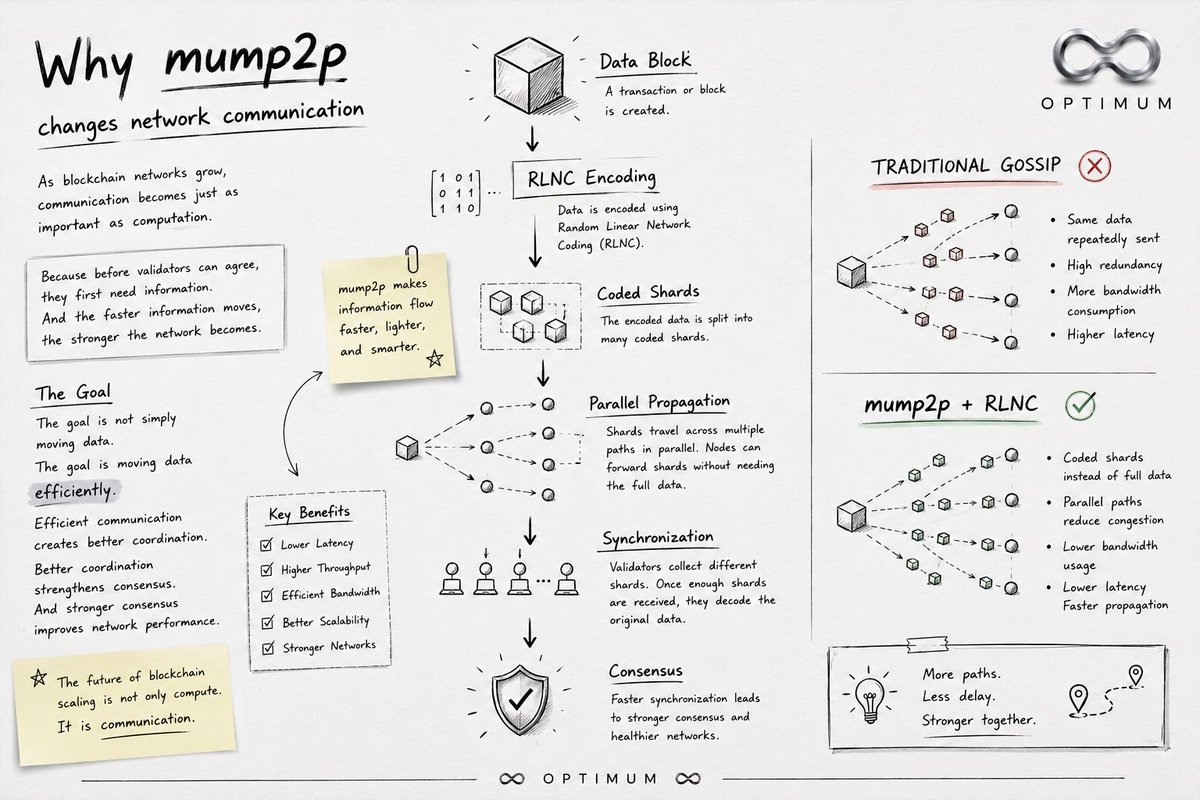
Why mump2p changes how networks communicate
Blockchains do not struggle because of computation alone.
They struggle because information takes time to move.
Before consensus happens,
data must reach validators.
And when data moves slowly,
the entire network slows down.
This is where mump2p comes in.
Traditional gossip protocols repeatedly send the same data across the network.
mump2p takes a different approach.
Instead of forwarding identical messages,
it encodes data into smaller coded pieces using Random Linear Network Coding (RLNC)
Validators can begin forwarding data even before reconstructing the full message.
The result:
faster propagation
↓
lower latency
↓
better synchronization
↓
stronger consensus
↓
healthier networks
By reducing redundant transmissions,
mump2p uses bandwidth more efficiently while keeping performance high as networks scale.
Because blockchain performance is not only about execution.
It is also about how quickly information reaches participants.
Faster information creates earlier awareness
Earlier awareness creates better coordination
And better coordination strengthens the network
The future of scaling is not only compute
It is communication
@get_optimum
English
markets become efficient by destroying edges
every market starts with inefficiencies
hidden opportunities
mispriced assets
unnoticed patterns
that is where edges are born
but markets do not stay inefficient forever
because every edge attracts attention
attention creates analysis
analysis creates competition
and competition compresses advantage
what was once unique
eventually becomes common
what was once profitable
eventually becomes expected
that is how markets become efficient
not by creating edges
but by destroying them
the question is not whether an edge will disappear
most eventually do
the real question is how long it stays valuable before the market catches up
that is why information matters
because visibility often determines the lifespan of an advantage
the more visible an edge becomes
the faster it expires
@FlutonIO is built around protecting that window
private intents
protected execution
less information leakage
more control over what becomes visible and when
markets become efficient by destroying edges
and sometimes
protecting an edge is just as important as discovering it

English

mump2p: How It Actually Works
mump2p is already running on Ethereum Hoodi testnet.
But how does it actually integrate with a validator? What happens at the protocol level?
Here's the full technical picture.
mump2p runs as a sidecar alongside any standard Ethereum validator client like Lighthouse, Prysm, or Teku.
No changes to the validator client itself. no changes to consensus logic. no new hardware required.
It slots into the existing setup as an additional process that handles the data propagation layer.
The architecture is simple.
Gateways sit between validators and the Ethereum P2P network.
Each gateway works as a transparent acceleration layer.
A validator's consensus client communicates normally with its gateway, then the gateway handles propagation via mump2p to the rest of the network.
Validators don't change their operation. the propagation layer changes underneath them.
When a block arrives at a gateway :
1. The gateway receives the block from the proposer's consensus client
2. It fragments the block into RLNC coded packets using algebraic linear combinations
3. It begins broadcasting unique fragments to peer gateways immediately
4. Receiving gateways recode received fragments and forward fresh combinations downstream
No gateway needs the full block before forwarding. every hop contributes new information.
The Prometheus metrics architecture
Each gateway records key data points per block :
→ Slot time, the deterministic start
→ libp2p received timestamp, the Gossipsub path
→ mump2p received timestamp, the Optimum path
→ Gateway ID
Both protocols run simultaneously on every block. same block, same gateway, only the protocol differs.
This makes the comparison methodology airtight.
Data is scraped into Prometheus histograms every 5 seconds across all 30 gateways.
This produces percentile views, time series latency evolution, and fleet wide consistency checks.
• p50
• p95
• p99
This is the same infrastructure used for the published 6x result.
The 30 gateway global fleet is distributed across US, EU, and Asia.
Each gateway independently measures both protocols on every block.
The ~200-250ms spikes visible in the latency charts are cross continental propagation. physics, not protocol.
They appear consistently across all gateways for the same blocks, which is how they're identified and characterized.
The dual path measurement is the methodological key.
Because Gossipsub and mump2p run in parallel on the same block from the same gateway, external variables affect both protocols identically.
Network congestion, block size, and time of day hit both paths the same way.
The only variable is the propagation path.
The performance difference is attributable to the mump2p/RLNC design.
Client compatibility is complete today :
→ Lighthouse supported
→ Prysm supported
→ Teku supported
All three major Ethereum consensus clients can run mump2p as a sidecar today with zero infrastructure changes.
The long term architecture extends mump2p beyond a single sidecar.
As Flexnodes join the network, they extend the fragment relay layer globally.
More coverage. more coding diversity. more redundant propagation paths.
The sidecar today becomes the entry point into a global decentralized relay network.
Validator operator? Get on the waitlist.
getoptimum.xyz/ethereum-valid…

English

GLiquid CT 💧
I tried @coinvestai today and one thing stood out immediately.
I didn't ask for a signal.
I just asked it to analyze SOL.
That's it.
A few seconds later, it had already pulled together:
↬ market context
↬ funding and open interest data
↬ key risk factors
↬ possible entry and exit levels
↬ a complete trade setup
What I found interesting wasn't the trade idea itself.
It was how the conversation evolved.
First, it gave a market view.
Then it pointed out the risks.
Then it pulled a chart.
And after looking at the chart data, it actually refined the setup further.
That felt a lot closer to a real trading discussion than a typical AI response.
You're not getting:
↬ "buy here"
↬ "sell here"
↬ "100x moon soon"
Instead, you're building a thesis step by step.
And honestly, that's probably the part I liked most.
As you can see below, Co-Invest gives:
↬ context
↬ data
↬ possible scenarios
↬ a framework for thinking
But the final decision is still yours, that's honestly amazing.
To me, it felt less like asking an AI for a prediction
and more like having a second set of eyes before placing a trade.
@liquidtrading
English
How does network coding differ from traditional peer to peer transmission?
@get_optimum utilizes network coding technology to improve how blockchain data moves across decentralized networks. While traditional peer to peer transmission focuses on forwarding individual packets between nodes, network coding introduces a different approach that can improve efficiency and reliability during propagation.
1. Traditional Peer to Peer Transmission:
Most blockchain networks distribute information by passing data packets from one node to another until the entire network receives the information.
Packet Dependency: Each packet must be delivered successfully for the receiving node to reconstruct the original data.
Retransmission Requirements: If packets are lost during transmission, additional requests are often needed to recover missing information.
Propagation Delays: As data moves through multiple network hops, latency can accumulate and slow overall distribution.
This approach has powered blockchain networks for years but can become less efficient as network activity and scale increase.
2. Network Coding Changes the Transmission Process:
Instead of forwarding original packets individually, network coding combines and encodes data before transmission.
Encoded Packets: Each transmitted packet contains information derived from multiple pieces of the original data.
Flexible Reconstruction: Nodes can recover the original information once they receive a sufficient number of encoded packets, regardless of the order they arrive.
Reduced Dependence on Specific Packets: Missing a particular packet does not necessarily prevent successful reconstruction of the original data.
This creates a more adaptable transmission process that can better tolerate packet loss and network instability.
3. Optimum's Network Coding Architecture:
Optimum integrates Random Linear Network Coding (RLNC) into its data acceleration layer to optimize blockchain propagation.
Efficient Distribution: Encoded data can be transmitted across multiple network paths simultaneously.
Improved Reliability: Nodes can recover information without waiting for specific packets to arrive.
Faster Synchronization: Information can spread throughout the network more efficiently, helping participating nodes remain synchronized.
Scalable Communication: The system is designed to support growing network demand while reducing communication bottlenecks.
@get_optimum by moving beyond traditional packet forwarding, network coding introduces a more resilient method for distributing blockchain data across decentralized networks.

English
Good night homies
When you break down any blockchain system, everything connects back to one thing.
How quickly data can be accessed and shared. That is why Optimum's approach stands out.
@get_optimum improves data access across the entire network,
• faster for validators
• easier for developers
• cheaper and smoother for users
Bcz scaling is not just technical improvement. It is ecosystem-wide improvement.
When data access becomes faster and cheaper, every participant in the network benefits at the same time.
That is the kind of scaling that actually matters.
Gmum
@shariaronchain

English

Every digital ecosystem generates an endless stream of information, but the real advantage comes from knowing how to act on it.
This is where @RialoHQ stands out.
Rather than treating data as a passive asset, Rialo is building infrastructure that helps transform live information into intelligent execution. As conditions evolve, systems can adapt, automate, and respond with greater precision.
The result is a smarter digital environment where decisions are driven by context, not guesswork.
In a world overflowing with data, the next generation of innovation will belong to platforms that turn insight into action - and Rialo is moving in that direction.

English

Gradient has everything-
> Best product
> Best community
> Best admin ( @HexxRL interesting + highly knowledgeable facts )
> Best intern(ngl, he's goat @gradientintern )
> Shipping consistently
That's what a project needs for a long term vision.
Prove me wrong, if you have anything better than this.

English
Day 14 The Owner Operator Model : How Anyone Can Participate
Right now, PrismaX is building the foundation robots, data, models.
But the end state is much bigger. a network where anyone with a robot can plug in, contribute, and earn.
Here's the Owner Operator Model.
Why this model exists.
The core problem with robotics today isn't just data it's economics.
Current AI models lack sufficient accuracy for fully autonomous operation.
This creates an economic justification problem for robot ownership : if a robot can't reliably complete tasks on its own, why would anyone buy one?
PrismaX solves this by keeping humans in the loop not as a limitation, but as the economic engine.
Three stages of PrismaX's evolution.
PrismaX has defined a clear roadmap for how the network matures :
• Stage I Now: Collect large scale visual data. train teleoperation operators. build foundational models with research partners.
• Stage II Mid-term: Teleoperators operate fleets to complete real tasks for real customers. early operators become skilled, competitive, and valuable in real world labor markets.
• Stage III Long-term: Robots achieve high degrees of autonomy. the network shifts to production scale services for millions of robots decentralized, efficient, cost optimized.
What the Owner Operator Model looks like in practice.
An individual or organization owns a robot. they register it to the PrismaX network.
That robot operates in their real environment completing tasks, capturing interaction data, contributing to the shared protocol.
The data it generates has two paths :
• Network owned data: community controlled, sold via token burn mechanism
• Customer owned data fee based, private transactions
Either way, the owner earns. The network grows. the models improve.
Why the flywheel accelerates at this stage.
More robots registered → more diverse environments → richer real world data → better foundation models → more autonomous robots → more robots sold → more owners joining the network.
Every new Owner Operator makes the entire network more valuable.
This is the compounding effect PrismaX is engineered for.
What this means for early participants.
The operators training on PrismaX today aren't just earning points.
They're building skills that will be directly valuable in Stage II when teleoperators manage real fleets completing real tasks for real customers in a live labor market.
Getting in early isn't just about rewards. it's about positioning.

English

Good afternoon homies
Lemme tell you about RAFA, today.
@RAFA_AI is building a decentralized insight marketplace where AI generated intelligence can be shared, verified, and utilized in an open ecosystem.
The goal is not just to create insights but to make them trustworthy.

English

